
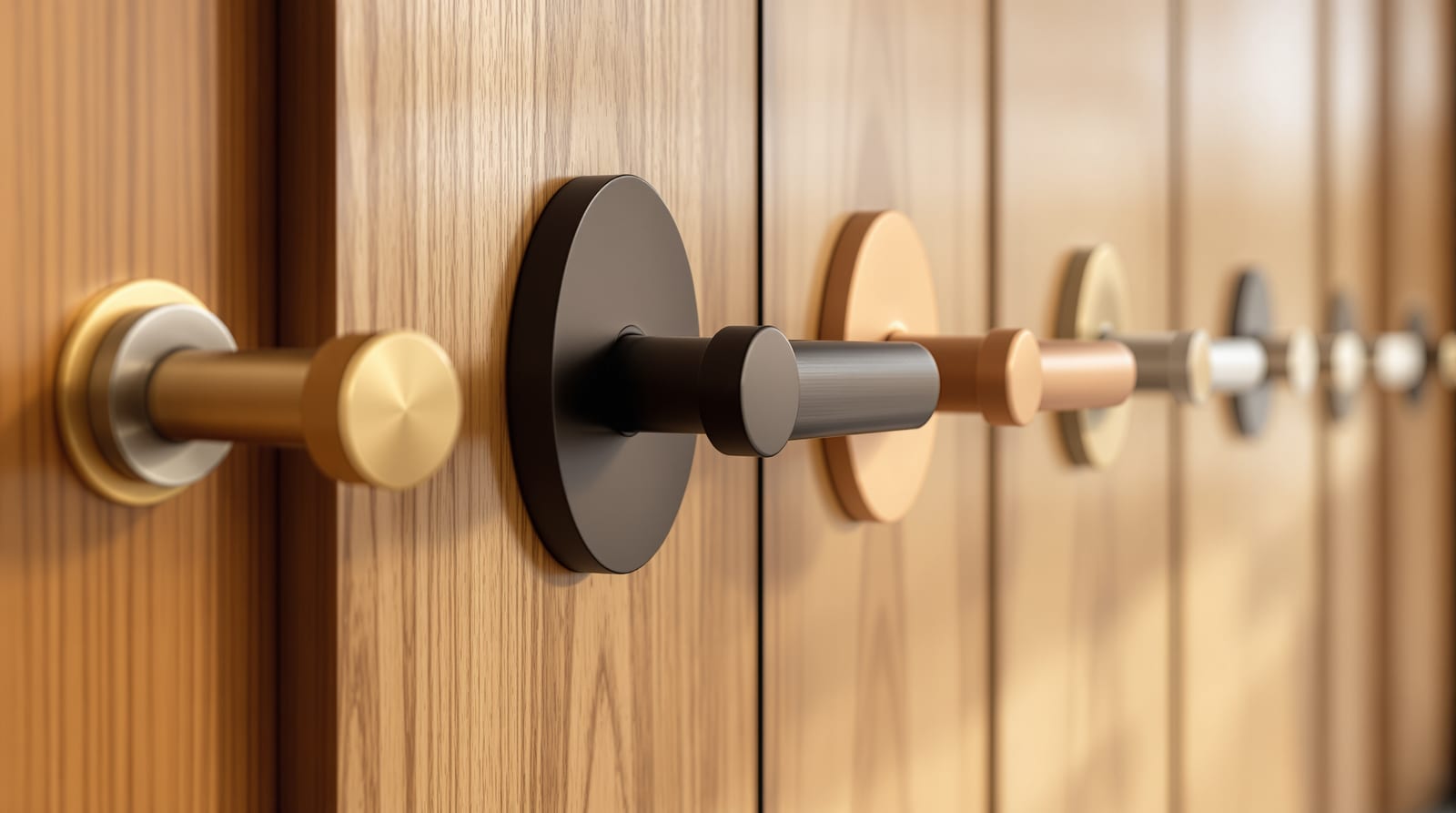
Door Hardware Finishes in India: Satin SS, Brass, Matte Black, PVD & Coastal Picks
How to choose handle, lock and hinge finishes that look right, age well and survive Indian humidity and coastal salt air.
The finish on a door handle is the first thing a guest touches and the last thing a wet Mumbai monsoon forgives. Two handles can be mechanically identical and yet one stays mirror-bright for a decade while the other blooms with rust spots in eight months — the difference is almost entirely the finish and the base metal under it. This guide walks through the finish families sold in India, how to read the all-important "PVD vs electroplated" label, why coastal homes need different rules, and how to keep everything looking new.
It pairs with the broader door hardware guide (the overview of what hardware a home needs) and the deep-dives on door handles and door hinges. Here we stay narrowly on finishes — the surface, not the mechanism.
What a "finish" actually is
A door handle has two parts that matter for longevity: the base metal (the body) and the surface finish (the colour and coating). In Indian retail the body is usually one of three things:
- Stainless steel (SS) — graded 201 or 304. SS 304 has more chromium and nickel and resists corrosion far better; SS 201 is cheaper and rusts in humid or salty air.
- Brass — solid brass is heavy, premium and naturally corrosion-resistant; it is the traditional choice for brass-fitted traditional doors.
- Zinc alloy (zamak) / die-cast — light, cheap, takes plating well, but the plating is the only thing protecting it. Once the coating chips, the zinc corrodes quickly.
The finish sits on top. It can be the natural surface of the metal (brushed SS), an electroplated layer (chrome, nickel, gold) or a PVD coating (Physical Vapour Deposition) — the toughest option, explained below. When a showroom says "rose gold" or "matte black", they are describing the finish, not the metal underneath. Always ask what is under it.
The finish families sold in India
| Finish | Look | Typical durability | Coastal / humid OK? | Where it suits |
|---|---|---|---|---|
| Satin / brushed stainless steel | Soft matte silver, fine grain hides scratches | Excellent (if SS 304) | Yes — best all-rounder | Main door, kitchen, everywhere |
| Polished / mirror chrome | Bright reflective silver | Good, but shows fingerprints & water spots | Moderate (PVD chrome better) | Bathrooms, modern interiors |
| Antique / aged brass | Warm dark gold with worn highlights | Good (solid brass excellent) | Yes if solid brass; plated less so | Traditional, carved & heritage doors |
| Matte black | Flat charcoal, modern | Good if PVD; plated/painted chips at edges | PVD yes; painted no | Contemporary, minimalist homes |
| Rose gold | Warm pinkish gold | Decorative; depends entirely on coating | PVD only | Feature doors, wardrobes |
| PVD gold | Bright gold, very hard | Excellent | Yes | Luxury main doors, glass doors |
| Bronze / oil-rubbed bronze | Deep brown-bronze, living finish | Good (solid bronze excellent) | Yes if solid; coating-dependent | Rustic, classic, pivot doors |
| Brushed nickel / satin nickel | Warm-grey muted silver | Good | Moderate; PVD nickel better | Soft modern, bedrooms |
A quick read: satin SS 304 and any PVD finish are the safe, low-maintenance choices. Polished chrome looks stunning in the showroom but is high-maintenance at home — every fingerprint and water droplet shows. Solid brass and bronze are "living finishes" that develop a patina over time, which is a feature for traditional homes and a flaw for someone who wants permanent shine.
PVD vs electroplated — the single most important question
This is the distinction that decides whether your hardware survives Indian conditions, so it deserves its own section.
Electroplating deposits a thin metallic layer (chrome, nickel, gold, rose gold) onto the body using an electric current in a chemical bath. The layer is microns thin and bonded only at the surface. It looks identical to PVD when new, costs far less, and is what most budget handles use. The problem: it wears through at high-touch spots (thumb pad, lever tip), and once breached, humidity reaches the base metal and corrosion creeps under the coating.
PVD (Physical Vapour Deposition) vaporises a metal (often titanium-based compounds) inside a vacuum chamber and bonds it to the surface at the molecular level. The result is a coating that is dramatically harder, scratch-resistant, and far more corrosion-resistant. PVD gold, PVD rose gold and PVD matte black hold their colour for years where electroplated versions fade or rub off.
| Property | Electroplated | PVD |
|---|---|---|
| Coating bond | Surface-level | Molecular, into the metal |
| Hardness / scratch resistance | Low–moderate | Very high |
| Colour fade over years | Common | Rare |
| Salt-air / coastal life | Poor–moderate | Excellent |
| Price premium | Baseline | Roughly 30–80% more |
| How to spot it | "chrome/EP/plated" on the box | Box/listing explicitly says "PVD" |
Rule of thumb: in dry inland cities, electroplated SS 304 hardware is fine for interior doors. For the main door, bathrooms, and anywhere coastal, pay the premium for PVD or stick to brushed SS 304 (where the finish IS the metal, so there is nothing to wear through).
Coastal and humid homes: why the sea changes everything
Salt-laden air on the Mumbai, Goa, Kerala, Chennai and Vizag coasts is brutally corrosive. Chloride ions accelerate the rusting of iron and pit cheaper stainless grades. A handle that lasts fifteen years in Pune can streak orange within a single monsoon in a sea-facing Mangalore flat.
For coastal and high-humidity homes the rules tighten:
- Insist on SS 304, never SS 201 or mild steel. Ask the dealer; magnet tests are unreliable for grade, so buy from brands that print the grade — Dorset, Ozone, Europa, Hettich, Hafele, Godrej.
- Prefer PVD coatings for any coloured finish (gold, black, rose gold). Electroplated colours fail fastest in salt air.
- Solid brass and solid bronze are excellent near the sea — they corrode gracefully into a patina rather than rusting.
- Avoid bare zinc die-cast with thin plating; it is the first thing to bloom.
- Even with the right metal, wipe down sea-facing hardware weekly with a dry cloth; salt deposits are the trigger, and removing them resets the clock.
This pairs with broader coastal detailing — termite, swelling and salt are the three monsoon-belt enemies covered across our door material guides.
Matching hardware across the home
A common mistake is buying handles room by room and ending up with four different "silvers". A few principles keep a home looking designed rather than assembled:
- Pick one primary finish family for all visible door hardware — handles, locks, hinges where seen, and even the tower bolts and latches on the inside. Satin SS or matte black are the easiest whole-home choices.
- Allow one accent. A brass or PVD-gold main door against a satin-SS interior is intentional and elegant; three random finishes are not.
- Match the metal temperature. Warm finishes (brass, bronze, rose gold) sit together; cool finishes (chrome, nickel, SS) sit together. Mixing warm and cool needs a deliberate hand.
- Carry the finish to small parts. Door stoppers, viewers/peepholes, knobs and even cabinet handles in the same room should echo the door finish — a chrome handle beside a brass tower bolt reads as a mistake.
- Consider the lever vs knob mix. If you use door knobs on some doors and levers on others, keeping a single finish ties them together.
For traditional and heritage homes, antique brass on the main and pooja doors with simpler SS inside is a classic, time-tested split.
Indicative costs in India
Finish drives a surprising amount of the price. The same mortise handle set can double in cost between a basic electroplated SS version and a PVD rose-gold one. Figures below are indicative and vary by city, brand and vendor; add 18% GST and fitting labour.
| Item & finish | Indicative price (per piece/set) |
|---|---|
| SS butt hinges (satin/SS 304) | ₹40–250 each |
| Mortise lock + handle set, electroplated SS | ₹600–2,500 |
| Mortise lock + handle set, PVD gold / rose gold / matte black | ₹2,500–6,000 |
| Solid brass handle set (antique finish) | ₹1,500–6,000+ |
| Tower bolt (SS / brass finish) | ₹80–500 |
| Door stopper, magnetic catch, viewer (matched finish) | ₹50–600 each |
| PVD premium over electroplated (same model) | roughly +30–80% |
If budget is tight, spend the finish premium on the main door and bathrooms (highest exposure and highest visibility) and use solid satin SS 304 — which needs no coating — everywhere else.
Care and cleaning to avoid tarnish
Most "the handle went dull" complaints are cleaning errors, not product failures:
- Daily/weekly: wipe with a soft, dry or barely-damp microfibre cloth. This alone prevents most coastal salt and kitchen-grease build-up.
- Never use abrasive scrubbers, steel wool, or harsh acidic/bleach cleaners on any coated finish — they scratch through PVD and strip electroplating.
- Polished chrome: use a drop of mild soap in water, then dry immediately to avoid water spots.
- Brass (lacquered): just wipe; do not use brass polish, which removes the protective lacquer.
- Brass (unlacquered/living finish): if you want it bright, a paste of lemon and salt or a dedicated brass polish restores shine — but accept it will re-patina. Many traditional homes let it darken intentionally.
- Matte black & PVD: soap and water only; no polish, no solvents.
- Coastal homes: add a thin film of car wax or a hardware-safe protectant once or twice a year to sea-facing handles for an extra barrier.
For deeper restoration of old hardware on heritage doors, see our notes on brass-fitted traditional doors.
Frequently asked questions
Which door hardware finish is best for Indian homes overall?
Satin (brushed) stainless steel in SS 304 is the best all-round choice — it hides scratches and fingerprints, needs almost no maintenance, and resists humidity. For coloured looks (gold, black, rose gold), choose PVD-coated hardware rather than electroplated.
Is PVD really worth the extra money?
For the main door, bathrooms and any coastal home, yes. PVD coatings are molecularly bonded, much harder, and hold colour for years where electroplating wears through at touch points and fades. Inland, for low-touch interior doors, good electroplated SS 304 is acceptable.
Why does my door handle rust near the coast?
Almost always because it is SS 201 (or mild steel/zinc) rather than SS 304, or because an electroplated coating has worn through. Salt air attacks the cheaper metals. Switch to SS 304, solid brass, or PVD finishes and wipe sea-facing hardware regularly.
Can I mix gold and silver door hardware?
You can, but deliberately. Keep one finish as the home-wide default and use a second as a single intentional accent — for example a brass or PVD-gold main door against satin-SS interiors. Random mixing across rooms looks unplanned.
How do I stop brass handles from tarnishing?
If they are lacquered, just wipe them dry and never use brass polish. If they are unlacquered "living finish" brass, they will patina naturally; restore shine occasionally with brass polish or a lemon-and-salt paste, or simply let them age — which suits traditional and heritage homes.
Export this guide
Related Guides — Deep-dive reading
Door Hardware Guide India 2026: Hinges, Handles, Locks, Closers and Every Fitting Explained
What each piece of door hardware actually does, where it belongs, which material (SS304, brass, zinc or iron) survives Indian conditions, the quality signals to check before you pay, and a buyer's checklist with 2026 prices.
Home Doors & EntrancesCoastal Region Door Buying in India 2026: Salt-Air Guide
Why cheap flush and MDF doors fail near the sea, and which water-resistant materials and corrosion-proof hardware actually last.
Home Doors & EntrancesBathroom Accessories Buying Guide India: How to Choose Towel Bars, Hooks, Holders & Hardware That Won't Rust
A buyer's decision guide to bathroom accessories and hardware for Indian homes — which material actually survives humidity (SS304 vs SS202 vs brass vs zinc vs plastic), concealed vs exposed fixing, matching finishes, ready-made sets vs individual pieces, good/better/best budget tiers, warranty, and how to spot cheap chrome-plated plastic sold as steel.
BathroomsRelated Tools — Try Free
Full-Room BOQ — Living, Bedroom, Kitchen, Bath
Room-wise BOQ across living, bedrooms, kitchen, utility, and bathrooms with line-item pricing.
Full-Room BOQDoor Hardware Cost Estimator
Estimate the all-in hardware cost for a door — hinges, lock, handle, closer, bolts, stopper and fitting — with GST.
Door CalculatorDoor Material Comparison Tool
Compare 2–4 door materials on cost, durability, maintenance, security and moisture resistance.
Comparison Tool