
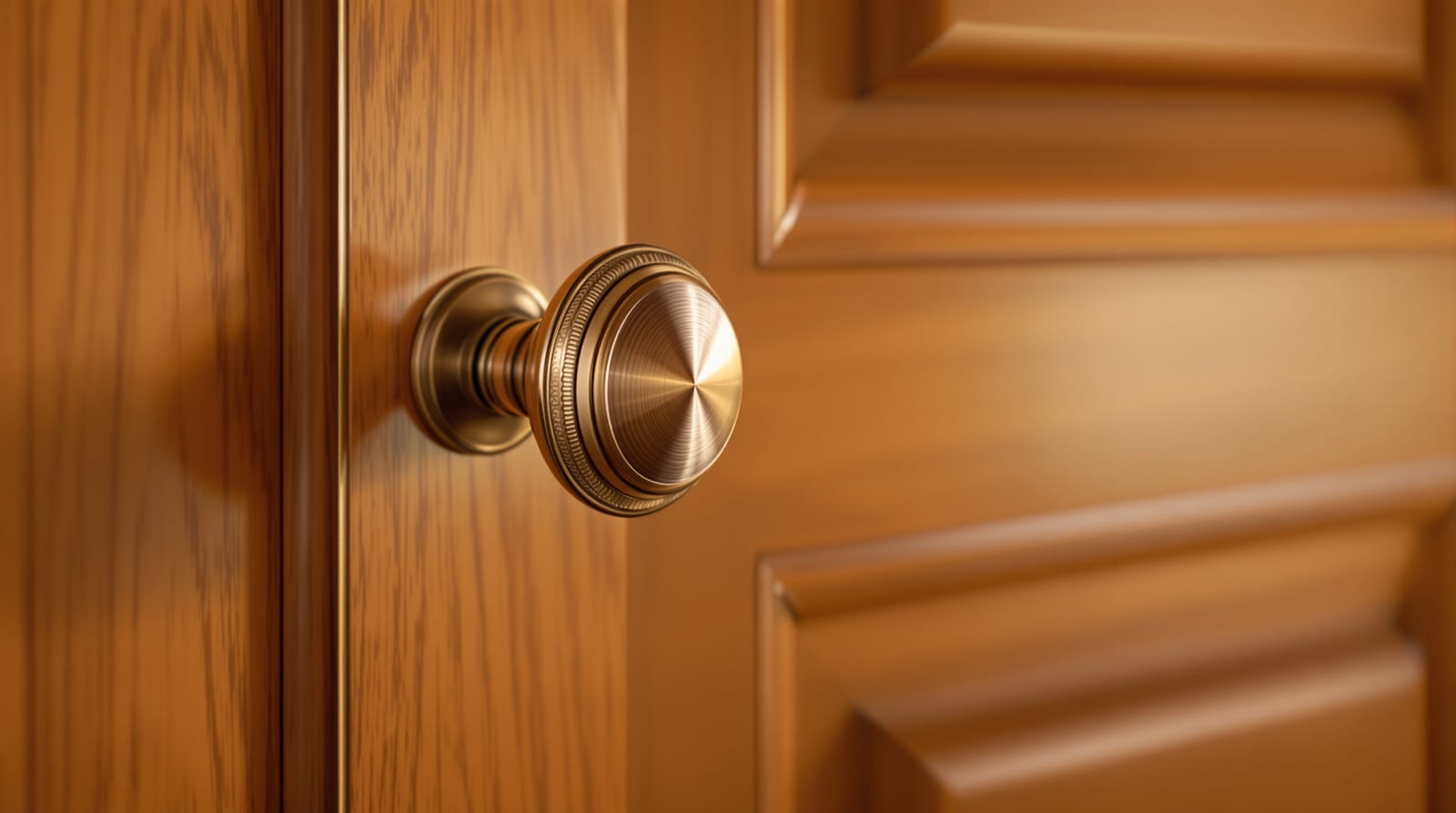
Door Knobs for Indian Homes: Types, Functions & When to Choose a Knob (2026)
Passage, privacy, keyed-entry and dummy knobs — how they work, knob vs lever for elderly users, finishes, and where a round knob still belongs in an Indian home.
The round door knob is the oldest hardware story in the house, and in most new Indian homes it has quietly lost the fight to the lever handle. That is mostly the right outcome — a lever is easier to operate and friendlier to older hands. But the knob is not dead. On a decorative panel door, a vintage teak shutter, a low-traffic store room or a wardrobe, a well-chosen knob still does a clean, honest job, often for less money. This guide explains the four knob functions you will actually meet at the hardware shop, the genuine knob-versus-lever trade-off, and exactly where a knob still earns its place in an Indian home.
This is a deep dive on a single component. For the bigger picture of handles, levers and pull handles, see the door handle guide; for how knobs sit inside the overall hardware system, see the door hardware overview.
The four knob functions you must know
When a shopkeeper or carpenter talks about a "knob set", they almost always mean one of four functions. The knob shape can be identical across all four — what changes is the mechanism behind it. Getting the function right matters far more than the looks.
- Passage knob (non-locking). A plain latch with a knob on each side and no lock at all. Turn either knob, the latch retracts, the door opens. Use it where you never need privacy: a store room, a utility, a passage between kitchen and dining, a child's play area, or a wardrobe shutter. It is the cheapest function.
- Privacy knob (push-button / push-lock). A passage latch plus a simple privacy lock — usually a push-button or twist-button on the inside knob, with a small emergency-release pinhole on the outside. Push to lock from inside; a coin or thin pin pops it open from outside in an emergency. This is the correct choice for a bathroom or bedroom, where you want to stop someone walking in but do not need key security. No key, no cylinder.
- Keyed-entry knob. A passage latch plus a key cylinder in the outside knob and usually a thumb-turn or button inside. This locks with a key from outside. It can go on a side entry, a terrace door or an outbuilding, but be honest about security — a knob-only keyed lock is weak against forcing and is not adequate for a flat's main door. For the main door use a mortise deadbolt; see types of door locks.
- Dummy knob (fixed / non-turning). A solid knob with no mechanism — it does not turn and has no latch. It is purely a pull or a decorative element, screwed onto the face of the door. Use it on the inactive (fixed) leaf of a double door, on a fixed wardrobe shutter, or anywhere you just need something to grip and pull.
| Function | What it does | Best room/use | Indicative ₹ (set, fitting extra) |
|---|---|---|---|
| Passage | No lock, turns both sides | Store, utility, passage, wardrobe | ₹150-700 |
| Privacy (push-lock) | Push-button lock + emergency pinhole | Bathroom, bedroom | ₹300-1,200 |
| Keyed entry | Key cylinder outside, button/turn inside | Side/terrace/outbuilding door (low security) | ₹600-2,500 |
| Dummy (fixed) | No turn, pull/decorative only | Inactive leaf of double door, fixed shutter | ₹100-600 |
Prices are indicative and vary by city, brand and finish; add 18% GST and roughly ₹150-400 carpenter fitting labour per door. Decorative antique-brass and designer knobs run well above these ranges.
Knob vs lever — the honest accessibility note
This is the part most product pages skip. A round knob requires you to grip and twist with your wrist and fingers. A lever needs only a push down — you can do it with an elbow, a forearm, a closed fist, or full hands when you are carrying a child or a tray of cups.
For anyone with arthritis, a weak grip, limited wrist rotation, or wet/oily hands, the lever wins clearly. In a household with elderly parents or grandparents — very common in Indian joint families — the default for bedroom, bathroom and frequently-used doors should be a lever, not a knob. India's accessibility guidance (the RPwD Harmonised Guidelines 2021) and universal-design practice specifically favour lever-style hardware over round knobs for exactly this reason. If you are designing for ageing-in-place, treat the lever as the rule and the knob as the exception. See accessible doors in India for the wider picture.
So why fit a knob at all? Because not every door is a daily, must-be-easy door. A knob is the right call where ergonomics barely matter but looks, cost or tradition do — and that is a real set of doors, covered next.
Where a knob still suits
- Decorative and period doors. On a carved teak shutter, a Chettinad or Rajasthani panel door, or a heritage restoration, a round brass knob is historically correct and looks right where a modern lever would jar. See traditional Indian doors and carved door designs.
- Low-traffic doors. A store room, loft, meter cupboard or rarely-used terrace door — opened a few times a week — does not need lever ergonomics.
- Wardrobes, cabinets and fixed shutters. Small dummy or passage knobs are the natural fit; a full lever set would look oversized.
- Double-door inactive leaves. A dummy knob on the bolted-shut leaf, with the working hardware on the active leaf.
- Budget interior doors where a passage knob is the cheapest way to operate a door that never needs locking.
Shapes, materials and finishes
Knob shapes range from the plain round ball and mushroom to oval/egg, faceted/cut-glass, octagonal and ornate cast-brass period designs. For grip, a slightly oval or faceted knob is easier to turn than a perfectly smooth sphere, especially with dry hands — a small but real point for older users who still prefer a knob.
Common materials and finishes in the Indian market:
- Stainless steel (SS 304): the workhorse — corrosion-resistant, good for coastal and bathroom use, usually satin or mirror polished.
- Brass (solid or plated): the traditional choice; antique-brass, polished-brass and aged finishes suit heritage and teak doors. Solid brass ages beautifully but is pricier.
- Zinc alloy / die-cast with chrome, satin-nickel, matt-black, rose-gold or PVD coatings: most decorative knobs sit here — looks-led and affordable, but check the coating quality.
- Glass/crystal and ceramic knobs: lovely on dressers, wardrobes and feature doors; decorative, not high-strength.
In coastal cities (Mumbai, Chennai, Kochi, Goa) salt air is brutal on cheap plating, so prefer SS 304 or solid brass and PVD coatings; thin chrome on zinc will pit within a year or two. For how finish choices age across the whole house, see door hardware finishes. Look for hardware tested to IS 208 (mortise locks and handle/knob furniture) where the manufacturer states it. Common brands you will see: Godrej, Dorset, Europa, Yale, Ozone, Hettich and Hafele, plus countless unbranded imports — branded sets last longer and replacement spares are easier to find.
Fitting a knob on Indian flush and panel doors
A knob set fits a standard tubular or cylindrical latch that goes into a hole bored through the door face, with a smaller hole drilled in the door edge for the latch. The carpenter needs two measurements: the backset (distance from the door edge to the centre of the bore — commonly 60 mm or 70 mm in India) and the bore diameter (typically about 54 mm / 2-1/8 inch for the cross-bore). Buy the latch and the knob set together so the backset matches.
- Flush doors (IS 2202): make sure the knob bore lands on the solid timber lock block inside the flush door, not on the hollow core, or the screws will have nothing to bite into. Good flush doors have a lock block at a marked height — tell the carpenter before drilling.
- Panel and carved doors (IS 1003): bore through the solid stile, never through a thin panel.
- Standard height: centre the knob about 900-1000 mm from finished floor level, consistent with the rest of the house.
- Monsoon swelling: in humid and coastal zones doors swell and the latch can bind. Leave a correct edge gap, seal the door edges, and prefer a slightly longer latch throw so it still catches when the timber moves. See the door installation guide.
- Termite belt: the hardware survives, but the door under it may not — a knob on a termite-eaten store-room door is a false economy. Pair good hardware with treated timber or WPC.
A quick room-by-room rule of thumb
- Main door / flat entrance: not a knob job — fit a mortise deadbolt or multipoint lock for real security.
- Bedroom (no elderly user): privacy push-lock knob is fine; with elderly users, switch to a lever.
- Bathroom: privacy push-lock with emergency pinhole — and prefer SS 304 against humidity.
- Store/utility/passage: passage (non-locking) knob, cheapest sensible choice.
- Wardrobe/cabinet/fixed leaf: dummy or small passage knob.
- Heritage/decorative panel door: antique-brass knob for looks; keep the actual locking to a discreet mortise lock.
Frequently asked questions
Is a door knob safe enough for my main door?
No. A knob-only lock, even a keyed one, is easy to force and is not adequate security for a flat or house entrance. Use a mortise deadbolt, rim lock or multipoint system on the main door, and keep knobs for interior and low-security doors. See types of door locks in India.
Knob or lever for elderly parents?
Lever. A lever needs only a downward push and works with a weak grip, an elbow or full hands; a knob needs wrist twist and grip strength. For ageing-in-place, make levers the default on bedroom, bathroom and daily-use doors, and keep knobs only where ergonomics barely matter.
How do I unlock a privacy knob if someone is stuck inside?
A privacy knob has a small pinhole on the outside knob. Insert a thin pin, a straightened paperclip or the supplied release key straight in and press; it pops the push-button lock open. Keep one near bathroom and child-room doors.
Can I fit a knob on a hollow flush door?
Yes, but only where the flush door has its internal solid lock block. Bore the knob hole into that block, not the hollow core, so the screws hold. Tell your carpenter the lock-block height before drilling; otherwise the knob will loosen and pull out.
What does a knob set cost to fit in India?
The set itself runs roughly ₹150-700 for passage, ₹300-1,200 for privacy and ₹600-2,500 for keyed entry, plus 18% GST and about ₹150-400 carpenter labour per door. Decorative antique-brass and crystal knobs cost more. Figures are indicative and vary by city and vendor.
Export this guide
Related Guides — Deep-dive reading
Door Handle Guide for Indian Homes: Levers, Knobs & Pull Handles (2026)
How to choose the right door handle — lever-on-rose, knob, pull or mortise handle set — for every door and room in an Indian home.
Home Doors & EntrancesUniversal Design Doors for Indian Homes: Inclusive Doors That Work for Everyone (2026)
How to design and specify doors that serve children, the elderly, pregnant women, the injured and wheelchair users by default - generous width, lever handles, near-flush thresholds, low-force closing, contrast and good lighting - without your home ever looking medical.
Home Doors & EntrancesMortise Lock Guide for Indian Homes: How They Work, Cylinders & Security (2026)
Why the mortise lock — body sunk inside the door leaf — is the standard for Indian main and bedroom doors, and how to choose the cylinder, handle set and brand.
Home Doors & EntrancesRelated Tools — Try Free
Door Cost Calculator
Estimate the all-in cost of a door — leaf, frame, hardware, fitting and GST — by type, material and size.
Door CalculatorDoor Lock Selector
Answer a few questions and get the right lock type — mortise, multipoint, deadbolt, privacy or smart — for any door.
Door ToolDoor Material Comparison Tool
Compare 2–4 door materials on cost, durability, maintenance, security and moisture resistance.
Comparison Tool