
Door Viewer & Peephole Guide India: Optical vs Digital Peepholes (2026)
How to choose, fit and price a door viewer for Indian homes - optical peepholes vs digital door viewers, field of view, fitting height, and where they beat a video door phone.
A door viewer is the cheapest security upgrade most Indian homes never finish well. A ten-rupee idea - look before you open - is undone by a peephole fitted at the wrong height, with a narrow lens a tall caller can dodge, or no viewer at all because the main door is solid teak and "we'll add it later." Whether you choose a simple optical peephole or a digital door viewer with a camera and screen, the value is the same: you decide who comes in without showing yourself, and without unbolting anything. This guide covers the optics, the right fitting height, the digital upgrades worth paying for, and exactly where a viewer beats - and where it loses to - a video door phone.
What a door viewer actually does
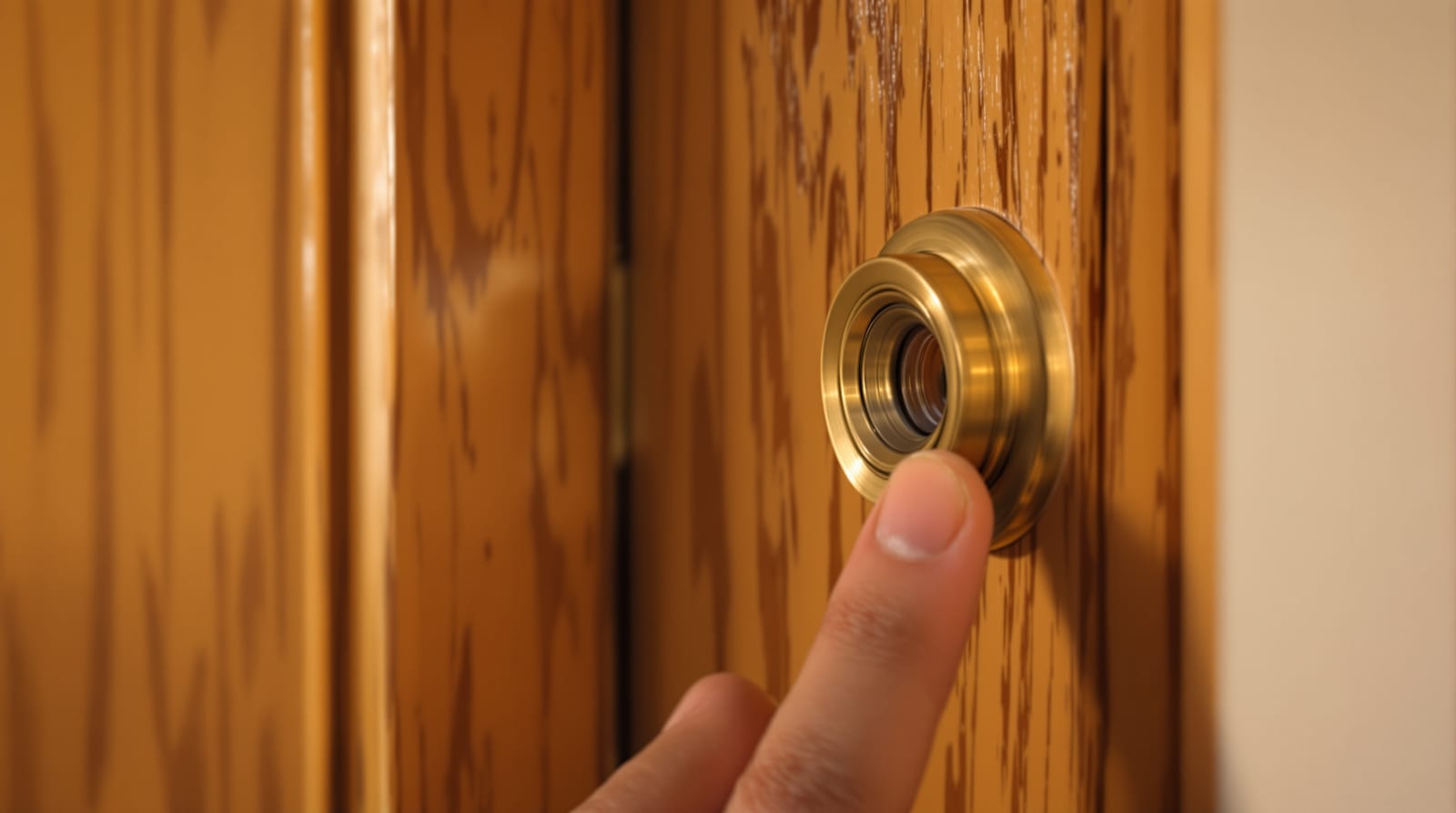
A peephole (door viewer, or "door eye") is a wide-angle lens set through the door leaf. From inside you see a fish-eye view of the landing; from outside the lens is a small dark dot that gives a caller almost nothing. The two things that separate a good viewer from a useless one are field of view and anti-look-back.
- Field of view (FOV): cheap viewers show 120-160 degrees; better ones reach 180-200 degrees. Wider is genuinely better in an Indian apartment landing because a caller who knows where the peephole is will stand to the side, flat against the wall, out of a narrow lens. A 200-degree viewer leaves almost nowhere to hide on a normal-width landing.
- Anti-look-back (privacy lens): a quality viewer is designed so that someone outside cannot reverse the optics and see in, even with a torch or a reverse-viewer gadget sold to snoopers. Look for "anti-look-back", "privacy", or "one-way" in the spec. The cheapest brass viewers often lack this.
The lens needs to match your door thickness. Most viewers cover a barrel range of roughly 35-60 mm, which suits standard 30-35 mm flush doors and many 40-45 mm solid doors. A heavy teak main door of 50-60 mm needs a long-barrel viewer - check the throat range before buying, or you will be left with a viewer that will not screw shut.
Fitting height: the detail everyone gets wrong
The classic mistake is fitting the peephole at the carpenter's eye level - usually a tall man's - so that women, older parents and children in a joint family cannot use it. Fix this with intent, not habit.
- Standard adult height: centre the viewer at about 1500-1600 mm from finished floor. This is a fair compromise for most adults.
- Mixed/joint-family or accessibility: consider a lower viewer at ~1100-1200 mm, or simply fit two viewers - one at ~1550 mm and one at ~1150 mm. A second optical peephole costs ₹80-300; it is the cheapest inclusion you can make for shorter family members, wheelchair users and children. This complements the broader thinking in accessible doors and the main door security checklist.
- A digital door viewer with a screen sidesteps the height problem entirely - anyone who can reach the screen button can see the caller - which is part of why families with elderly parents prefer them.
Position it central in the door width where the landing is best framed, and never directly over a lock body or a stile joint.
Optical vs digital vs video door phone
The honest comparison most shops will not give you:
| Feature | Optical peephole | Digital door viewer | Video door phone (VDP) |
|---|---|---|---|
| Indicative price | ₹80-600 | ₹2,500-9,000 | ₹4,000-25,000 |
| What you look at | Fish-eye lens | LCD screen on inner unit | Indoor monitor / phone app |
| Field of view | 120-200 deg | 90-160 deg (camera) | Camera-dependent |
| Power | None | Rechargeable / AA battery | Wired mains (+ battery backup) |
| Recording | No | Yes (photo/video to SD) | Yes (some models) |
| Motion / doorbell capture | No | Yes (PIR motion snapshot) | Yes |
| Night vision | No | Yes (IR LED) | Some models |
| Two-way talk | No | Rarely | Yes |
| Unlock door remotely | No | No | Some (with e-lock) |
| Fitting | DIY, 2 holes | Fits existing peephole hole | Wiring + drilling, electrician |
| Best for | Every door, budget, backup | Tenants, retrofits, elderly | New homes, gated, frequent visitors |
The quick rule: a plain optical peephole belongs on every main door as the zero-power, never-fails baseline. A digital door viewer is the smart middle - it slots into the same hole, needs no wiring, records who knocked while you were out, and is ideal for rented flats where you cannot run cables. A video door phone wins when you want two-way talk, a proper doorbell, app access from your office, and remote unlocking - typically a planned install in your own home.
How an optical peephole frames the landing
A narrow viewer would taper the blue cone so a person flattened against the side wall slips outside it. A 180-200 degree viewer keeps the whole landing in frame - which is the entire point of paying a little more.
Digital door viewer features worth paying for
If you go digital, these are the upgrades that earn their cost:
- PIR motion capture: the unit snaps a photo or short clip when someone lingers at your door while you are out - the single most useful feature for catching parcel theft or repeated unknown callers.
- Night vision (IR): Indian landings are often dim; infra-red LEDs give you a usable face image in the dark.
- Local recording to microSD: keeps footage on your own card, no subscription, no cloud account.
- Wide screen and a real doorbell button outside so the digital viewer doubles as a doorbell.
- Rechargeable battery (USB) rather than AA cells you will forget to change.
Skip gimmicks like very low-resolution screens (below 3 inches), or "smart" units with flaky apps - for app access and two-way talk a proper VDP or a smart doorbell is a cleaner choice.
Indian buying and fitting realities
- Price (indicative, varies by city and vendor; +18% GST): brass/zinc optical peephole ₹80-600; long-barrel viewer for teak doors at the top of that range; digital door viewer ₹2,500-9,000; quality branded smart units (e.g. Qubo and similar) toward the higher end.
- Fitting: an optical peephole is a genuine DIY job - a 12-14 mm bore through the door, two threaded halves screwed together; a carpenter charges very little to add one. A digital viewer reuses the existing peephole hole (typically 14-50 mm bore depending on model), which is why it is the natural retrofit.
- On a teak or carved main door, drill carefully and use the longest-barrel viewer rated for your leaf thickness; a botched bore in expensive teak is a costly scar. Pre-finished doors should be drilled with a sharp hole-saw to avoid splintering the laminate or veneer.
- Climate: in coastal homes, salt air pits cheap chrome and zinc viewers - choose stainless or solid brass outer rings. For digital units, keep the outer camera shaded from driving monsoon rain; most are only splash-resistant, not weatherproof.
- Finish coordination: match the viewer ring to your handle and hinge finish - antique brass, matte black, satin nickel - per door hardware finishes, so it reads as deliberate rather than an afterthought.
For the full picture on hardening your entrance - locks, hinges, frames, grilles - read door security and the main door security checklist. For the camera-and-talk route, see video door phones.
Frequently asked questions
What field of view should an Indian apartment door viewer have?
Aim for 180-200 degrees. Apartment landings are narrow, and a caller who wants to stay unseen will stand flat against the side wall. A wide lens keeps them in frame; a 120-degree budget viewer leaves blind spots a person can exploit. Also insist on an anti-look-back (privacy) lens so nobody can reverse-view into your home.
At what height should a peephole be fitted?
Centre it about 1500-1600 mm from the floor for adults. In a joint family or where shorter members, elderly parents or children also answer the door, fit a second viewer at ~1150 mm, or choose a digital door viewer with a screen so height stops mattering. A spare optical peephole costs almost nothing to add.
Is a digital door viewer better than a video door phone?
They solve different problems. A digital door viewer is a cheap, wire-free retrofit that records who knocked and works great for rented flats and elderly users. A video door phone adds two-way talk, a proper doorbell, app access and (with an electronic lock) remote unlocking - better for a home you own and plan around. Many homes keep an optical peephole as a never-fails backup either way.
Can I fit a digital viewer into my existing peephole hole?
Usually yes. Most digital door viewers are designed to reuse a standard peephole bore; you only enlarge the hole if your existing one is smaller than the model needs. Check the model's required hole diameter and door-thickness range before buying - a long-barrel option is essential for thick teak doors.
Do peepholes work on solid teak and carved main doors?
Yes, but you need a long-barrel viewer rated for the full leaf thickness (50-60 mm doors need more reach than the common 35-mm-range viewers). Drill slowly with a sharp bit to avoid splitting the timber, and choose solid brass or stainless to match a traditional door - see door hardware finishes.
Export this guide
Related Guides — Deep-dive reading
How to Choose a CCTV Camera (2026): The Homeowner's Decision Guide for India
Cut through the spec-sheet noise and choose the right CCTV camera for each spot around an Indian home. What actually matters — sensor and low-light performance, lens and field of view, form factor, IP and IK ratings, honest smart features — and the marketing claims to ignore.
SecurityCCTV vs Video Door Phone: Which Does Your Home Need?
They look similar and get confused constantly, but a CCTV camera and a video door phone do different jobs — one watches the whole property and records, the other answers your door and controls who comes in. This guide settles CCTV vs video door phone for Indian homes: what each is for, where they overlap, real rupee costs, apartment versus villa relevance, and why most homes end up wanting both.
Smart HomeSmart Doorbell for Indian Homes: WiFi Video Doorbells, Storage & Cost (2026)
How WiFi video doorbells like Qubo and Mi work in Indian homes - battery vs wired, cloud vs local SD storage, person detection, two-way talk, mounting and the honest comparison with a video door phone.
Home Doors & EntrancesRelated Tools — Try Free
Video Door Phone Type Selector
Answer a few questions about your building, cabling, budget and internet and get the right video door phone — analog / wired / wireless / IP, single-home or multi-apartment, monitor or app.
Door Phone SelectorDoor Security Rating Calculator
Score your main door out of 100 across leaf, frame, lock and hardware — and see the top upgrades.
Security ToolCCTV Cloud vs Local Cost Calculator
Compare cloud CCTV subscription against a local NVR + HDD — upfront, 5-year total, monthly fee and break-even.
Cloud vs Local