
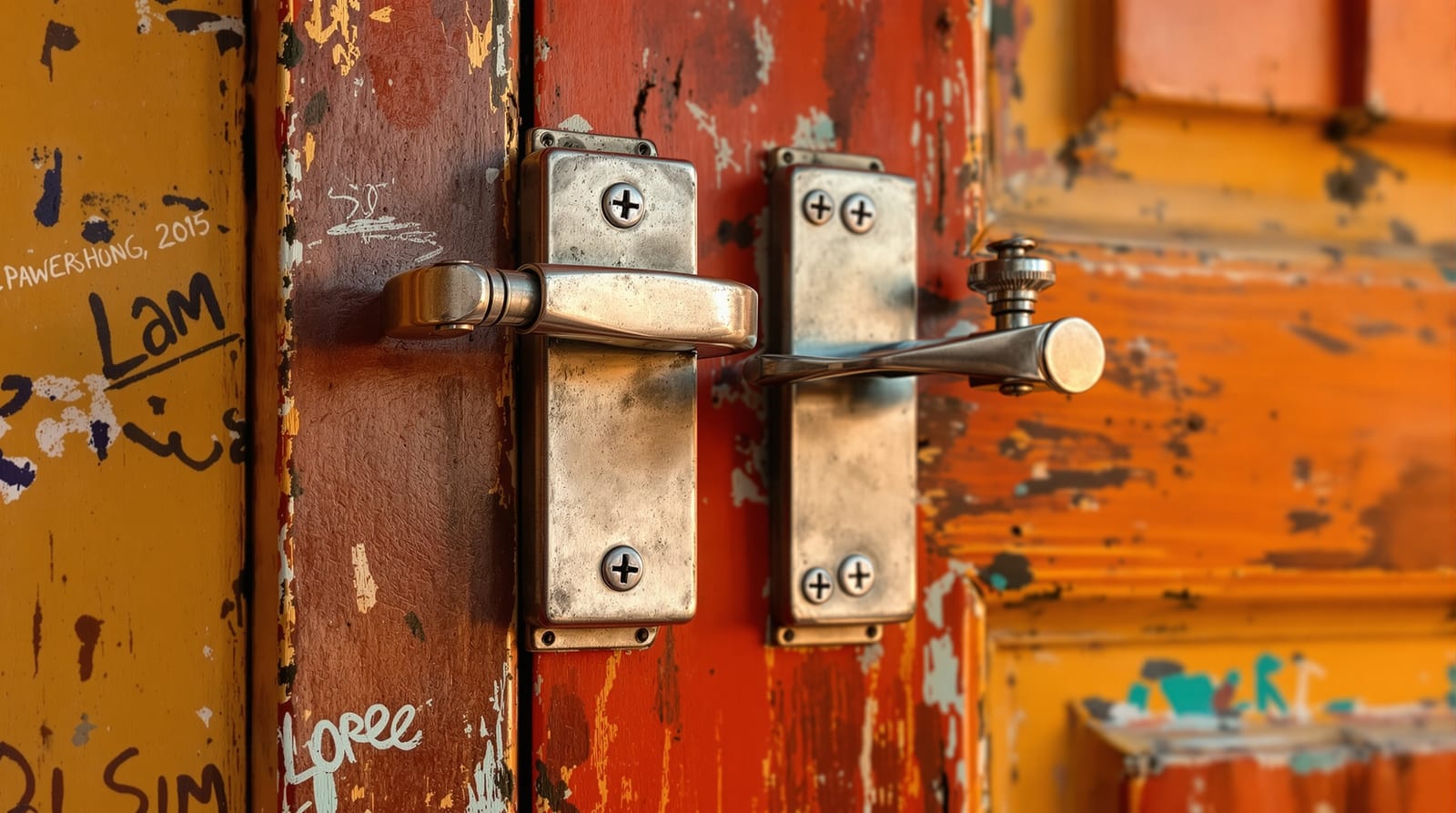
Tower Bolts, Aldrops & Latches for Indian Doors: Types, Sizes & Prices (2026)
A practical guide to tower bolts (4"-12"), aldrops, sliding and hook latches, flush bolts and barrel bolts - materials, IS 7196, where each belongs, and 2026 costs.
The lock on your door gets all the attention, but it is rarely the thing actually holding the door shut at night. In most Indian homes that job belongs to a humble set of secondary fasteners - the tower bolt you slide across before bed, the aldrop your grandmother snapped a padlock through, the little latch on the bathroom door, the flush bolt buried in the inactive leaf of a double door. They cost a few hundred rupees, they are bought by the dozen at the hardware shop, and they quietly do more daily work than the expensive mortise lock beside them.
This guide is about those everyday fasteners: what a tower bolt actually is and which size to buy, when an aldrop earns its place over a bolt, how sliding, hook and barrel latches differ, and where the flush bolt fits into a double door. It covers materials and finishes that survive Indian monsoon and coastal salt, the relevant Indian Standard (IS 7196), real 2026 rupee prices, and the simple logic of which fastener belongs on which door. For the bigger picture of locks, hinges, handles and closers, this sits as a companion to our door hardware guide.
Tower bolts: the workhorse fastener
A tower bolt is the most common door fastener in India - a sliding metal bolt running through two guides (the "towers"), with a knob you push to shoot the bolt into a fixed socket or keeper. You slide it horizontally on a single door, or fit a pair vertically (top and bottom) on a tall or double-leaf door. It does not lock with a key; it simply holds the door closed and bolted from the inside, which is exactly what you want on a bedroom, bathroom, balcony or back door secured from within.
Indian Standard IS 7196 governs "tower bolts for use with wooden doors" - it sets the materials, dimensions, bolt diameters and finish quality a properly made tower bolt should meet. A bolt made to IS 7196 has a bolt rod of the right thickness for its length, smooth travel, and guides that will not work loose. Branded hardware (Godrej, Dorset, Ozone, Europa, Yale) and good local brands generally meet or exceed it; the very cheapest unbranded bolts often do not, and you feel it within months as the bolt starts to bind or rattle.
Tower bolt sizes - how to choose
Tower bolts are sold by length in inches, typically from 4" to 12" (roughly 100 mm to 300 mm). The length refers to the overall bolt body, and a longer bolt means a longer throw and a heavier rod - so longer is sturdier, but oversized on a small door it just looks clumsy and the bolt fouls the frame.
| Tower bolt size | Best suited to | Notes |
|---|---|---|
| 4" (100 mm) | Small cabinet, window shutter, ventilator | Light duty; thin bolt rod |
| 6" (150 mm) | Bathroom door, internal bedroom door | The everyday default for interior doors |
| 8" (200 mm) | Main internal doors, balcony door | Heavier rod, more positive throw |
| 10" (250 mm) | Tall doors, one leaf of a double door | Vertical fit, top and bottom |
| 12" (300 mm) | Heavy main doors, gates, godown shutters | Long throw, thick rod, fitted vertically |
A practical rule: 6" for ordinary internal doors, 8"-10" for main and balcony doors, and 10"-12" fitted vertically for the leaves of a double door or a heavy gate. Always check the bolt's rod diameter, not just its length - two 8" bolts can have very different rod thickness, and the thicker one is far more secure and less prone to bending.
Aldrop: when you need a padlock
An aldrop (also spelled "hasp and staple", and called a kunda in much of India) is the fastener built to take a padlock. Instead of bolting from the inside like a tower bolt, an aldrop has a hinged hasp on the door leaf that swings over a fixed loop or staple on the frame; you then pass a padlock through the staple to lock the door from the outside. This is the classic way Indian homes secure the main door when leaving the house, and the standard fitting on compound gates, terrace doors, store rooms, garages and godowns.
The defining feature of a good aldrop is that, once the padlock is on, the fixing screws are concealed behind the hasp - so a thief cannot simply unscrew the fitting. Cheap aldrops leave the screws exposed and are next to useless. A quality aldrop is heavy-gauge, fitted with through-bolts or concealed screws, and paired with a hardened-shank padlock; this combination is genuinely tough and is why the humble aldrop-and-padlock has guarded Indian doors and gates for generations.
Aldrops come in light (for store-room and cupboard duty) and heavy (for main doors and gates) patterns, and in the same materials as tower bolts. For the main door's outward security, an aldrop complements rather than replaces the lock - see our door locks types guide for how mortise, rim and night latches fit alongside it.
The latch family: sliding, hook, barrel and flush
Beyond the tower bolt and aldrop, a handful of smaller latches each have a specific job around the home.
- Sliding latch (slide bolt): a compact bolt and keeper, smaller and flatter than a tower bolt, used where a low-profile catch is enough - cupboard shutters, the inside of bathroom and toilet doors, light internal doors. Many bathroom sliding latches include an indicator (a red/green or "vacant/engaged" window) for privacy doors.
- Hook latch (hook and eye): the simplest fastener - a swinging hook on one leaf dropping into an eye screw on the other. It is not security; it just stops a door or a casement window from swinging open in the breeze. Common on balcony shutters, screen doors, and the loose-fitting inner doors of older homes.
- Barrel bolt: a small cylindrical bolt sliding in a tubular housing (the "barrel"), throwing a round bolt into a keeper. It is the neat, surface-mounted cousin of the tower bolt, used on lighter internal doors, gates and shutters where a tidy round bolt looks better than a flat tower bolt. Larger heavy-duty barrel bolts are used vertically on gates.
- Flush bolt: a bolt recessed into the edge of the door so it sits flush with the surface, throwing up into the head frame or down into the threshold. This is the correct fastener for the inactive (fixed) leaf of a double door - you bolt that leaf top and bottom into the frame so it stays put, and the active leaf then latches against it. Flush bolts are also used on French doors and large gates for a clean, hidden look.
Which fastener for which door
| Fastener | Where it is used | Locks from | Indicative 2026 price |
|---|---|---|---|
| Tower bolt 6"-8" | Bedroom, bathroom, balcony door (inside) | Inside | ₹80-300 per piece |
| Tower bolt 10"-12" | Main door, gate, double-door leaf (vertical) | Inside | ₹200-500 per piece |
| Aldrop (heavy) | Main door, gate, store room (padlock) | Outside, with padlock | ₹150-600 per set |
| Aldrop (light) | Cupboard, store room | Outside, with padlock | ₹80-250 per set |
| Sliding latch | Bathroom, toilet, cupboard (inside) | Inside | ₹60-250 per piece |
| Sliding latch with indicator | Bathroom / privacy door | Inside | ₹150-450 per piece |
| Hook latch (hook & eye) | Balcony, screen door, casement | Inside (light hold) | ₹40-150 per piece |
| Barrel bolt | Light internal door, gate, shutter | Inside | ₹60-300 per piece |
| Flush bolt | Inactive leaf of double / French door | Top & bottom into frame | ₹150-600 per pair |
Prices are indicative and vary by city, material and brand; add 18% GST, and budget ₹50-150 of carpenter labour per fitting if you are not fixing them yourself.
Materials and finishes: surviving Indian conditions
The fastener you buy is only as good as the metal it is made from, and India's monsoon humidity, coastal salt air and damp bathrooms are unforgiving on cheap material.
- Stainless steel (SS 304): the best all-round choice. It resists rust, takes the monsoon and bathroom damp without staining, and stays smooth-sliding for years. SS 304 is genuinely corrosion-resistant; SS 202 (often sold simply as "stainless") is cheaper and rusts faster in coastal and bathroom settings, so ask which grade you are getting. For coastal homes - Mumbai, Goa, Chennai, Kochi, Vizag - insist on SS 304.
- Brass: traditional, handsome and naturally corrosion-resistant, brass suits main doors, pooja-room doors and heritage or carved doors where the warm golden look matters. It can be left to develop a patina or kept polished. Brass aldrops and bolts are the classic look on a traditional carved door or double door.
- Mild steel (MS): the cheapest, usually sold powder-coated or painted black/bronze. Fine for dry internal doors and budget jobs, but it rusts wherever there is moisture - avoid in bathrooms, balconies and coastal homes unless well coated and kept dry.
- Zinc / zinc-alloy (die-cast): moderately priced, takes a good plated finish, common in branded mid-range bolts. Decent for internal use; quality varies.
On finishes, the usual choices are satin/matte stainless, polished chrome, antique brass, antique copper, black (matte or powder-coated) and bronze. The practical advice is to match the fastener finish to the door's handles and hinges so the hardware reads as a set - a matte-black tower bolt beside a chrome handle looks like an afterthought. Pick the finish for the setting too: brushed stainless and antique brass hide water spots and fingerprints far better than bright polished chrome on a bathroom or main door.
Fitting and small details that matter
A tower bolt or aldrop is simple to fit, but a few details decide whether it works smoothly for years or becomes the rattly thing nobody likes to use:
- Alignment is everything. The bolt must line up exactly with its socket. If the door drops even slightly over time (a sagging door issue), the bolt stops meeting the socket. Fit the bolt first, then mark and cut the socket against the thrown bolt, not by guesswork.
- Use the right screws and pre-drill in hardwood like teak so you do not split the timber; for a security aldrop on a main door or gate, use through-bolts or long screws into solid wood, never the short screws in the box into a hollow door.
- Bolt into the frame, not the architrave. On the inactive leaf of a double door, the flush bolt should throw into a metal socket let into the head and threshold, not just into soft plaster.
- Lubricate twice a year. A drop of light machine oil or a dry PTFE spray on the bolt rod keeps the slide smooth; in coastal homes this also slows corrosion at the contact points.
For the broader job of hanging and aligning a door so its hardware all lines up, our door installation and maintenance guidance is the natural next read, and the door hardware overview ties the bolts together with the locks, hinges and handles.
Frequently asked questions
What size tower bolt should I use on a bedroom or bathroom door?
A 6" (150 mm) tower bolt is the everyday default for ordinary internal bedroom and bathroom doors - it gives a positive throw without being oversized. Step up to 8" for heavier main internal doors and balcony doors. For bathrooms specifically, many people prefer a sliding latch with a vacant/engaged indicator, but a 6" tower bolt is perfectly secure from the inside.
What is the difference between a tower bolt and an aldrop?
A tower bolt secures a door from the inside - you slide it shut before bed and it cannot be opened from outside. An aldrop secures a door from the outside with a padlock - you swing its hasp over the frame staple and snap a lock through it when you leave the house. Tower bolts are for occupied-room security; aldrops are for locking up an empty house, gate, store room or godown.
Is a tower bolt or aldrop secure enough for my main door?
On its own, no - secondary fasteners support but do not replace a proper lock. The standard Indian set-up is a mortise or rim lock for the main door's primary security, an aldrop for padlocking when you are out, and tower bolts top and bottom for night-time bolting from inside. Buy a heavy IS 7196 tower bolt and a concealed-screw aldrop, and pair the aldrop with a hardened padlock. See our door locks types guide for the lock side.
What is a flush bolt and where do I need one?
A flush bolt is a bolt recessed into the edge of a door so it sits flush, throwing up into the head frame and down into the threshold. Its main job is to hold the inactive (fixed) leaf of a double door firmly in place - you bolt that leaf top and bottom, then the active leaf latches against it. They are also used on French doors and large gates for a clean, hidden look. Our double doors guide covers how the two leaves work together.
Which material is best for tower bolts in a coastal or humid home?
Stainless steel grade SS 304. It resists the salt air of coastal cities and the damp of bathrooms without rusting or staining, and stays smooth-sliding for years. Avoid mild steel near moisture, and be wary of "stainless" that is actually the cheaper SS 202 grade, which rusts faster - ask the dealer to confirm SS 304. Brass is also naturally corrosion-resistant and suits main and traditional doors where its golden look is wanted.
Export this guide
Related Guides — Deep-dive reading
Door Hardware Guide India 2026: Hinges, Handles, Locks, Closers and Every Fitting Explained
What each piece of door hardware actually does, where it belongs, which material (SS304, brass, zinc or iron) survives Indian conditions, the quality signals to check before you pay, and a buyer's checklist with 2026 prices.
Home Doors & EntrancesTypes of Door Locks for Indian Homes: Complete Buying Guide (2026)
Mortise, rim, cylindrical, deadbolt, multipoint, aldrop and smart locks — which lock suits your main door, bedroom, bathroom and gate, with security ratings, prices and trusted brands.
Home Doors & EntrancesDoor Hardware Finishes in India: Satin SS, Brass, Matte Black, PVD & Coastal Picks
How to choose handle, lock and hinge finishes that look right, age well and survive Indian humidity and coastal salt air.
Home Doors & EntrancesRelated Tools — Try Free
Window Hardware Cost Calculator
Estimate window hardware cost — hinges, handles, locks, rollers and multipoint gears.
Window CalculatorWindow Grill Design Selector
Pick a window grille style and material by priority — security, looks, budget, view — and estimate cost.
Window ToolWindow Maintenance Cost Calculator
Estimate annual window upkeep by frame material — yearly, per-window and 5-year cost.
Window Calculator