
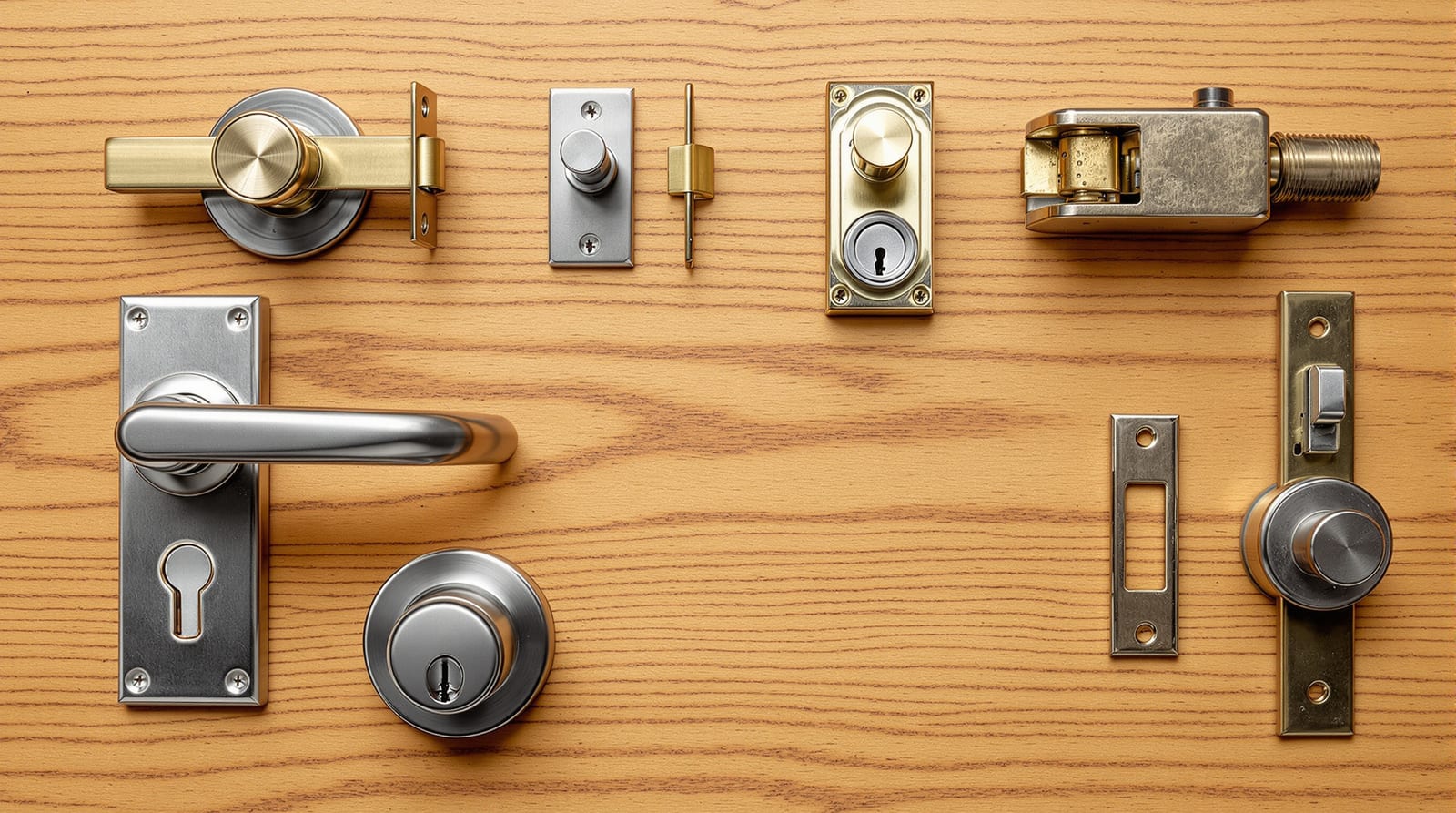
Types of Door Locks for Indian Homes: Complete Buying Guide (2026)
Mortise, rim, cylindrical, deadbolt, multipoint, aldrop and smart locks — which lock suits your main door, bedroom, bathroom and gate, with security ratings, prices and trusted brands.
Walk into any hardware shop in India and ask for "a door lock," and you will be shown ten things that all do roughly the same job in completely different ways. A mortise lock and a cylindrical lock are not interchangeable. An aldrop is brilliant on a main door at night and useless on a bathroom. A smart lock can be the safest thing in your house or the easiest to defeat, depending on what is behind the touchscreen. Choosing the wrong lock type is how families end up with a flimsy main door and an over-engineered store room. This guide maps every common lock type to the right door, with honest security levels, real Indian prices and the brands worth your money.
This is the overview hub for door locks. Where a topic deserves its own deep dive — mortise mechanisms, smart locks, whole-door security — we link out so you can go further.
The seven lock families you will actually meet
Locks confuse people because shops mix up the body type (how the lock sits in the door) with the mechanism (how it resists attack). Here are the seven families that cover almost every Indian home.
1. Mortise lock. The lock body is buried (mortised) inside a pocket cut into the door edge, with a lever handle on each face and a key cylinder. This is the default "good" lock for main doors and bedrooms in India because the body is hidden, the bolt is substantial, and you get a lever you can operate with full hands. Quality ranges enormously — a ₹600 mortise set and a ₹6,000 one look similar but differ hugely in cylinder pick-resistance and bolt throw. We go deep in mortise locks.
2. Rim lock / night latch. Surface-mounted on the inside face of the door (the "rim"), it latches automatically when the door shuts and is opened by key outside, knob inside. The classic Indian "Godrej night latch" on a main door. Convenient and cheap, but a surface body can be attacked, and a simple night latch alone is not enough security for a front door — pair it with a deadbolt or mortise.
3. Cylindrical / tubular lock. The mechanism lives in a cylinder that passes through the door face, operated by a knob or lever. Quick to fit (just two holes), so it is common on interior doors, bedrooms and budget builder-fit homes. Knob versions are weakest — they can be gripped and forced. Lever-handle tubular versions are better and accessibility-friendly.
4. Deadbolt. Not a full handle set — a single throw bolt with no spring latch, so it cannot be slipped with a card and only moves when you turn the key or thumb-turn. A deadbolt is the muscle, usually fitted above a latch or mortise to reinforce a main door. A "single-cylinder" deadbolt has a thumb-turn inside; a "double-cylinder" needs a key both sides (riskier in a fire — avoid on a main exit).
5. Multipoint locking. One handle action throws three to five bolts up, down and into the frame simultaneously. Standard on good uPVC and steel security doors, increasingly on premium wooden main doors. The gold standard for distributing force so the door cannot be levered open at one weak point. More in multipoint locking doors.
6. Aldrop / tower bolt / hasp-and-padlock. The traditional, hugely popular Indian hardware. An aldrop (sliding latch with a hasp for a padlock) and tower bolts secure a door from inside; the hasp-and-padlock secures gates, terraces and store rooms from outside. Cheap, strong against brute prying when heavy-gauge, but only as good as the padlock and the screws. Covered fully in tower bolts and latches.
7. Smart / digital lock. Keyless entry by fingerprint, PIN, RFID card, Bluetooth or Wi-Fi, almost always built on a motorised mortise or deadbolt body. Convenience and audit trails are real benefits; security depends on the mechanical bolt behind the electronics and the build quality. Deep dive in smart door locks.
Lock type by door: the decision table
The honest answer to "which lock?" is "which door, and what is it protecting?" Prices are indicative (2026, +18% GST, fitting extra) and vary by city and vendor.
| Lock type | Best use | Security level | Indicative price (₹) | Typical brands |
|---|---|---|---|---|
| Mortise (lever + cylinder) | Main door, master bedroom | Medium–High (with good cylinder) | 600–6,000 / set | Godrej, Yale, Dorset, Europa, Hettich |
| Rim lock / night latch | Main door (as secondary), back door | Low–Medium | 300–1,500 | Godrej, Harrison, Link |
| Cylindrical knob | Store room, low-stake interior doors | Low | 250–1,200 | Europa, Dorset, Ozone |
| Tubular lever | Bedrooms, accessible doors | Low–Medium | 400–2,000 | Yale, Dorset, Hettich |
| Deadbolt (single-cylinder) | Main door reinforcement | High | 500–3,000 | Godrej, Yale, Europa |
| Multipoint | Premium main / security / uPVC doors | High–Very High | 3,000–15,000 + door | Hettich, Hafele, Ozone, Yale |
| Aldrop / tower bolt | Main door night-locking (inside) | Medium (heavy-gauge) | 80–500 each | Local brass/SS, Dorset, Ozone |
| Hasp + padlock | Gate, terrace, store, lock-up | Low–Medium | 60–400 hasp + 150–1,500 padlock | Godrej, Harrison, Link |
| Privacy bolt / thumb-turn | Bathroom, toilet | Privacy only | 150–700 | Ozone, Dorset, Europa |
| Smart / digital | Main door, rental, joint-family | Medium–High (model-dependent) | 5,000–30,000 | Yale, Godrej, Qubo, Ozone, Hettich |
A note on bathrooms: you do not want a keyed deadbolt on a toilet. Use a privacy bolt or thumb-turn that has an emergency release — a slot a coin can turn from outside — so a child or an elderly person locked in can be reached. This single detail matters more than brand.
How to read security level (so brands cannot bluff you)
A lock's security is the weakest of three things: the cylinder (resists picking and bumping), the bolt (resists forcing), and the fixing (resists the door or frame being kicked through). India has no single consumer lock star-rating like the UK's BS 3621, so judge by features:
- Cylinder: look for "anti-pick," "anti-bump," "anti-drill" and ideally a computer-cut / dimple key rather than a simple flat key. Pin-tumbler with 5–6 pins is the realistic minimum for a main door.
- Bolt throw: a deadbolt or mortise bolt should throw at least 20 mm into the frame; longer is better. Hardened steel inserts resist hacksawing.
- Fixing: even a great lock fails on a hollow flush door or a soft frame. A main door should be solid-core or engineered hardwood with a seasoned hardwood frame anchored to the wall — see door reinforcement.
For a whole-door view — frame, hinges, viewer, chain and grade — read door security, and grade your own setup with the door security rating tool.
Inline diagram: four lock bodies at a glance
The single biggest source of confusion is where the lock sits in the door. This cutaway shows the four body types side by side.
Matching locks to the four key doors
Main door. The single door worth spending on. The strong combination in Indian homes is a mortise lever-lock set with a quality anti-pick cylinder, reinforced by either a deadbolt above it or a multipoint mechanism, plus a heavy aldrop and tower bolt used at night from inside, and a door viewer. For joint families and rentals where keys circulate, a smart lock earns its price by giving each member a PIN and an access log. Build a full checklist with main door security checklist.
Bedrooms. Privacy and modest security, not fortress-grade. A tubular lever lock or a simple mortise privacy set is right. A master bedroom doubling as a valuables store can justify a keyed deadbolt or a small safe instead.
Bathrooms / toilets. Privacy bolts and thumb-turns with emergency outside release. Never a keyed lock that can trap someone. Choose corrosion-resistant finishes (SS 304 or good zinc) because bathroom humidity rusts cheap locks fast — see door hardware finishes.
Gates, terraces and store rooms. Hasp-and-padlock and heavy aldrops rule here, because they secure from outside and tolerate weather. Buy a brass or hardened-steel padlock with a shrouded shackle (the exposed shackle is what bolt-cutters love), and stainless or galvanised hasps with concealed screws. For motorised compound gates, see motorised gate automation.
Climate and the Indian reality check
Locks live in a brutal environment here. Coastal salt air pits chrome and corrodes cheap internal springs within a year — insist on SS 304 bodies and marine-grade finishes in Mumbai, Chennai, Kochi, Goa. Monsoon swelling makes wooden doors expand so a tight-fitting mortise bolt jams; a competent carpenter leaves clearance and you re-check alignment each season, as in fix sagging door. Dust is a smart lock's enemy — touch panels and motors need gasketing under a porch, never full sun and rain. And power cuts matter: every digital lock must have a mechanical key override or external battery jump point. Buy for your weather, not the showroom's.
What to actually buy: a quick rule of thumb
- Front door: mortise lever set (good cylinder) + deadbolt or multipoint + aldrop/tower bolt + viewer. Add a smart lock if many people need access.
- Bedrooms: tubular lever or privacy mortise.
- Bathrooms: privacy thumb-turn with emergency release, corrosion-resistant.
- Gates/store: shrouded-shackle padlock + heavy hasp/aldrop, SS or galvanised.
- Anywhere coastal/humid: step up to SS 304 and sealed mechanisms.
For brand-by-brand comparison see door hardware brands, and for the wider fitting picture the door hardware guide. Estimate fitted budgets with the door cost calculator.
Frequently asked questions
Which lock is best for a main door in India?
A quality mortise lever-lock with an anti-pick, anti-bump cylinder, reinforced by a deadbolt or a multipoint mechanism, is the strongest mainstream choice. Add a heavy aldrop and tower bolt for night locking from inside and a door viewer. A smart lock is excellent on top for families and rentals, provided it has a mechanical key override.
What is the difference between a mortise lock and a cylindrical lock?
A mortise lock's body is buried inside a pocket cut into the door edge, giving a hidden, substantial bolt and a lever handle. A cylindrical (tubular) lock passes through the door face and only needs two drilled holes, so it fits faster but is generally less secure, especially in knob form. Mortise suits main and bedroom doors; cylindrical suits interior and budget doors.
Are smart locks safe for Indian homes?
A well-built smart lock is as safe as the mechanical bolt behind its electronics, so judge the lock body, not just the touchscreen. Choose models with a physical key override, low-battery alerts and IP-rated weather protection, and shelter the unit from direct sun and monsoon rain. Cheap, unbranded units with weak motors and no override are a security and lock-out risk.
What lock should I use on a bathroom door?
Use a privacy bolt or thumb-turn that has an emergency outside release — a slot a coin or flat tool can turn from outside — so anyone accidentally locked in can be reached. Avoid keyed deadbolts on bathrooms entirely, and pick corrosion-resistant SS 304 or quality zinc to survive the humidity.
Is an aldrop and padlock enough security for a front door?
On their own, no. A heavy-gauge aldrop with a good padlock resists prying well and is great for night locking and for gates or store rooms, but it works only from one side and the padlock can be attacked. On a main door, use it to supplement a mortise or deadbolt lock, never as the sole lock.
Export this guide
Related Guides — Deep-dive reading
Mortise Lock Guide for Indian Homes: How They Work, Cylinders & Security (2026)
Why the mortise lock — body sunk inside the door leaf — is the standard for Indian main and bedroom doors, and how to choose the cylinder, handle set and brand.
Home Doors & EntrancesSmart Lock vs Traditional Lock in India (2026): Which Should Guard Your Door?
An honest, even-handed head-to-head for Indian homes — keyless convenience, e-keys and remote access on one side, simple key-in-hand reliability with no power dependence on the other — ending in a clear verdict by household, and one rule both must obey: never trap anyone inside.
SecurityReinforced Wooden Doors in India (2026): Making the Timber Main Door Actually Secure
A homeowner's decision guide to choosing or upgrading the wooden main or flat door most Indian homes actually have, so it genuinely resists a break-in, without pretending a hollow flush door is secure.
SecurityRelated Tools — Try Free
Door Security Rating Calculator
Score your main door out of 100 across leaf, frame, lock and hardware — and see the top upgrades.
Security ToolDoor Lock Selector
Answer a few questions and get the right lock type — mortise, multipoint, deadbolt, privacy or smart — for any door.
Door ToolSmart Lock Cost Calculator
Estimate smart door lock cost by access type, tier and number of doors — and compare it to a mechanical lock.
Door Calculator