
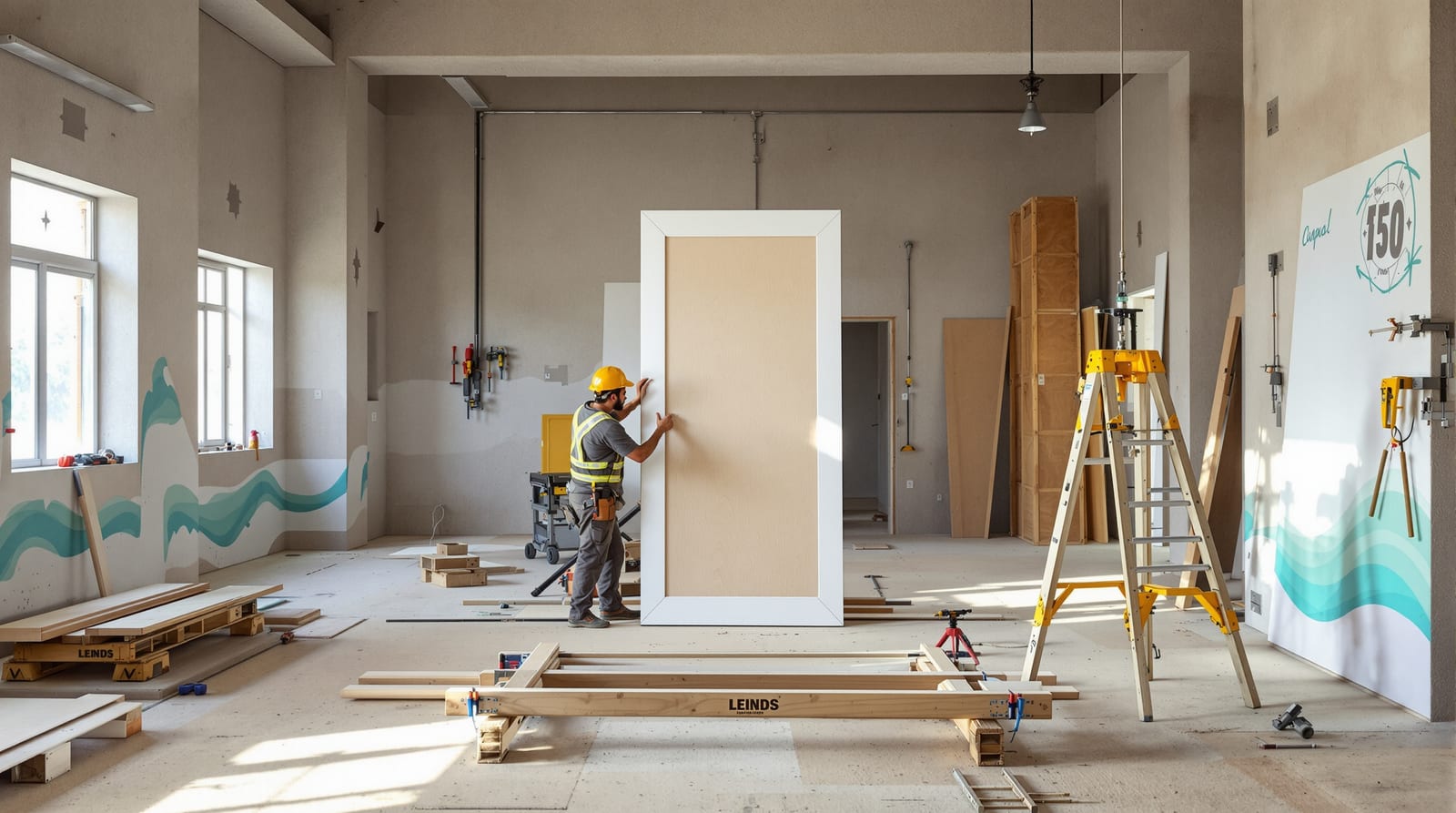
Door Fitting Workshop Setup: Site & Bench Guide India 2026
How to set up a fast, safe, accurate door-fitting station on an Indian site or workshop — stands, bench, clamps, lighting, dust and tools.
A good door fitting workshop setup is the quiet difference between a carpenter who hangs four to six clean doors a day and one who fights every leaf, splinters lippings and leaves a snag list behind. Whether you work from a fixed joinery shop or set up a fresh station in a half-finished flat each morning, the same principles apply: hold the leaf steady at a sensible working height, give yourself a flat bench to mark and morticing on, light the work properly, control the dust, and keep your tools within arm's reach. This guide is the trade-craft of building that station on an Indian site or in a workshop — the stands, bench, clamps, lighting, power, dust control and layout. It complements, not duplicates, the tool-by-tool guides; for the kit itself start at door fitting tools, and for the bigger picture see the complete door guide.
Why a proper fitting station matters
Most door faults are set-out and accuracy faults, and accuracy collapses when the work is held badly. A leaf wobbling on two bricks, marked by phone-torch light in a dusty, half-plastered room, will get a hinge mortice 2mm out and a lock backset that wanders — and that becomes a binding door or one that won't latch first time. The door fitting workshop setup exists to remove those variables: steady support, true reference surfaces, clear sightlines and clean cuts. On a typical Indian site you are also fighting monsoon damp, fine cement dust, intermittent power and mixed-skill labour, so the station has to be robust and quick to strike and re-pitch. Get the setup right once and the marking-out and fitting work — covered in marking out door hardware and fitting door hardware — becomes repeatable.
The core of the station: door stands and trestles
The single most important piece of kit is whatever holds the leaf. You need to present the door on edge at a comfortable working height (roughly 700–900mm to the top edge) so you can plane, mark and mortice hinges and locks, and also flat for boring face cut-outs and finishing. Three approaches dominate on Indian sites.
| Support method | What it is | Indicative cost | Best for |
|---|---|---|---|
| Pair of timber/steel trestles | Two A-frames carrying the leaf flat or on edge | ₹800–2,500/pair | General site work, cheap and rugged |
| Door fitting stand (edge gripper) | Foot/cam-clamped stand gripping the leaf vertically on edge | ₹1,500–5,000 | Fast hinge and edge work, one-person hanging |
| Foot-operated door lifter | Lever that lifts and holds a hung leaf at the floor | ₹500–1,500 | Offering up the leaf into the frame to mark hinges |
As a rule of thumb, a skilled fitter carries a pair of trestles plus one edge stand and a door lifter — trestles for the bench-type work, the edge stand for clamping the leaf vertically while mortising hinges, and the lifter for the moment of hanging the leaf in the frame. The edge stand earns its keep most because it lets one person work a heavy main-door leaf safely; without it you are wrestling a 35–45kg flush or solid leaf alone. Pad all contact faces with felt or rubber so you do not bruise the finished lipping; chipped lippings are a classic snag in common door defects.
A stable bench and reference surfaces
Alongside the stands you need one flat, stable bench for the work that wants a solid backing: paring hinge mortices, chopping the lock pocket, boring the cylinder hole, fitting the lever rose. A site bench can be as simple as a sheet of 18–25mm ply or a solid-core door laid across the trestles and braced so it does not flex, ideally about 850–950mm high for standing work. The bench must give you a true, flat reference face and a straight edge to set squares and gauges against; if the bench rocks, every gauge line drifts. Fit a simple end-stop or bench dog so you can plane an edge without the leaf sliding. A quality joinery shop will run a proper workbench with a tail vice, but on site a braced ply top plus a couple of clamps does the job. Keep the bench top clear and clean — grit under a finished leaf scratches it, and scratches are a snag in door finish defects.
Clamps, holding and protection
Nothing moves accurately unless it is held still. Stock a spread of clamps and protect every finished surface.
| Item | Typical sizes | Use at the station |
|---|---|---|
| F/sash clamps | 300–1200mm | Pulling joints, holding jigs to the leaf |
| Quick/trigger clamps | 150–600mm | Fast one-hand holding of templates and stops |
| G-clamps | 50–200mm | Clamping hinge and lock jigs hard down |
| Bench/edge vice | — | Holding the leaf on edge for planing |
| Folding wedges + packers | — | Levelling, shimming, holding the leaf in the frame |
| Felt/rubber pads & corner blocks | — | Protecting finished lippings and faces |
Clamp jigs (the hinge jig and lock morticer) hard and square to the leaf — the jig guides are covered in hinge mortising jig and lock mortising jig. A jig that creeps even a millimetre under the router gives a sloppy mortice and a loose hinge. Always pad clamps against polished or laminated faces; clamp marks on a main door are an avoidable defect.
Lighting, power and dust on an Indian site
Three services make or break a site station. Light: mark and mortice under bright, even, shadow-free light — a couple of clamp-on or tripod LED work lights (10–30W, ₹600–2,500 each) beat squinting at a gauge line in a gloomy room. Side-lighting across the leaf reveals bow and proud lippings that flat light hides. Power: Indian sites have intermittent supply and long, daisy-chained extension leads, so feed your power tools through a small board with an MCB/RCD (ELCB) and use heavy-gauge leads; a power cut mid-cut with a router is dangerous, so keep hand tools ready as a fallback and never force a stalling tool. A cordless drill, planer and trim router de-risk the supply problem and are covered in door fitting power tools. Dust: routing and mortising flush doors and MDF lippings throws fine, lung-damaging dust on top of ambient cement dust. Work near an opening, run a shop-vac or dust extractor off the router and planer where you can, and wear an FFP2/N95 mask, eye protection and ear defenders — power planers and routers are loud. A simple ground sheet under the station catches shavings and keeps the finished floor clean for the painter.
Tool organisation and the daily strike-and-pitch
The fastest fitters lose no time hunting for a chisel. Keep a tool board, roll or systainer so every chisel, gauge, square and bit has a home, and a small parts tray for the day's hinges, screws, strikes and lever sets keyed to the door schedule. Keep edge tools — chisels and plane irons — sharp; a blunt chisel tears flush-door veneer and a blunt plane chatters. Sharpening and care live in door fitting tool maintenance, and the measuring kit that drives accuracy is in door fitting measuring tools. On site, design the station so it can be struck and re-pitched in fifteen minutes: collapsible trestles, a ply top that stacks, tools in a closing roll, and the leaves stored as received — flat, off the floor, dry and acclimatised, protected at the edges, fitted only after the wet trades and plaster are dry. That receiving and storage discipline ties straight into door delivery and storage on site and the wider door trades coordination.
Layout, safety and acceptance
Lay the station so the leaf flows stand → bench → frame with a clear walk-around, tools and power on one side, dust zone and offcuts on the other, and nothing to trip over. Keep a first-aid kit and a fire extinguisher to hand — you are running power tools near timber dust. The point of all of it is accuracy you can prove at handover: even 2–4mm gaps, hardware fitted square, the leaf operating with one hand and latching first time, against the criteria in door acceptance criteria and the QA in door installation QA. IS 1200 and CPWD specifications govern measurement and workmanship on contract jobs; IS 4021 covers timber door and frame work; NBC 2016 and the RPwD Harmonised Guidelines set the life-safety and accessibility musts — free egress, fire-door integrity, and accessible lever heights — that no shortcut at the bench may compromise. When the work is custom, fire-rated, or a heavy hardwood main door, a fixed joinery shop with proper benches and extraction will out-finish any site station; know when to send the leaf to the shop. To plan the kit and the cost of building your station, the door fitting tool kit builder and the door fitting cost estimator help you budget before you buy.
Frequently asked questions
What is the minimum kit to set up a door fitting station on site?
As a rule of thumb: a pair of trestles, one edge stand and a foot lifter, a braced ply bench top, a spread of F/G/quick clamps, a couple of LED work lights, a power board with an RCD, a dust mask and ground sheet, and a tool roll with sharp chisels, gauges and squares. That covers the door fitting workshop setup for almost any site door.
How high should a door fitting bench be?
For standing work, roughly 850–950mm to the bench top, and present the leaf on edge so its top edge sits about 700–900mm off the floor — comfortable height to plane and mortice without stooping. Adjust to your own height; the test is whether you can pare a hinge mortice without bending your back.
How do I control dust when routing doors on an Indian site?
Work near an opening for ventilation, run a shop-vac or extractor off the router and planer where the tool allows, lay a ground sheet, and wear an FFP2/N95 mask, eye protection and ear defenders. Fine MDF and flush-door dust on top of cement dust is a real health hazard, so do not skip the mask.
How do I protect a finished door leaf at the station?
Pad every contact point. Felt or rubber on the trestles and edge stand, corner blocks under clamps, a clean ground sheet under the work, and a clean bench top free of grit. Clamp marks, bruised lippings and scratches are avoidable snags that show up at handover and cost you a rectification visit.
Is a site station as good as a workshop bench?
For standard internal flush and panelled doors, a well-set site station is fine and faster than carting leaves back and forth. But for custom joinery, fire-door sets, heavy hardwood main doors and fine veneer finishes, a fixed joinery shop with a proper workbench, vices and dust extraction will out-finish a site setup. Know when to send the leaf to the shop.
Export this guide
Related Guides — Deep-dive reading
Door Fitting Hand Tools: Chisels, Planes, Gauges (India 2026)
A trade guide to the hand tools every door fitter needs in India — chisels, planes, marking gauges, squares and rasps — how to choose them, why sharp matters, and what they cost.
Home Doors & EntrancesDoor Fitting Power Tools: Pro Buyer's Guide (India 2026)
Cordless drills, planers, routers, jigsaws, multi-tools and the right bits for fast, clean door fitting on Indian sites.
Home Doors & EntrancesDoor Hanging Tools: Stands, Lifters & Jigs India 2026
The specific kit a fitter reaches for to hang a door leaf in India — stand, foot lifter, wedges, planes, chisels, marking tools and clamps.
Home Doors & EntrancesRelated Tools — Try Free
Door Security Rating Calculator
Score your main door out of 100 across leaf, frame, lock and hardware — and see the top upgrades.
Security ToolCross-Ventilation Analyzer
Estimate airflow and air changes per hour (ACH) from room size, window areas, layout, and local wind — with NBC 2016 Part 8 compliance check.
Ventilation CalculatorDoor Cost Calculator
Estimate the all-in cost of a door — leaf, frame, hardware, fitting and GST — by type, material and size.
Door Calculator