
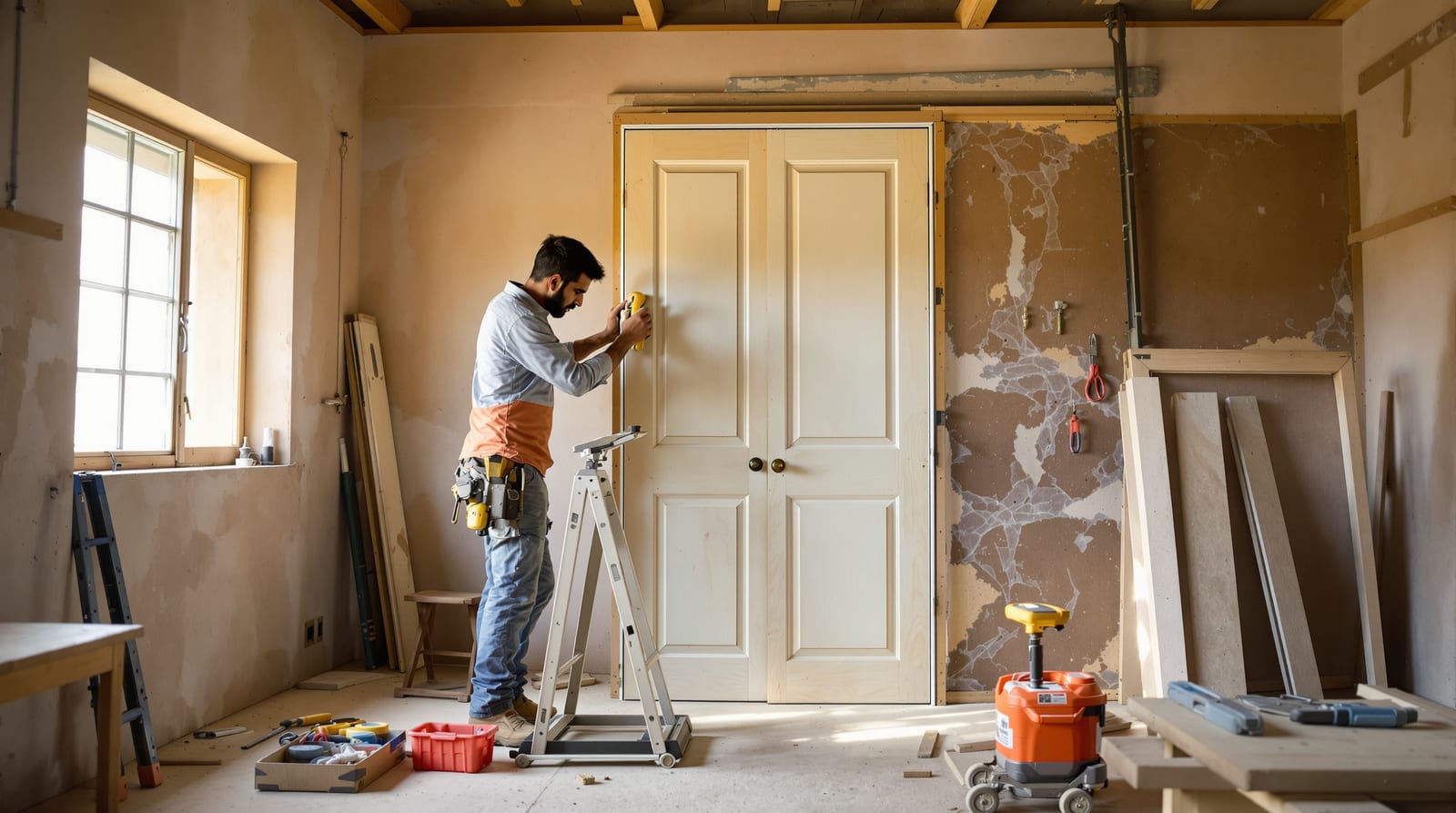
Door Hanging Tools: Stands, Lifters & Jigs India 2026
The specific kit a fitter reaches for to hang a door leaf in India — stand, foot lifter, wedges, planes, chisels, marking tools and clamps.
Hanging a door leaf is a distinct craft moment, and it has its own short list of door hanging tools that a fitter reaches for the instant the frame is set and the leaf comes off the stack. This is narrower than a full tool kit: it is the gear that holds the leaf steady, shaves it to the opening, marks the hinge and lock positions, and clamps it tight while the screws go in. The broader inventory — every drill, router and measuring tool a door fitter owns — is covered in the door-fitting tools pillar; this guide is the hang-specific subset and how each item earns its place in the sequence. For the whole picture, start from the complete door guide.
Get the hang right and a 35kg flush leaf swings on three hinges, latches first time and sits with even 2–4mm margins. Get the tools or the technique wrong and you are back the next day planing a binding leaf or re-cutting a hinge that was set out by eye. On Indian sites — mixed-skill labour, dust, monsoon damp, power cuts that kill the cordless mid-mortise — the hand tools below matter more than anywhere, because they are what keep working when the battery dies.
The hanging-specific tool list
These are the items that come out specifically for hanging the leaf, as distinct from frame fixing or hardware fit-out. Sharpness is everything: a blunt iron tears flush-door veneer and a blunt chisel crushes the hinge housing instead of paring it.
| Tool | Indicative price | Role in the hang |
|---|---|---|
| Door stand / trestle (pair or single) | ₹1,200–4,000 | Holds the leaf on edge at working height, hands free |
| Foot-operated door lifter | ₹400–1,500 | Lifts & holds the leaf to the frame to mark the hang |
| Door / folding wedges (set) | ₹150–600 | Pack the leaf in the opening at the gap you want |
| Jack plane (350–380mm) | ₹1,500–5,000 | Scribes / shoots the long leaf edges to width |
| Block plane | ₹600–2,500 | Eases the closing edge, lippings & arrises |
| Bevel-edge chisels 12–25mm | ₹150–700 each | Pares hinge housings (gains) & clean corners |
| Combination / try square | ₹300–1,200 | Squares hinge knuckle lines across the edge |
| Marking gauge | ₹250–900 | Sets the consistent hinge-leaf depth line |
| Marking knife | ₹150–500 | Crisp severed line so the chisel doesn't wander |
| Hinge jig / template + router | ₹2,500–9,000 | Repeatable, square hinge gains at speed |
| Sash clamp / F-clamp | ₹400–2,000 each | Holds the leaf to bench or frame while fixing |
| 600 / 1200mm spirit level | ₹500–2,500 | Checks leaf and hinge line are plumb |
A basic hanging kit (stand, lifter, wedges, plane, chisels, square, gauge) lands around ₹4,000–9,000; add a hinge jig and router and you are at ₹12,000–20,000. GST on tools is generally 18%. See the door-fitting hand tools and door-fitting power tools guides for the wider catalogue, and the door-fitting tool-kit builder to price a list.
How each tool is used in the hang
Supporting the leaf: stand, trestle and foot lifter
A door stand or trestle grips the leaf on edge at about waist height so both hands are free to plane an edge or chop a hinge gain. A simple site version is two trestles with a notched rail; a dedicated door stand has a clamping jaw. Without one, a fitter ends up wedging the leaf against a wall and working it half-blind.
The foot-operated door lifter is the single most useful hanging gadget. You set the leaf into the opening, step on the lifter's pedal, and it raises and holds the leaf at the exact floor gap you want while you mark the hinge knuckle positions from frame onto leaf, or drive the first screw. One person can hang a leaf that would otherwise need two. Cheap lever lifters work; a roller-bar lifter is gentler on a polished floor.
Setting the gap: wedges
Folding wedges (pairs of tapered hardwood or plastic) pack the leaf in the opening so it floats at the margins you want before anything is fixed — typically 3mm at the head and hinge stile, 2–4mm at the lock stile, ~6–10mm at the floor (more for carpet or an external weather bar). Slide a pair in from each side and tap them together to micro-adjust. They are also how you hold the leaf dead-still for transferring hinge marks.
Scribing and trimming: planes and Surform
When the leaf is a few millimetres oversize for a slightly out-of-square opening, you scribe it — mark the leaf to follow the frame line, then plane to the line. A jack plane shoots the long edges to width and corrects a bowed edge; a block plane eases the leading (closing) edge to a slight 2–3 degree back-bevel so it doesn't bind on the frame as it shuts, and tidies the lippings. Always plane the bottom rail rather than the top if you need to lose height, and take it off the hinge stile in preference to the lock stile so the lock edge stays full. A Surform or rasp is for quick bulk removal where finish doesn't matter. Never plane more than the lipping thickness on a flush door or you expose the hollow core.
Marking the hinges: square, gauge, knife
Good hanging is marking, not muscle. A combination or try square carries the hinge knuckle lines square across the edge; a marking gauge sets a consistent housing depth (equal to the hinge leaf thickness) so all three gains are flush; a marking knife severs the surface fibres so the bevel-edge chisel can pare a clean-walled housing without splitting out. Set the hinges out at the standard heights below, transfer them from frame to leaf with the wedged leaf held still, then chop. The deeper craft is in marking out door hardware and the actual housing cut in fitting door hinges.
Speed and repeatability: the hinge jig
A router with a hinge jig / template cuts square-cornered gains to a set depth in seconds and makes every door on a job identical — worth it from a dozen doors up. The jig clamps to the leaf edge; the router rides a guide bush. It is the bridge to production-rate hanging and is covered in detail in the hinge-mortising jig guide.
Holding for the fix: clamps and level
Sash clamps and F-clamps hold the leaf to the bench while you chop, and a clamp across the lock stile keeps the leaf snug to the frame while you drive the hinge screws. A spirit level (or a long straight-edge against the frame) confirms the hinge line is plumb before the last screw goes in, so the door neither self-swings nor drags. Pilot-drill every screw — a hinge screw driven without a pilot will split a hardwood stile.
Set-out heights to mark from
Hanging is only as good as the marking, and the marking follows India's standard heights (NBC 2016 and the RPwD Harmonised Guidelines for accessible work). Set these from the finished floor level, not the rough slab.
| Element | Set-out height / position | Note |
|---|---|---|
| Top hinge | ~150–200mm down from head | Carries most leaf weight |
| Bottom hinge | ~250mm up from floor | Resists sag |
| Third hinge | Mid or one-third down | Stiffens against bow |
| Fourth hinge | Add for heavy / fire leaves | FD30/FD60 fire doors |
| Lever / handle centre | ~900–1050mm (≈1000mm common) | Lever, not knob, for accessibility |
| Door viewer | ~1400–1500mm | Adjust to user eye level |
| Floor gap (set with wedges) | ~6–10mm | More for carpet / weather bar |
Three hinges is standard for a flush leaf; heavy, fire-rated or external leaves get a fourth, and a fire-door SET must keep its gaps ≤3mm (4mm max) around the leaf — see fire-door installation compliance. The door hardware height calculator confirms the lever and lock heights against the brief before you mark.
Skill, supervision and when to hand it on
Hanging a simple internal flush door is within reach of a careful site carpenter — a skilled hand fits 4–6 a day. Scribing a leaf to a racked old opening, hanging a heavy timber main door or a glazed leaf, or chopping gains on a veneered leaf without chipping the lipping is finer work that wants an experienced joiner and good supervision. Fire doors are non-negotiable: the leaf, frame and ironmongery are a tested set, the gaps are life-safety critical, and free egress and accessible lever heights must be preserved — don't improvise these on a mixed-skill crew. For costs and crew rates see door-fitting cost breakdown, and for installing the leaf in sequence see fitting door hardware. Keep chisels and plane irons honed — a five-minute strop saves a torn veneer and a rejected snag.
Frequently asked questions
What is the minimum tool kit to hang a door?
A door stand or trestle, a foot lifter, a set of wedges, a jack plane and block plane, two or three sharp bevel-edge chisels (12–25mm), a try square, a marking gauge and knife, a clamp and a spirit level. That covers scribing, marking and hanging a standard flush leaf and runs roughly ₹4,000–9,000.
What does a foot-operated door lifter actually do?
It lets one person raise and hold a heavy leaf at the exact floor gap while marking hinges or driving the first screw. You step on a pedal, the lifter wedges the leaf up to the frame, and your hands stay free. It is the single biggest time-saver for solo door hanging.
How much do I plane off when scribing the leaf?
Only enough to reach even margins — aim for ~3mm at the head and stiles and 6–10mm at the floor. Take height off the bottom rail, take width off the hinge stile in preference to the lock stile, and on a flush door never plane past the solid lipping or you expose the hollow core.
Do I need a hinge jig, or will chisels do?
For one or two doors, a square, gauge, knife and sharp chisel cut perfectly good hinge housings. From a dozen doors up, a router and hinge jig pay for themselves in speed and consistency — every gain comes out identical depth and square. See the hinge-mortising jig guide.
Why does my newly hung door bind or self-swing?
Usually the hinge line is not plumb. Check it with a spirit level before the final screws, ease the closing edge with a slight back-bevel using a block plane, and pack solidly behind the hinges. A leaf that swings open on its own means the hinge stile leans away from plumb; a binding leaf means the gaps are too tight or the leaf is bowed.
What hanging tools are different on an Indian site?
The hand tools matter more because power cuts stall cordless routers mid-job, so keep chisels and planes sharp and ready. Dust and monsoon damp swell timber leaves, so allow for seasonal movement when setting gaps, and store leaves flat, dry and acclimatised before you hang — see door delivery and storage on site.
Export this guide
Related Guides — Deep-dive reading
Door Fitting Hand Tools: Chisels, Planes, Gauges (India 2026)
A trade guide to the hand tools every door fitter needs in India — chisels, planes, marking gauges, squares and rasps — how to choose them, why sharp matters, and what they cost.
Home Doors & EntrancesMarking Out Door Hardware Positions: Set-Out (India 2026)
Standard fitting heights, story rods and templates for setting out hinges, locks, viewers and bolts consistently across an Indian project.
Home Doors & EntrancesHow to Fit a Door Leaf: Hang, Trim & Hinge (India 2026)
A practical India guide to hanging a door slab — measuring, scribing and planing to the frame, the lock-edge bevel, mortising three hinges, and checking the swing.
Home Doors & EntrancesRelated Tools — Try Free
Accessibility Compliance Calculator
Check a planned lift against the CPWD and RPwD accessible-lift benchmarks for a score.
Lift CheckerDoor Hardware Height Calculator
Get the standard fitting heights for handle, lock, hinges, viewer and bolts, with the accessible RPwD lever range flagged.
Height CalculatorDoor Security Rating Calculator
Score your main door out of 100 across leaf, frame, lock and hardware — and see the top upgrades.
Security Tool