
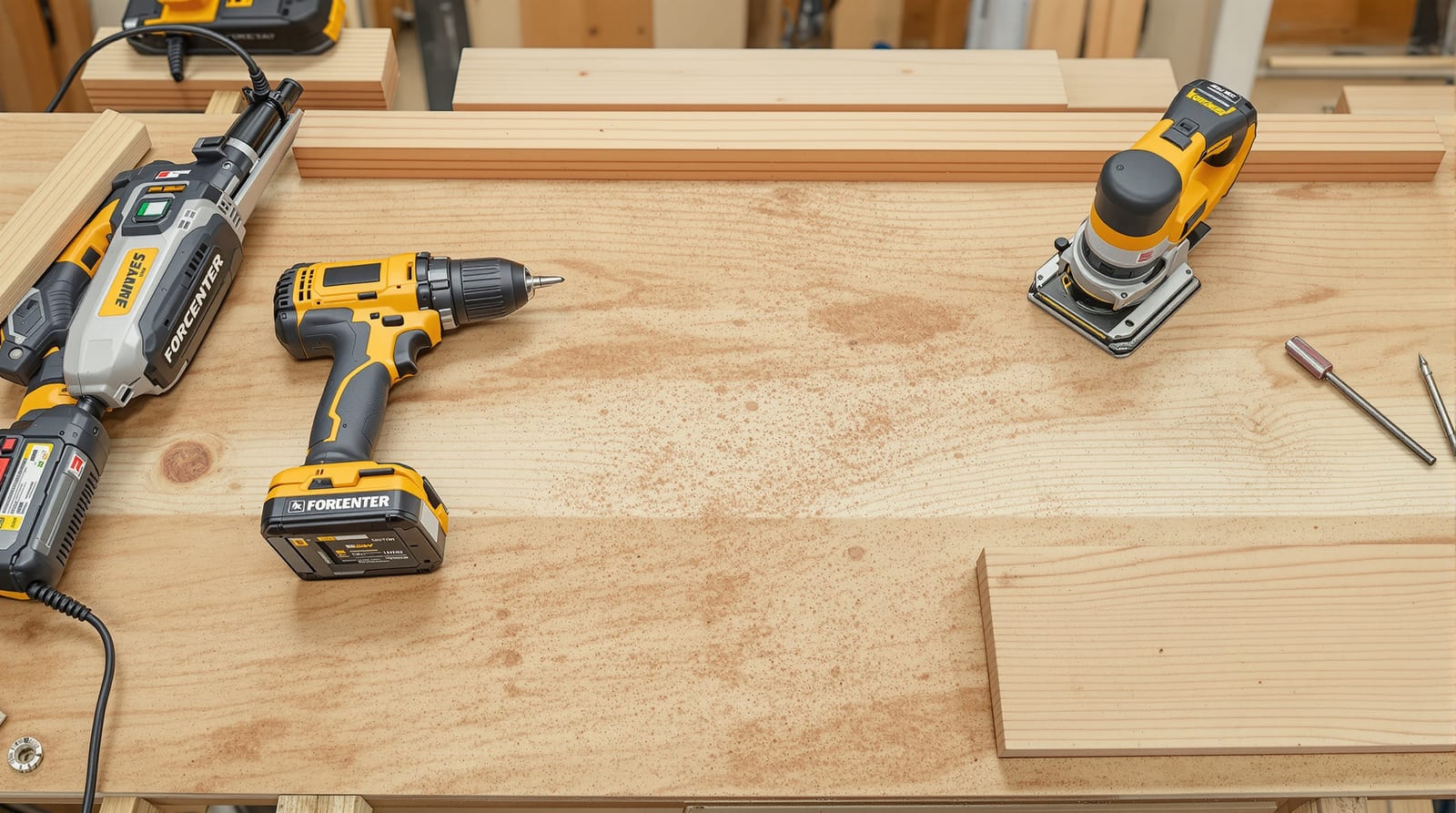
Door Fitting Power Tools: Pro Buyer's Guide (India 2026)
Cordless drills, planers, routers, jigsaws, multi-tools and the right bits for fast, clean door fitting on Indian sites.
The right door fitting power tools are what separate a carpenter who hangs four crisp flush leaves a day from one who fights every door. On an Indian site you are not just buying machines — you are buying speed, repeatable accuracy and a clean finish on veneer that a blunt or wrong tool will tear. This guide is for the fitter, site engineer or contractor deciding what to put in the van: what each power tool actually does in door work, which bits matter, the corded-versus-cordless call for our power-cut reality, honest cost bands in ₹, and the safety basics. It pairs with the hand tools, jigs and the wider kit covered across the cluster — here we focus only on the powered side.
The core power-tool kit for door fitting
A professional door-fitting power set is small but precise. You do not need a workshop full of machines; you need five or six tools that each earn their place when you are hanging and ironmongering a leaf.
Cordless drill/driver — the workhorse
The combi drill/driver is the tool you reach for fifty times a door: pilot holes, screwing hinges and strike plates, driving frame fixings, boring with Forstner and auger bits. For door work a brushless 18V (sometimes badged 20V max) drill with two batteries is the sweet spot — enough torque for 22-25mm bores into hardwood frames, light enough to hold at handle height all day. A separate impact driver speeds up long frame screws but is too coarse for delicate hinge screws into a flush-door lipping, where over-driving splits the edge. Keep the clutch set low for ironmongery screws.
Electric planer — fitting the leaf to the opening
New doors rarely drop straight into the opening; you trim the leaf for an even 2-4mm margin all round. A hand jack plane does this beautifully, but on volume work an electric planer removes a controlled shaving fast along the long edges and the closing stile. Take light passes (0.5-1mm), plane into the leaf at the ends to avoid blowing out the corner, and never plane more than the lipping thickness off a flush door or you expose the hollow core. Re-seal any freshly cut edge — bare timber drinks monsoon moisture and bows.
Router with a hinge/lock jig — the accuracy machine
A plunge router paired with a hinge jig cuts identical, square-shouldered hinge recesses (the "sinkings") far faster and cleaner than a chisel, and a lock-mortising jig or chain morticer lets the router plunge the deep mortise for a sash or mortise lock. This is the difference between a leaf that closes flush and one that is hinge-bound. Pair the router with the dedicated hinge mortising jig and lock mortising jig covered separately; the router is the powered half of that craft.
Jigsaw and oscillating multi-tool — the cut-out duo
A jigsaw handles letter-plate apertures, vision-panel cut-outs and scribing a leaf to an out-of-square opening; use a clean, down-cutting blade on veneer to stop chipping. An oscillating multi-tool is the get-out-of-jail tool: trimming a frame leg flush to a finished floor, plunge-cutting a tight recess, undercutting an architrave, or finishing a corner the router cannot reach. Neither is used every door, but on a fit-out you will be glad of both.
The bits that do the real work
The machine is only as good as the bit in it. For door fitting, three bit types matter most, and getting their sizes right keeps your lock and cylinder bores clean.
| Bit | Typical size | What it bores in door work |
|---|---|---|
| Forstner bit | 22-25mm (cylinder), 15-16mm (spindle) | Flat-bottomed lock-case and cylinder bores; tubular latch holes; clean, splinter-free faces |
| Auger / lip-and-spur | 22-25mm | Deep cross-bores for rim-lock cylinders and through-bores in solid timber |
| Spade (flat) bit | 16-25mm | Quick rough bores where finish is hidden; cheaper but rougher than Forstner |
| Hinge-sinker / self-centring bit | 35mm cutter; 3-4mm pilot | Hinge recesses with a jig; self-centring pilots so hinge screws sit dead-centre |
| Pilot / countersink | 2.5-4mm | Pilots for hinge, strike and closer screws so the lipping never splits |
Match the bore to the standard 60mm backset (some locksets 57mm) and the lever-handle set-out around 900-1050mm centre — bore in the wrong place and the leaf is scrap. A self-centring ("Vix") bit for hinge and strike screws is a small spend that saves a misaligned, sloppy fixing on every door.
Corded vs cordless — the India power-cut reality
This is the call that defines an Indian door-fitting kit. Power cuts, long extension runs from a single site supply, and working in a half-finished flat with no socket nearby all push you toward battery tools. But not every tool wants to be cordless.
| Tool | Recommended for door work | Why |
|---|---|---|
| Drill/driver | Cordless (brushless, 18V) | Used constantly, moved around the leaf; cordless wins on freedom and outlasts a cut |
| Impact driver | Cordless | Same — frame fixings anywhere on the floor plate |
| Jigsaw | Cordless or corded | Cordless fine for occasional cut-outs; corded for heavy run work |
| Oscillating multi-tool | Cordless | Short bursts; battery is ideal, avoids trailing leads on a finished floor |
| Electric planer | Corded (or high-capacity cordless) | Sustained, power-hungry cuts; corded gives steady output, but cordless saves you in a cut |
| Router | Corded for heavy morticing; cordless for light recessing | Lock morticing draws real power; light hinge recessing is fine cordless |
The practical answer for most Indian door fitters: a single 18V brushless platform (one battery system across drill, impact, jigsaw and multi-tool) plus a corded planer and router for the heavy, sustained cuts — backed by a small inverter or genset when the area supply is unreliable. Carry at least two batteries per tool and a fast charger; a power cut should slow you, never stop you. Standardising on one battery brand is the cheapest way to cut cost and weight.
Cost bands — what a power kit really costs
Prices move with brand, brushless versus brushed motors and GST (18% on hardware/tools), so treat these as rules of thumb for India 2026, not quotes. A homeowner doing one door needs almost none of this; a working fitter should view it as kit that pays back in days saved.
| Tool / item | Indicative ₹ band | Note |
|---|---|---|
| Cordless drill/driver (brushless 18V, 2 batteries) | 6,000-15,000 | Core tool; standardise the battery platform |
| Impact driver (bare / kit) | 4,000-10,000 | Optional but speeds frame fixings |
| Electric planer (corded) | 4,000-9,000 | Light passes only; re-sharpen blades |
| Router (plunge) | 5,000-14,000 | Pair with hinge/lock jigs |
| Jigsaw | 3,000-8,000 | Down-cut blades for veneer |
| Oscillating multi-tool | 3,500-9,000 | Versatile finishing tool |
| Forstner / auger bit set + hinge sinker | 800-3,000 | The bits that make or break the bore |
| Spare batteries + fast charger | 3,000-9,000 | At least two batteries per platform — power-cut insurance |
As a rule of thumb a basic DIY door tool kit runs ₹3,000-8,000, while a pro powered kit with router, jigs and a morticer reaches ₹25,000-60,000+. Buy quality bits before extra machines — a worn Forstner or chipped planer blade will tear flush-door veneer faster than any cheap tool, and refinishing a torn lipping costs more than the bit.
Safety and site discipline
Power tools on a busy Indian site demand the same discipline as any code-driven trade. Wear eye protection and a dust mask — MDF, laminate and primed surfaces throw fine dust; keep cuts away from the lungs. Use an earth-leakage / RCD-protected supply for corded tools, and inspect leads for monsoon-damp damage before plugging in. Clamp the leaf on a stand or trestle — never freehand-rout a loose door. Unplug or remove the battery before changing bits or blades. Keep the planer guard working and rest it on the toe, never the cutter. And remember the life-safety musts a fast tool can quietly breach: do not oversize a lock or vision cut-out on a fire-rated leaf (it breaches the certified core), keep leaf gaps to ≤3mm on fire doors, and set lever handles at the accessible 800-1100mm band per the RPwD Harmonised Guidelines. Clean, accurate boring with the right bit is what keeps the fire-door installation compliance intact.
For the wider toolkit — chisels, planes, jigs and how it all fits together — see the Act pillar on door-fitting tools, the door hanging tools and door fitting hand tools guides, and the complete door guide. To price a job and spec the kit, use the door fitting tool kit builder and the door fitting cost estimator.
Frequently asked questions
Do I really need a router, or can I chisel hinge recesses?
For one or two doors, a sharp chisel is fine. For volume work a router with a hinge jig cuts identical, square recesses far faster and cleaner — it pays for itself across a fit-out and reduces hinge-bound leaves. See the hinge mortising jig guide.
What size bit do I use for a mortise lock cylinder?
A 22-25mm Forstner or auger bit for the cylinder/case bore, 15-16mm for the spindle, drilled at the 60mm backset (some locksets 57mm) and lever centre around 900-1050mm. Confirm against the fitting mortise locks set-out before boring.
Corded or cordless on a site with frequent power cuts?
Go cordless on one 18V battery platform for the drill, impact, jigsaw and multi-tool, and keep a corded planer and router for heavy sustained cuts — backed by a small inverter or genset. Carry two-plus batteries per tool so a cut slows you, never stops you.
Will an electric planer ruin a flush door?
It can if misused. Take 0.5-1mm passes, never plane more than the lipping thickness (you would expose the hollow core), plane into the ends to avoid blow-out, and re-seal the cut edge against monsoon moisture.
How much should a professional door-fitting power kit cost?
As a rule of thumb, ₹25,000-60,000+ for a pro kit with drill, planer, router, jigsaw, multi-tool, jigs and good bits — versus ₹3,000-8,000 for a basic DIY kit. Prices include 18% GST and vary by brand; price your specific list with the door fitting cost estimator.
Export this guide
Related Guides — Deep-dive reading
Door Fitting Hand Tools: Chisels, Planes, Gauges (India 2026)
A trade guide to the hand tools every door fitter needs in India — chisels, planes, marking gauges, squares and rasps — how to choose them, why sharp matters, and what they cost.
Home Doors & EntrancesDoor Fitting Guide: Step-by-Step Installation (India 2026)
The complete step-by-step door fitting guide for India — set the frame plumb, fix it with holdfasts, grout, hang the leaf on three hinges, fit the lock, trim and seal — with the tools and checks a homeowner needs.
Home Doors & EntrancesDoor Fitting Tools Guide: The Fitter's Kit (India 2026)
Every hand tool, power tool, jig and support an Indian carpenter needs to hang and fit doors — organised by category, with indicative kit costs.
Home Doors & EntrancesRelated Tools — Try Free
Window Hardware Cost Calculator
Estimate window hardware cost — hinges, handles, locks, rollers and multipoint gears.
Window CalculatorDoor Fitting Tool Kit Builder
Build the right door-fitting tool kit for your job — hand tools, power tools, jigs and supports, with an indicative cost.
Tool Kit BuilderDoor Hardware Cost Estimator
Estimate the all-in hardware cost for a door — hinges, lock, handle, closer, bolts, stopper and fitting — with GST.
Door Calculator