
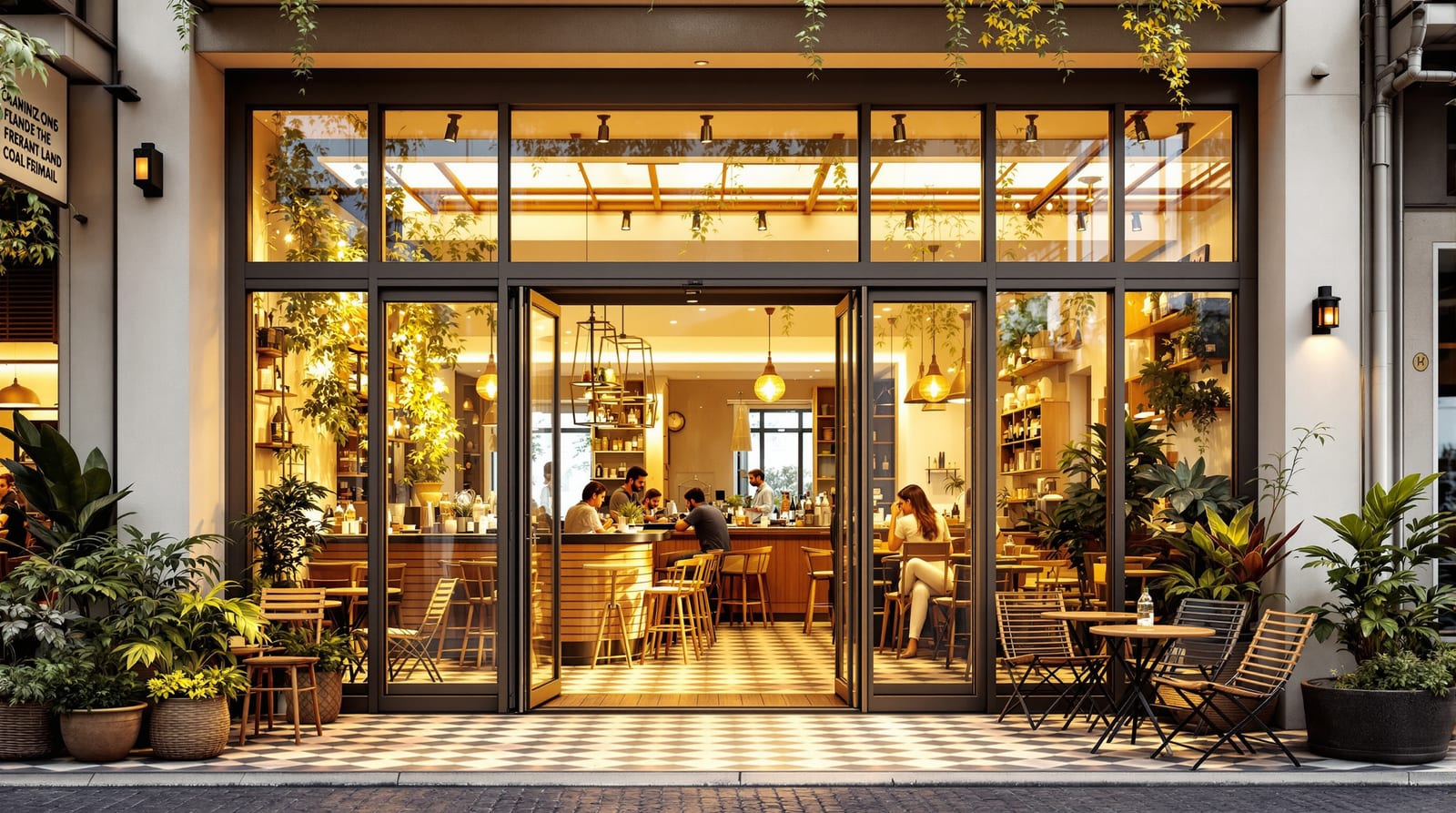
Cafe Door in India: Glass, Bi-Fold and Crittall-Style Entrances That Sell the Brand (2026)
A design-led, footfall-aware guide to choosing doors for a cafe or coffee shop in India - the Instagrammable glass or Crittall-steel storefront, bi-fold frontages that open to the street, automatic accessible entry, kitchen swing and washroom doors - with the vibe each creates and indicative per-door costs.
In a cafe, the door is not just a way in - it is the first photograph. Before a single coffee is poured, the frontage has already decided whether someone walking past stops, steps in, and tags the place. The cafe door carries the brand on the street, frames the indoor-outdoor mood that defines modern Indian coffee culture, lets footfall pulse in and out without a bottleneck, welcomes a wheelchair or a stroller, and still locks down cleanly at midnight. That is a lot to ask of one opening, which is why cafe entrances in India have converged on a short list of design-led systems - framed and frameless glass, the bi-fold or folding frontage that opens to the street, and the Crittall-style steel-and-glass door that has become the signature look of the moment.
This guide ranks those options by the vibe each one creates, gives you indicative per-door costs, and covers the doors most cafe plans forget: the kitchen swing, the washroom, and the accessible entry. It is the application companion to the mechanism guides - for how each door type actually works, follow the links through. For the sit-down, kitchen-heavy cousin of this space, pair it with the restaurant doors guide for India.
What a cafe door actually has to do
Before choosing a system, line up the drivers that should decide it. The doors people remember - and the ones owners regret - both come down to these:
- Visual brand identity. The frontage is the cafe's billboard and its Instagram backdrop. The door, frame colour, glazing and signage band do more marketing than any ad. A black Crittall grid, a clean frameless sheet, or a folding timber-and-glass wall each says something different about the brand.
- Indoor-outdoor charm. The defining cafe move in India - from Bengaluru to Goa to hill-station towns - is opening the frontage to the street or courtyard in good weather, so inside and outside blur into one room. That is a job for a bi-fold or folding system, not a single swing.
- Footfall flow. Mornings and weekend evenings come in pulses. A single narrow leaf jams when six people arrive at once; a wide opening or an automatic door keeps the queue moving.
- Accessibility. Under RPwD 2021 a public entrance should give a clear opening width of at least 900 mm, a threshold no higher than 12 mm, and need no heavy force to operate - so a parent with a pram or a wheelchair user gets in easily.
- Climate and AC sealing. When the weather turns hot, humid or monsoon-wet, the frontage has to close up tight and hold the air-conditioning in. The best cafe systems do both jobs: open wide on a pleasant evening, seal hard on a Chennai afternoon.
- After-hours security. A glass frontage is a cafe's strength by day and its weak point at night. The standard answer is a rolling shutter or collapsible gate behind the glass line - see shutter doors for India.
The cafe frontage systems, ranked by vibe
1. Bi-fold / folding glass frontage - the indoor-outdoor signature
This is the door that makes a cafe feel like a cafe. A run of glazed leaves folds and stacks to one side, opening most of the frontage so street-side tables and the interior become a single space - the pavement-cafe vibe that defines the best Indian coffee spots. On a good Bengaluru morning or a Goa evening the whole face opens; when the monsoon arrives or the AC goes on, it folds shut into a sealed, weather-tight wall. It is the most expensive frontage option but the highest-impact one. Read the mechanism in bi-fold doors for India and folding doors for India.
2. Crittall-style steel-framed glass - the on-trend brand look
The slim black steel grid - originally an industrial window style, now the most-photographed cafe aesthetic in India - turns the frontage into the brand. Narrow steel sections divide large glass panes into a crisp geometric grid that reads as premium, editorial and warm against exposed brick, terrazzo or timber interiors. It can be a fixed screen with a swing or pivot door, or framed into a folding set. It costs more than aluminium framing and needs proper anti-corrosion treatment for Indian humidity and coastal salt air, but nothing else delivers the same instant "design cafe" identity. For the glazing fundamentals see glass doors for India.
3. Frameless or framed glass swing / pivot - clean and bright
Where the brand is minimal and light-filled rather than industrial, a frameless toughened-glass door on a floor spring, or a slim aluminium-framed glazed leaf, gives a clean, transparent shopfront that shows the busy, inviting interior to the street - the best free advertising a cafe has. A statement pivot door makes a bolder entrance for a flagship outlet. These are manual doors: lighter on budget, but plan a closer and accessible operating force.
4. Automatic sliding glass - the high-footfall, accessible default
For a mall-format cafe, an airport or station kiosk, or any outlet with heavy hands-free traffic, an automatic sliding glass door is the most practical entry. It is completely hands-free (a hygiene and accessibility win), seals the AC the instant the gap closes, and carries branding on the glass. It reads less "boutique" than a Crittall or folding frontage, so it suits convenience-format and high-volume cafes more than design-led independents. See automatic glass doors for India.
Cafe frontage comparison - vibe, suitability and cost
| Frontage system | Vibe it creates | Indoor-outdoor | Footfall flow | Accessible alone | Indicative cost (ex-GST) |
|---|---|---|---|---|---|
| Bi-fold / folding glass | Open, pavement-cafe, social | Excellent (opens wide) | Excellent when open | If a leaf gives 900 mm | 1,20,000 - 6,00,000+ per run |
| Crittall-style steel + glass | Editorial, premium, on-trend | Good (as folding/fixed + door) | Moderate (swing) | Marginal | 25,000 - 90,000+ per door |
| Frameless / framed glass swing | Clean, bright, minimal | Limited (single leaf) | Moderate (manual) | Marginal | 18,000 - 55,000 per leaf |
| Automatic sliding glass | Convenient, modern, hands-free | Limited | Excellent | Yes | 1,80,000 - 6,00,000+ system |
Costs are indicative and vary by size, glass thickness, frame finish, operator brand and city; add 18% GST. Use the commercial door cost calculator to size a quote for your frontage and back-of-house doors together.
How a bi-fold frontage opens the cafe to the street
The leaves fold flat and park against the jamb, so almost the entire frontage disappears and the boundary between pavement and counter dissolves. When the weather turns, the same leaves swing back into a sealed glazed wall - one system that gives you both the open-air cafe and the air-conditioned one.
The back-of-house doors a cafe plan forgets
The frontage gets all the attention, but two unglamorous doors decide whether the kitchen and washroom actually work.
- Kitchen / counter swing door. Between the service counter or kitchen and the seating area, fit a double-acting impact swing door - it pushes open both ways for staff carrying trays, self-closes behind them, and a vision panel prevents collisions. Choose a hygienic, wipe-clean leaf (laminate-faced or steel-edged) that shrugs off splashes and trolley knocks. See swing doors for India. Where the cafe has a cold room or chiller, that needs an insulated gasket-sealed door, not an ordinary one.
- Washroom door. Public washroom doors take constant, damp use - so specify a moisture-proof material rather than timber that swells. A WPC door, PVC door or a laminate-faced flush leaf with an occupancy indicator lock is the durable, hygienic choice, with a lever handle for accessibility.
Hardware to specify for a cafe
- Door closer on the entrance so it never sits propped open bleeding AC - mandatory in practice for any commercial swing. See door closers for India.
- Floor spring and patch fittings for frameless or Crittall glass swing leaves.
- Lever handles, not knobs, everywhere for RPwD-compliant, glove-friendly operation; foot-pull or push-plate hygiene options at the kitchen door.
- Glass manifestation - a frosted band, logo film or etched pattern at eye and waist height on any large glass leaf, both a safety must and free branding.
- After-hours protection - a rolling shutter or collapsible gate planned with the frontage, not bolted on later.
For the full picture across hardware choices, see the door hardware guide for India.
Standards and clearances to specify
- Accessibility (RPwD 2021): entrance clear width at least 900 mm, threshold no higher than 12 mm, lever handles, no high operating force. A flush or low threshold also stops pram and chair wheels catching.
- NBC 2016 egress: for a cafe above ground floor or with significant occupant load, the exit must meet egress width for the occupancy and, where required, open in the direction of escape with panic hardware - see fire exit doors for India.
- Glass safety: toughened or laminated glass with manifestation on all transparent frontage leaves.
- Climate durability: anti-corrosion treatment on steel (Crittall) frames and stainless fixings, essential in coastal and high-humidity Indian locations.
For the broader logic of matching a door to any commercial space, see the doors by space guide for India.
Do and don't
- Do choose the frontage for the vibe you want first - open-air social (folding), editorial-premium (Crittall), bright-minimal (glass) or high-footfall (automatic) - then cost it.
- Do spend on a folding or Crittall frontage if the brand and the photo matter; it is the cheapest marketing a cafe will ever buy.
- Do anti-corrosion-treat steel frames and use stainless fixings in coastal and humid cities.
- Do plan the kitchen swing and washroom doors at the same time as the frontage - they decide daily operations.
- Don't rely on a single narrow manual leaf for a high-footfall outlet; it jams at the morning rush and bleeds AC.
- Don't leave large glass un-manifested - it is a walk-into hazard and a liability.
- Don't use a plain timber door for a public washroom; it swells and rots with damp use.
Frequently asked questions
What is the best door for a cafe in India?
It depends on the vibe. For the indoor-outdoor, pavement-cafe feel, a bi-fold or folding glass frontage is best because it opens the whole face to the street and still seals shut in bad weather. For an on-trend, editorial brand look, a Crittall-style steel-and-glass door wins. For high-footfall mall or kiosk formats, an automatic sliding glass door is the most practical, accessible choice.
How much does a Crittall-style cafe door cost in India?
A Crittall-style steel-framed glass door typically runs about 25,000 to 90,000 per door plus GST, depending on size, the number of glass panes, glass thickness, finish and whether it is a single door or part of a screen. Folding glass frontages run higher - roughly 1,20,000 upward for a full run. Use the commercial door cost calculator to size your quote.
How do I make the cafe frontage open to the street?
Use a bi-fold or folding glass system: a run of glazed leaves on an overhead track that fold and stack to one side, opening most of the frontage so interior and pavement become one space. The same leaves fold back into a sealed glazed wall when the weather turns. See bi-fold doors for India and folding doors for India.
What door should I use between the cafe kitchen and seating?
A double-acting impact swing door with a vision panel and a self-closer - it opens both ways for staff carrying trays, closes behind them, and the vision panel prevents collisions. Choose a hygienic, wipe-clean leaf. See swing doors for India.
Is a cafe entrance door required to be wheelchair-accessible?
Yes - as a public entrance it should meet RPwD 2021: a clear opening width of at least 900 mm, a threshold no higher than 12 mm, lever handles and low operating force. On a folding frontage, ensure at least one leaf alone gives the 900 mm clear width; an automatic door satisfies all of this effortlessly.
Export this guide
Related Guides — Deep-dive reading
Universal Design Doors for Indian Homes: Inclusive Doors That Work for Everyone (2026)
How to design and specify doors that serve children, the elderly, pregnant women, the injured and wheelchair users by default - generous width, lever handles, near-flush thresholds, low-force closing, contrast and good lighting - without your home ever looking medical.
Home Doors & EntrancesFrench Doors for Indian Homes: Glazing, Security, Cost & Monsoon Sealing
The double-leaf glazed door that opens a living room to a balcony or garden - where it works, how to specify the glass, frame and seals, what it costs, and how it stacks up against sliding and bi-fold.
Home Doors & EntrancesAccessible Doors in India: Wheelchair & Senior-Friendly Door Design Guide
Clear width, lever handles, flush thresholds, swing vs sliding, lock reach and sensor doors - how to specify wheelchair- and senior-friendly doors to the RPwD Harmonised Guidelines 2021 and NBC 2016.
Home Doors & EntrancesRelated Tools — Try Free
Window Hardware Cost Calculator
Estimate window hardware cost — hinges, handles, locks, rollers and multipoint gears.
Window CalculatorCross-Ventilation Analyzer
Estimate airflow and air changes per hour (ACH) from room size, window areas, layout, and local wind — with NBC 2016 Part 8 compliance check.
Ventilation CalculatorDoor Cost Calculator
Estimate the all-in cost of a door — leaf, frame, hardware, fitting and GST — by type, material and size.
Door Calculator