
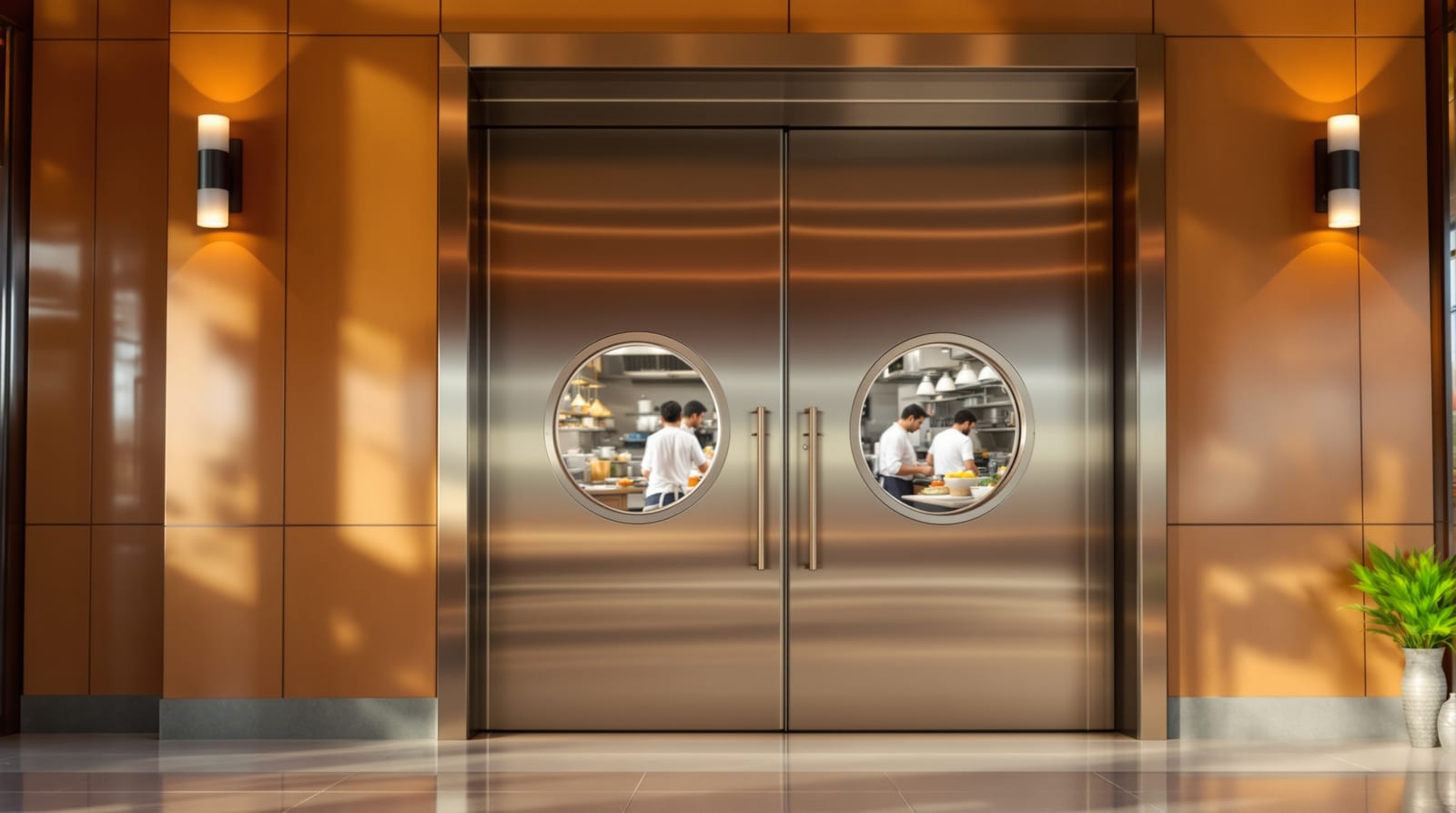
Restaurant Doors in India: Entrance, Kitchen Swing, Cold Room and Fire Exit by Zone (2026)
A zone-by-zone, FSSAI- and fire-code-led guide to specifying doors for a restaurant in India - the inviting glass entrance, the critical double-swing impact kitchen door with vision port, the insulated cold room, washroom, service back and panic-barred fire exit - with indicative per-door costs.
A restaurant is two buildings stitched together at one threshold. Out front is theatre - light, warmth, the smell of food and a door that has to pull a hesitant passer-by off the street. Behind it is a factory - hot, wet, loud, lit at 3am for the deep clean, and crossed all day by servers carrying trays in both directions with no free hand for a handle. The single most expensive door mistake in Indian F&B is treating the kitchen door like any other door. Hang a normal hinged door between a dining room and a working kitchen and within a month you have collisions, dropped plates, a held-open door leaking heat and odour into the dining room, and a hygiene auditor writing notes. The kitchen door is not a door you walk through; it is a piece of kitchen equipment. This guide walks the restaurant zone by zone - entrance, kitchen, cold room, washroom, service back, fire exit - and tells you which door belongs at each, the driver that decides it, the FSSAI and fire codes that govern it, and what each costs in 2026. For the wider logic of matching a door to its space, read the master overview on choosing a door by space; this guide is the F&B application of that idea.
The six forces that shape every restaurant door
Before the zones, the drivers. Every door in a restaurant is decided by where it sits on these six demands, and the weighting flips completely as you move from the street into the kitchen:
- Ambience and pulling power. The entrance has one job before anything else: make people want to come in. Transparency, a clear view of a busy room, easy operation and a generous, accessible width all sell. This force dominates the front-of-house and nowhere else.
- Two-way high traffic with hands full. Servers cross the kitchen line constantly, carrying loaded trays, plates and bus tubs, often colliding with someone coming the other way. The kitchen door must open by a shoulder, hip or foot - never a handle - and must be safe when two people approach blind from opposite sides.
- Hygiene and FSSAI compliance. A commercial kitchen is a regulated food-handling space. Surfaces must be smooth, non-absorbent, washable and pest-resistant; the kitchen-to-dining door must control flies, odour and grease migration. FSSAI Schedule 4 and the food-business licence inspection both look at this.
- Fire and egress. A restaurant is an assembly occupancy with cooking - one of the higher fire risks in NBC terms. Kitchens, LPG areas and escape routes need fire-rated separation per IS 3614, and every public exit needs panic hardware and outward swing per NBC 2016.
- Thermal and odour separation. Cold rooms, the hot line, the dining room and the street each want their own climate held. Doors that seal - cold-room gaskets, self-closers, draught seals - keep energy bills and smells where they belong.
- Durability and washdown. Back-of-house doors live in heat, steam, oil mist and daily hose-and-scrub cleaning. Hollow timber swells and rots; the survivors are stainless steel, FRP and high-pressure laminate.
No single door scores high on all six. The skill is reading each threshold and specifying for its dominant force.
Restaurant zones and the door each one needs
Read the restaurant as a gradient from public to operational. The front-of-house (entrance, dining, customer washrooms) is welcoming, accessible and styled. The kitchen line is the busiest, most safety- and hygiene-critical threshold in the building. The back-of-house (cold room, service, fire exit) is hard-wearing, sealed and code-driven. Doors get tougher, more functional and less decorative as you move inward.
| Zone | Recommended door | Driver behind it | Indicative ₹ (per door, 2026) |
|---|---|---|---|
| Main entrance | Automatic sliding or frameless toughened-glass swing | Ambience, footfall, accessibility | 25,000 - 80,000 (auto 1,50,000+) |
| Vestibule / airlock (AC + fly control) | Second glass door or air curtain | Energy, fly and odour barrier | 18,000 - 55,000 |
| Dining-to-kitchen line | Double-swing impact door, SS/FRP/laminate, vision port, self-closing | Two-way traffic, hygiene, vision safety | 14,000 - 45,000 |
| Cold room / walk-in chiller | Insulated gasketed cold-room door + strip curtain | Thermal seal, energy | 22,000 - 90,000 |
| Customer washrooms | PVC or laminate; one accessible (lever, threshold <=12 mm) | Wet area, accessibility | 1,800 - 8,000 |
| Service / receiving / store | Steel or FRP, hard-wearing, lockable | Durability, security, washdown | 6,000 - 30,000 |
| Fire exit / escape route | IS 3614 fire-rated steel + panic bar, outward swing | Fire & egress (NBC 2016) | 14,000 - 45,000 |
The numbers below are 2026 supply-and-fit benchmarks; they vary with size, finish, automation and city. Add 18% GST. Use the commercial door cost calculator for a project schedule and the door selector by space to confirm a fit before you buy.
The entrance: ambience first, then accessibility
Front door is marketing. In a competitive market street people decide in seconds whether your restaurant looks open, busy and worth the stop, and a transparent door that shows a warm, full room does more selling than any signboard. The two workhorses are an automatic sliding glass door for high-footfall or mall locations - hands-free, accessible by default, dramatic - and a frameless toughened-glass swing door on a floor spring for smaller, character-led places. For the door-type mechanics and floor-spring detail, see the glass-door guides; this is the application call.
Two non-negotiables sit under the styling. First, accessibility: the main entrance should give a clear opening of at least 1000 mm, with a near-flush threshold (<=12 mm) and, if it is not automatic, a lever or push operation an elderly diner or a parent with a pram can manage one-handed. Second, a climate and fly barrier: a single glass door straight onto a Chennai or Delhi street bleeds air-conditioning and lets flies in, which is both an energy cost and an FSSAI problem. The fix is a vestibule - a second glass door forming an airlock - or an air curtain over the entrance. In tight frontages, a double door pair, one leaf normally bolted, gives a wide festival-night opening without two full automations.
The kitchen door: the one that earns its keep
This is the door the whole guide exists for. The threshold between the dining room and a working commercial kitchen carries more daily door-cycles than any other in the building, and almost all of them are made by someone whose hands are full. Get it wrong and you pay every single service.
The correct answer is a double-swing impact door - also called a traffic door or impact door. Its defining traits, in order of why they matter:
- It swings both ways and self-centres shut. A spring-loaded double-action hinge or a gravity pivot lets a server push through with a shoulder, hip or foot from either side, and the leaf swings back to closed on its own. No handle, no held-open door, no leaking dining room. This is the swing door mechanism in its most demanding form.
- It has a vision port. A clear panel at roughly eye level on each leaf so two people approaching blind from opposite sides see each other before the collision. On a busy line this single feature prevents most dropped-tray accidents. Specify the port low enough that someone bent under a tray still appears in it.
- It is hands-free and hygienic. Push plates, not handles. The surface must be smooth, non-absorbent and washable - stainless steel, FRP (fibreglass-reinforced plastic), or high-pressure laminate over a sealed core. Bumper rails or kick plates at trolley height take the punishment. Hollow timber is the wrong choice here: it swells, harbours grease and fails the hygiene audit.
- It controls flies, odour and grease. Because it self-closes and seals reasonably, it stops kitchen smells and hot grease-laden air drifting into the dining room and keeps flies on the right side of the line - a direct FSSAI Schedule 4 concern.
For a wider commercial-kitchen door, two leaves are better than one: a stretcher-width or trolley-width double door opening lets a loaded trolley or two crossing servers pass. Where the kitchen connects to a high-traffic corridor in a hotel or food court, the same impact-door logic applies. If your concept is a casual cafe with a low-key open kitchen, a charming cafe-style saloon door gives the half-height swing look, but be clear: a saloon door is ambience, not the hygienic separation a closed commercial kitchen needs.
The cold room: seal the cold in
Walk-in chillers and freezers are graded by how well their door holds temperature. A standard door here is money leaking as warm air. The right choice is a purpose-built insulated cold-room door - a thick PUF or polystyrene-cored leaf with a continuous magnetic or compression gasket, a heated frame on freezers to stop ice-up, and an internal safety release so no one is ever locked inside. Hang a PVC strip curtain in the opening for the constant in-and-out of stock so the door itself opens less often. Specify the gasket and the inside release as line items; they are the parts cheap installs skip and the parts that fail first.
Washrooms: wet, washable, and one accessible
Customer washroom doors are wet-area doors that get heavy daily use. The default is a PVC door - waterproof, cheap, rot-proof - or a laminate-faced flush leaf for a more finished cubicle. The rule the inspections care about: at least one washroom must be accessible, meaning a clear width of 900 mm, a lever handle (not a knob), a threshold under 12 mm and an outward or sliding swing so a fallen occupant is not trapped behind an inward door. For the full accessibility detail, see accessible doors.
Service, receiving and fire exit: the code-driven back
The back-of-house doors are about durability and law. Service and receiving doors - to the store, the bin yard, the staff entrance - take abuse and need security; a steel door or an FRP leaf with a mortise lock is the norm, lockable from inside and out.
The fire exit is not optional and not negotiable with a fire officer. A restaurant is an assembly occupancy with cooking, so escape routes need a fire-rated, self-closing door to IS 3614, fitted with panic / push-bar hardware so a crowd can shove it open in the dark, swinging outward in the direction of escape, and never chained or blocked by stacked crates - the single most common and most lethal violation in Indian F&B. The width follows the occupancy load under NBC 2016. The dedicated fire exit doors guide covers ratings, panic hardware and signage in full; treat it as required reading for the licence.
Hardware that does the heavy lifting
Restaurant doors live or die on their hardware, not their leaf:
- Self-closers / spring pivots on the kitchen and fire doors - mandatory function, not a nicety. See door closers.
- Push plates and kick / bumper plates on the kitchen door; no lever a greasy hand has to grip.
- Floor spring under a frameless glass entrance for clean two-way swing.
- Panic / push bar on every public fire exit.
- Strip curtains on cold rooms and busy service openings.
- Air curtain over the entrance for fly and AC control.
Browse the full range in the door hardware guide before you finalise the schedule - the hardware is usually 15-30% of a commercial door's installed cost.
Do and don't
- Do make the kitchen door a double-swing impact door with vision ports - it pays for itself in one quarter of unbroken plates.
- Do give the entrance an airlock or air curtain; flies and lost AC are both FSSAI and P&L problems.
- Do keep the fire exit clear, outward-swinging and panic-barred at all times, including the moment the auditor walks in.
- Don't hang hollow timber anywhere wet or hot - kitchen, cold room, washroom, dish area. It swells, harbours grease and fails hygiene.
- Don't put a handled, single-direction door on the kitchen line; it will be propped open within a week.
- Don't treat a saloon / cafe door as kitchen hygiene separation - it is a look, not a seal.
Frequently asked questions
What is the best door between a restaurant kitchen and the dining room?
A double-swing impact (traffic) door with a vision port and a self-closing action, faced in stainless steel, FRP or high-pressure laminate. It lets servers through hands-free from either side, self-closes to contain heat and odour, prevents blind collisions through the vision port, and survives daily washdown. It is the single most important door specification in the restaurant.
What does a commercial kitchen swing door cost in India?
Indicatively 14,000 to 45,000 rupees per door installed in 2026, depending on size, single or double leaf, and facing - laminate at the lower end, stainless steel and double-leaf trolley-width openings at the upper end. Add 18% GST. Costs vary by size, finish and city; use the commercial door cost calculator for a project estimate.
Does FSSAI have door requirements for restaurants?
FSSAI Schedule 4 requires food-handling surfaces - which include kitchen doors - to be smooth, non-absorbent, washable and pest-proof, and requires effective control of flies and contamination, which is where self-closing, fly-controlling kitchen and entrance doors matter. The food-business licence inspection checks these. It does not mandate a specific door product, but a swelling timber door or a permanently propped kitchen door will draw an adverse note.
Which door rules are non-negotiable for a restaurant fire exit?
The exit must be a self-closing fire-rated assembly to IS 3614, fitted with panic / push-bar hardware, opening outward in the direction of escape, sized to the occupancy load per NBC 2016, and kept permanently unobstructed and unlocked from the inside. Blocking or chaining a fire exit is the most common and most dangerous violation in Indian F&B.
Can I use a cafe saloon door for my open kitchen?
Only for ambience in a casual, semi-open concept - it gives the charming half-height two-way swing look. It does not provide the hygienic, thermal and fly separation a closed commercial kitchen needs, so it cannot replace a proper double-swing impact door on a full kitchen line. See the cafe door guide for where the saloon look fits.
Export this guide
Related Guides — Deep-dive reading
Cold Storage Doors in India: Insulated Cold-Room and Freezer Doors That Actually Seal (2026)
How to specify cold-room and freezer doors for Indian warehouses, food plants and pharma stores - PUF-insulated sliding and hinged doors, heated-frame sub-zero freezer doors, high-speed insulated roll-ups for traffic, strip and PVC curtains as a buffer, pressure-relief ports and the inside safety release that stops anyone being trapped - with indicative per-door costs by temperature band.
Home Doors & EntrancesFire Exit Doors in India: NBC 2016 Egress, Panic Bars & Costs (2026)
How fire exit and emergency egress doors must be sized, swung, hardware-fitted and signed to NBC 2016 Part 4 in Indian buildings, and what they cost.
Home Doors & EntrancesSwing Doors in India: Double-Action Café Doors, Self-Closing & How to Read Door Handing
Two-way swinging pass-through doors, self-closing AC-room doors, and a plain-English guide to door handing — left/right hand, inswing/outswing — so you order the right swing the first time.
Home Doors & EntrancesRelated Tools — Try Free
Window Hardware Cost Calculator
Estimate window hardware cost — hinges, handles, locks, rollers and multipoint gears.
Window CalculatorAccessible Door Checker
Check a door against wheelchair-accessibility guidance — clear width, threshold, handle and closer force per RPwD 2021.
Compliance ToolFire Door Rating Checker
See the likely fire-door rating (30/60/90/120 min) and components a location needs per IS 3614 / NBC — guidance, confirm with your architect.
Compliance Tool