

Annual Lift Inspection Checklist (India): What the Yearly Service Should Cover
The complete checklist of what the annual professional service and statutory inspection should cover — so you can hold your technician or AMC to it.
Once a year, your home lift gets a deeper look than any of the monthly preventive visits. The annual service is where the technician actually tests the safety systems — drops the car onto the safety gear, load-tests the rescue battery, checks rope and brake wear — rather than just lubricating and adjusting. And in the roughly ten Indian states that have a Lift Act, there is a second, separate annual event: a government inspector signs off the lift and issues a renewal certificate before you may legally keep operating it.
This guide is the checklist of what that yearly service and statutory inspection should cover, written so that you, the owner, can hold the technician or AMC provider to it. It is not a do-it-yourself job. Everything below happens inside the shaft, the controller, the brake or the machine — that is licensed-technician territory. Your job is to be present, to ask the right questions, to read the report, and to make sure the logbook gets signed.
Safety rule (state it to yourself before every visit): a homeowner does routine cleaning and visual checks outside the shaft. Anything inside the shaft, the controller, the brake, the ropes or the door interlock is a licensed technician's job — and a safety device must never be bypassed to "make the lift work." If a technician offers to defeat an interlock, that is a red flag.
For the lighter, between-services routine you can do yourself, see the monthly home lift maintenance checklist. For how all of this fits together across the year, see the home lift maintenance guide.
Two different "annual inspections" — don't confuse them
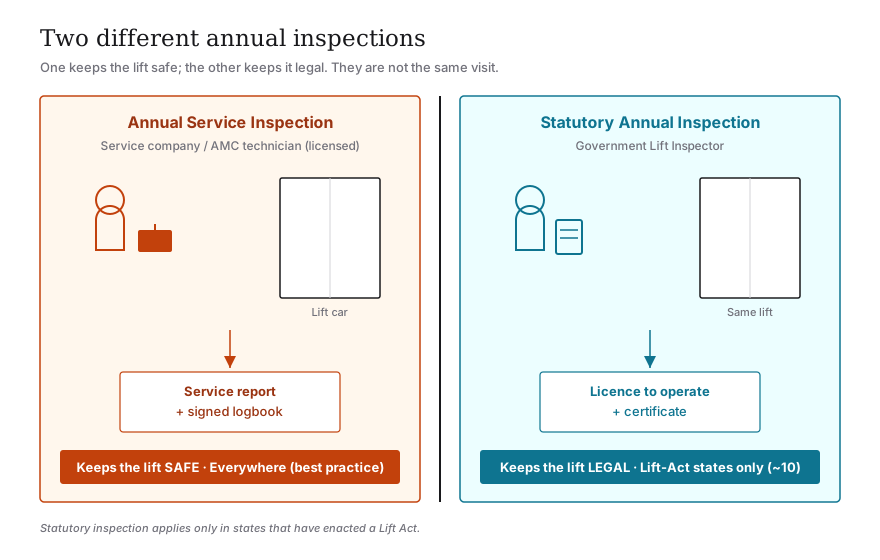
People say "annual inspection" to mean two quite different things. You may need one, the other, or both.
| Annual service inspection | Statutory annual inspection | |
|---|---|---|
| Who does it | Your lift service company / AMC technician (licensed) | A government Lift Inspector (State Electrical / Lift Inspectorate) |
| Why | Preventive maintenance — your safety + uptime | Legal compliance under the state Lift Act |
| Where required | Everywhere — it is best practice and your AMC obligation | Only in states that have a Lift Act (~10 states) |
| Output | A service report + signed logbook entry | A renewal of your licence to operate + inspection certificate |
| Frequency | At least once a year (usually part of ~12 visits/yr) | Typically annual; some states differ — confirm locally |
| You pay | Inside your AMC, or per-visit | A statutory inspection fee to the state |
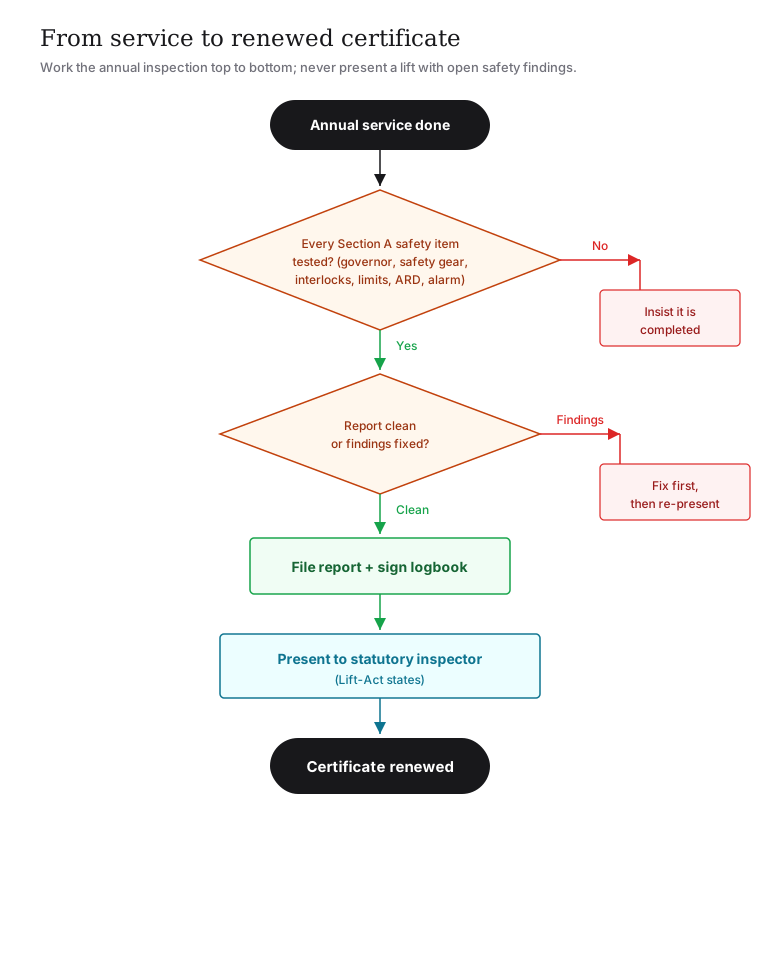
The service inspection keeps the lift safe and running. The statutory inspection keeps it legal. The cleanest arrangement is to have your AMC do its full annual service first, fix anything it finds, and then present a healthy lift to the government inspector — so the certificate renews without drama.
When the state Lift Act applies to you
Lifts are state-regulated in India. Roughly ten states issue lift licences and mandate periodic inspection — including Maharashtra, Gujarat, Karnataka, Kerala, Tamil Nadu, Assam, West Bengal, Delhi, Haryana and Himachal Pradesh. Acts such as the Maharashtra Lifts, Escalators and Moving Walks Act, 2017, the Karnataka Lifts, Escalators and Passenger Conveyors Act, 2015, the Delhi Lifts and Escalators Act, 2007 and the Tamil Nadu Lifts Act, 1997 typically require an installation licence before commissioning, an operation licence or registration, and a periodic safety inspection by a government-appointed inspector to renew that licence.
In states without a Lift Act, no statutory inspection or registration may be mandated — but IS 14665 and NBC 2016 remain the right benchmark, and your annual service inspection still matters just as much.
Indicative — confirm locally. Which states have an Act, the inspection interval, and the fees all change. Verify against your own state's Lift Act, your local municipal bye-laws and a licensed lift contractor before you assume. (The official Maharashtra "licence to operate lift" service portal is linked in the references.)
The annual service inspection checklist
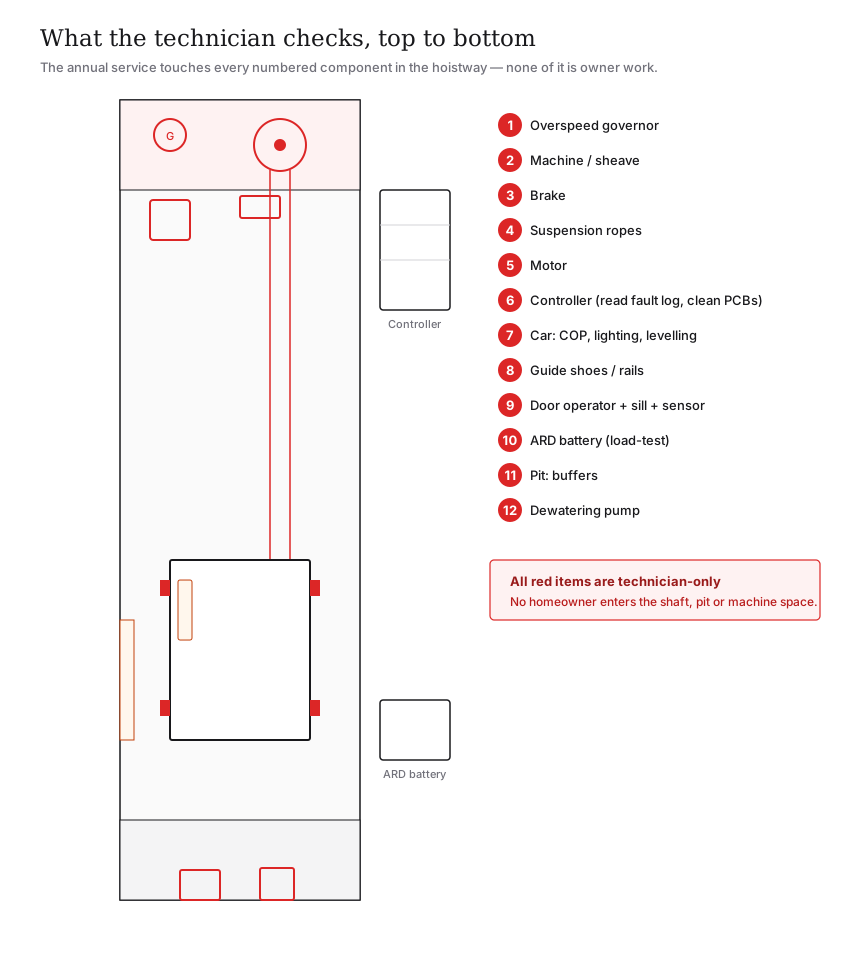
This is the heart of the guide: what a thorough annual professional service should cover. Print it, keep it with your logbook, and tick alongside the technician's report. It is grouped the way a competent technician actually works through the lift — safety systems first, because those are the parts that save a life if something else fails.
The "☐" boxes are for the technician's findings, not for you to action. Your role is to confirm each line was checked and to ask "what did you find, and what did you do about it?"
A. Safety systems — the life-safety tests (the priority)
| ☐ | Item | What the technician should do | Why it matters |
|---|---|---|---|
| ☐ | Overspeed governor | Inspect, clean, check the trip mechanism and that the calibration/seal is intact | It triggers the safety gear if the car over-speeds |
| ☐ | Safety gear (car drop test) | Actuate the safety gear so it grips the guide rails and arrests the car | This is the device that stops a falling car — it must be proven, not assumed |
| ☐ | Buffers (pit) | Inspect car and counterweight buffers; check oil level on oil buffers, no cracks/corrosion | Cushions the car at the bottom of travel |
| ☐ | Door interlocks | Verify the lift cannot move with any landing door open, and a door cannot open off-floor | The single most important everyday safety device — never to be defeated |
| ☐ | Final limit + over-travel switches | Test top and bottom limit switches and final limits stop the car | Prevents the car running past the ends of the shaft |
| ☐ | ARD / rescue battery — load test | Simulate a power cut: confirm the car moves to the nearest floor and opens the doors, then load-test the battery | In India's outages, this is what gets people out — see below |
| ☐ | Emergency alarm + intercom | Confirm the alarm bell and two-way intercom/phone work from inside the car | A trapped occupant must be able to call for help |
| ☐ | Overload sensor | Verify the car refuses to move and warns when overloaded | Protects ropes, brake and occupants |
| ☐ | Fireman's switch (if fitted) | Test recall-to-ground operation | Required on taller installations; verify if present |
B. Machine and drive
| ☐ | Item | What the technician should do |
|---|
| ☐ | Brake | Inspect lining wear, check clearance/adjustment, test holding under load, clean |
| ☐ | Suspension ropes / belts | Inspect for wear, broken wires, stretch, corrosion, correct tension; condemn/replace if past limits |
| ☐ | Traction sheave / drive | Check groove wear, alignment, bearing condition |
| ☐ | Motor | Check temperature, vibration, bearings, electrical connections |
| ☐ | Hydraulic system (hydraulic lifts) | Check oil level and condition, ram/cylinder for leaks, valve operation, packing seals |
| ☐ | Gearbox / oil (geared) | Check oil level and condition, top up or change per schedule |
C. Doors (the #1 source of stoppages)
| ☐ | Item | What the technician should do |
|---|---|---|
| ☐ | Door operator | Service the motor/mechanism; check opening/closing speed and force |
| ☐ | Sill / bottom tracks | Deep-clean grooves; check the lock arm seats; check for wear |
| ☐ | Sensors / light curtain | Clean and align the infrared eyes; confirm the door reopens on obstruction |
| ☐ | Rollers, belts, hangers | Inspect for wear; replace noisy/worn rollers; re-tension belts |
| ☐ | Alignment | Correct any drift so doors close cleanly and the interlock seats every time |
More than 70% of lift stoppages are door-related, so this section earns its space. For symptoms you might notice between services, see lift door problems and fixes and how doors differ in lift door types explained.
D. Car and guide rails
| ☐ | Item | What the technician should do |
|---|---|---|
| ☐ | Guide shoes / rollers | Inspect wear, replace if needed, confirm smooth ride |
| ☐ | Guide rails | Inspect alignment and fixings; clean and lubricate (or wipe, for roller-guide systems) |
| ☐ | Levelling accuracy | Confirm the car stops flush with each landing within tolerance |
| ☐ | Cabin fixtures | Check COP buttons, lighting, fan, position indicator, handrails, mirror |
E. Electrical and controls
| ☐ | Item | What the technician should do |
|---|---|---|
| ☐ | Controller diagnostics | Read the fault log/error history; clear, test and confirm normal operation |
| ☐ | PCB / control panel cleanliness | Blow out / clean dust off boards — a leading cause of "phantom" faults in India |
| ☐ | Earthing | Test earth continuity and resistance |
| ☐ | MCB / RCBO / isolator | Test the main isolator and protective devices trip correctly |
| ☐ | Voltage / stabiliser | Confirm supply is within range; check the stabiliser if fitted (surges cause ~65% of phantom faults) |
| ☐ | Wiring / connections | Inspect for loose terminals, heating, rodent damage |
F. Pit, shaft and housekeeping
| ☐ | Item | What the technician should do |
|---|---|---|
| ☐ | Pit | Confirm it is dry and clean; check the dewatering pump if fitted (critical before monsoon) |
| ☐ | Shaft / ventilation | Check the well is clear, lit, ventilated, no water ingress |
| ☐ | Lubrication | Lubricate all designated points per IS 14665 Part 2 schedule |
| ☐ | Signage / instructions | Confirm load plate, emergency instructions and licence display are present and legible |
| ☐ | Logbook | Record the visit, findings, parts changed, and sign — see below |
The ARD battery load-test — don't let it be skipped
The most commonly under-done line on this list is the ARD (Automatic Rescue Device) battery load-test. A quick "press the test button, the car moves" check is not a load-test. Batteries — sealed lead-acid SMF, increasingly lithium — fade over roughly 3–5 years, and a battery can pass a no-load button-test yet fail to carry a loaded car to the next floor. Insist the technician load-tests the battery at the annual service and replaces the set on schedule rather than waiting for total failure. This is exactly what gets people out during a power cut. For the upkeep detail see lift battery backup maintenance; for the hardware itself, battery backup systems for elevators.
After the inspection: the report, the certificate and the logbook
A proper annual visit produces paper. Make sure you receive and file it.
- Service report — what was inspected, what was found, what was replaced or adjusted, and any parts flagged for future replacement (ropes near wear limit, ageing battery, brake lining). This is your early warning for budgeting.
- Signed logbook entry — date, technician name, work done. A continuous logbook is your maintenance history; it protects resale value and is exactly what a statutory inspector wants to see.
- Statutory certificate (Lift-Act states) — the renewed licence to operate. Keep it displayed and filed. Without it you may be operating the lift illegally.
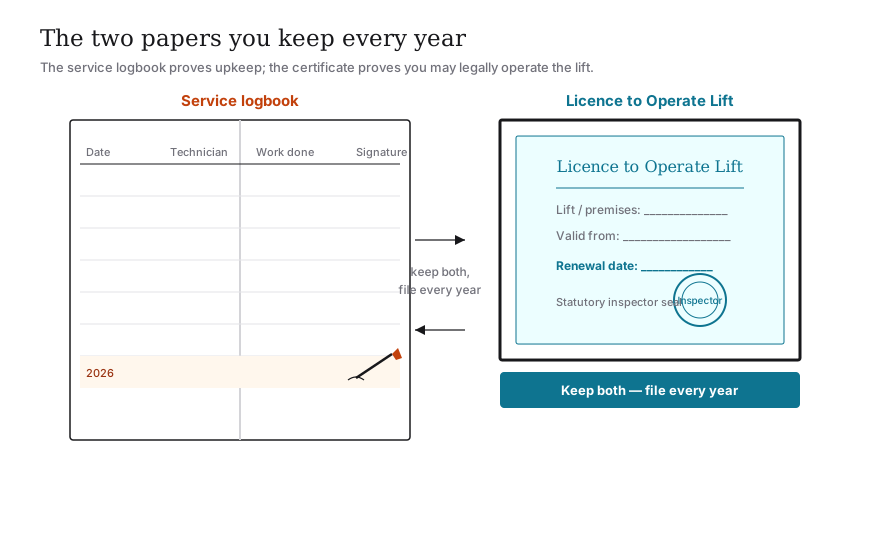
Keep every annual report. When you reach roughly year 20 and components start aging out, this history is exactly what your service company will use to advise modernisation versus replacement.
How this connects to your AMC
Your Annual Maintenance Contract is what should deliver this annual inspection — typically as one deeper visit among about 12 preventive visits a year, plus breakdown response. When you renew or sign an AMC, ask the provider to confirm the annual service covers the safety-system tests in section A above, not just lubrication and door adjustment. A non-comprehensive AMC may bill major parts (ropes, motor, controller, battery) separately, so read the fine print. The operational side — what each visit covers, the SLA, the logbook discipline — is in the lift AMC guide; for scoring and comparing providers, the lift AMC evaluation guide.
What stays your job — and what never is
To keep the boundary crisp:
| Owner does (no tools, outside the shaft) | Licensed technician only |
|---|---|
| Be present at the annual visit; ask what was found | All shaft, pit, controller, brake, rope work |
| Read the report; file it; keep the logbook signed | Safety-gear drop test, governor, buffers |
| Keep the car, sills and sensors clean between visits | ARD battery load-test and replacement |
| Confirm the alarm/intercom and light work | Door interlock, operator, alignment |
| Renew the AMC before it lapses; arrange the statutory inspection | Any work on a safety device — never defeated |
If a fault appears between services, do not force anything: use the alarm/intercom if someone is inside, switch the lift off at the main isolator if it behaves erratically, and call the technician. See common home lift problems and solutions and lift noise troubleshooting.
Costs
Annual service is usually bundled into your AMC; the statutory inspection carries a separate state fee. Figures vary widely by state, vendor and lift type, so treat any number as indicative — confirm with your technician and your state inspectorate. For benchmarks see the home lift cost guide (India 2026).
Related guides
- Home lift maintenance guide (India) — the full picture
- Monthly home lift maintenance checklist — what you do between services
- Lift AMC guide (India) and AMC evaluation guide
- Lift battery backup maintenance
- Lift door problems and elevator safety components explained
- Emergency rescue systems for home lifts
- When to replace your home lift and home lift modernization
- Residential elevator buyer's guide (India) — the pillar
References
- IS 14665 (Electric Traction Lifts), BIS — Part 2 is the Code of practice for installation, operation and maintenance; Part 5 is the Inspection manual. IS 14665 Part 1: https://law.resource.org/pub/in/bis/S05/is.14665.1.2000.pdf — IS 14665 Part 2 (maintenance): https://law.resource.org/pub/in/bis/S05/is.14665.2.1-2.2000.pdf
- IS 15259 — Hydraulic lifts (companion code) — by name.
- IS 17900 / EN 81-20 and EN 81-50 — lift safety and test-and-examination methods — by name.
- National Building Code of India 2016, Part 8 (Building Services), Section 5 — Installation of Lifts, Escalators and Moving Walks: https://www.bis.gov.in/standards/technical-department/national-building-code/ — Guide for Using NBC 2016: https://www.bis.gov.in/wp-content/uploads/2022/08/Booklet-Guide-for-Using-NBC-2016.pdf
- State Lift Acts — Maharashtra Lifts, Escalators and Moving Walks Act 2017; Karnataka Lifts, Escalators and Passenger Conveyors Act 2015; Delhi Lifts and Escalators Act 2007; Tamil Nadu Lifts Act 1997. Maharashtra licence-to-operate-lift service portal: https://services.india.gov.in/service/detail/maharashtra-license-to-operate-lift
- Lift regulations overview (India) — 99acres: https://www.99acres.com/articles/know-all-about-the-lift-regulations-in-india.html
- Maintenance and longevity — TK Elevator (ensuring lift longevity): https://www.tkelevator.com/in-en/news/ensuring-lift-longevity.html — TK Elevator (modernization lifecycle and ROI): https://www.tkelevator.com/in-en/news/elevator-modernization-lifecycle-and-roi-considerations.html
- Common home-lift problems — EFE: https://efepvtltd.com/blogs/what-are-the-common-problems-with-home-lifts/ — residential elevator lifespan (ShuttleSky): https://shuttlesky.in/residential-elevator-lifespan/
Standards and statutory requirements are indicative and change by state and year — confirm with your local municipal bye-laws, your state Lift Inspectorate and a licensed lift contractor.
Export this guide
Related Guides — Deep-dive reading
Lift Door Problems Explained (India): Why Doors Cause Most Faults
Doors cause over 70 percent of home-lift stoppages. Read the symptom, find the cause, and know which fixes are owner-safe and which belong to a licensed technician.
Home Lifts & AccessibilityMonthly Home Lift Maintenance Checklist (India): The Owner's Routine
A complete, printable monthly routine you can run yourself in ten minutes — clean, check, listen, and know exactly when to stop and call the technician.
Home Lifts & AccessibilityHome Lift Maintenance Guide (India): Keeping Your Lift Safe and Reliable
The homeowner's map to lift upkeep — the maintenance cadence, who does what, the safety boundary, and the lifecycle from first service to modernisation.
Home Lifts & AccessibilityRelated Tools — Try Free
Electrical Safety & Load Audit
Home electrical audit — 10 categories, 65+ checkpoints across earthing, RCCB, MCB, wiring, switchboards, appliance circuits, DG/inverter backup.
Safety AuditHome Lift Cost Calculator
All-in home lift cost by floors, type, capacity and city — equipment, civil, GST and AMC, with a drive-type comparison.
Lift CalculatorLift Safety Audit Checklist
Interactive checklist that scores your home lift on safety devices, compliance and upkeep.
Checklist