
Lift AMC Guide (India): What an Annual Maintenance Contract Covers and How to Manage It
The operational manual for your home lift's Annual Maintenance Contract — what it covers, the ~12 preventive visits a year, your job versus the provider's, and how to keep cover continuous.
A home lift is one of the few things in your house that carries people and must not fail mid-use. The single most important decision for keeping it safe and running is also the one most owners treat as paperwork: the Annual Maintenance Contract (AMC). This guide is the operational manual for that contract — what an AMC actually is, why every home lift needs one, what comprehensive versus non-comprehensive cover gives you at a glance, what the technician should do on each visit, what is your job versus theirs, and how to manage the contract so the lift never falls out of cover.
This is the operational AMC guide — how to run and manage the contract you have. If you are still choosing or comparing providers and want a scoring framework, read our companion Lift AMC Evaluation Guide (India) for the full comparison and scorecard. Use the two together: evaluate, then operate.
Why every home lift needs an AMC
A lift is a piece of machinery with safety devices — an overspeed governor, safety gear, door interlocks, a brake, and a battery rescue device. These are not "fit and forget" parts. Ropes stretch, brakes wear, door sensors drift out of alignment, batteries fade, and dust settles on the control boards. Left alone, small drifts become breakdowns, and breakdowns with a person inside become emergencies.
An AMC converts that risk into a predictable, scheduled relationship:
- Preventive maintenance — the technician inspects, lubricates, adjusts, and tests on a regular cadence before things fail.
- Breakdown response — when something does go wrong, you have a named provider obligated to attend within an agreed time.
- A documented service history — proof that the lift has been maintained, which matters for safety, for resale, and for the statutory inspection that several Indian states require under their Lift Acts.
In the roughly ten states with a Lift Act (Maharashtra, Gujarat, Karnataka, Kerala, Tamil Nadu, Assam, West Bengal, Delhi, Haryana, Himachal Pradesh), keeping the lift maintained is part of your operating obligation. Even where no Act applies, IS 14665 Part 2 — the code of practice for installation, operation and maintenance — treats periodic professional maintenance as the baseline of safe operation. An AMC is simply how a homeowner meets that bar without becoming a lift engineer.
Safety rule, stated once and meant throughout: a homeowner does routine cleaning and visual checks outside the shaft. Anything inside the shaft, controller, brake, ropes, or door interlock is a licensed technician's job — and a safety device is never to be defeated, bypassed, or wedged.
What an AMC covers: comprehensive vs non-comprehensive at a glance
AMCs come in two broad shapes. The difference is almost entirely about who pays for spare parts.
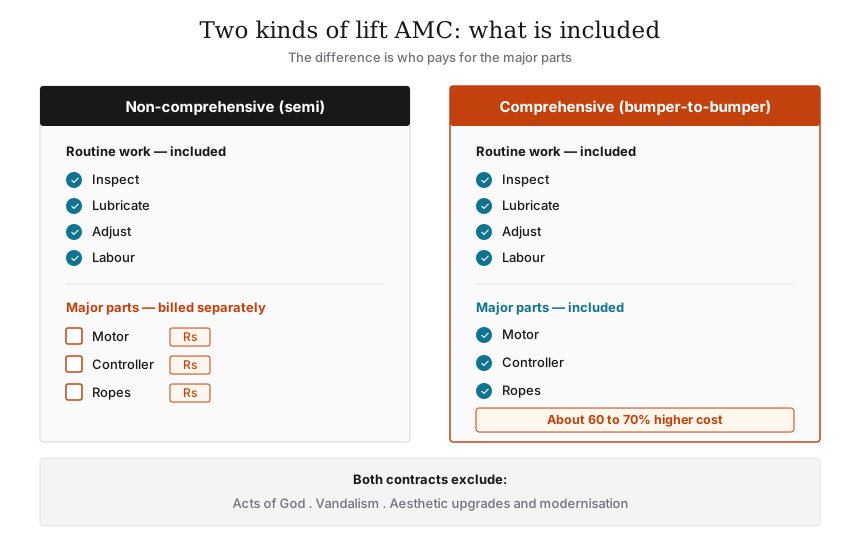
- Non-comprehensive (semi / labour-only): covers routine inspection, lubrication, adjustment, and the technician's labour. Major parts are billed separately — if the controller or motor fails, you get a quote. Cheaper monthly, but exposed to surprise bills.
- Comprehensive ("bumper-to-bumper"): covers the same routine service plus most spare parts and major repairs. It typically costs around 60–70% more than non-comprehensive, but it caps the surprises. For a single home lift that you depend on daily, this predictability is usually worth it.
Here is the operational coverage picture. Treat the part-by-part column as indicative — the exact inclusion list is whatever your signed contract says, so read the fine print.
AMC-at-a-glance coverage table
| Item | Non-comprehensive (semi) | Comprehensive ("bumper-to-bumper") |
|---|---|---|
| Routine preventive visits (about 12/year) | Included | Included |
| Lubrication, cleaning, adjustment | Included | Included |
| Technician labour on visits | Included | Included |
| Breakdown / emergency call-out | Included (labour) | Included (labour) |
| Door operator, rollers, sensors | Usually billed | Usually included |
| Contactors, relays, small electricals | Usually billed | Usually included |
| Controller / PCB boards | Billed | Usually included (check) |
| Motor / machine | Billed | Often included (some exclude — check) |
| Ropes / suspension | Billed | Often included (some exclude — check) |
| ARD / backup battery replacement | Billed | Sometimes included, often a separate consumable |
| Acts of God (pit flooding, lightning) | Excluded | Usually excluded |
| Vandalism, misuse, accident damage | Excluded | Usually excluded |
| Aesthetic / cosmetic modernisation | Excluded | Excluded |
Note the exclusions: even a comprehensive AMC commonly excludes acts of God (monsoon pit flooding, lightning surge), vandalism and misuse, and aesthetic upgrades. Some comprehensive contracts also carve out the motor, controller, machine, pulley, or ropes — exactly the expensive items you bought "comprehensive" to cover. Verify these line by line before you sign; the full side-by-side scoring lives in the Lift AMC Evaluation Guide.
On price: AMCs are indicative and vary by lift type, location, and provider — confirm with your technician. Small residential lifts commonly land in the ₹20,000–38,500 per year range, often with around a 5% annual escalation clause. For how AMC sits inside the total cost of ownership, see Home Lift Cost in India (2026).
The service rhythm: ~12 preventive visits plus breakdown response
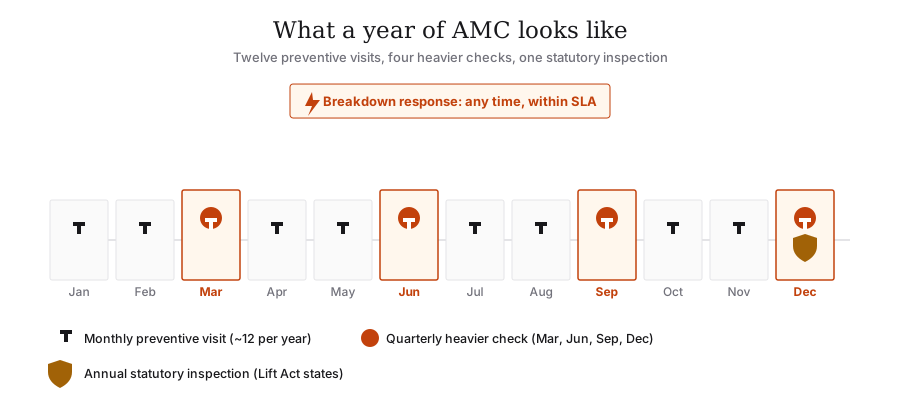
The heart of a good AMC is preventive work on a predictable schedule. The Indian norm is about 12 monthly preventive visits per year, plus emergency breakdown calls whenever the lift faults between visits.
| Cadence | What it is | Who does it |
|---|---|---|
| Weekly / monthly (you) | Wipe sills and door sensors, check cabin light, alarm and intercom, listen for new noises | Homeowner — outside the shaft only |
| Monthly (provider) | Preventive visit: inspect, lubricate, adjust, test safety devices | Licensed technician |
| Quarterly (provider) | Heavier check: door operation, levelling, brake, ARD battery load-test | Licensed technician |
| Annual | Full review; statutory inspection where the state Lift Act requires it | Technician + government inspector |
| On demand | Breakdown response within the contracted SLA | Licensed technician |
The monthly homeowner tasks are not part of the AMC — they are yours, and they keep the lift cleaner between professional visits. Our Monthly Home Lift Maintenance Checklist is the printable version. The statutory annual inspection (in states with a Lift Act) is carried out by a government-appointed inspector, not the AMC company — your provider's job is to keep the lift in a condition that passes it. See the Annual Lift Inspection Checklist for what that inspection looks at.
What each preventive visit should actually do
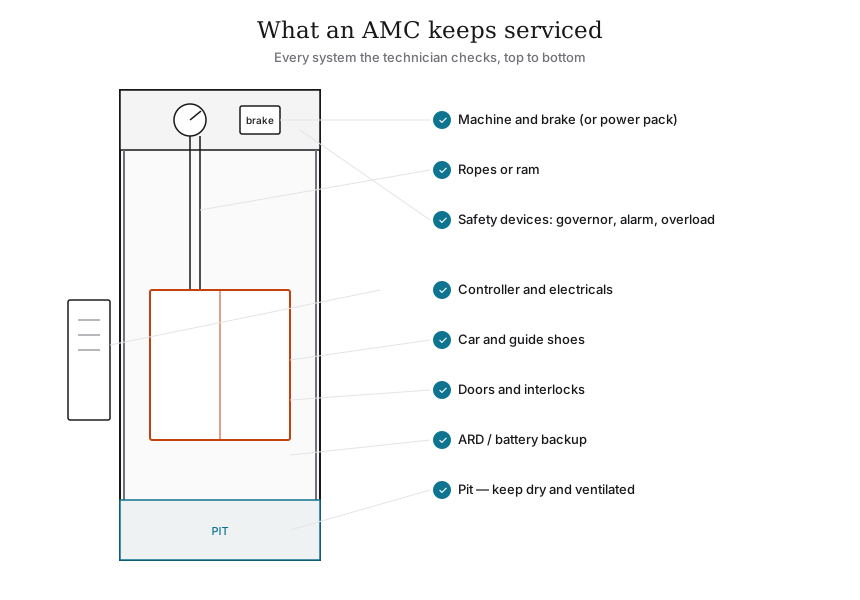
"A visit happened" is not the same as "the lift was maintained." A genuine preventive visit, aligned to IS 14665 Part 2 practice, should touch every system that can fail. Ask your provider to confirm their visit covers this, and check it off in your logbook.
| System | What the technician should check |
|---|---|
| Doors and interlocks | Sill tracks clean, light-curtain/sensor alignment, interlock seating, roller and belt wear, closing force and timing |
| Controller and electricals | Connections, contactors and relays, fault log, surge/voltage condition, PCB dust |
| Machine and brake | Brake operation and clearance, bearings, gear oil (geared), unusual noise or heat |
| Ropes / ram | Traction rope wear and tension; or hydraulic ram, oil level, valves and seals |
| Car and guides | Guide shoes/rollers and rail lubrication, levelling accuracy, vibration |
| Safety devices | Overspeed governor and safety gear, overload sensor, emergency alarm and intercom, manual lowering |
| ARD / battery backup | Load-test the rescue battery, confirm auto-rescue to the nearest floor on power loss |
| Pit and machine area | Dry, ventilated, free of water and debris (critical in monsoon) |
Doors deserve special attention because they cause more than 70% of lift stoppages, and dust on door sensors and control boards is behind a large share of "phantom" faults in Indian homes. A visit that cleans sensors and tracks and load-tests the ARD prevents most call-outs. For deeper troubleshooting between visits, see Common Home Lift Problems and Solutions, Lift Door Problems, Lift Noise Troubleshooting, and Lift Battery Backup Maintenance.
Your responsibilities vs the provider's
An AMC is a two-sided contract. Many disputes come from owners assuming the provider does things that are actually the owner's job, and vice versa. Here is the clean split.
| Responsibility | Yours (homeowner) | Provider's (AMC) |
|---|---|---|
| Routine cleaning of cabin, sills, sensors | Yes | No |
| Keeping pit/machine area dry and accessible | Yes | Checks condition |
| Reporting faults and new noises promptly | Yes | Diagnoses and fixes |
| Not overloading or misusing the lift | Yes | No |
| Stable power supply / stabiliser | Yes (provide) | Advises |
| Preventive visits on schedule | No | Yes |
| Lubrication, adjustment, safety-device testing | No | Yes |
| Breakdown response within SLA | No | Yes |
| Major-part repair/replacement | Pays (if non-comprehensive) | Does the work; pays parts if comprehensive |
| Keeping the service logbook updated | You retain it | They sign each visit |
| Statutory inspection liaison | You are the licence holder | Prepares the lift to pass |
A practical point on power: a large share of Indian residential lift faults trace to voltage surges and dust. Providing a clean, stabilised supply and keeping the environment dust-free is your side of the bargain — it reduces breakdowns the AMC would otherwise be called out for.
Managing your AMC: logbook, SLA, and renewing before lapse
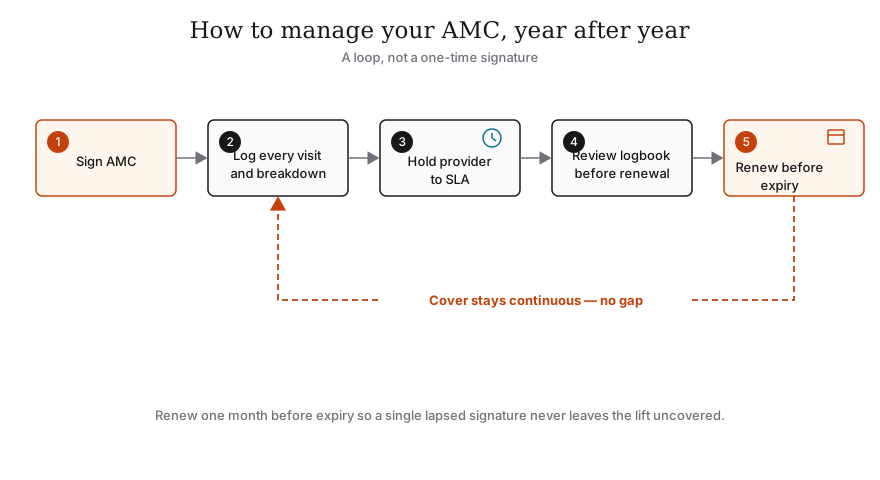
Signing the AMC is the start, not the finish. Three habits keep the contract working for you.
1. Keep a service logbook
Every preventive visit and every breakdown should be recorded — the date, who attended, what was done, parts changed, and the technician's signature. A logbook is your evidence that the lift was maintained (for the statutory inspector, for resale, and if a dispute arises), and it lets you see patterns: a part that keeps failing, visits that get skipped, a problem that never quite gets fixed.
2. Hold the provider to the response SLA
Your contract should state a breakdown response time — for example, attend within X hours, with a faster window if a person is trapped. That SLA is the number that matters most on a bad day. Note the time you call and the time they arrive in the logbook. If the provider repeatedly misses the SLA, you have a documented case at renewal — and a reason to switch using the evaluation scorecard.
If someone is trapped in the lift, do not force the doors. Use the cabin alarm and intercom to stay in contact, switch the lift off at the main isolator only if it is behaving erratically, and call the AMC emergency line. Rescue is a technician's job; see Common Home Lift Problems and Solutions for first-response steps.
3. Renew before it lapses — keep cover continuous
The most common own-goal is letting the AMC expire. A gap in cover means a breakdown lands on you at full price, a missed preventive visit, and — in Lift Act states — a lift running without the maintenance record an inspector expects. Diarise the renewal date a month before expiry, review the past year's logbook, confirm the escalation clause and any changes to the parts list, and renew so cover is continuous with no gap.
Manage-your-AMC checklist
| ☐ | Task | Frequency |
|---|---|---|
| ☐ | Confirm the next preventive visit is scheduled | Monthly |
| ☐ | Log every visit and breakdown (date, technician, work done, signature) | Every visit |
| ☐ | Note call time and arrival time on any breakdown | Per breakdown |
| ☐ | Check the ARD battery was load-tested this quarter | Quarterly |
| ☐ | Review the logbook for recurring faults or skipped visits | Quarterly |
| ☐ | Confirm statutory inspection is booked (Lift Act states) | Annual |
| ☐ | Verify SLA performance over the year | Before renewal |
| ☐ | Re-read the parts inclusion/exclusion list for changes | Before renewal |
| ☐ | Diarise renewal one month before expiry | Annual |
| ☐ | Renew with no gap in cover | Annual |
Where the AMC fits with the rest of lift care
The AMC is the professional backbone, but it works best alongside your own routine and a longer-term plan:
- Day to day: your monthly checklist and the overall home lift maintenance guide.
- Year to year: the annual inspection checklist.
- Decade to decade: around year 20, talk to your provider about modernisation or when to replace the lift. A well-maintained lift lasts 20–25 years, and a good AMC plus partial modernisation can push that to 35-plus.
Get the AMC right and it quietly does its job: the lift is serviced before it fails, faults are fixed fast, and you have a clean record proving it. For the buying-side picture, see the Residential Elevator Buyer's Guide and the Lift Specification Checklist.
References
- IS 14665 (Electric Traction Lifts), BIS — especially Part 2, Code of practice for installation, operation and maintenance, which underpins AMC preventive-maintenance scope. Part 1 (outline dimensions): https://law.resource.org/pub/in/bis/S05/is.14665.1.2000.pdf ; Part 2: https://law.resource.org/pub/in/bis/S05/is.14665.2.1-2.2000.pdf
- IS 15259 — Hydraulic lifts (companion code, named for completeness).
- National Building Code of India 2016, Part 8 (Building Services), Section 5 — Installation of Lifts, Escalators and Moving Walks: https://www.bis.gov.in/standards/technical-department/national-building-code/ ; Guide for Using NBC 2016: https://www.bis.gov.in/wp-content/uploads/2022/08/Booklet-Guide-for-Using-NBC-2016.pdf
- State Lift Acts governing operation, registration and periodic inspection — e.g. Maharashtra Lifts, Escalators and Moving Walks Act 2017; Karnataka Lifts, Escalators and Passenger Conveyors Act 2015; Delhi Lifts and Escalators Act 2007; Tamil Nadu Lifts Act 1997. Maharashtra licence to operate a lift (Govt services portal): https://services.india.gov.in/service/detail/maharashtra-license-to-operate-lift
- Lift regulations in India (overview): https://www.99acres.com/articles/know-all-about-the-lift-regulations-in-india.html
- TK Elevator — ensuring lift longevity (maintenance): https://www.tkelevator.com/in-en/news/ensuring-lift-longevity.html
- EFE — common problems with home lifts (2026): https://efepvtltd.com/blogs/what-are-the-common-problems-with-home-lifts/
All regulatory and price figures here are indicative and vary by state, vendor and year — confirm with your local municipal bye-laws and a licensed lift contractor.
Export this guide
Related Guides — Deep-dive reading
Monthly Home Lift Maintenance Checklist (India): The Owner's Routine
A complete, printable monthly routine you can run yourself in ten minutes — clean, check, listen, and know exactly when to stop and call the technician.
Home Lifts & AccessibilityAnnual Lift Inspection Checklist (India): What the Yearly Service Should Cover
The complete checklist of what the annual professional service and statutory inspection should cover — so you can hold your technician or AMC to it.
Home Lifts & AccessibilityLift Door Problems Explained (India): Why Doors Cause Most Faults
Doors cause over 70 percent of home-lift stoppages. Read the symptom, find the cause, and know which fixes are owner-safe and which belong to a licensed technician.
Home Lifts & AccessibilityRelated Tools — Try Free
Home Lift Cost Calculator
All-in home lift cost by floors, type, capacity and city — equipment, civil, GST and AMC, with a drive-type comparison.
Lift CalculatorLift Annual Maintenance Cost Calculator
AMC cost for a home lift — comprehensive vs non-comprehensive, with a 5-year projection.
Lift CalculatorLift Safety Audit Checklist
Interactive checklist that scores your home lift on safety devices, compliance and upkeep.
Checklist