
Lift Noise Troubleshooting Guide (India): Diagnosing a New Sound
Map the sound to its cause, log when and where it happens, and brief your technician — what a new grind, hum, bang or rattle is really telling you.
A home lift that has run quietly for years and then starts making a new sound is trying to tell you something. The noise itself is not the emergency — the emergency is ignoring it. A fresh grind, hum, bang or scrape almost always means a part has started to wear, work loose or run dry, and catching it early is the difference between a small lubrication visit and a large repair.
This guide teaches you to listen like a technician. You will learn to map a sound to its likely cause, to record exactly when and where it happens, and to brief your service company so they arrive knowing what to check. What it will NOT do is send you climbing into the shaft. Diagnosing a lift is a listening job for the homeowner and a hands-on job for a licensed lift technician — the two are different, and the line between them keeps you safe.
The one rule that matters most: a sudden, new noise that was not there last week means call your AMC technician and have it inspected. Do not open shaft or landing doors, do not enter the pit, and never touch the machine, brake, ropes or controller. Those live inside the shaft and panel, and they are a licensed technician's domain.
This guide is the diagnosis companion to our noise reduction in residential lifts guide, which is about preventing noise by design — quiet drives, dampening, smart shaft location. If your lift was never quiet to begin with, start there. If your lift was quiet and changed, you are in the right place.
Why a new noise deserves attention
A lift is a controlled fall managed by dozens of moving parts: a machine and brake, guide rails and the shoes that ride them, door rollers and tracks, a counterweight or hydraulic ram. When all of those are clean, lubricated and tight, the lift is nearly silent. A new sound means one of them has changed state — drying out, wearing, loosening, or working harder than it should.
The reassuring news, from Indian residential service data, is that most noises trace back to ordinary, fixable causes: dust, voltage issues, dry guide shoes, worn door rollers. Roughly 65% of residential service calls in India trace to voltage surges or dust, and doors are behind more than 70% of stoppages. A noise is often the early-warning stage of those same problems — which is exactly why logging it well pays off.
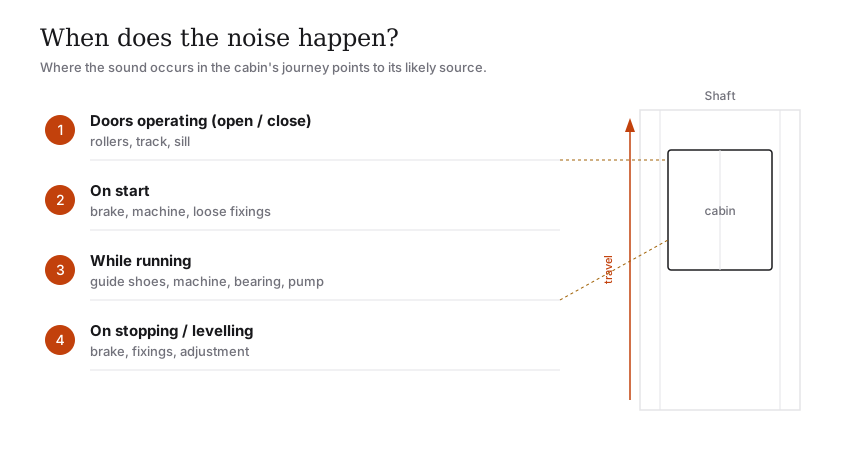
Step 1 — Note WHEN the noise happens
This single observation tells a technician more than any description of the sound itself. A lift makes noise at four distinct moments, and each points to a different family of parts:
- When the doors operate (opening or closing) — door rollers, track, sill or operator.
- On start (the instant the car begins to move) — the brake releasing, machine starting, or loose fixings taking the load.
- While running (steady travel between floors) — guide shoes on the rails, the machine and its bearings, the hydraulic pump.
- On stopping / levelling (as the car arrives at a floor) — the brake re-applying, fixings settling, or a levelling adjustment.
Listen for the moment, not just the sound. "A squeal the whole way up" and "a bang only when it stops" are two completely different diagnoses even if both feel like "the lift is noisy."
Step 2 — Note WHERE it happens
Does the noise occur at every floor, or only between two specific floors? A noise that appears only on one stretch of travel often points to a localised problem on the guide rails — a dry or worn guide shoe passing a rough section, or a rail joint needing attention. A noise that happens everywhere is more likely the machine, brake or doors, which travel with the car. Tell your technician the floor numbers; it narrows the search dramatically.
Step 3 — Match the sound to a likely cause
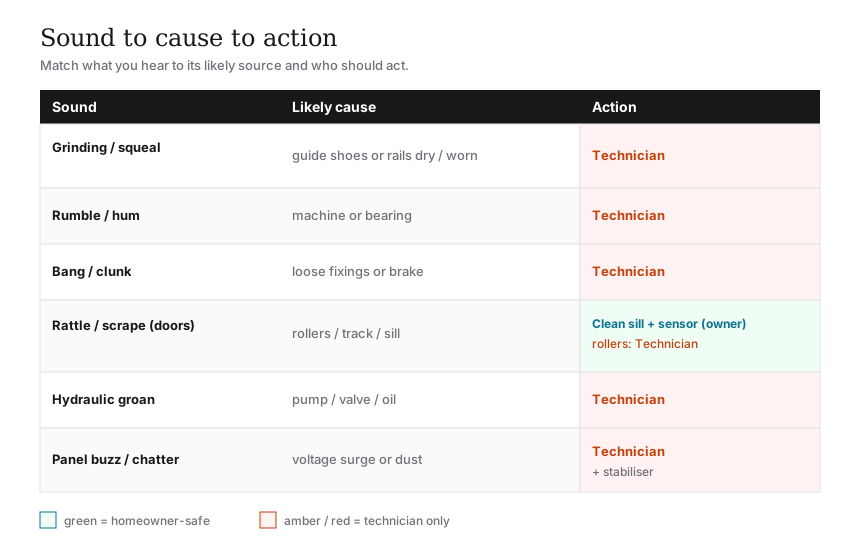
Use the table below as a translator. Describe the sound in plain words, read across to the likely cause, and note the action. Every "investigate / repair" action in the shaft, panel or machine is a technician's job — your job is to observe, log and call.
| Sound you hear | When it happens | Likely cause | What it means / action |
|---|---|---|---|
| Grinding or metallic squeal | While running, often worse between certain floors | Guide shoes or rails dry, dirty or worn | Needs lubrication or shoe replacement — technician. Do not oil rails yourself; wrong lubricant can be dangerous |
| Low rumble or continuous hum | While running | Machine motor or a worn bearing | Machine/bearing inspection — technician. A rising rumble over weeks means schedule sooner |
| Bang, clunk or thud | On start or on stop | Loose fixings, bracket bolts, or brake adjustment | Tighten / brake service — technician. Bangs at start-stop should not be ignored |
| Rattle or scrape | When doors open or close | Door rollers, track or sill (dust, debris, wear) | Clean sill track and wipe sensor eyes (homeowner-safe); roller/operator work is a technician job |
| Hydraulic groan or shudder | While running (hydraulic lifts) | Pump, valve or oil level/temperature | Pump/valve/oil check — technician. More common in hot weather or after long idle periods |
| Click, buzz or chatter from the panel | Random, no clear pattern | Voltage surge, relay, or dust on PCBs | Often a stabiliser / clean-supply or sensor-cleaning fix — technician; ask about a voltage stabiliser |
| Sharp screech on stopping | On stop / levelling | Brake pads or worn brake | Brake is a safety component — technician only, promptly |
A note on door noises
Door rattles and scrapes are the most common new noise homeowners hear, and they are also the one area where you can safely help. Keeping the bottom sill track clean of dust and debris and wiping the infrared sensor eyes clean is genuinely useful preventive care and may quiet a minor rattle. But worn rollers, belt wear, alignment drift and the door operator are technician territory. If a door noise is paired with the lift hesitating, reopening or refusing to move, treat it as a fault and read our lift door problems guide, then call your technician.
Step 4 — Fill in a "what to log" card
When you call your AMC provider, the quality of your description decides how fast and cheaply the problem is solved. A technician who arrives knowing "a grinding squeal, only while running, between the second and third floor, started three days ago" can go straight to the guide rails. One who hears only "the lift is noisy" has to investigate everything.
Capture these before you call:
| What to record | Example |
|---|---|
| What the sound is like | Grinding / hum / bang / rattle / groan / screech |
| When it happens | On start / while running / on stopping / when doors operate |
| Which floor(s) | Every floor, or only between 2nd and 3rd |
| When it started | Suddenly three days ago / gradually over a month |
| Is it getting worse? | Same / louder each day |
| Any other change? | New jerk, vibration, smell, slower travel, levelling off |
| Loaded vs empty? | Only with people in / also when empty |
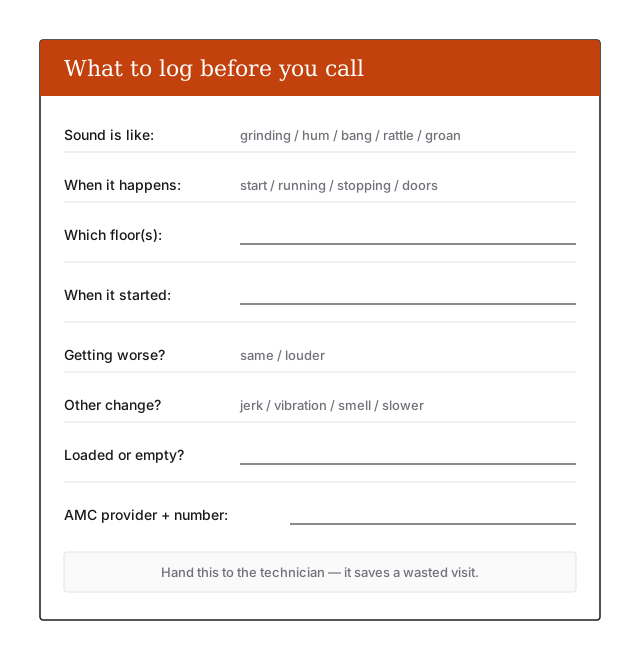
Keep this in your service logbook next to the lift, along with the AMC provider's number. Noting the date you first heard a sound also helps you and your technician spot a pattern over time — see our home lift maintenance guide for keeping a good logbook.
What you should and should NOT do
This is the part that keeps everyone safe. A home lift has powerful moving parts and live safety devices; the shaft is not a place for investigation.
| ✅ Homeowner-safe (outside the shaft) | ❌ Technician only — never DIY |
|---|---|
| Listen and note when/where the noise happens | Open shaft or landing doors |
| Keep the door sill track clean of dust/debris | Enter the pit or stand on the car top |
| Wipe the infrared sensor eyes clean | Oil or adjust the guide rails / shoes |
| Check the cabin light, alarm and intercom work | Touch the machine, brake, ropes or counterweight |
| Switch the lift OFF at the isolator if it behaves erratically | Open the controller / electrical panel |
| Call the AMC technician for any new noise | Defeat or bypass any safety device or interlock |
If someone is inside the lift when it makes an alarming noise and stops, they should stay calm, stay inside, and use the alarm and intercom — never try to force the doors. If the lift is behaving erratically, switch it off at the main isolator and keep it off until the technician arrives. A working ARD (Automatic Rescue Device) should bring the car to the nearest floor on a power cut; if yours does not, see lift battery backup maintenance.
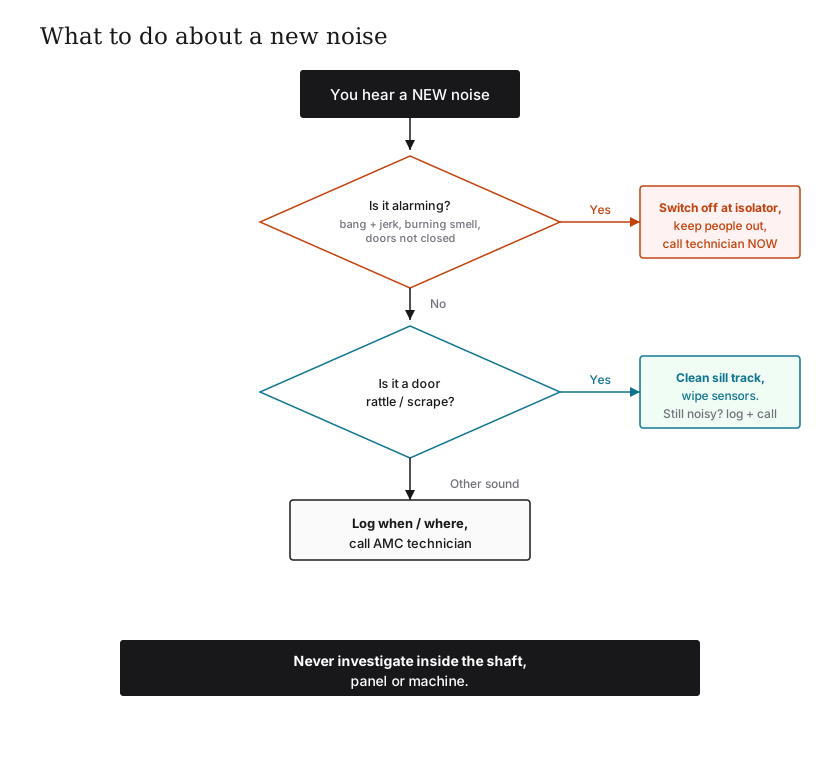
When a noise is urgent
Most noises mean "book a service visit soon." A few mean "stop using the lift and call now":
- A bang or clunk paired with a jerk or jolt in travel.
- A screech on stopping plus the car not levelling correctly with the floor.
- Any noise combined with a burning smell, smoke, or the lift moving with the doors not fully closed.
- A noise that has gone from occasional to constant in a matter of days.
In any of these, switch the lift off at the isolator, keep people out, and call your AMC technician immediately. A new sound is cheap to fix early and expensive to ignore.
How this connects to the rest of your lift care
A noise is one symptom in a wider maintenance picture. To keep noises rare in the first place, follow a routine: the homeowner-safe checks in our common home lift problems and solutions guide and a real service schedule via a sound lift AMC. If you find yourself calling about the same noise repeatedly and parts are getting hard to source, that can be an early signal it is time to look at home lift modernization or, eventually, when to replace your home lift.
And if your lift has always hummed or rumbled rather than developing a new sound, the fix is design-side, not diagnostic — our noise reduction in residential lifts guide covers drive choice, dampening and shaft placement.
Cost note: lubrication, roller and bearing work, and brake service vary widely by lift type, brand and city — all indicative, confirm with your technician. For realistic ranges see our home lift cost guide; most are covered under a comprehensive AMC, so check your contract first.
Quick reference: listen, log, call
1. Listen for the moment — doors, start, run, or stop.
2. Locate the floor or stretch where it happens.
3. Log what it sounds like, when it started, and whether it is worsening.
4. Call your AMC technician — and for a sudden alarming noise, switch off and call now.
5. Never investigate inside the shaft, panel or machine — that is a licensed technician's job.
References
- IS 14665 (Parts 1–5), Electric Traction Lifts (Bureau of Indian Standards) — Part 2 is the code of practice for installation, operation and maintenance; Part 4 covers components including guide rails, shoes and safety gears; Part 5 is the inspection manual. IS 14665 Part 1: https://law.resource.org/pub/in/bis/S05/is.14665.1.2000.pdf — IS 14665 Part 2 (maintenance): https://law.resource.org/pub/in/bis/S05/is.14665.2.1-2.2000.pdf
- IS 15259, Hydraulic Lifts — companion code for hydraulic installations (relevant to pump/valve/oil noises). Cited by name.
- NBC 2016, Part 8 (Building Services), Section 5 — Installation of Lifts, Escalators and Moving Walks (BIS): https://www.bis.gov.in/standards/technical-department/national-building-code/ — Guide for Using NBC 2016: https://www.bis.gov.in/wp-content/uploads/2022/08/Booklet-Guide-for-Using-NBC-2016.pdf
- State Lift Acts (for statutory periodic inspection where applicable) — e.g. Maharashtra Lifts, Escalators and Moving Walks Act 2017; Karnataka Lifts, Escalators and Passenger Conveyors Act 2015; Delhi Lifts and Escalators Act 2007; Tamil Nadu Lifts Act 1997. Maharashtra licence-to-operate service: https://services.india.gov.in/service/detail/maharashtra-license-to-operate-lift
- TK Elevator — ensuring lift longevity (maintenance): https://www.tkelevator.com/in-en/news/ensuring-lift-longevity.html
- EFE — common problems with home lifts (2026): https://efepvtltd.com/blogs/what-are-the-common-problems-with-home-lifts/
- 99acres — lift regulations in India: https://www.99acres.com/articles/know-all-about-the-lift-regulations-in-india.html
Standards, regulatory triggers and any figures here are indicative and vary by state, vendor and year — always confirm with your local licensed lift contractor and municipal bye-laws.
Export this guide
Related Guides — Deep-dive reading
Lift Door Problems Explained (India): Why Doors Cause Most Faults
Doors cause over 70 percent of home-lift stoppages. Read the symptom, find the cause, and know which fixes are owner-safe and which belong to a licensed technician.
Home Lifts & AccessibilityMonthly Home Lift Maintenance Checklist (India): The Owner's Routine
A complete, printable monthly routine you can run yourself in ten minutes — clean, check, listen, and know exactly when to stop and call the technician.
Home Lifts & AccessibilityCommon Home Lift Problems and Solutions (India)
The troubleshooting reference: symptom, likely cause, and what you can safely do versus when to call the technician.
Home Lifts & AccessibilityRelated Tools — Try Free
Home Lift Cost Calculator
All-in home lift cost by floors, type, capacity and city — equipment, civil, GST and AMC, with a drive-type comparison.
Lift CalculatorLift Installation Timeline Calculator
Phase-wise timeline in weeks for installing a home lift — new build or retrofit.
Lift CalculatorAccess-Control Battery-Backup Calculator
Size the standby battery so an access system keeps running through a power cut, with an egress life-safety note.
Battery Backup