
Home Lift Maintenance Guide (India): Keeping Your Lift Safe and Reliable
The homeowner's map to lift upkeep — the maintenance cadence, who does what, the safety boundary, and the lifecycle from first service to modernisation.
A home lift is one of the few machines in your house that carries people. Treated well, it runs quietly for two decades or more; neglected, it becomes the thing that traps a family member on a power cut or jolts to a stop between floors. The good news is that keeping a residential lift safe and reliable is mostly routine, predictable and shared between you and a technician. This guide is the map of that routine: what maintenance is, why it matters, how often it happens, who does what, and where the hard safety line sits.
This is the overview of our maintenance cluster. From here you can branch into the monthly homeowner checklist, the annual inspection checklist, the operational AMC guide, the common-problems troubleshooter, and the end-of-life decisions around modernization and when to replace.
Why maintenance matters
There are two reasons, and they reinforce each other: safety and lifespan.
Safety. A lift is held by a system of overlapping safety devices — an overspeed governor and safety gear, door interlocks, a light curtain or door sensors, an emergency alarm and intercom, an overload sensor, and a battery-backed Automatic Rescue Device (ARD) that brings the car to a floor on a power cut. Every one of these is designed to fail safe, but they only stay reliable if they are inspected, cleaned and adjusted on a schedule. Most "scary" lift incidents in homes are not dramatic mechanical breaks; they are a dirty sensor, a worn interlock, or a tired battery that nobody load-tested.
Lifespan. A well-maintained residential lift lasts roughly 20 to 25 years. With consistent care and a partial modernisation around year 20, the same installation can serve 35 years or more. The single biggest variable is not the brand you bought — it is whether the maintenance actually happened. A neglected lift ages out fast; a serviced one quietly outlives its warranty by decades.
Think of it like a car. Skipping services does not make the car fail tomorrow — it makes the failures arrive earlier, cost more, and cluster at the worst moments. A lift is the same, except the consequences sit closer to your family's safety.
The maintenance cadence
Maintenance happens on three overlapping clocks. None replaces the others.
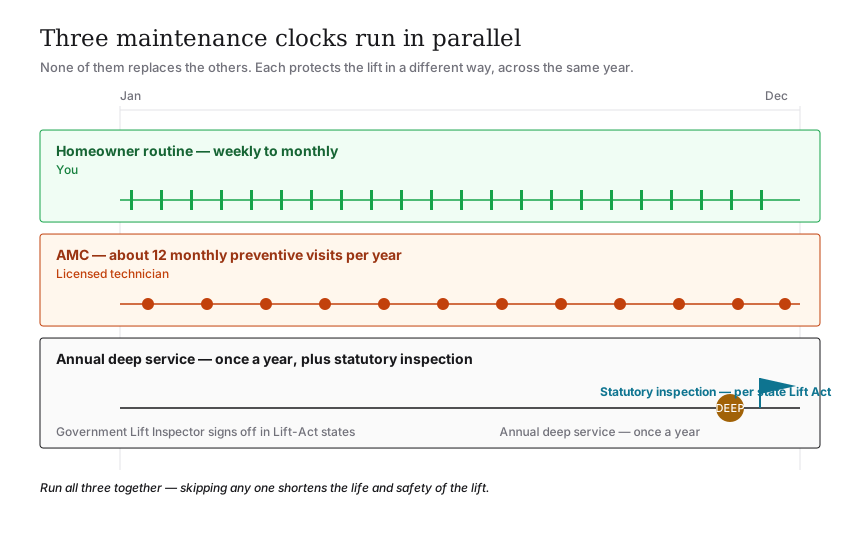
1. The homeowner routine (weekly to monthly). No tools, nothing inside the shaft. You keep the car and landing sills clean, wipe the door sensor eyes, confirm the cabin light, alarm and intercom work, and listen for new noises. This is covered step-by-step in the monthly maintenance checklist.
2. The AMC — roughly 12 monthly preventive visits a year. A standard Annual Maintenance Contract sends a technician about once a month to lubricate, adjust, inspect and test, plus breakdown calls when something goes wrong. This is the workhorse of lift upkeep and the practical answer to "who services my lift." See the AMC guide for what each visit should cover and how to hold the provider to the contract, and the AMC evaluation guide when you are choosing or scoring a provider.
3. The annual professional service and statutory inspection. At least once a year a deeper service is done — and in states with a Lift Act (Maharashtra, Karnataka, Tamil Nadu, Delhi and others), a periodic safety inspection by the government Lift Inspectorate is a legal obligation, not an optional extra. The annual inspection checklist walks through what this covers and how to prepare.
In practice, a good AMC delivers both the monthly visits and the annual deep service under one contract — but the statutory inspection (where it applies) is carried out by a government-appointed inspector, not by your private service company. Do not confuse the two; passing your AMC visits does not satisfy the State Lift Act.
| Clock | Who | Roughly how often | What it covers |
|---|---|---|---|
| Homeowner routine | You | Weekly to monthly | Cleaning sills/tracks, wiping sensor eyes, checking light/alarm/intercom, listening for noise |
| AMC preventive visit | Licensed technician | ~12 times a year (monthly) | Lubrication, adjustment, inspection, safety-device test, logbook entry |
| Annual deep service | Licensed technician | Once a year | Thorough inspection, ropes/brake/controller checks, ARD battery load-test |
| Statutory inspection | Government Lift Inspector | Per state Lift Act (periodic) | Legal safety certification where a state Act applies |
The crucial safety boundary
This is the most important section in the guide. There is a clear line between what a homeowner may do and what only a licensed technician may touch.
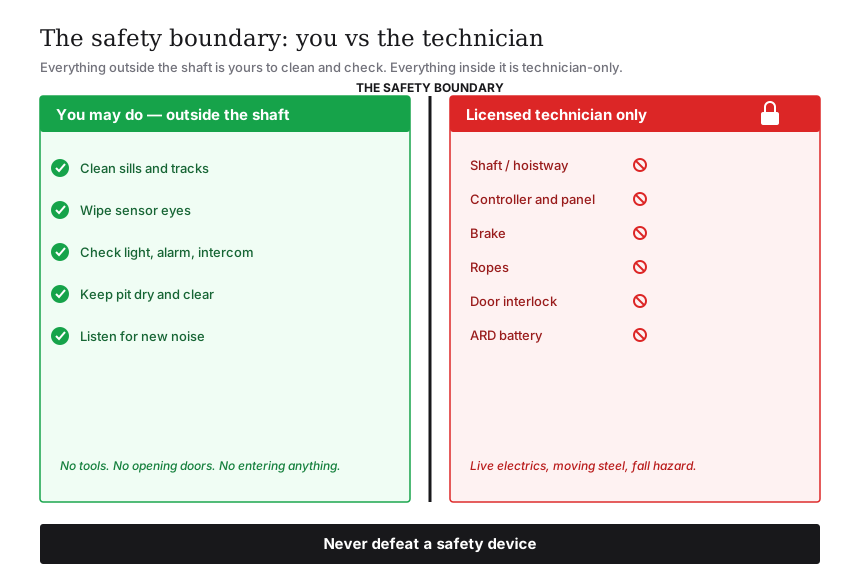
You may do (the green zone) — routine cleaning and visual checks, all outside the shaft:
- Sweep and wipe the car floor, landing sills and visible bottom tracks so dust and debris do not build up.
- Wipe the infrared door-sensor eyes / light-curtain edges clean with a dry or barely-damp cloth.
- Confirm the cabin light, emergency alarm and intercom actually work.
- Keep the machine and pit area dry, ventilated and clutter-free (never use the pit as storage).
- Listen and watch — note any new noise, jerk, vibration or levelling-off and report it.
Only a licensed technician may do (the red zone):
- Open or enter the shaft / hoistway, or open landing doors.
- Touch the controller, the drive, or any electrical panel.
- Adjust or service the brake, the traction ropes, the safety gear or governor.
- Service, align or "fix" the door interlock or door operator.
- Replace the ARD / backup battery or do any load-testing.
Never defeat a safety device. The door interlock that stops the lift moving with a door open, the light curtain that re-opens the doors, the overload sensor — these exist to protect lives. Bypassing one to "make the lift work" turns a stoppage into a serious hazard. If a safety device is tripping, that is information for your technician, not a problem to override.
If something feels wrong, your first response to ANY fault is the same: do not force anything. If someone is inside the car, use the alarm and intercom to keep them calm; switch the lift off at the main isolator if it is behaving erratically; and call your AMC or technician. That is the whole emergency playbook for a homeowner. For trapped-occupant scenarios, your installation's emergency rescue system and the ARD are designed precisely for this.
A map of common problems
When a lift misbehaves, the cause is usually one of a small set of culprits — and in Indian homes the pattern is well-known. The single biggest factor: doors account for more than 70% of lift stoppages, and roughly 65% of residential service calls trace back to voltage surges or dust rather than genuine mechanical failure. A stabiliser or clean power supply and clean sensors prevent most "phantom" faults.
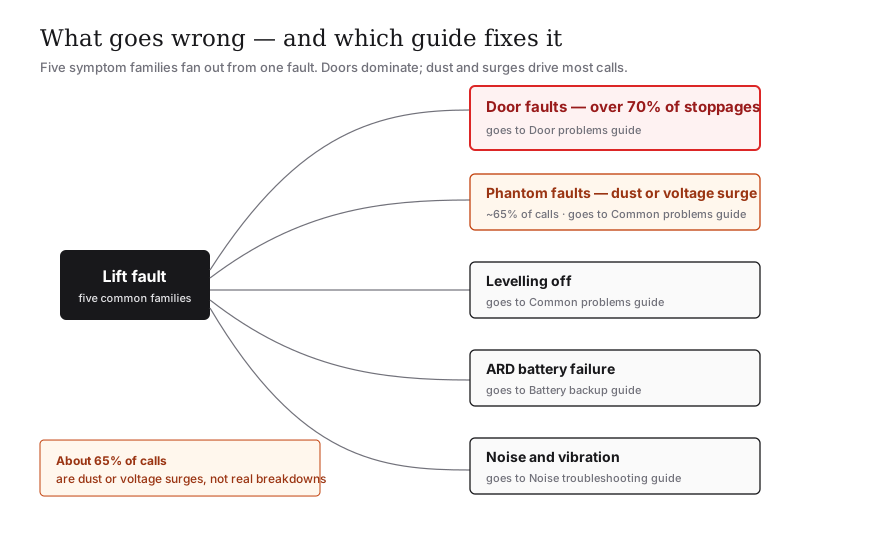
| Symptom | Likely culprit | Where it leads |
|---|---|---|
| Doors will not close, reopen, or lift will not move with door shut | Dirty sill track, dusty/misaligned sensor, interlock not seating | Lift door problems |
| Lift stops "for no reason", trips intermittently | Voltage surge or dust on PCBs / sensors | Common problems and solutions |
| Car stops above or below the floor (levelling off) | Levelling sensor / encoder or door-zone issue | Common problems and solutions |
| No auto-rescue on a power cut; dim backup light | Aged / failed ARD battery | Battery backup maintenance |
| New grinding, rumble, banging or door noise | Guide shoes, bearings, fixings, rollers or hydraulics | Lift noise troubleshooting |
The common-problems troubleshooter is your starting point for any unexplained fault; it links out to the door, noise and battery deep-dives. Note the deliberate split in our cluster: the noise-troubleshooting guide diagnoses an existing noise, while the noise-reduction (design) guide is about preventing it before installation; similarly, the battery-backup maintenance guide covers upkeep, while the battery-backup systems guide is the hardware reference.
The AMC: the contract that makes it all happen
Most homeowners do not personally arrange monthly visits — they buy an Annual Maintenance Contract and the cover happens on autopilot. Two broad shapes exist:
- Non-comprehensive (semi): routine inspection, lubrication, adjustment and labour are included; major parts (motor, controller and similar) are billed separately.
- Comprehensive ("bumper-to-bumper"): includes most spare parts and major repairs. It costs roughly 60 to 70% more than non-comprehensive but caps surprise bills.
Either way the standard rhythm is about 12 monthly preventive visits a year plus emergency breakdown calls. Operationally, the things that matter are: know what each visit should cover, keep a service logbook signed off each visit, hold the provider to the agreed response time (SLA), and renew before the contract lapses so cover is never broken. Read the AMC guide for the full operational picture, and the AMC evaluation guide when comparing providers on a scorecard. We deliberately do not quote prices here — confirm those with your technician and see the home-lift cost guide. All figures in this cluster are indicative; confirm with your vendor or licensed lift technician.
The end of the lifecycle
Maintenance keeps a lift alive; modernisation and replacement decide what happens when the equipment, not the structure, ages out.
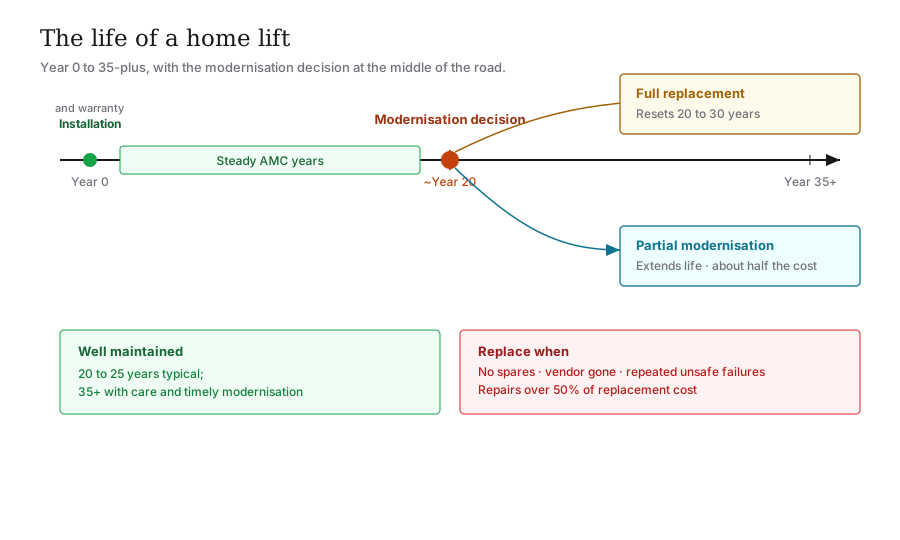
Around year 20, the electrical and control components — controller, drive, fixtures — start to age out even when the mechanical structure is sound. This is the moment to talk to your service company about modernisation. Partial modernisation (new controller, drive, doors, fixtures, a cabin refresh) extends life at sometimes around half the cost of full replacement, with far less disruption to your home. Full replacement resets the lifecycle for another 20 to 30 years and is the right call when the structure is sound but the equipment is obsolete or unsupported, spares are unavailable, the vendor has gone, the lift has failed an inspection that cannot be economically remedied, or repairs exceed roughly 50% of replacement cost.
| Situation | Usually points to |
|---|---|
| Controls aging but mechanics sound; spares still available | Modernization (partial) |
| No spares / vendor gone / unsupported equipment | Replacement |
| Repeated unsafe failures or a failed inspection that cannot be economically fixed | Replacement |
| Major capacity or accessibility change needed | Replacement |
See home-lift modernization for what can be upgraded in place, and when to replace your home lift for the full decision framework.
How it all fits together
The cleaning map below shows the handful of points a homeowner actually touches in a week — and reinforces, by what is missing from it, everything that belongs to the technician.
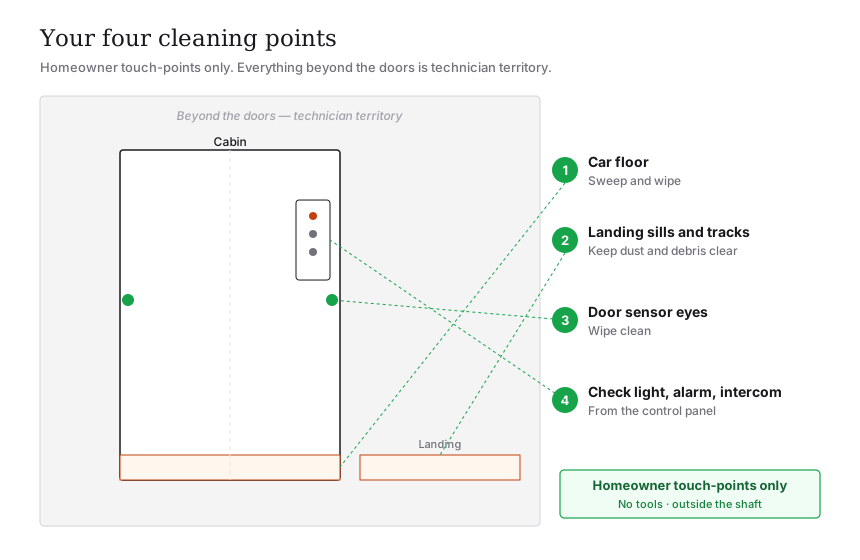
Put simply: you do a little, often, on the outside; a licensed technician does the rest, on a schedule, behind the doors. Keep both clocks running, renew the AMC before it lapses, log every visit, never override a safety device, and plan for modernisation before the lift forces the decision for you. Do that, and the lift that carries your family will keep doing it safely for decades.
Where to go next
- New, unexplained fault: Common home-lift problems and solutions
- Your monthly routine: Monthly home-lift maintenance checklist
- The yearly deep check: Annual lift inspection checklist
- Setting up cover: Lift AMC guide
- Specific symptoms: Door problems, Noise troubleshooting, Battery backup maintenance
- End of life: Modernization, When to replace
- Background and buying: Residential elevator buyer's guide, Home-lift cost in India 2026, Lift specification checklist
References
- IS 14665 (Electric Traction Lifts) — BIS, committee ETD 25; in particular Part 2, Code of practice for installation, operation and maintenance, which governs how a lift is to be serviced over its life.
- Part 2 (installation, operation and maintenance): https://law.resource.org/pub/in/bis/S05/is.14665.2.1-2.2000.pdf
- IS 15259 — companion code of practice for hydraulic lifts (referenced by name).
- IS 17900 / EN 81-20 and EN 81-50 — modern lift safety and testing standards aligned with Indian practice (referenced by name).
- National Building Code of India 2016, Part 8 (Building Services), Section 5 — Installation of Lifts, Escalators and Moving Walks.
- BIS Guide for Using NBC 2016: https://www.bis.gov.in/wp-content/uploads/2022/08/Booklet-Guide-for-Using-NBC-2016.pdf
- State Lift Acts (for periodic statutory inspection, where applicable) — e.g. Maharashtra Lifts, Escalators and Moving Walks Act 2017; Karnataka Lifts, Escalators and Passenger Conveyors Act 2015; Tamil Nadu Lifts Act 1997; Delhi Lifts and Escalators Act 2007.
- Overview of lift regulations in India: https://www.99acres.com/articles/know-all-about-the-lift-regulations-in-india.html
- Residential lift lifespan (ShuttleSky): https://shuttlesky.in/residential-elevator-lifespan/
- Elevator modernization lifecycle and ROI (TK Elevator): https://www.tkelevator.com/in-en/news/elevator-modernization-lifecycle-and-roi-considerations.html
- Ensuring lift longevity through maintenance (TK Elevator): https://www.tkelevator.com/in-en/news/ensuring-lift-longevity.html
- Common problems with home lifts (EFE): https://efepvtltd.com/blogs/what-are-the-common-problems-with-home-lifts/
All regulatory and cost references in this cluster are indicative and vary by state, vendor and year — confirm with your local municipal bye-laws and a licensed lift contractor.
Export this guide
Related Guides — Deep-dive reading
Lift Door Problems Explained (India): Why Doors Cause Most Faults
Doors cause over 70 percent of home-lift stoppages. Read the symptom, find the cause, and know which fixes are owner-safe and which belong to a licensed technician.
Home Lifts & AccessibilityCommon Home Lift Problems and Solutions (India)
The troubleshooting reference: symptom, likely cause, and what you can safely do versus when to call the technician.
Home Lifts & AccessibilityMonthly Home Lift Maintenance Checklist (India): The Owner's Routine
A complete, printable monthly routine you can run yourself in ten minutes — clean, check, listen, and know exactly when to stop and call the technician.
Home Lifts & AccessibilityRelated Tools — Try Free
Lift Safety Audit Checklist
Interactive checklist that scores your home lift on safety devices, compliance and upkeep.
ChecklistHome Lift Cost Calculator
All-in home lift cost by floors, type, capacity and city — equipment, civil, GST and AMC, with a drive-type comparison.
Lift CalculatorLift Annual Maintenance Cost Calculator
AMC cost for a home lift — comprehensive vs non-comprehensive, with a 5-year projection.
Lift Calculator