

When Should You Replace a Home Lift? (India)
The end-of-life decision: a calm replace-vs-modernise framework and the five clear triggers to replace an ageing residential lift rather than modernise it.
A home lift is a long-lived machine. Looked after well, a residential lift in India lasts about 20 to 25 years, and with steady care plus partial modernisation along the way, many keep running safely for 35 years or more. So if your lift is getting old, slow or temperamental, the honest first answer is usually reassuring: you very rarely need to rip it out and start again. Most ageing lifts can be modernised — new controller, drive, doors, fixtures and cabin — for far less money and disruption than a full replacement.
This guide is about the smaller set of cases where modernisation is not enough and replacement is the right call. It gives you a calm decision framework — age, safety, spares, cost and changing needs — and the clear triggers that tip the balance from "modernise" to "replace". If you have not yet read it, the companion piece on home lift modernization in India is the one to start with: it explains what modernisation actually involves and is the right answer for the large majority of older lifts. This guide is its counterpart for the end-of-life decision.
The big picture: a sound shaft and structure are worth a lot. As long as the building and hoistway are fine, replacing only the equipment inside (which is what modernisation does) is usually the cheaper, faster, less disruptive path. Replacement is for when the equipment itself has reached the end of the road.
How long a home lift actually lasts
Think of a residential lift's life in phases rather than a single expiry date.
| Phase | Typical age | What is happening | What to do |
|---|---|---|---|
| Run-in and prime | 0 to 10 years | Everything modern and supported; routine wear only | Keep up routine maintenance and a live AMC |
| Mature | 10 to 20 years | Doors, rollers, batteries, fixtures show wear; minor parts replaced | Tighten servicing; budget for door/battery refresh |
| Modernisation window | ~20 years | Electrical and control components age out; controller and drive become dated | Talk to your service company about partial modernisation |
| Extended life | 20 to 35+ years | A modernised lift runs like a much newer one | Modernise in stages; replace only if a trigger below fires |
| End of life | varies | Equipment obsolete or unsupported, spares gone, or unsafe | Replace — resets the clock for another 20 to 30 years |
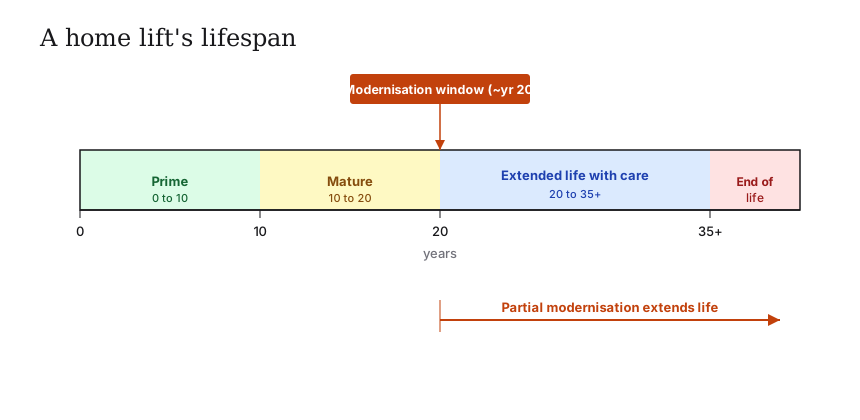
The key takeaway from this timeline: year 20 is a decision point, not a death sentence. It is the moment to sit down with your service company, look at the condition of the control gear, drive and doors, and decide whether a partial modernisation will carry the lift comfortably for another decade or two. For most homes, it will.
Replace or modernise? The core decision
Almost every ageing lift falls into one of two camps.
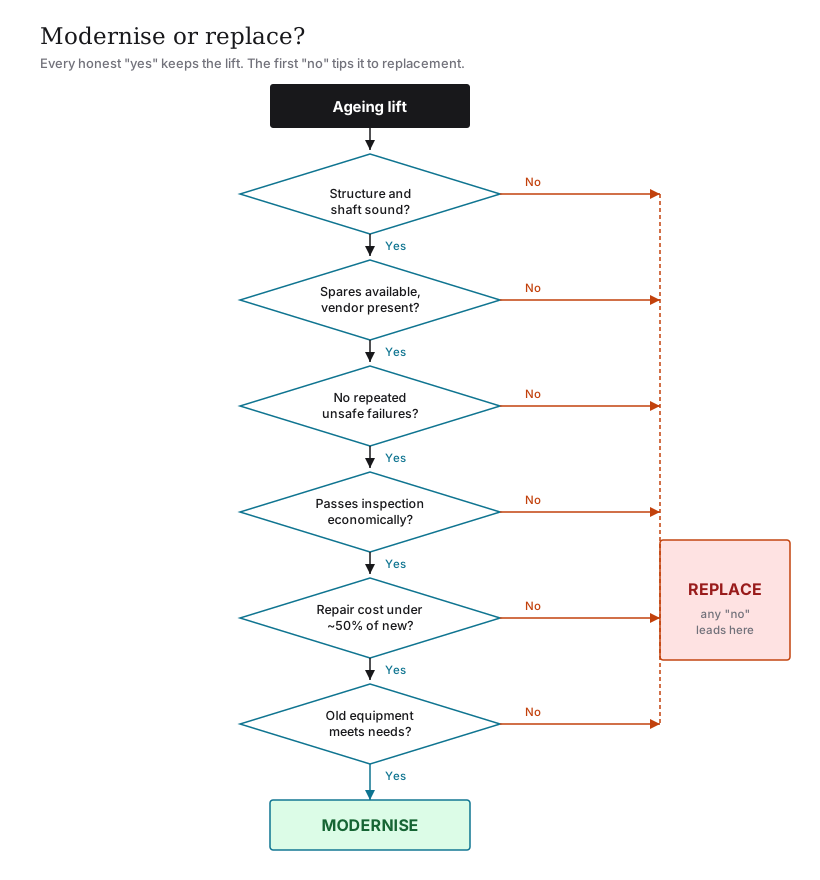
- Modernise when the structure and shaft are sound and the problem is ageing or dated equipment — an old controller, a tired drive, clunky manual doors, faded fixtures, a worn cabin. You keep the rails, the hoistway and often the car frame, and renew the parts that have aged. It typically costs meaningfully less than a full replacement (sometimes roughly half) and disrupts the household far less.
- Replace when the equipment has genuinely reached the end of its supportable life — spares no longer exist, the maker has vanished, it keeps failing unsafely, it cannot pass inspection economically, or your needs have changed in a way the old machine simply cannot meet.
The honest default is modernise. Replacement is the exception, justified by one of the specific triggers below — not by age alone.
The five triggers to REPLACE rather than modernise
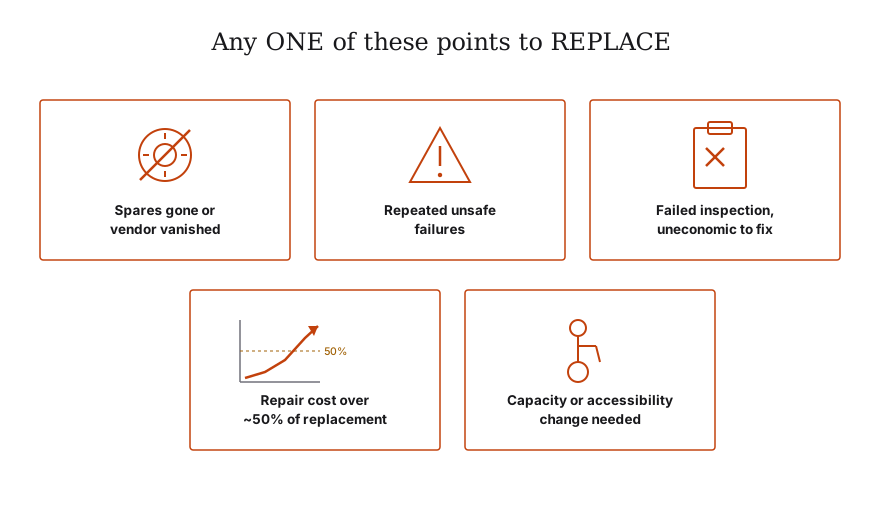
You do not need all five. Any one of these, clearly met, points to replacement. Treat them as a checklist you work through with your licensed technician.
| ☐ | Trigger | Why it forces replacement |
|---|---|---|
| ☐ | Spare parts gone, or the vendor has vanished | If the controller, drive or door operator can no longer be sourced and your installer has shut down or exited the market, the lift cannot be reliably repaired or modernised. Orphaned equipment is the most common reason to replace. |
| ☐ | Repeated unsafe failures | A lift that keeps failing in ways that affect safety — not just nuisance stops — is past saving by patching. If brake, levelling or door-safety faults recur despite proper servicing, replace. |
| ☐ | A failed statutory inspection that cannot be economically remedied | Where your state Lift Act requires periodic inspection, a failure you cannot fix at sensible cost (because the fix needs unavailable parts or a wholesale rebuild) is a clear replace signal. |
| ☐ | Repair and upkeep costs exceeding roughly 50% of replacement | When the running cost of keeping it alive — repeated major repairs plus rising maintenance — climbs past about half the cost of a new lift, you are pouring money into a sinking asset. |
| ☐ | A major change in capacity or accessibility the old lift cannot meet | If you now need a larger car, wheelchair access, a 900 mm clear door, automatic doors, or to serve an added floor, and the old equipment and shaft cannot be adapted, replacement is the route. |
Reading the triggers calmly
A single off day does not count. "Repeated unsafe failures" means a genuine, recurring pattern that survives proper servicing — confirmed by your technician, not by a frustrating week. Likewise, a failed inspection that can be economically remedied is a repair job, not a replacement; only an uneconomic failure tips the scale. The 50% cost rule is a guide, not a law — weigh it against how many more years a sound modernisation would buy you.
Safety note, as always: judging brake, levelling, door-interlock or rope condition is a licensed technician's job. A homeowner does routine cleaning and checks outside the shaft; never open the shaft, controller or panel, and never defeat a safety device to "keep it running". If a lift is failing unsafely, take it out of service and call your technician.
A calm decision framework
When the question comes up, walk through five lenses in order. The first that returns a hard "replace" settles it; otherwise you almost certainly modernise.
1. Age — Is it past the ~20-year modernisation window? Age alone is a prompt to assess, not a reason to replace.
2. Safety — Are failures merely a nuisance, or do they touch safety and recur despite servicing? Recurring unsafe failures point to replace.
3. Spares — Can the controller, drive and door parts still be sourced, and is the vendor (or a competent successor) still around? No spares means replace.
4. Cost — Are accumulating repairs and upkeep heading past ~50% of a new lift? If so, replacement is the better spend.
5. Needs — Has your requirement changed — bigger car, wheelchair access, an extra floor — beyond what the old shaft and equipment can deliver? A needs change the old lift cannot meet points to replace.
If none of these returns a clear replace, your lift is a modernisation candidate — read the modernization guide for what that involves and how it is staged.
What replacement actually buys you
A full replacement removes the old equipment and installs a new lift in the existing shaft (assuming the structure is sound). The benefit is a clean reset: a new lift resets the lifecycle for another 20 to 30 years, with current safety features — overspeed governor and safety gear, door light-curtain, an ARD battery backup for India's power cuts, overload sensing and intercom — and the chance to fix the things the old lift never had, such as automatic doors or an accessible car.
On cost, we keep numbers in one place rather than scattering figures that date quickly. For indicative replacement and modernisation costs — and how civil work, GST and AMC factor in — see the home lift cost guide for India 2026. As a rule of thumb only: modernisation typically costs meaningfully less than a new lift, which is exactly why it is the default for a sound, supported lift; replacement is the call when the equipment is genuinely beyond support. Treat any figure as indicative — confirm with your technician and current quotations.
If you are weighing the two, ask your service company for a written assessment of (a) spare-parts availability for your specific model, (b) the cost to bring the lift through its next statutory inspection, and (c) a modernisation quote versus a replacement quote. Those three documents usually make the decision obvious.
Before you decide — and after
Whichever way you go, the foundations are the same: a live AMC, honest servicing and good records. A well-documented service history is itself evidence in the decision — it shows whether failures are recurring and whether parts are still being sourced. Keep these companions handy:
- Home lift maintenance guide (India) — the routine that gets a lift to 25 and beyond.
- Home lift modernization (India) — the right answer for most ageing lifts; read this before concluding "replace".
- Lift AMC guide (India) — what a maintenance contract should cover; and the AMC evaluation guide for the scorecard view.
- Common home lift problems and solutions (India) — so you can tell a fixable fault from a fatal one.
- Residential elevator buyer's guide (India) and the lift specification checklist — for getting the replacement right if you reach that point.
The bottom line: do not let age alone scare you into a replacement. A sound shaft and a supportable machine almost always favour modernisation. Reach for replacement only when one of the five triggers clearly fires — spares gone, repeated unsafe failures, an uneconomic failed inspection, repair costs past half of new, or a needs change the old lift cannot meet — and when it does, replace with confidence, knowing you are buying another two to three decades of safe travel.
References
- IS 14665 (Electric Traction Lifts) — Part 2: Code of practice for installation, operation and maintenance (the basis for keeping a lift serviceable through its life); Part 5: Inspection manual. BIS, committee ETD 25.
- IS 14665 Part 2 (BIS): https://law.resource.org/pub/in/bis/S05/is.14665.2.1-2.2000.pdf
- IS 17900 / EN 81-20 and EN 81-50 — modern lift safety and design/installation requirements that a replacement lift should meet (referenced by name).
- National Building Code of India 2016, Part 8 (Building Services), Section 5 — Installation of Lifts, Escalators and Moving Walks.
- BIS Guide for Using NBC 2016: https://www.bis.gov.in/wp-content/uploads/2022/08/Booklet-Guide-for-Using-NBC-2016.pdf
- State Lift Acts (periodic statutory inspection by government-appointed inspectors) — for example the Maharashtra Lifts, Escalators and Moving Walks Act 2017; Karnataka Lifts, Escalators and Passenger Conveyors Act 2015; Delhi Lifts and Escalators Act 2007; Tamil Nadu Lifts Act 1997. Verify obligations against your state's Act and local bye-laws.
- Lift regulations in India (overview): https://www.99acres.com/articles/know-all-about-the-lift-regulations-in-india.html
- Lifespan, modernisation and end-of-life (industry references):
- TK Elevator — modernization lifecycle and ROI considerations: https://www.tkelevator.com/in-en/news/elevator-modernization-lifecycle-and-roi-considerations.html
- TK Elevator — ensuring lift longevity: https://www.tkelevator.com/in-en/news/ensuring-lift-longevity.html
Regulatory and cost details are indicative and vary by state, vendor and year — confirm with your local municipal bye-laws and a licensed lift contractor before deciding.
Export this guide
Related Guides — Deep-dive reading
Home Lift Maintenance Guide (India): Keeping Your Lift Safe and Reliable
The homeowner's map to lift upkeep — the maintenance cadence, who does what, the safety boundary, and the lifecycle from first service to modernisation.
Home Lifts & AccessibilityHome Lift Modernization Guide (India): Upgrading an Ageing Lift
When an old lift's controller, drive, doors and cabin age out around year 20, partial modernisation renews the equipment inside the existing shaft — extending life at lower cost than full replacement.
Home Lifts & AccessibilityLift Specification Checklist (India): The Spec Sheet to Hand Every Home-Lift Vendor
One fillable spec sheet that forces every vendor to quote like-for-like on your shaft, your stops, your safety features.
Home Lifts & AccessibilityRelated Tools — Try Free
Lift Safety Audit Checklist
Interactive checklist that scores your home lift on safety devices, compliance and upkeep.
ChecklistHome Lift Budget Planner
Full line-item budget for a home lift — equipment, finishes, civil, GST, AMC and contingency.
Lift PlannerLift Annual Maintenance Cost Calculator
AMC cost for a home lift — comprehensive vs non-comprehensive, with a 5-year projection.
Lift Calculator