
Lift AMC Evaluation Guide (India): Comprehensive vs Non-Comprehensive, Costs & What to Check
The second half of buying a home lift: how to read, score and renew the contract that keeps it running.
A home lift is the only machine in your house that carries your family between floors several times a day, year after year. Like a car, it does not look after itself: ropes stretch, door sensors drift out of alignment, controllers age, and battery backups quietly lose charge. The contract that keeps all of this in good health is the Annual Maintenance Contract (AMC) — and choosing the right one is as consequential as choosing the lift itself.
This guide is written for homeowners who have already bought (or are about to buy) a home elevator and now have to sign — or renew — an AMC. We explain what an AMC is and why a lift legally and practically needs one, unpack the two contract types you will be offered (comprehensive versus non-comprehensive), give indicative ₹ costs for India in 2026, and hand you two ready-to-use tables: a coverage comparison matrix and an AMC scorecard you can fill in to rate competing offers side by side. It is a spoke of our residential elevator buyer's guide; for the purchase price itself, see the home lift cost guide, and to choose the maker behind the contract, the lift vendor comparison.
Why a home lift must be under AMC
In the roughly ten Indian states that regulate lifts under their own Acts — Maharashtra, Gujarat, Karnataka, Kerala, Tamil Nadu, Assam, West Bengal, Delhi, Haryana and Himachal Pradesh — keeping a lift in safe, serviced condition is not optional. Periodic safety inspection by the State Electrical or Lift Inspectorate is part of your operating obligation, and an inspector will expect a maintenance record. Even in states without a dedicated Act, IS 14665 Part 2 (the code of practice for installation, operation and maintenance) treats regular preventive maintenance as standard practice. Skipping the AMC to save money is, in most states, both unsafe and non-compliant.
Beyond the law, the economics are simple. A lift is a wear system. Door operators, sensors, governors and brakes need periodic adjustment; lubricant breaks down; the Automatic Rescue Device (ARD) battery — the unit that brings the car to the nearest floor and opens the doors during a power cut, essential given India's outages — must be tested and replaced before it fails silently. A serviced lift breaks down less, stops less often with someone inside, and lasts longer. The AMC is what converts a one-time purchase into two decades of reliable service.
Treat the AMC as the second half of the purchase decision, not an afterthought you negotiate in the last five minutes. A cheap lift on a weak contract is more expensive over ten years than a fairly priced lift on a strong one.
The standard service: what "12 visits a year" actually means
The industry baseline for a residential lift is roughly 12 preventive visits per year — one a month — plus emergency breakdown calls on top. Each preventive visit is a checklist exercise: the technician inspects and lubricates moving parts, checks door timing and sensors, tests the alarm, intercom, overload sensor and the ARD battery, examines ropes or the screw/piston for wear, and logs the readings. Breakdown calls are reactive — you ring when the lift stops — and how fast someone arrives is governed by the response-time SLA in your contract, discussed below.
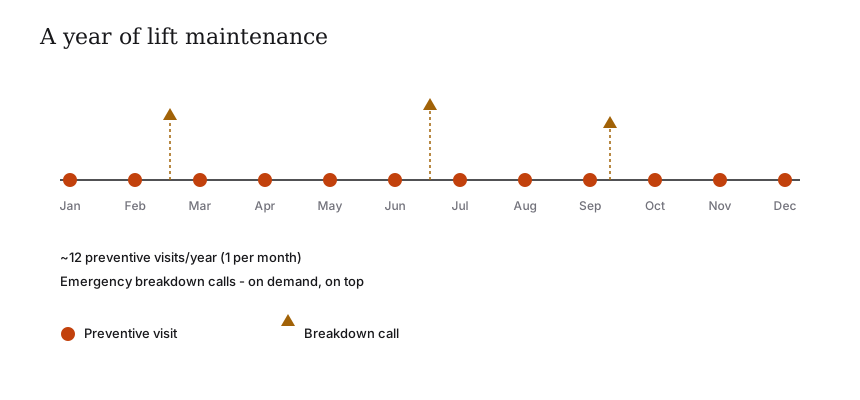
When you compare offers, confirm the visit frequency in writing. Some low-priced contracts quietly drop to quarterly visits. For a lift carrying elderly parents or a wheelchair user, monthly is the standard you want — and it is the cadence assumed by the indicative prices in this guide.
Comprehensive vs non-comprehensive: the core choice
Every AMC you are offered will be one of two kinds.
Non-comprehensive (also called "semi" or labour-only) covers the routine work: scheduled inspection, lubrication, adjustment and the technician's labour. Crucially, major parts are billed to you separately. If the motor, controller, door operator or a worn rope needs replacing, you pay for that part on top of the contract fee. This is cheaper year-on-year but leaves you exposed to large, unpredictable bills.
Comprehensive ("bumper-to-bumper") rolls most spare parts and major repairs into the fixed annual fee. It costs about 60–70% more than a non-comprehensive contract for the same lift, but it caps your surprise bills: a failed controller or motor is the vendor's problem, not a sudden ₹1–2 lakh demand. For a young lift under a known brand with good parts availability, comprehensive buys peace of mind; for an older or out-of-warranty lift, it can be the difference between a predictable budget and a nasty year.
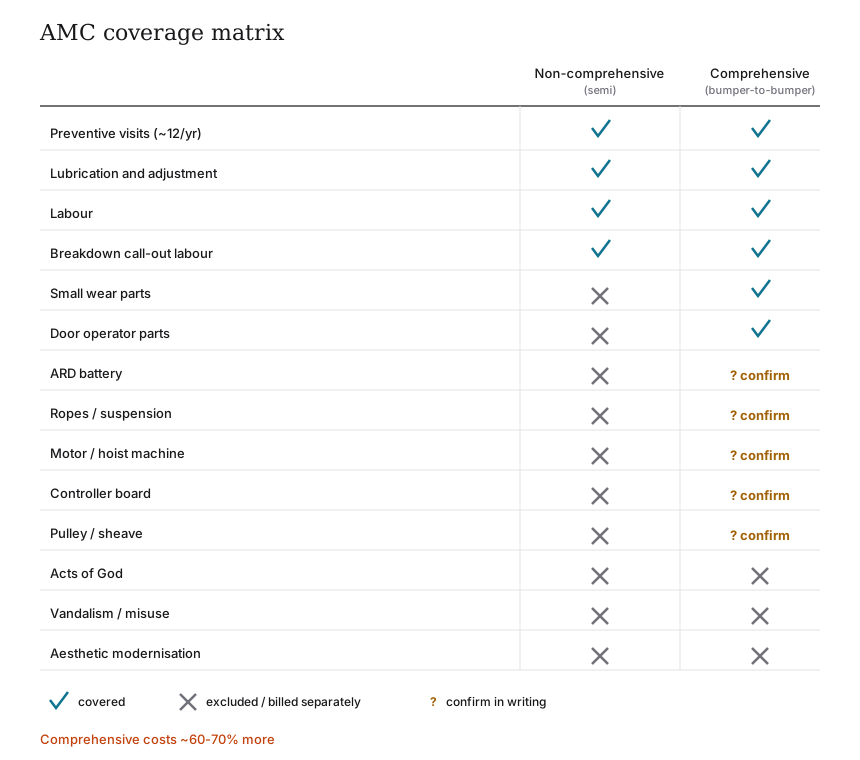
The catch is that "comprehensive" is not a regulated term — what it covers varies by vendor, and several contracts that call themselves comprehensive still exclude specific high-value items such as the motor, controller, machine, pulley or rope. The matrix below shows the typical split; the exclusions list shows what to hunt for in the fine print.
Coverage comparison table
| Item / Event | Non-comprehensive (semi) | Comprehensive ("bumper-to-bumper") |
|---|---|---|
| Scheduled preventive visits (~12/yr) | Included | Included |
| Lubrication & routine adjustment | Included | Included |
| Technician labour (visits & repairs) | Included | Included |
| Emergency breakdown call-outs | Included (labour); parts extra | Included |
| Small wear parts (sensors, contacts, fuses) | Billed separately | Usually included |
| Door operator / door parts | Billed separately | Usually included |
| ARD battery replacement | Billed separately | Often included — confirm |
| Ropes / suspension (traction) | Billed separately | Sometimes excluded — confirm |
| Motor / hoist machine | Billed separately | Sometimes excluded — confirm |
| Controller / control board | Billed separately | Sometimes excluded — confirm |
| Pulley / sheave | Billed separately | Sometimes excluded — confirm |
| Acts of God (pit flooding, lightning) | Excluded | Excluded |
| Vandalism / misuse damage | Excluded | Excluded |
| Aesthetic modernisation / upgrades | Excluded | Excluded |
The right-hand column deliberately says "usually" and "sometimes excluded — confirm" because the variation between vendors is real. Treat the table as your interview script: walk down the list and make the vendor mark each row "in" or "out" on their own letterhead before you sign.
The single most important question to ask a salesperson is not "is this comprehensive?" but "does this comprehensive contract cover the motor, the controller and the ropes — yes or no, in writing?" Those three items are the expensive failures, and they are exactly the ones some contracts carve out.
Indicative costs for India, 2026
For a small residential lift, a non-comprehensive AMC runs roughly ₹20,000–38,500 per year — one widely seen example contract is around ₹38,500 with an annual escalation of about 5%. A comprehensive contract for the same lift costs about 60–70% more, so expect broadly ₹32,000 to ₹65,000 per year depending on lift type, brand, floors served and your city.
| AMC type | Indicative annual cost (small home lift) | What drives it up |
|---|---|---|
| Non-comprehensive | ₹20,000 – ₹38,500 | More floors, premium brand, faster SLA |
| Comprehensive | ~60–70% more than the above (≈₹32,000 – ₹65,000) | Parts coverage depth, brand, lift type |
These are indicative — confirm with your licensed lift contractor and against the actual quotation for your model. A contract is usually quoted exclusive of GST (18% applies), and the figures rise with each additional floor and with premium imported brands. They are also separate from the purchase price; for that whole picture see the home lift cost guide.
Response time, SLAs and spare-parts availability
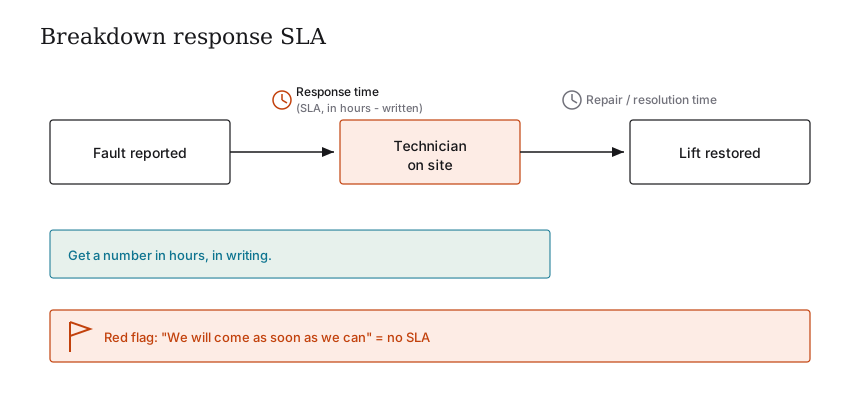
A contract is only as good as how fast help arrives when the lift stops with a person inside. Three things decide that, and all three should be written into the AMC, not promised verbally.
- Breakdown response time / SLA. This is the maximum time the vendor commits to having a technician on site after you report a fault — distinct from the time to resolve it. A serious local vendor will commit to a few hours within the city; a vague "we'll come as soon as we can" is a red flag, especially if elderly residents could be trapped.
- Local service presence. A national brand with no engineer in your city can be slower than a smaller regional installer next door. Ask where the nearest service team is based and how many lifts of your type they already maintain locally.
- Spare-parts availability. Confirm that parts for your specific model are stocked in India and how long a non-stocked part takes to arrive. An imported lift with a long parts lead time can sit dead for weeks — this is one of the classic home-lift pitfalls, alongside undersizing the shaft and skipping the ARD.
The vendor you choose for the lift largely dictates the service you will get, so weigh service depth at purchase time — the vendor comparison guide and the specification checklist both help you bake AMC quality into the buying decision rather than discovering it later.
How to read the fine print
Before you sign, read the document — not the brochure — and look specifically for the gaps where money and safety hide:
- Exclusions clause. Even comprehensive contracts exclude acts of God (pit flooding from monsoon, lightning), vandalism, misuse and aesthetic modernisation. Note these so you understand what your home insurance or a separate provision must cover.
- Parts carve-outs. Re-read for any line removing the motor, controller, machine, pulley or rope from coverage. This is where a "comprehensive" contract can quietly become semi-comprehensive.
- Visit frequency. Confirm it states ~12 visits a year, not "periodic" or "as required".
- Response-time commitment. A number in hours, with a sense of what happens if it is missed.
- Escalation clause. The annual percentage increase (≈5% is common) and whether it is capped.
- Term and exit. Contract length, auto-renewal, notice period and what a mid-term cancellation costs.
- ARD and safety testing. That the battery backup, alarm, intercom and overload sensor are tested every visit and logged.
The AMC scorecard: rate competing offers
When two or three vendors quote, price alone is the wrong tie-breaker. Score each offer on weighted criteria so coverage, speed and service presence count alongside cost. Fill the scorecard below for each vendor: rate every row 0–5, multiply by the weight, and total the weighted column. The highest weighted total — not the cheapest sticker — is usually your best contract.
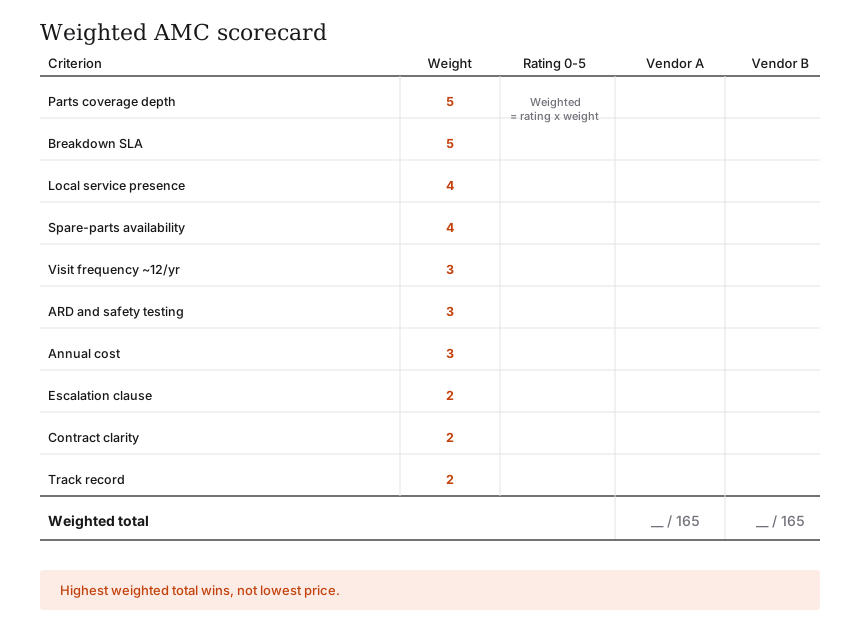
| Criterion | Weight | Vendor A (0–5) | Vendor A × wt | Vendor B (0–5) | Vendor B × wt |
|---|---|---|---|---|---|
| Parts coverage depth (motor/controller/ropes in?) | 5 | ☐ | ☐ | ||
| Breakdown response-time SLA (hours, in writing) | 5 | ☐ | ☐ | ||
| Local service presence / engineers nearby | 4 | ☐ | ☐ | ||
| Spare-parts availability for your model | 4 | ☐ | ☐ | ||
| Visit frequency confirmed (~12/yr) | 3 | ☐ | ☐ | ||
| ARD & safety-feature testing each visit | 3 | ☐ | ☐ | ||
| Annual cost vs comparable offers | 3 | ☐ | ☐ | ||
| Escalation clause (low %, capped) | 2 | ☐ | ☐ | ||
| Clarity / completeness of written contract | 2 | ☐ | ☐ | ||
| Track record & references for your lift type | 2 | ☐ | ☐ | ||
| Weighted total | — | ___ / 165 | ___ / 165 |
A perfect score is 165 (the sum of all weights × 5). Use the totals to start a conversation, not to end it — if the cheaper offer scores well on coverage and SLA but loses only on brand prestige, it may be the smarter contract.
Renewal and escalation tips
- Diarise the renewal date. Lapsing the AMC even for a month leaves you uncovered for a breakdown and can complicate your state inspection record.
- Expect ~5% annual escalation and confirm it is written and ideally capped; resist open-ended "market rate" clauses.
- Re-evaluate type at renewal. As the lift ages and leaves warranty, the case for switching from non-comprehensive to comprehensive strengthens — older parts fail more often, and the fixed fee starts to pay for itself.
- Use the scorecard again. A renewal is a chance to re-quote against a competitor; vendors sharpen their pencils when they know you have an alternative.
- Keep the service log. A complete, signed visit record protects you at inspection time, supports any warranty claim, and lifts the resale value of the home.
- Bundle the conversation with future-proofing. If you are renewing as part of a larger renovation, revisit accessibility provisions too — our accessible home design guide and lift-ready, future-proof home guide cover the long view.
A well-chosen AMC is invisible: the lift simply works, the family never thinks about it, and the annual cheque is the cheapest insurance in the house. The work of choosing it well happens once a year, with the two tables above and a willingness to read past the brochure.
References
- IS 14665 (Electric Traction Lifts) — Part 1, Outline dimensions (BIS): https://law.resource.org/pub/in/bis/S05/is.14665.1.2000.pdf
- IS 14665 — Part 2, Code of practice for installation, operation & maintenance (BIS): https://law.resource.org/pub/in/bis/S05/is.14665.2.1-2.2000.pdf
- National Building Code of India 2016, Part 8 Section 5 — Installation of Lifts, Escalators & Moving Walks (BIS): https://www.bis.gov.in/standards/technical-department/national-building-code/
- BIS Guide for Using NBC 2016: https://www.bis.gov.in/wp-content/uploads/2022/08/Booklet-Guide-for-Using-NBC-2016.pdf
- Rights of Persons with Disabilities (RPwD) Act 2016 — full text: https://ssepd.odisha.gov.in/sites/default/files/2024-01/RPWD%20ACT.pdf
- CPWD Harmonised Guidelines & Space Standards for a Barrier-Free Built Environment (2016): https://www.cpwd.gov.in/Publication/Harmonisedguidelinesdreleasedon23rdMarch2016.pdf
- Maharashtra licence to operate lift — National Government Services Portal: https://services.india.gov.in/service/detail/maharashtra-license-to-operate-lift
- Lift regulations in India (overview) — 99acres: https://www.99acres.com/articles/know-all-about-the-lift-regulations-in-india.html
Export this guide
Related Guides — Deep-dive reading
Home Lift Planning Checklist (India): Everything to Decide Before You Buy
A printable, ten-stage checklist that takes you from the first family conversation to a signed handover.
Home Lifts & AccessibilitySecurity AMC Buying Guide (2026): How to Buy a Maintenance Contract That Keeps the System Working
A decision guide to buying an Annual Maintenance Contract for a home or building security system in India — the types of AMC and how to choose, what a good scope must include, the clauses that decide whether you are covered, how to compare quotes like-for-like, and the red flags that hide a dead camera you only discover the night you need it.
SecurityLift Specification Checklist (India): The Spec Sheet to Hand Every Home-Lift Vendor
One fillable spec sheet that forces every vendor to quote like-for-like on your shaft, your stops, your safety features.
Home Lifts & AccessibilityRelated Tools — Try Free
Lift Installation Timeline Calculator
Phase-wise timeline in weeks for installing a home lift — new build or retrofit.
Lift CalculatorAccessibility Compliance Calculator
Check a planned lift against the CPWD and RPwD accessible-lift benchmarks for a score.
Lift CheckerHome Lift Budget Planner
Full line-item budget for a home lift — equipment, finishes, civil, GST, AMC and contingency.
Lift Planner