
Battery Backup Systems for Elevators (India): ARD Battery vs Full Lift UPS
The power-and-battery hardware behind a home lift: a small ARD that does one auto-rescue move on a power cut versus a full lift UPS or inverter that keeps the lift running on battery — chemistries, sizing, maintenance and how to choose for India.
A home lift is only as reliable as the power feeding it, and in most Indian neighbourhoods the grid still blinks several times a week. The question is not whether your lift loses mains power, but what it does in those minutes. There are two very different answers, and they cost very different money. A small ARD battery does one thing: when the power cuts, it drives the car to the nearest floor, opens the doors, and lets everyone walk out. A full lift UPS (also sold as a lift inverter or lift backup) does something far more ambitious: it keeps the lift running on battery, so you carry on using it through a power cut as if nothing happened.
This guide is about that hardware choice — the lift battery backup itself. It is the deliberate companion to our emergency rescue systems guide, which covers the rescue system and exactly what to do if you are ever trapped. Here we stay on the power and battery side: what each box does, the battery chemistries inside, how they are sized, how often they need replacing, and how to decide between the two for an Indian home.
The real decision is not "do I want a backup" — every Indian home lift needs at least an ARD. It is "do I only need to escape the lift on a power cut, or do I need to keep using it?"
Two boxes, two jobs
It helps to picture the two devices side by side, because vendors often blur them in a quotation.
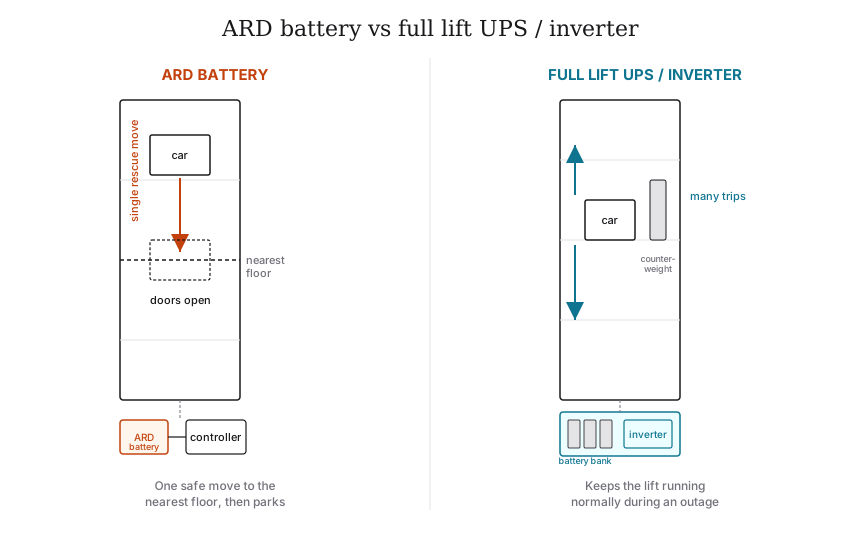
An ARD (Automatic Rescue Device) is a small battery and a control board that sit next to the lift controller. It does not try to power the whole lift. On a mains failure it uses the gentlest possible move — usually letting the car drift in the easy direction under controlled brake release, or driving the motor briefly at low speed — to reach the nearest landing, then it opens the doors. One move, doors open, job done. The factbase is blunt about this: an ARD is essential in India given outages — do not buy a home lift without it.
A full lift UPS or inverter is a bigger animal. It carries a proper battery bank and an inverter that, the moment the grid drops, switches the lift over to battery power. For a three-phase lift the inverter has to generate a 3-phase output from the battery's DC, and that handover takes roughly 15 to 20 seconds — the lift pauses, the inverter spins up its 3-phase waveform, and then normal service resumes. From then on the lift runs trip after trip on battery until either the mains returns or the battery is exhausted.
| ARD battery | Full lift UPS / inverter | |
|---|---|---|
| What it does on a power cut | One automatic rescue move to the nearest floor, then opens doors | Keeps the whole lift running normally, trip after trip |
| Outcome for you | You can get out safely | You can keep using the lift |
| Switchover | Near-instant, single move | About 15-20 seconds (inverter builds the 3-phase output) |
| Three-phase lifts | Just needs enough power for one slow move | Inverter must synthesise a full 3-phase supply from the battery |
| Battery size | Small | Large (sized for the number of runs you want) |
| Typical run capacity | A handful of rescue moves | Many full trips, or sustained running for a set time |
| Relative cost | Low — often bundled | Considerably higher (battery bank + inverter) |
| Best when | Outages are short and infrequent | Outages are long or frequent and you must keep using the lift |
The clean way to remember it: ARD is for the people inside the lift; UPS is for the household that wants the lift to keep working. Both run off batteries, but they are sized and priced for completely different jobs.
What actually happens at the moment of a power cut
The switchover sequence is where the two diverge, and it is worth understanding because the 15-to-20-second pause on a UPS surprises people who expect instant continuity.
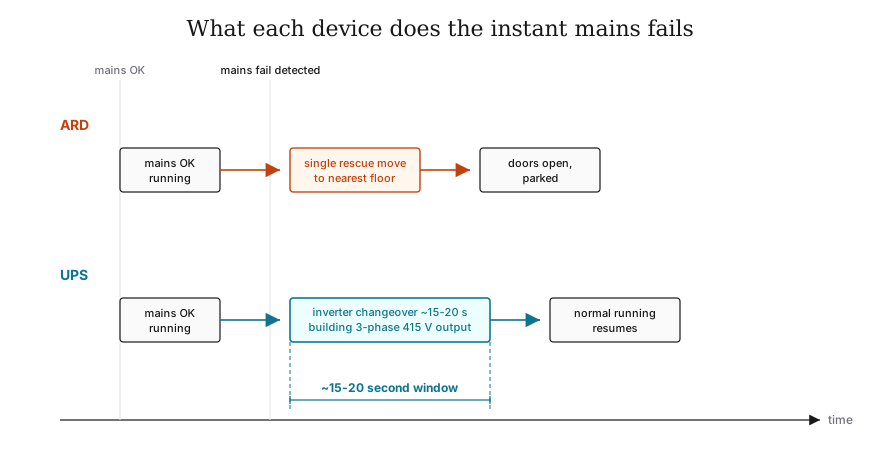
With an ARD, the controller senses the mains has gone, waits a moment for the car to be safe, and executes its one rescue move. If you were standing still between floors, the car eases to the nearest landing and the doors open. There is no attempt to resume normal service — the lift is now "parked" until mains returns. This is also why an ARD pairs naturally with the emergency alarm and two-way intercom described in the rescue systems guide: the ARD gets you out, and if anything prevents that, the intercom gets you help.
With a full UPS, the inverter detects the failure and begins its changeover. For a single-phase lift this is relatively quick. For a three-phase lift the inverter must build a stable three-phase, 415 V output from the DC battery — that synthesis is what takes the 15-to-20-second window. During those seconds the lift is paused for safety; afterwards it runs as normal. The trade-off is honest: you get continuity, but not seamless continuity. (If your lift is single-phase, see our single-phase versus three-phase guide — the phase of your lift changes how much work the inverter has to do and therefore the cost of a UPS.)
What is inside the box: battery chemistries
Both ARDs and UPS systems store their energy the same way, and you will see two chemistries quoted.
- Sealed lead-acid (SMF / VRLA): the long-standing default. SMF stands for "sealed maintenance-free" — they do not need topping up with water and they are sealed against acid spillage, which is why they are common in lift backup. They are heavier, have a shorter calendar life, and prefer a cool, ventilated spot. Inexpensive and proven.
- Lithium (Li-ion / LiFePO4): increasingly common. Lighter, longer-lived, tolerant of more charge-discharge cycles, and happier with partial discharges. They cost more up front, but the longer replacement interval can even out over the life of the lift. Lithium also takes up less space, which matters when the battery bank for a UPS is large.
"Sealed" and "maintenance-free" describe the casing, not the lifespan. Even an SMF battery quietly ages and must be replaced on schedule — the seal just means it will not leak acid or need watering while it does.
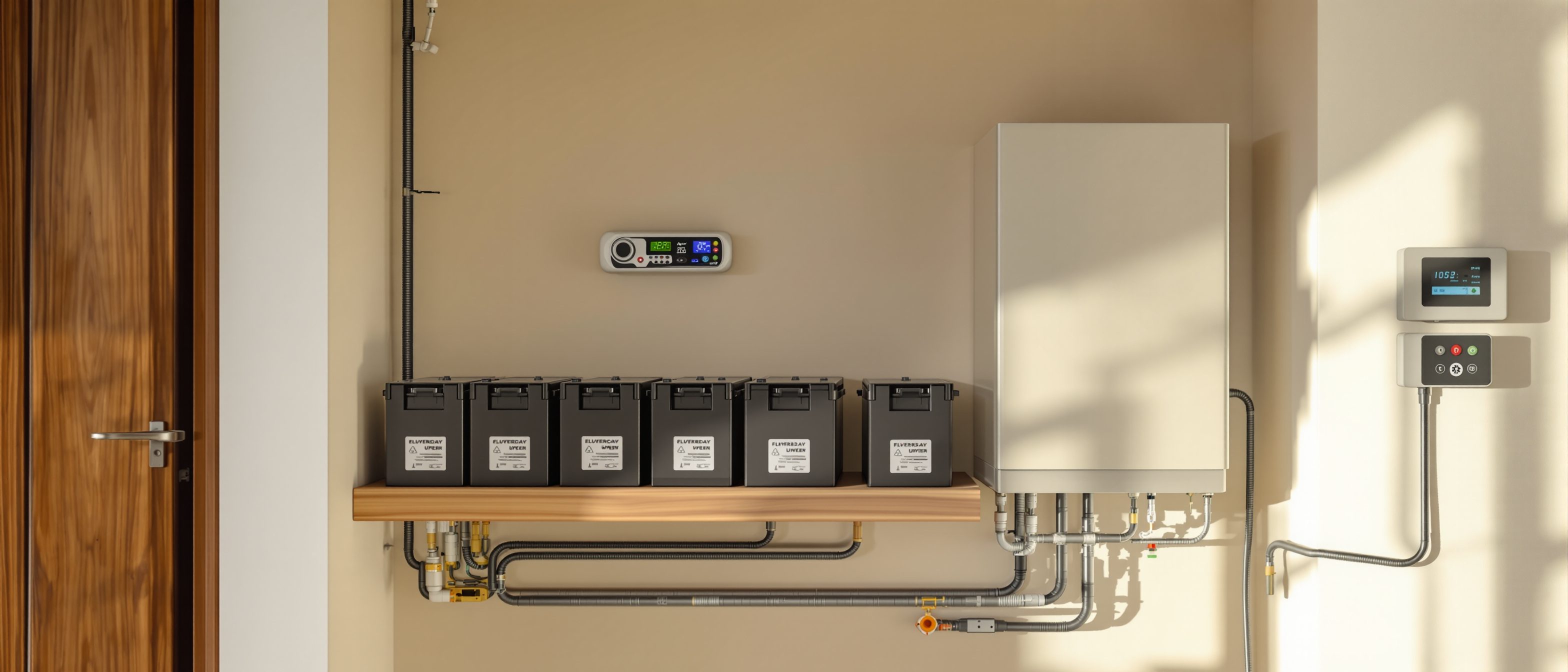
Whichever chemistry, the rule from the supplement holds: keep the batteries ventilated and maintained. Lead-acid in particular can off-gas, and all batteries lose capacity faster when they cook in an unventilated cupboard.
How a battery bank is sized
Sizing is where ARD and UPS part ways most visibly, and it is the part of a quotation worth questioning.
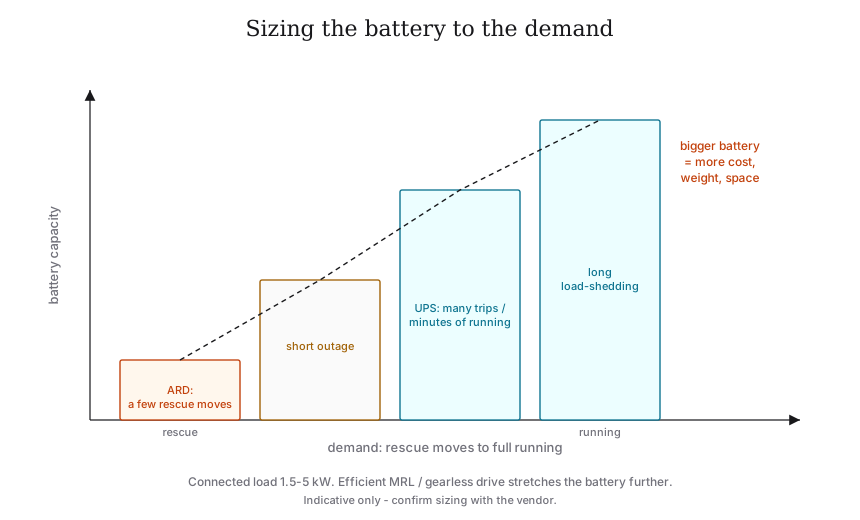
An ARD is sized for a small number of rescue moves — enough to guarantee it can complete its one job even after a few cuts in quick succession, with margin as the battery ages. That is a modest battery.
A full UPS is sized by a different question: how many runs, or how many minutes of running, do you need to ride through a typical outage? A household that loses power for ten minutes at a time needs far less than one facing two-hour load-shedding. More runs means more battery, which means more cost, more weight, and more space. Be specific with your vendor about your usual outage length and how many trips you realistically make during one — oversizing wastes money and floor area, undersizing leaves you stranded mid-outage.
The drive type matters here too. An efficient MRL or gearless lift draws less power per trip than an older geared system, so it stretches a given battery further — another reason the broader power requirements guide is worth reading alongside this one. The connected load of the lift (roughly 1.5 to 5 kW for small home lifts) is the starting figure your vendor uses to size the bank.
These are engineering quantities, not catalogue numbers — treat any run-count or duration figure as indicative and confirm it with your vendor and electrician for your specific lift and supply.
Maintenance and replacement
Batteries are the one part of a lift that is guaranteed to wear out on a clock, regardless of how little you use the lift. Planning for that replacement is part of owning the system.
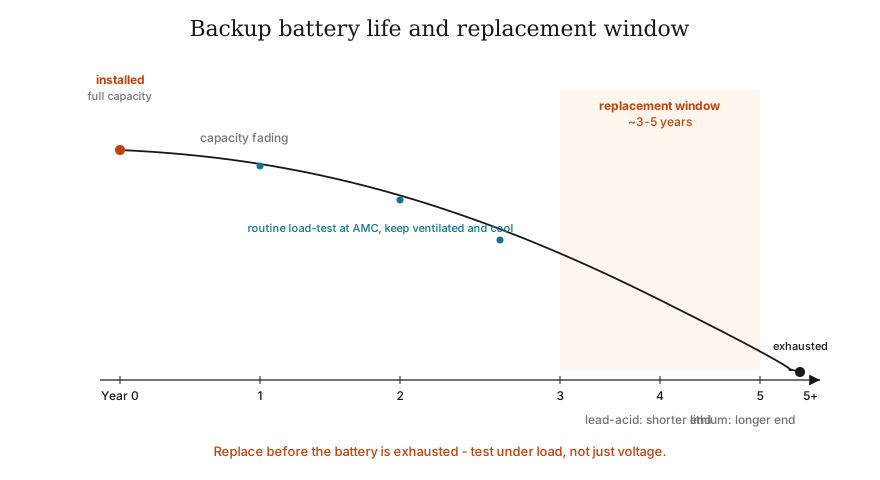
The working rule from the fact base is to replace the batteries roughly every 3 to 5 years. Lead-acid tends toward the shorter end, lithium toward the longer. A battery that has quietly lost capacity is dangerous in a subtle way: the ARD or UPS may seem fine on a normal day but fail to complete a rescue or a run when you actually need it, because the cells can no longer hold charge.
Practical maintenance points:
- Ventilation — keep the battery in a cool, ventilated location, never sealed in a hot cupboard. Heat is the single biggest killer of battery life.
- Make it part of the AMC — your annual maintenance contract technician should test the backup under load at each visit, not just glance at it. A bench voltage reading does not prove a battery can drive a rescue.
- Watch the calendar, not just the symptoms — by the time a tired battery shows obvious symptoms it may already be past safe. Replace on schedule.
- Read the fine print — some AMCs treat batteries as a consumable billed separately. Check whether replacement is inside your contract or an extra, so the cost does not surprise you in year three.
Making the decision: ARD-only or full UPS
Every Indian home lift should have at least an ARD — it is a non-negotiable safety device, not an upgrade. The genuine decision is whether to add the expense of a full UPS on top, and it comes down to two honest questions:
1. How often, and for how long, does your area lose power? Short, rare blips strengthen the case for ARD-only. Frequent or long load-shedding strengthens the case for a UPS.
2. Do you need to keep using the lift, or only to escape it? A household with someone who genuinely cannot manage stairs — elderly parents, a wheelchair user, anyone for whom the lift is the only practical way between floors — may need continuity, not just rescue. For most others, getting out safely is enough.
Decide by how often your area loses power and whether you need to keep using the lift, not just escape it. In much of India that single sentence does most of the work.
A reasonable middle path many homeowners take: fit the ARD as standard, then add a UPS only if real-life experience in your area shows the power genuinely goes for long enough, often enough, that "park and wait" is not acceptable. You can usually retrofit a UPS later; you should never run a lift without an ARD from day one.
For the wider picture of how the lift draws power and whether your home supply is even suited to a UPS, read the lift power requirements and single-phase versus three-phase guides. To see where backup sits among every other buying decision, return to the residential elevator buyer's guide.
All technical figures here are indicative — confirm battery type, sizing, run capacity and replacement interval with your lift vendor and a licensed electrician for your specific installation.
References
- IS 14665 (Electric Traction Lifts), BIS — Part 2 (installation, operation and maintenance) and Part 3 (safety rules), which cover backup and rescue provisions. Part 1: https://law.resource.org/pub/in/bis/S05/is.14665.1.2000.pdf and Part 2: https://law.resource.org/pub/in/bis/S05/is.14665.2.1-2.2000.pdf
- National Building Code of India 2016, Part 8 (Building Services), Section 5 — Installation of Lifts, Escalators and Moving Walks, BIS: https://www.bis.gov.in/standards/technical-department/national-building-code/
- Renutron — lift UPS / inverter / backup systems (India), for the inverter-mode and 3-phase-output behaviour described above: https://www.renutron.com/lift-inverter-india-lift-backup-lift-ups.php
- Nibav — machine-room-less (MRL) home elevator, on drive efficiency and backup provisioning: https://www.nibavlifts.com/machine-room-less-mrl-home-elevator/
Standards are cited by name; always confirm current requirements against your local municipal bye-laws and your State Lift Inspectorate, as lift regulation is state-specific in India.
Export this guide
Related Guides — Deep-dive reading
Power Failure Safety in Elevators (India): What Happens and What to Do
A power cut does not drop the car. Here is exactly what happens, why an ARD is non-negotiable in India, and how to protect the controller so your lift restarts safely.
Home Lifts & AccessibilityLift Battery Backup Maintenance (India): Keeping the ARD Ready
A power cut should never trap anyone. How your lift's backup battery fades over 3-5 years, the signs it is failing, and the care routine that keeps the Automatic Rescue Device ready.
Home Lifts & AccessibilityLift and Fire Safety Planning (India): What Home Lifts Must Do When There's a Fire
Why your home lift is never the escape route, how fire recall works, when a fireman's lift is required, and the local fire NOC and bye-law checks every Indian homeowner should make.
Home Lifts & AccessibilityRelated Tools — Try Free
Cross-Ventilation Analyzer
Estimate airflow and air changes per hour (ACH) from room size, window areas, layout, and local wind — with NBC 2016 Part 8 compliance check.
Ventilation CalculatorLift Annual Maintenance Cost Calculator
AMC cost for a home lift — comprehensive vs non-comprehensive, with a 5-year projection.
Lift CalculatorLift Installation Timeline Calculator
Phase-wise timeline in weeks for installing a home lift — new build or retrofit.
Lift Calculator