

Home Lift Modernization Guide (India): Upgrading an Ageing Lift
When an old lift's controller, drive, doors and cabin age out around year 20, partial modernisation renews the equipment inside the existing shaft — extending life at lower cost than full replacement.
A home lift can serve a family for a generation. The shaft, the guide rails and the structure are built to last decades — but the parts that actually run the lift age faster. The controller, the drive, the door operator, the cabin fittings and the lights all wear out, fall out of support or simply start to feel dated long before the structure does. That mismatch is exactly what home lift modernization solves: instead of tearing everything out, you renew the equipment that has aged and keep the bones you already paid for.
This guide explains what modernisation is, when an ageing lift is ready for it, what can and cannot be upgraded, the return you get for the spend, and how partial modernisation differs from a full replacement. It is a companion to our deeper when to replace a home lift guide — read that when the structure itself is in question, and read this when the structure is sound but the equipment is tired.
Money figures here are indicative and move with vendor, model, city and the year. Always confirm the actual scope and quote with a licensed lift contractor. For ballpark pricing see our home lift cost guide.
What modernisation actually means
Modernisation is the planned renewal of a lift's working parts inside an existing shaft. Think of it as keeping the well, the rails and the structure, then swapping the "brains and muscles" — the control system, the drive, the doors and the cabin — for current technology.
It sits between two extremes:
- Routine maintenance keeps a healthy lift running (see our home lift maintenance guide and the monthly and annual checklists). It does not change the technology — it preserves it.
- Full replacement removes everything, including the rails and sometimes reworks the shaft, and starts the lifecycle over.
- Modernisation is in the middle: it renews the equipment without the cost and disruption of a rip-out, and it can be done in stages.
Because the heavy civil work is avoided, modernisation is often around 50% cheaper than a full replacement and far less disruptive — frequently completed in days rather than weeks, with the shaft left largely untouched.
When an ageing lift is ready for it
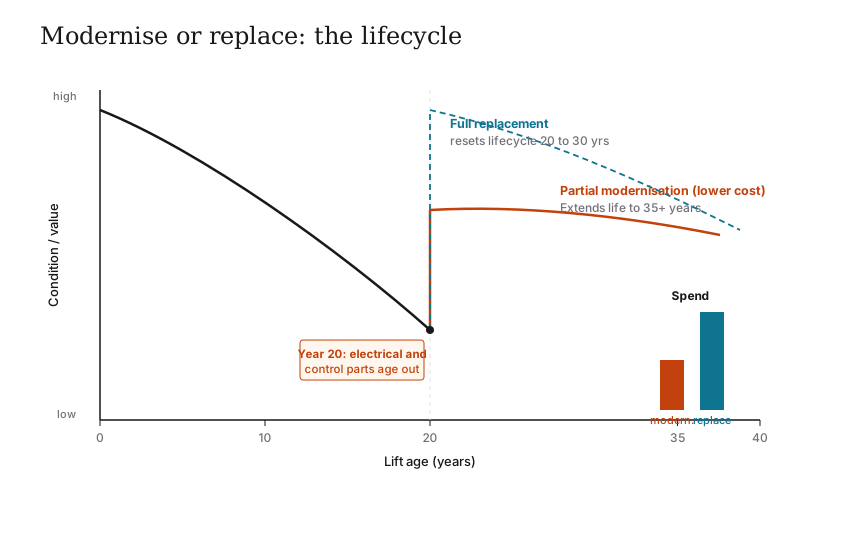
A well-maintained residential lift typically lasts about 20 to 25 years. With good care plus a partial modernisation along the way, many keep running well past 35 years. The trigger point is usually electrical, not structural.
Around year 20, the electrical and control components age out. Relay-logic or early microprocessor controllers become hard to service, drives lose efficiency, door operators wear, and the original manufacturer may stop stocking spares. None of that means the lift is unsafe today — it means the clock has started, and it is the right moment to talk to your service company about a modernisation plan.
Signs your lift is a modernisation candidate (rather than a replacement candidate):
- It is roughly 15 to 25 years old and the shaft and structure are still sound.
- Spares are getting scarce or slow for the controller or drive, but the vendor still exists.
- Ride quality has slipped — jerky starts and stops, levelling drift, longer waits.
- Energy bills feel high for the usage, or the lift runs warm.
- The cabin, doors, fixtures and lighting look and feel dated, and accessibility is limited (manual doors, no Braille, no audio indicator).
- Breakdowns are creeping up but are not yet unsafe or un-repairable.
If instead spares are gone, the vendor has vanished, the lift has failed a statutory inspection that cannot be economically fixed, or repeated failures are genuinely unsafe — that is replacement territory, covered in the when to replace guide.
What gets upgraded — the modernisation scope
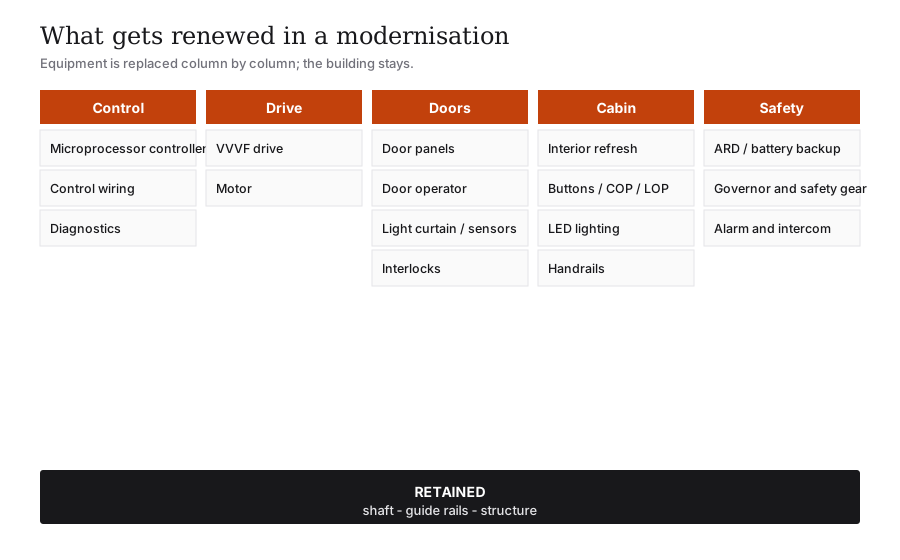
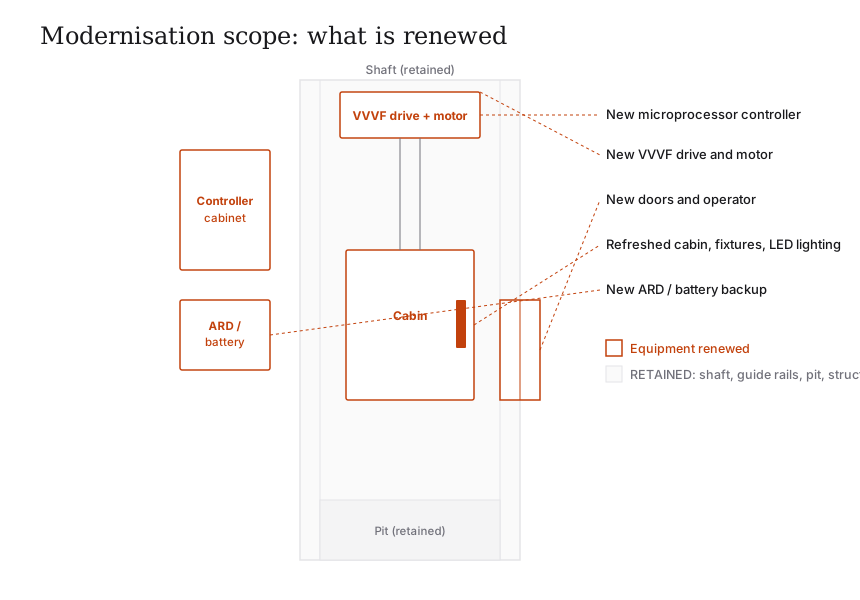
Partial modernisation usually targets the components that age and the components that most affect daily experience. You do not have to do all of it at once; a good contractor can phase it. The table below is the core of a modernisation scope.
| Component | Why upgrade it | Benefit to you |
|---|---|---|
| Microprocessor controller | Old relay/early-logic controllers go out of support; spares dry up | Reliable operation, fault diagnostics, fewer "phantom" stops, future-ready |
| VVVF drive and motor | Older drives waste energy and give jerky motion | Lower power bills, smooth acceleration/stop, accurate floor levelling |
| Doors and door operator | Doors cause the majority of stoppages; old operators wear and drift | Fewer breakdowns, quieter, faster, smoother opening (see door problems) |
| Cabin refresh | Dated, scratched or worn interiors | Modern, clean look; better light and finish; lifts property feel |
| Fixtures (buttons, indicators, COP/LOP) | Worn buttons, no audio/visual indicators, no Braille | Better usability and accessibility; tactile and audio cues |
| Lighting | Old tube/halogen lighting runs hot and dim | LED lighting — cooler, brighter, far lower energy |
| Handrails and grab rails | Missing or non-compliant for accessible use | Safer support; closer to barrier-free best practice |
| ARD / battery backup | Aged batteries fail to auto-rescue on a power cut | The car reaches a floor and opens on an outage — essential in India |
| Door sensors / light curtain | Old single-beam edges miss obstructions | Full-height detection; fewer nips and false stops |
For the battery side specifically, pair a modernisation with our battery backup maintenance guidance, and for the door subsystem see door problems and door types explained.
What can — and cannot — be modernised
The simple rule: the structure stays, the equipment is renewed.
| Usually retained (the bones) | Usually renewed (the equipment) |
|---|---|
| Shaft / hoistway and pit | Controller and control wiring |
| Guide rails and brackets (if sound) | Drive and motor |
| Building structure and openings | Door panels, operator, interlocks, sensors |
| Often the car frame | Cabin interior, fixtures, lighting, handrails |
| ARD / battery backup |
What modernisation does not change is the shaft size, the travel and the floors served. If you need a bigger car, an extra floor, a different door swing footprint, or a major accessibility footprint change, that is a structural change — and it usually pushes you toward replacement. Likewise, anything inside the shaft, the controller, the brake, the ropes or the interlocks during the work is a licensed technician's job — modernisation is never a homeowner DIY project.
The return on modernising
Modernisation is not just cosmetic. The payback shows up across several lines:
- Lower energy use. A modern VVVF drive plus LED lighting and standby modes can cut a lift's running power noticeably versus a 20-year-old drive and tube lights. Less heat, lower bills.
- Lower maintenance and downtime. New controller, doors and sensors mean fewer breakdowns — and because doors cause the majority of stoppages and dust/voltage account for a large share of Indian service calls, renewing those subsystems removes the most common failure points. Fewer emergency calls, less time waiting for the lift.
- Better ride quality and reliability. Smooth starts and stops, accurate levelling, quieter operation. If noise is your specific complaint, diagnose it first with our lift noise troubleshooting guide.
- Improved accessibility. Automatic doors, tactile and Braille buttons, audio/visual floor indicators and handrails bring an old lift closer to barrier-free best practice (CPWD Harmonised Guidelines, RPwD Act 2016).
- Higher property and rental value. A reliable, modern, good-looking lift is a genuine selling and letting point — buyers and tenants read an old, dated lift as a future cost.
- Lower cost and disruption than replacement. Often around half the spend, done in a fraction of the time, with the family barely inconvenienced.
The shape of the return is a curve, not a single number: condition declines toward year 20, modernisation lifts it back up at modest cost, and you avoid the steep one-time outlay of a full replacement until it is truly warranted.
Partial modernisation vs full replacement
| Question | Partial modernisation | Full replacement |
|---|---|---|
| What changes | Equipment renewed; shaft, rails, structure kept | Almost everything, sometimes the shaft reworked too |
| Indicative cost | Often around 50% less than replacement | Highest (a fresh installation; see cost guide) |
| Disruption | Lower — often days; shaft largely untouched | Higher — weeks; lift out of service longer |
| Lifecycle gained | Extends life, often to 35+ years | Resets the clock for another 20 to 30 years |
| Best when | Structure sound, equipment tired, vendor still exists | Spares gone/vendor gone, unsafe failures, failed inspection, capacity/access change needed |
| Energy and ride | Big improvement from new drive and doors | New throughout |
| Phasing | Can be staged over time | One project |
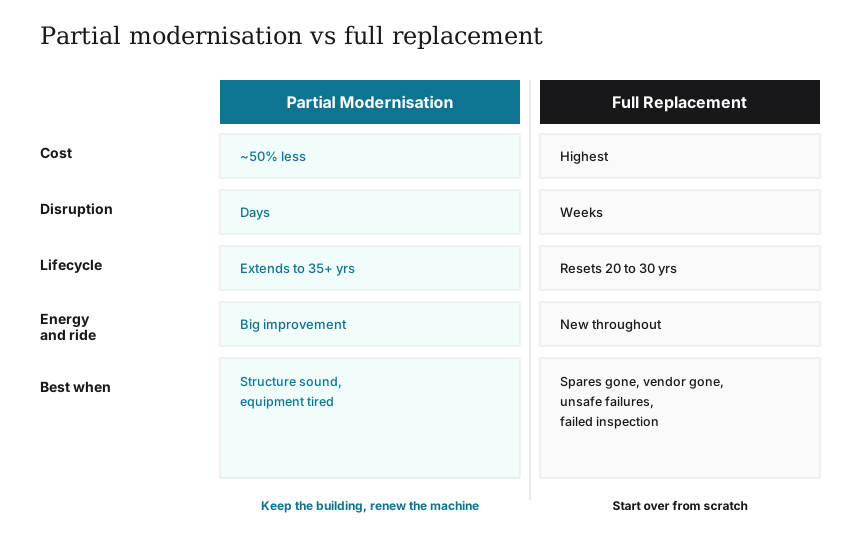
If the snapshot above leaves you genuinely on the fence — spares marginal, vendor uncertain, costs creeping toward half of a new lift — that is precisely the decision the when to replace your home lift guide walks through in detail.
How to go about it
1. Start with your service company or AMC provider. They know the lift's history. Operationally, keep a service logbook and hold them to it — see the AMC guide and, for choosing/scoring a contract, the AMC evaluation guide.
2. Get a condition survey. A licensed contractor assesses the shaft, rails, controller, drive, doors and safety devices, and tells you what is sound and what is end-of-life.
3. Agree a scope and phasing. Use the scope table above. Decide what is essential now (controller, drive, doors, ARD) and what can wait (cabin cosmetics, fixtures).
4. Confirm compliance. Modernisation must keep the lift compliant with IS 14665 and, in the ~10 states with a Lift Act, may need re-inspection or licence updating. Statutory inspection stays with the government inspectorate, not a private firm.
5. Insist on the safety essentials. ARD/battery backup, overspeed governor and safety gear, door light curtain, alarm and intercom. Never let a "modernisation" defeat or remove a safety device.
6. Plan around the family. Confirm how long the lift is out of service and arrange access for anyone who depends on it.
Safety boundary: a homeowner does routine cleaning and visual checks outside the shaft — wiping sills and door sensors, checking the cabin light, alarm and intercom. Everything inside the shaft, the controller, the brake, the ropes or the interlocks — including all modernisation work — is a licensed technician's job.
Where this guide fits
This sits in the lift-lifecycle end of our Home Lifts cluster. For day-to-day upkeep start with the home lift maintenance guide; for specific faults see common home lift problems, door problems and noise troubleshooting; and when the structure itself is in doubt, move to when to replace a home lift. New to home lifts entirely? Begin at the residential elevator buyer's guide.
References
- IS 14665 — Electric Traction Lifts (BIS): Part 1, Outline dimensions — https://law.resource.org/pub/in/bis/S05/is.14665.1.2000.pdf
- IS 14665 Part 2 — Code of practice for installation, operation and maintenance (BIS): https://law.resource.org/pub/in/bis/S05/is.14665.2.1-2.2000.pdf
- IS 15259 — Hydraulic lifts (companion installation/maintenance code, cited by name).
- IS 17900 / EN 81-20 and EN 81-50 — lift safety and component standards (cited by name as the safety-rule and component-testing benchmarks aligned to Indian practice).
- National Building Code of India 2016, Part 8 (Building Services), Section 5 — Installation of Lifts, Escalators and Moving Walks (BIS): https://www.bis.gov.in/standards/technical-department/national-building-code/
- BIS Guide for Using NBC 2016: https://www.bis.gov.in/wp-content/uploads/2022/08/Booklet-Guide-for-Using-NBC-2016.pdf
- State Lift Acts (inspection and licensing): Maharashtra Lifts, Escalators and Moving Walks Act 2017; Karnataka Lifts, Escalators and Passenger Conveyors Act 2015; Delhi Lifts and Escalators Act 2007; Tamil Nadu Lifts Act 1997. Maharashtra licence to operate a lift — https://services.india.gov.in/service/detail/maharashtra-license-to-operate-lift ; overview — https://www.99acres.com/articles/know-all-about-the-lift-regulations-in-india.html
- CPWD Harmonised Guidelines and Space Standards for a Barrier-Free Built Environment (2016): https://www.cpwd.gov.in/Publication/Harmonisedguidelinesdreleasedon23rdMarch2016.pdf
- RPwD Act 2016 (accessibility provisions): https://ssepd.odisha.gov.in/sites/default/files/2024-01/RPWD%20ACT.pdf
- TK Elevator — Elevator modernization lifecycle and ROI considerations: https://www.tkelevator.com/in-en/news/elevator-modernization-lifecycle-and-roi-considerations.html
- TK Elevator — Ensuring lift longevity: https://www.tkelevator.com/in-en/news/ensuring-lift-longevity.html
- ShuttleSky — Residential elevator lifespan: https://shuttlesky.in/residential-elevator-lifespan/
Standards and inspection rules vary by state and are periodically revised — confirm the current requirements with your local municipal bye-laws and a licensed lift contractor before commissioning any modernisation work.
Export this guide
Related Guides — Deep-dive reading
Home Lift Maintenance Guide (India): Keeping Your Lift Safe and Reliable
The homeowner's map to lift upkeep — the maintenance cadence, who does what, the safety boundary, and the lifecycle from first service to modernisation.
Home Lifts & AccessibilityBuilding Codes for Residential Elevators (India): NBC 2016 and Local Bye-Laws
How NBC 2016 Part 8 Section 5 and your municipal building bye-laws decide when a home lift is required, where its shaft goes, and how it must be built and fire-protected.
Home Lifts & AccessibilityHome Lift Planning Checklist (India): Everything to Decide Before You Buy
A printable, ten-stage checklist that takes you from the first family conversation to a signed handover.
Home Lifts & AccessibilityRelated Tools — Try Free
Accessibility Compliance Calculator
Check a planned lift against the CPWD and RPwD accessible-lift benchmarks for a score.
Lift CheckerLift Safety Audit Checklist
Interactive checklist that scores your home lift on safety devices, compliance and upkeep.
ChecklistLift Shaft Size Calculator
Required hoistway, pit and headroom dimensions for a home lift by capacity and drive type.
Lift Calculator