
Lift Door Problems Explained (India): Why Doors Cause Most Faults
Doors cause over 70 percent of home-lift stoppages. Read the symptom, find the cause, and know which fixes are owner-safe and which belong to a licensed technician.
If your home lift keeps stopping, the odds are overwhelming that the door is to blame. Across the residential lift world, more than 70 percent of stoppages are door-related — not the motor, not the ropes, not the controller. The door is the part that moves on every single trip, several times a day, year after year. It is also where dust, grit and monsoon damp collect first. Understanding the door turns most "the lift is broken" panics into a five-minute clean or a calm, correct call to your technician.
This guide explains WHY doors cause most faults, walks you through the common symptoms with their likely causes and fixes, and draws a hard line between what a homeowner can safely do and what only a licensed lift technician should touch. One rule sits above everything else: the door interlock is a safety device, and it must never be defeated or bypassed.
For the bigger picture of all lift faults, see the companion guide Common Home Lift Problems and Solutions in India. For how doors are built and chosen, see Lift Door Types Explained (India). For the safety logic behind the interlock and sensors, see Elevator Safety Components Explained (India).
Why the door is the weak point
A lift door is the busiest moving assembly in your home. Think about what happens on a single trip: the car door and the landing door open together, hold open while you step in, close, lock, prove they are locked, and only then is the lift allowed to move. That sequence repeats on arrival. A lift used a dozen times a day cycles its doors thousands of times a month. Constant motion plus an open invitation to dust is exactly the recipe for wear and dirt-related faults.
There are four mechanical and electrical reasons doors dominate the fault list.
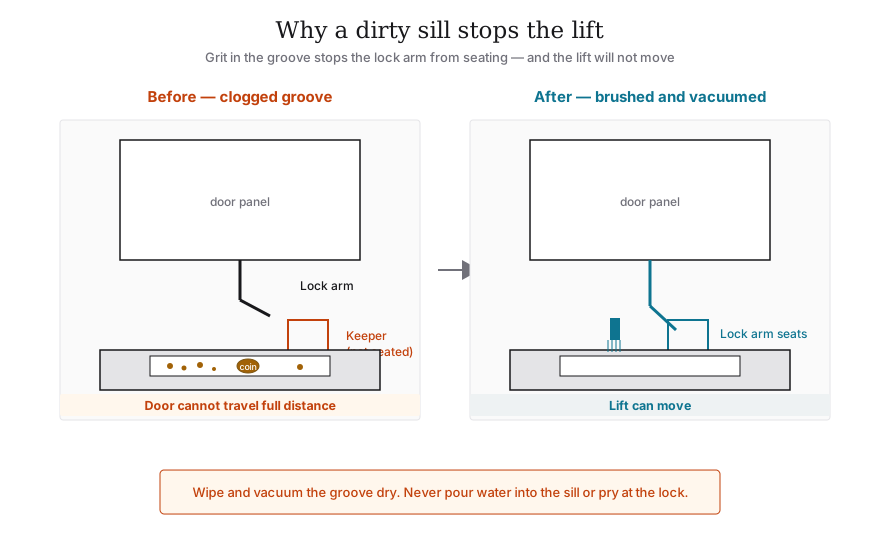
1. The sill track collects dust and grit. At the bottom of every doorway is a grooved metal sill (the threshold the door slides along). Hair, dust, sand tracked in on shoes, coins, rice grains, pooja flowers — all of it falls into that groove. When the groove is clogged, the door cannot travel its full distance, so the lock arm cannot seat into its keeper. The lift reads the door as "not properly shut" and refuses to move, even though the door looks closed to you.
2. Infrared sensors and light curtains get dirty or misaligned. Modern automatic doors are guarded by a safety detector across the opening — either a pair of infrared eyes or a full light curtain (a vertical grid of beams). If anything breaks a beam, the door reopens so it cannot close on a person, a pet or a bag strap. That is exactly what you want. But a film of dust on the lens, or a sensor knocked slightly out of alignment, makes the system "see" an obstruction that is not there. The door reopens again and again, or refuses to close at all.
3. The interlock circuit is unforgiving by design. Every landing door and the car door carry an electrical contact that closes only when the door is fully shut and locked. These contacts are wired in series, so if even one is not seated, the whole safety circuit is open and the lift will not move. This is deliberate: it is what stops a lift travelling with a door ajar. The downside is that a single dirty track or a slightly worn lock anywhere in the building stops the entire lift.
4. Rollers, belts and the operator wear out. The door hangs on rollers that run along a top track, and an electric door operator (a small motor and belt) drives it open and shut. Rollers flat-spot, belts stretch and fray, and the operator drifts out of adjustment. The result is noisy, slow, juddery or erratic doors.
"Phantom" faults are real and common. In Indian homes, a large share of service calls trace back to nothing more than dust on sensors and PCBs (and voltage surges). A lift that stops "for no reason" is very often a lift with a dirty sensor eye or a clogged sill.
Symptom, cause and fix: the door table
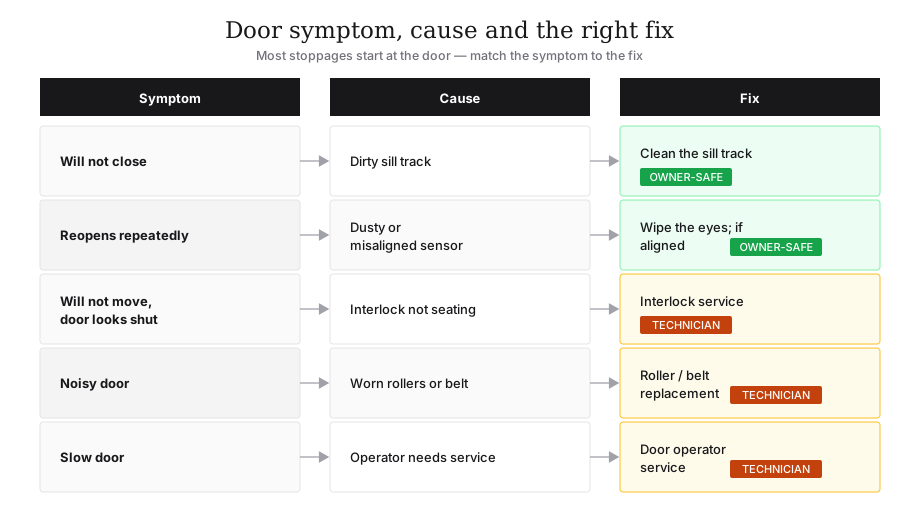
Use this table to read your symptom, understand the likely cause, and know whether it is a clean you can do or a job for your technician. Treat any fix labelled TECHNICIAN as off-limits for a homeowner.
| Symptom | Most likely cause | Fix | Who |
|---|---|---|---|
| Door will not close | Obstruction in the opening, or dust/debris in the bottom sill track, or a blocked sensor | Remove the obstruction, clean the sill track, wipe the sensor eyes | OWNER-SAFE |
| Door reopens repeatedly | Light curtain or infrared sensor seeing dust, or sensor misaligned | Wipe the sensor lenses clean; if it persists after cleaning, alignment is a technician job | OWNER clean, then TECHNICIAN |
| Lift will not move though the door looks shut | Interlock not seating — clogged sill track or worn door lock | Clean the sill so the door travels fully; if it still will not seat, the interlock/lock is a technician job | OWNER clean, then TECHNICIAN |
| Noisy door (grinding, rattling, banging) | Worn rollers or a stretched/frayed drive belt | Roller and belt replacement and re-tensioning | TECHNICIAN |
| Door opens or closes slowly | Door operator out of adjustment or needing service | Operator service and re-tuning | TECHNICIAN |
| Door judders or stops part-way | Operator fault or partial obstruction in the track | Clear the track of obvious debris; if it persists, operator service | OWNER clean, then TECHNICIAN |
| Doors do not line up at the floor | Door-zone or levelling sensor issue, or door drift | Diagnosis and adjustment | TECHNICIAN |
The pattern is consistent: cleaning solves a surprising number of door faults, and what cleaning does not solve is mechanical or electrical adjustment that belongs to a trained hand.
Owner-safe fixes (no tools, outside the shaft)
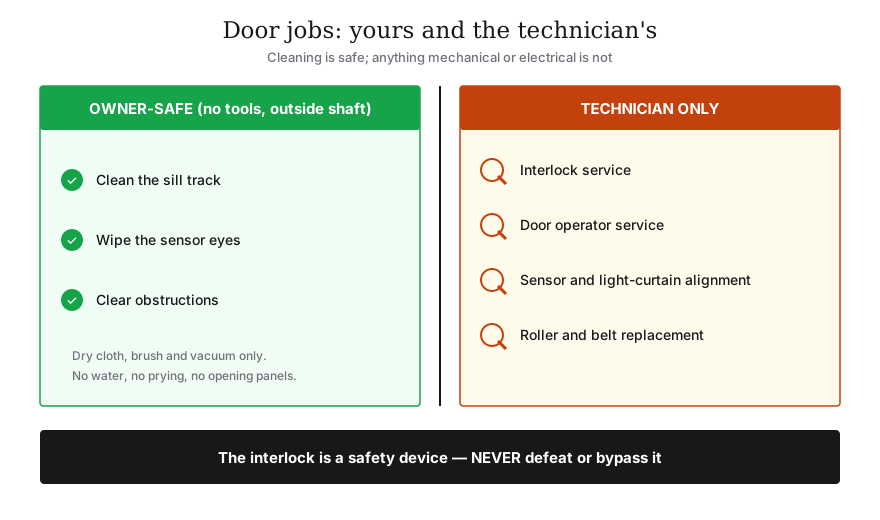
There are exactly three things a homeowner should do, and all of them are at the landing or inside the car — never inside the shaft.
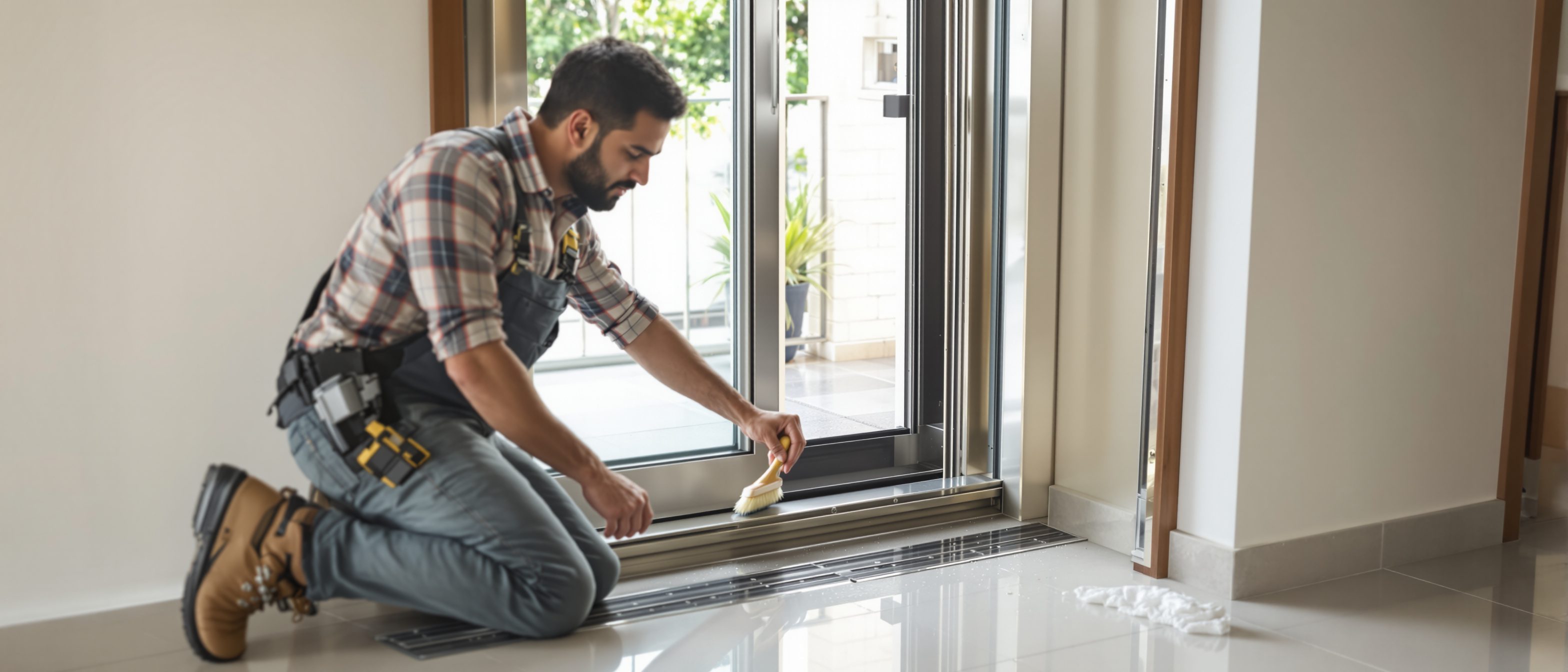
- Clean the bottom sill track. With the lift parked at the floor and doors open, brush and vacuum the groove in the threshold so the door can slide its full distance. Lift out coins, grit, hair and flowers. A clogged sill is the single most common reason a lift "will not move with the door shut".
- Wipe the sensor eyes. Find the small infrared lenses on the door edges (or the slim light-curtain strips running up both sides of the opening) and wipe them with a dry or barely-damp soft cloth. A dusty lens is the single most common reason a door "reopens for no reason".
- Clear obstructions. Check that nothing is sitting in the doorway, hanging from the car, or wedged in the track — a doormat corner, a bag, a child's toy. Remove it and try again.
That is the complete owner list. If the symptom remains after these three steps, stop and call your technician. Do not pull, push, force or wedge the door, and never open a landing door to look into the shaft.
How to clean a sill track without making it worse
- Park the car at the floor first so the doorway is at rest and the opening is safe to reach.
- Use a soft brush and a vacuum nozzle; do not flush the groove with water, which can carry grit deeper and reach electrical contacts.
- Do not spray oil or grease into the sill — the groove is meant to be dry and clean; lubricant turns dust into a sticky paste.
- Wipe, do not scrape with metal, so you do not score the track or damage the lock arm.
- If the door still does not seat after a thorough clean, the lock or interlock may be worn — that is a technician job.
Technician jobs (and why you must not attempt them)
Everything below involves a safety device or a part inside the door assembly. These are licensed-technician work, full stop.
- Interlock service or replacement. The interlock proves the door is shut and locked before the lift moves. Adjusting, repairing or replacing it is precise safety work.
- Door operator service. The motor-and-belt unit that drives the door is adjusted to fine tolerances for speed and force.
- Sensor or light-curtain alignment. Wiping a lens is yours; realigning the unit on its mounts is the technician's.
- Roller and belt replacement. Worn rollers and stretched belts cause most door noise; they are replaced as a set and re-tensioned.
- Anything inside the shaft, hoistway, controller or brake. Off-limits to homeowners under every Indian and international standard.
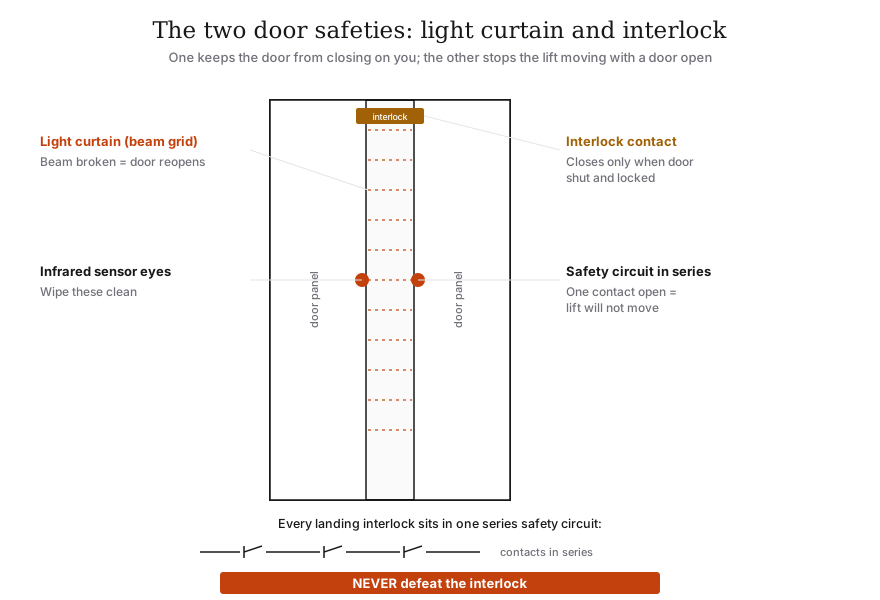
The interlock is sacred. It is the device that stops a lift travelling with a door open — the failure that causes the most serious lift injuries. No technician, and certainly no homeowner, should ever bridge, tape, wedge or otherwise defeat an interlock to "keep the lift running". A lift that will not move because a door is not seating is doing its job. Fix the cause; never disable the safety. The same goes for door sensors and light curtains — they are there to protect the people in the doorway.
When to switch off and call for help
If the door behaves erratically — closing on people, refusing to respond, or the lift moving with a door issue — do not keep using it. If someone is inside, use the alarm and intercom to stay in contact; the Emergency and Rescue Systems guide explains what to do during entrapment. Switch the lift off at the main isolator if it is misbehaving, and call your AMC provider or licensed technician.
A good Annual Maintenance Contract covers exactly this: roughly twelve preventive visits a year plus breakdown response, with the technician cleaning and adjusting doors, checking the interlock and testing the sensors at every visit. Keeping a strong AMC is the cheapest way to keep doors out of trouble. To judge whether your contract is good enough, see the AMC evaluation scorecard.
How to prevent door faults
- Keep the sill tracks and landings clean — make it part of your monthly home-lift routine.
- Wipe the sensor eyes regularly so dust never builds up enough to trigger phantom reopening.
- Do not let the doorway double as a doormat or storage ledge; keep the threshold clear.
- Stabilise your power supply — voltage surges and dust together drive most Indian residential lift faults.
- Do not force a slow or sticky door; report it early, before a worn roller or belt becomes a breakdown.
- Hold your AMC technician to a real door check at every visit, and keep a service logbook.
For the wider maintenance picture, start with the Home Lift Maintenance Guide for India. If your doors are noisy specifically, the Lift Noise Troubleshooting guide helps you describe the sound to your technician. Door operators and interlocks are also among the first parts upgraded in a lift modernization when a lift ages out around year twenty.
Prices in any quote are indicative — confirm with your licensed lift technician. For what door operators, interlocks and modernisation actually cost, see Home Lift Cost in India 2026.
References
- IS 14665 (Electric Traction Lifts), Part 2 — Code of practice for installation, operation and maintenance, and Part 3 — Safety rules (Bureau of Indian Standards, committee ETD 25; aligned to EN 81). Part 2: https://law.resource.org/pub/in/bis/S05/is.14665.2.1-2.2000.pdf ; Part 1 (dimensions and door types): https://law.resource.org/pub/in/bis/S05/is.14665.1.2000.pdf
- EN 81-20 / EN 81-50 — European lift safety standards on which IS 14665 and IS 17900 are aligned (door locking, interlocks and protective devices). Referenced by name.
- National Building Code of India 2016, Part 8 (Building Services), Section 5 — Installation of Lifts, Escalators and Moving Walks (BIS): https://www.bis.gov.in/standards/technical-department/national-building-code/ ; Guide for Using NBC 2016: https://www.bis.gov.in/wp-content/uploads/2022/08/Booklet-Guide-for-Using-NBC-2016.pdf
- State Lift Acts governing inspection and operation (e.g. Maharashtra Lifts, Escalators and Moving Walks Act 2017; Karnataka Lifts, Escalators and Passenger Conveyors Act 2015; Delhi Lifts and Escalators Act 2007; Tamil Nadu Lifts Act 1997). Maharashtra licence to operate a lift (National Govt Services Portal): https://services.india.gov.in/service/detail/maharashtra-license-to-operate-lift ; lift regulations overview: https://www.99acres.com/articles/know-all-about-the-lift-regulations-in-india.html
- EFE — common problems with home lifts (door and sensor faults): https://efepvtltd.com/blogs/what-are-the-common-problems-with-home-lifts/
- TK Elevator — ensuring lift longevity (maintenance): https://www.tkelevator.com/in-en/news/ensuring-lift-longevity.html
Standards and regulatory figures are indicative and vary by state, vendor and year — always confirm with your local municipal bye-laws and a licensed lift contractor.
Export this guide
Related Guides — Deep-dive reading
Monthly Home Lift Maintenance Checklist (India): The Owner's Routine
A complete, printable monthly routine you can run yourself in ten minutes — clean, check, listen, and know exactly when to stop and call the technician.
Home Lifts & AccessibilityCommon Home Lift Problems and Solutions (India)
The troubleshooting reference: symptom, likely cause, and what you can safely do versus when to call the technician.
Home Lifts & AccessibilityHome Lift Safety Guide (India): How Safe Home Lifts Are and How to Use One Safely
Why modern home lifts cannot free-fall or open onto an empty shaft, the safety features explained, and how to use one safely every day — for children, seniors and emergencies.
Home Lifts & AccessibilityRelated Tools — Try Free
Lift Safety Audit Checklist
Interactive checklist that scores your home lift on safety devices, compliance and upkeep.
ChecklistLift Annual Maintenance Cost Calculator
AMC cost for a home lift — comprehensive vs non-comprehensive, with a 5-year projection.
Lift CalculatorHome Lift Cost Calculator
All-in home lift cost by floors, type, capacity and city — equipment, civil, GST and AMC, with a drive-type comparison.
Lift Calculator