
Lift Battery Backup Maintenance (India): Keeping the ARD Ready
A power cut should never trap anyone. How your lift's backup battery fades over 3-5 years, the signs it is failing, and the care routine that keeps the Automatic Rescue Device ready.
A power cut should never trap anyone in your lift. That is the whole job of the Automatic Rescue Device (ARD) — the moment mains power fails, a backup battery takes over, gently drives the car to the nearest floor and opens the doors so anyone inside simply steps out. In India, where outages and voltage dips are routine, the ARD is not a luxury; it is the difference between a brief pause and a frightening wait in a dark cabin.
But that safety net only works if the battery behind it is healthy. Backup batteries fade quietly over about three to five years — and the cruel part is that a tired battery looks fine right up until the day there is an outage and the rescue does not happen. This guide is about the upkeep: why the backup matters, how the battery ages, the warning signs, and the simple care routine that keeps the ARD ready.
This is the upkeep guide. For how the hardware actually works — ARD battery versus a full lift UPS, battery types and sizing — see the hardware reference, Battery Backup Systems for Elevators. For what the ARD does the instant the power goes, see Emergency Rescue Systems for Home Lifts.
What the backup battery actually does
When mains power drops, a healthy lift does one of two things depending on its design:
- ARD (Automatic Rescue Device) — the most common home-lift setup. A small battery bank powers the controller and drive just long enough to move the car, unloaded by you, to the nearest landing and open the doors. It does this once, then waits. It is a rescue device, not a way to keep using the lift through a blackout.
- Full lift UPS / inverter backup — a larger battery system that can run the lift for a while during an outage. Less common in homes, more expensive, and the battery bank is bigger. Either way, the same ageing rules apply.
The battery chemistry is almost always sealed lead-acid (SMF / VRLA) — maintenance-free, valve-regulated cells that need no topping up with water — and, increasingly on newer installs, lithium packs that are lighter and last a little longer. Whichever you have, capacity fades with age and use, and an outage you cannot schedule is exactly when you need it.
India angle: frequent power cuts and voltage swings make the ARD work harder and cycle more often than it would in a steadier grid. Every rescue and every deep discharge takes a little life off the battery, so Indian homes tend to land at the shorter end of the 3–5 year window. A good voltage stabiliser on the lift supply protects the battery as well as the electronics.
How a backup battery ages
A backup battery does not fail on a neat schedule, but it does follow a predictable curve. It holds near-full capacity for the first couple of years, then declines — slowly at first, then steeply — until one day it can no longer hold the car for a full rescue.
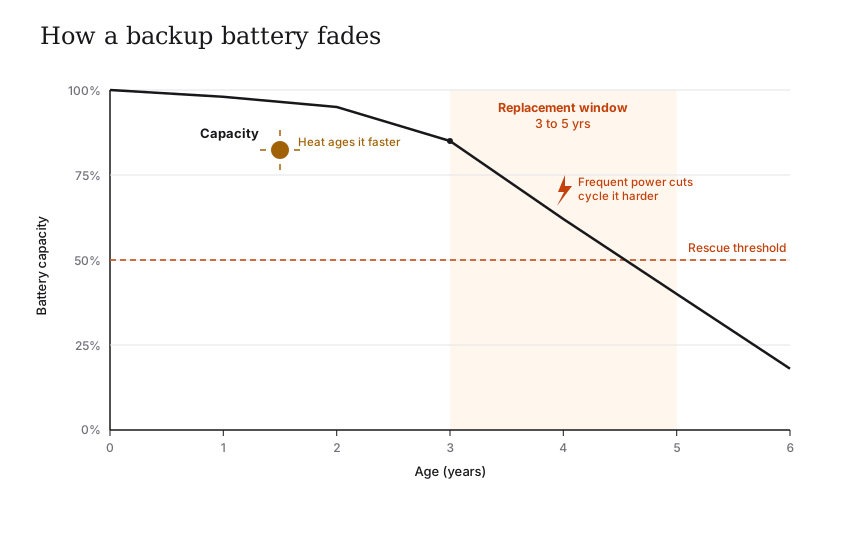
Three things speed up that decline, all of them common in India:
- Heat. Lead-acid and lithium both hate sustained high temperature. A battery cabinet baking next to a hot motor or in an unventilated machine space ages far faster than one kept cool.
- Deep discharges. Every time a long outage drains the battery hard, it loses a little permanent capacity. Frequent cuts mean frequent cycling.
- Standing idle. Ironically, a battery that is rarely called on but left float-charging for years also dries out and sulphates. It needs occasional real-world load to stay honest — which is exactly what the AMC load-test provides.
Signs your backup battery is fading
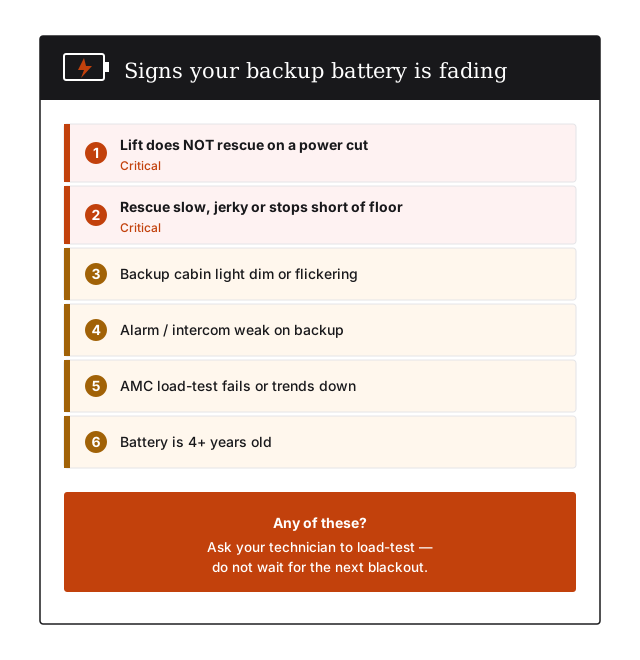
You cannot see capacity loss, but the lift gives you tells. Treat any of these as a reason to ask your technician to load-test the battery at the next visit — do not wait for the next blackout to find out.
- The lift does not auto-level or rescue on a power cut. The clearest sign of all: the power goes, and the car just stops where it is instead of moving to the nearest floor and opening. This means the battery can no longer deliver the rescue. Treat it as urgent.
- The rescue is slow, jerky, or stops short of the landing — the battery is starting but cannot sustain the load.
- The backup / emergency cabin light is dim or flickers when mains is off, when it used to glow steadily.
- The alarm or intercom sounds weak on backup power.
- The AMC load-test fails or shows declining capacity. Your service report should record battery condition at each visit; a downward trend is your early warning.
- The controller shows a battery / ARD fault code, or the lift logs repeated battery warnings.
- The battery is simply past its years — if the set is four-plus years old, it is on borrowed time regardless of how it seems.
If the lift stops mid-floor during a power cut and someone is inside, do not force the doors. Use the alarm and intercom, stay calm, and call your AMC for a manual rescue. The full procedure is in Emergency Rescue Systems for Home Lifts.
The care routine — what keeps the ARD ready
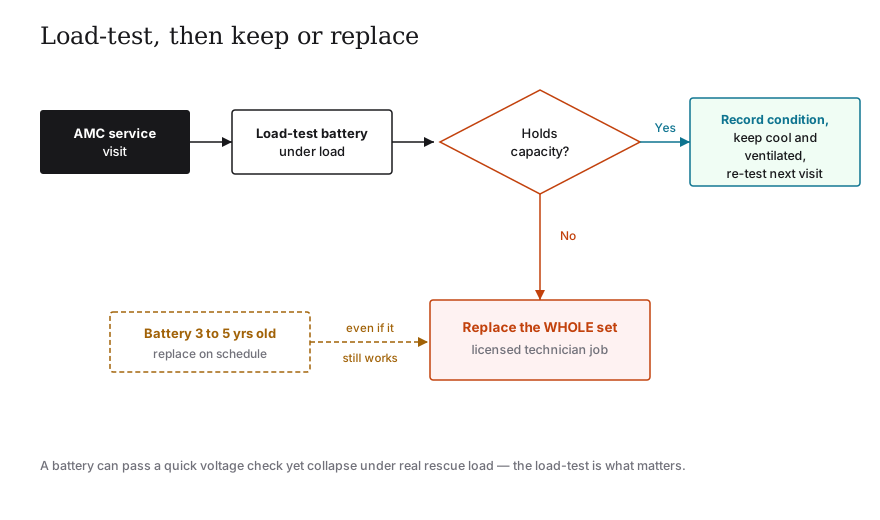
The single most important habit is to have the battery load-tested at every service visit, not just visually glanced at. A battery can read a normal voltage at rest and still collapse the instant it is asked to move the car — only a load test under realistic current reveals the truth. Your AMC's 12 preventive visits a year (see Lift AMC Guide for India) are the natural place for this; make sure it is on the checklist and recorded in your service logbook.
Around that, a few simple measures slow the ageing:
| Care task | Who does it | How often | Why it matters |
|---|---|---|---|
| Load-test the battery under realistic current | Technician (AMC visit) | Every service / at least annually | Only a load test reveals hidden capacity loss |
| Record battery condition in the service logbook | Technician | Every visit | Builds the trend that warns you before failure |
| Keep the battery cabinet cool and ventilated | Homeowner (passive) | Ongoing | Heat is the number-one killer of capacity |
| Keep the area dry — no pit/machine-space damp | Homeowner / technician | Ongoing, watch in monsoon | Moisture corrodes terminals and cases |
| Clean and tighten the terminals | Technician | At service | Loose or corroded terminals starve the rescue of current |
| Check the charger / float voltage is correct | Technician | At service | Over- or under-charging shortens battery life |
| Test an actual simulated power-cut rescue | Technician | Periodically | Proves the whole ARD chain, not just the cells |
| Replace the battery as a SET on schedule | Technician | Every ~3–5 years | Prevents a surprise failure during a real outage |
What you can safely do yourself is limited and entirely outside the shaft: keep the machine and battery space clean, dry and ventilated, make sure nothing is stacked against the cabinet blocking airflow, and listen and watch during the brief monthly times power flickers — does the lift behave? Note anything odd for the technician.
Safety rule: the battery sits with the controller and live drive electronics. Opening the controller, handling cells, checking terminals or replacing the battery is a licensed technician's job — never a homeowner one. Do not open the cabinet, do not bridge or defeat any safety device, and do not attempt a DIY battery swap. Your role is to keep the space right and to make sure the load-test happens.
Replace as a set, on schedule — not after it fails
The most important decision is when to replace, and the answer is proactively, as a complete set, before total failure — not reactively after a blackout exposes a dead battery.
Two reasons. First, this is a safety backup: the cost of waiting is someone stuck in a stopped car during the next outage. Second, batteries in a bank age together — replacing one weak cell while leaving older ones in place means the new cell is quickly dragged down to match the tired ones. Always replace the whole set.
Use this as a rough replacement guide. It is indicative — confirm the schedule and the exact battery spec with your licensed lift technician, and do not invent the price; for current AMC and parts costs see Home Lift Cost in India 2026.
| Battery age | Typical condition | What to do |
|---|---|---|
| 0–2 years | Near-full capacity | Routine load-test at each service; record condition |
| 2–3 years | Healthy, beginning to age | Watch the trend; keep cool and ventilated |
| 3–4 years | Capacity declining; nearing end of life | Plan replacement; tighten load-test scrutiny |
| 4–5 years | At or past end of life | Replace as a set even if it still seems to work |
| Any age, if rescue fails / load-test fails / light dim | Failing now | Replace promptly — it is a safety backup, treat as urgent |
Genuine ARD/UPS batteries from your lift maker or AMC are matched to the controller's charger and drive. Do not let anyone fit a cheap car-battery substitute — the chemistry, capacity and charging profile must match, or the rescue will be unreliable and the battery short-lived.
Where this fits in your maintenance routine
Battery upkeep is one slice of keeping a lift healthy. Fold it into your wider routine:
- The overall picture — Home Lift Maintenance Guide for India
- Your every-month, no-tools checks — Monthly Home Lift Maintenance Checklist
- The statutory and professional once-a-year — Annual Lift Inspection Checklist
- The contract that delivers the load-tests — Lift AMC Guide for India
- When backup trouble is part of a broader pattern — Common Home Lift Problems and Solutions
The takeaway is simple: an ARD is only as good as its battery, and a battery only stays good if it is load-tested at every service, kept cool, and replaced as a set on a three-to-five-year schedule — before the outage that needs it ever arrives.
References
- IS 14665 (Electric Traction Lifts), Part 2 — Code of practice for installation, operation and maintenance (covers periodic maintenance including safety and rescue provisions). Bureau of Indian Standards. https://law.resource.org/pub/in/bis/S05/is.14665.2.1-2.2000.pdf
- IS 14665, Part 1 — Outline dimensions and general requirements. https://law.resource.org/pub/in/bis/S05/is.14665.1.2000.pdf
- National Building Code of India 2016, Part 8 (Building Services), Section 5 — Installation of Lifts, Escalators and Moving Walks. Bureau of Indian Standards. https://www.bis.gov.in/standards/technical-department/national-building-code/
- BIS — Guide for Using NBC 2016. https://www.bis.gov.in/wp-content/uploads/2022/08/Booklet-Guide-for-Using-NBC-2016.pdf
- State Lift Acts (where applicable, e.g. Maharashtra Lifts, Escalators and Moving Walks Act 2017; Karnataka 2015; Delhi 2007; Tamil Nadu 1997) mandate periodic safety inspection by the government Lift Inspectorate. Maharashtra example: https://services.india.gov.in/service/detail/maharashtra-license-to-operate-lift
- Lift regulations in India (overview). https://www.99acres.com/articles/know-all-about-the-lift-regulations-in-india.html
- EFE — common problems with home lifts and solutions (2026). https://efepvtltd.com/blogs/what-are-the-common-problems-with-home-lifts/
- TK Elevator — ensuring lift longevity (maintenance). https://www.tkelevator.com/in-en/news/ensuring-lift-longevity.html
Note: IS 17900 / EN 81-20 and EN 81-50 are also relevant safety and testing standards aligned to Indian practice. Standards titles and applicability are cited by name; verify current editions with BIS and your state Lift Inspectorate. All figures are indicative — confirm with your licensed lift technician and local bye-laws.
Export this guide
Related Guides — Deep-dive reading
Battery Backup Systems for Elevators (India): ARD Battery vs Full Lift UPS
The power-and-battery hardware behind a home lift: a small ARD that does one auto-rescue move on a power cut versus a full lift UPS or inverter that keeps the lift running on battery — chemistries, sizing, maintenance and how to choose for India.
Home Lifts & AccessibilityPower Failure Safety in Elevators (India): What Happens and What to Do
A power cut does not drop the car. Here is exactly what happens, why an ARD is non-negotiable in India, and how to protect the controller so your lift restarts safely.
Home Lifts & AccessibilityEmergency Rescue Systems in Home Lifts (India): ARD, Manual Rescue, Alarm and What to Do
How the Automatic Rescue Device, manual rescue, alarm, intercom and emergency light work together — and the calm, simple thing to do if you are ever trapped.
Home Lifts & AccessibilityRelated Tools — Try Free
Cross-Ventilation Analyzer
Estimate airflow and air changes per hour (ACH) from room size, window areas, layout, and local wind — with NBC 2016 Part 8 compliance check.
Ventilation CalculatorLift Safety Audit Checklist
Interactive checklist that scores your home lift on safety devices, compliance and upkeep.
ChecklistAccess-Control Battery-Backup Calculator
Size the standby battery so an access system keeps running through a power cut, with an egress life-safety note.
Battery Backup