

Monthly Home Lift Maintenance Checklist (India): The Owner's Routine
A complete, printable monthly routine you can run yourself in ten minutes — clean, check, listen, and know exactly when to stop and call the technician.
A home lift rewards a few minutes of attention every month. Most of the small problems that strand a residential lift in India — a door that will not close, a "phantom" fault that stops the car for no reason — start as dust on a sill track or a sensor eye, and a homeowner can keep those at bay without any tools and without ever going near the moving parts. This guide gives you a complete, printable monthly lift maintenance checklist you can run yourself, plus a clear line you must never cross.
This is the owner's routine. It sits between two professional documents: the technician's annual lift inspection checklist and your overall home lift maintenance guide. It does not replace your AMC — it makes the lift easier for your AMC technician to keep healthy.
The one rule that governs everything below. You clean and check from OUTSIDE the shaft, with the lift switched on and the doors closed normally. The moment a task would mean opening a landing or shaft door, reaching into the pit, touching the controller, brake, ropes or interlock, or defeating any safety device — STOP. That is a licensed lift technician's job, every time, no exceptions.
How to use this checklist
Set a fixed day each month — the first Sunday works well. The whole routine takes about ten minutes. Run it with the lift powered on, at the ground landing, with at least one helper if you want to test the alarm and intercom from inside. Tick each box, and write the date and any niggle in your service logbook. If anything lands in the "STOP — call the technician" list, do not keep using the lift as if it were fine: log it, call your AMC, and tell your family.
The checklist is grouped into five passes — clean, check function, listen, check the environment, and the stop-list — so nothing gets missed.
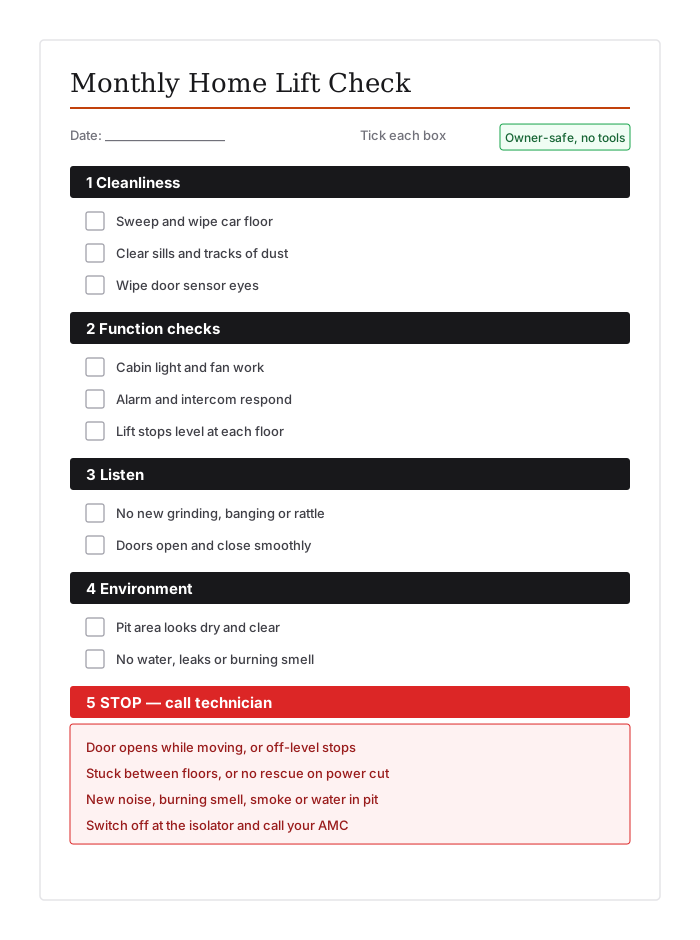
The monthly checklist (print this)
1. Cleanliness — the highest-value five minutes
Dust and grit are the single biggest cause of nuisance stoppages in Indian homes. Around 65 percent of residential service calls trace back to dust or an unclean supply, and door faults — most of them dust-related — account for over 70 percent of all lift stoppages. This pass prevents most of them.
| ☐ | Cleanliness task | How / what to use |
|---|---|---|
| ☐ | Wipe the cabin floor and walls | Dry or barely-damp microfibre cloth; no buckets of water |
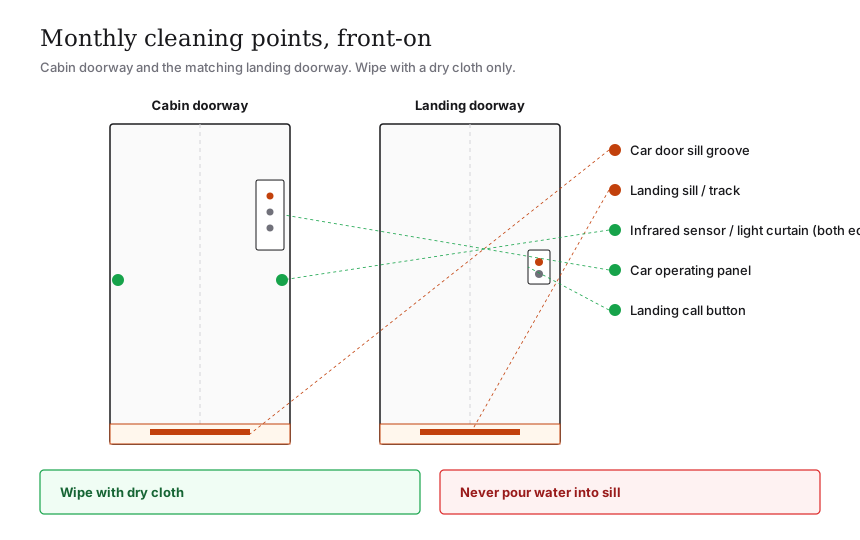
| ☐ | Clear the car door sill / threshold groove of dust and grit | Dry brush or vacuum nozzle along the bottom track |
| ☐ | At every landing, clear the door sill / track of dust, hair and debris | Same — a clean track lets the lock seat properly |
| ☐ | Wipe the door infrared sensors / light curtain (the eyes on both door edges) | Soft dry cloth; a smeared sensor makes the door reopen |
| ☐ | Wipe the call buttons and car operating panel | Lightly damp cloth, then dry |
| ☐ | Remove any mat, object or packaging left leaning in the doorway | Doorways must stay completely clear |
Never pour or spray water into the sill groove or the shaft. A damp cloth is plenty; standing water near the door bottom or in the pit causes far bigger problems than dust does.
2. Function checks — does everything still work?
Ride the lift for one full cycle and confirm each item. These are all things you operate every day anyway; the point is to test them deliberately, once a month, before you actually need them.
| ☐ | Function check | What "good" looks like |
|---|---|---|
| ☐ | Cabin light | Comes on, steady, bright enough to read by |
| ☐ | Cabin fan / ventilation | Runs quietly when switched on |
| ☐ | Alarm bell / button | Sounds clearly and is audible outside the lift |
| ☐ | Two-way intercom / emergency phone | You can talk and be heard both ways |
| ☐ | Doors open and close smoothly | No juddering, sticking, slamming or repeated reopening |
| ☐ | Door reversal on obstruction | Wave a hand across the closing doors — they should reopen |
| ☐ | Car stops level with the floor | No step up or down at any landing |
| ☐ | Floor buttons and indicators | Each registers; the floor display is correct |
| ☐ | Ride feels smooth | Starts, runs and stops without jolting |
If your lift has an Automatic Rescue Device (ARD) battery backup — and in India it should — note that you do not test it by cutting power yourself. Have your AMC load-test the battery at each visit; see the battery backup maintenance guide.
3. Listen — your ears are a diagnostic tool
Stand inside for one quiet ride and just listen. You know what your lift normally sounds like; a new noise is the earliest warning you will get.
| ☐ | Listen for | Note in the log |
|---|---|---|
| ☐ | Any new grinding, squealing or rumbling | When it happens: start, run, stop, or doors |
| ☐ | Any new vibration or knocking | Continuous or only at one point? |
| ☐ | Door noise — clatter, scrape, bang | At opening, closing, or both? |
A sudden new noise is a reason to call the technician, not to investigate yourself — see the lift noise troubleshooting guide. Logging exactly when the noise occurs saves your technician time and saves you money.
4. Environment — keep the lift's surroundings healthy
This is about the spaces around the lift that you can see and reach without opening anything. In monsoon-heavy India, water is the enemy.
| ☐ | Environment check | What to confirm |
|---|---|---|
| ☐ | Machine / power-pack area (if accessible in a cabinet) is dry and ventilated | No damp smell, no condensation, vents not blocked |
| ☐ | No water has collected near the lift after rain | Check the landing area and any visible pit drain grille |
| ☐ | Pit area looks dry — observed only, never entered | If you can see standing water, that is a STOP item |
| ☐ | Ambient temperature around the machine is reasonable | Not baking hot; airflow not blocked by stored items |
| ☐ | Nothing is stored against the lift machinery or leaning on doors | Keep the whole area clutter-free |
"Pit and machine area dry" means looking and smelling, from where you normally stand. You never climb into the pit, open the machine cabinet's electrical sections, or lift any access panel. If you cannot tell whether the pit is dry without opening something, treat it as a question for your technician.
OWNER-SAFE vs OFF-LIMITS — the line you never cross
Everything in the checklist above is owner-safe: cleaning surfaces and tracks, wiping sensor eyes, and operating the controls and safety devices the way you would on any normal ride. Off-limits work is anything that exposes the moving system or its safety chain.
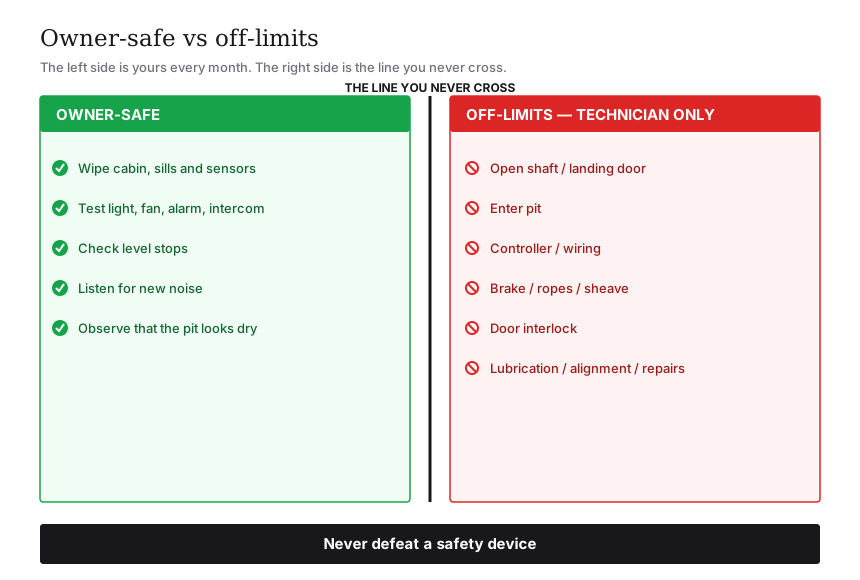
| OWNER-SAFE (you, monthly) | OFF-LIMITS (licensed technician only) |
|---|---|
| Wipe cabin, sills, tracks and sensor eyes | Opening any landing or shaft door to reach in |
| Test light, fan, alarm, intercom, buttons | Entering or working in the pit |
| Confirm smooth doors and level stops | Touching the controller / PCB / wiring |
| Listen for new noises and log them | Adjusting the brake, ropes, sheave or motor |
| Observe that pit and machine area look dry | Touching the door interlock or any lock |
| Switch the lift off at the main isolator in an emergency | Lubrication, alignment, levelling, repairs |
| Keep doorways and machine area clear | Anything requiring tools or covers removed |
The door interlock and the overspeed safety gear are what stop the lift moving with an open door and what arrest the car if it ever overspeeds. Never defeat, tape over, prop, or "fix" a safety device to make a stuck lift run. If a safety device is stopping the lift, the safety device is usually doing its job — call the technician.
STOP — call the technician if any of these is true
If you tick any box in this list, stop using the lift, tell your household, and call your AMC or licensed technician. Do not force, override, or "try one more time."
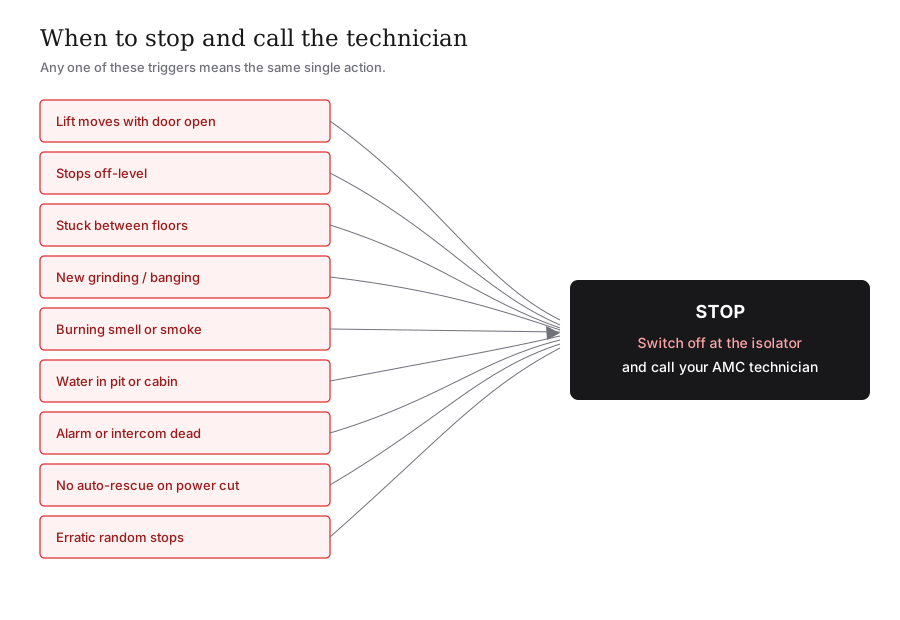
| ☐ | STOP — call the technician if… |
|---|---|
| ☐ | The lift moves with a door open, or a door will not fully close |
| ☐ | The car does not stop level with the floor (a step up or down) |
| ☐ | The lift stops between floors, drifts, or runs the wrong way |
| ☐ | A new grinding, banging, rumbling or vibration has appeared |
| ☐ | There is a burning smell, smoke, or visible spark |
| ☐ | Water is standing in the pit, around the machine, or in the cabin |
| ☐ | The alarm or intercom does not work (loss of your lifeline if trapped) |
| ☐ | The lift does not auto-level on a power cut (ARD / battery failing) |
| ☐ | A safety device keeps tripping and you are tempted to override it |
| ☐ | The lift behaves erratically — random stops, doors cycling, false calls |
If someone is trapped inside: keep calm, tell them to stay in the car (it is the safest place), use the alarm and intercom to stay in contact, and call your technician's emergency number. Never try to pry the doors open or wind the car by hand yourself — manual lowering is a trained-technician procedure on a home lift.
For an isolated lift behaving erratically with no one inside, it is fine to switch it off at its main isolator / MCB so no one uses it, then call for service. That is the one "intervention" a homeowner should make — and it is the opposite of forcing it to run.
What this checklist does NOT cover (and where to go)
Your monthly routine is deliberately shallow and safe. The deeper work belongs elsewhere in this cluster:
- The full annual once-over — ropes, brake, governor, levelling, controller, load test: that is the technician's job in the annual lift inspection checklist, plus any statutory inspection your state's Lift Act requires.
- A door that keeps faulting after you have cleaned the track and sensors: lift door problems.
- A noise you have logged: lift noise troubleshooting.
- A weak or aged backup battery: lift battery backup maintenance.
- Recurring faults across the board: common home lift problems and solutions.
- Choosing and running your service cover: the operational lift AMC guide and the scorecard-style AMC evaluation guide.
- An ageing lift near year 20: home lift modernization and when to replace a home lift.
For the bigger picture, see the pillar residential elevator buyer's guide; for what service costs, the home lift cost guide (all figures indicative — confirm with your technician).
Keep a one-line service logbook: date, what you checked, anything you noticed. Hand it to your AMC technician at each visit. A homeowner who runs this checklist and keeps a log is the single biggest reason a residential lift reaches its full 20-to-25-year life — and beyond, with modernization.
References
- IS 14665 (Electric Traction Lifts), Part 2 — Code of practice for installation, operation and maintenance (BIS, committee ETD 25): https://law.resource.org/pub/in/bis/S05/is.14665.2.1-2.2000.pdf
- IS 14665, Part 1 — Outline dimensions (BIS): https://law.resource.org/pub/in/bis/S05/is.14665.1.2000.pdf
- National Building Code of India 2016, Part 8 (Building Services), Section 5 — Installation of Lifts, Escalators and Moving Walks (BIS): https://www.bis.gov.in/standards/technical-department/national-building-code/
- BIS — Guide for Using NBC 2016: https://www.bis.gov.in/wp-content/uploads/2022/08/Booklet-Guide-for-Using-NBC-2016.pdf
- IS 17900 / EN 81-20 and EN 81-50 are the harmonised lift design and test standards referenced by Indian practice; IS 14665 Part 3 covers safety rules and Part 5 the inspection manual.
- State Lift Acts governing licensing and periodic statutory inspection — e.g. Maharashtra Lifts, Escalators and Moving Walks Act 2017; Karnataka Lifts, Escalators and Passenger Conveyors Act 2015; Delhi Lifts and Escalators Act 2007; Tamil Nadu Lifts Act 1997. Maharashtra licence-to-operate service portal: https://services.india.gov.in/service/detail/maharashtra-license-to-operate-lift
- Lift regulation overview (India): https://www.99acres.com/articles/know-all-about-the-lift-regulations-in-india.html
- Residential elevator lifespan (ShuttleSky): https://shuttlesky.in/residential-elevator-lifespan/
- Ensuring lift longevity — maintenance (TK Elevator): https://www.tkelevator.com/in-en/news/ensuring-lift-longevity.html
- Common problems with home lifts (EFE): https://efepvtltd.com/blogs/what-are-the-common-problems-with-home-lifts/
Standards, licensing and inspection rules vary by state and are revised periodically. All figures are indicative — confirm with your local municipal bye-laws and a licensed lift contractor. Last verified June 2026.
Export this guide
Related Guides — Deep-dive reading
Annual Lift Inspection Checklist (India): What the Yearly Service Should Cover
The complete checklist of what the annual professional service and statutory inspection should cover — so you can hold your technician or AMC to it.
Home Lifts & AccessibilityLift Door Problems Explained (India): Why Doors Cause Most Faults
Doors cause over 70 percent of home-lift stoppages. Read the symptom, find the cause, and know which fixes are owner-safe and which belong to a licensed technician.
Home Lifts & AccessibilityHome Lift Maintenance Guide (India): Keeping Your Lift Safe and Reliable
The homeowner's map to lift upkeep — the maintenance cadence, who does what, the safety boundary, and the lifecycle from first service to modernisation.
Home Lifts & AccessibilityRelated Tools — Try Free
Lift Safety Audit Checklist
Interactive checklist that scores your home lift on safety devices, compliance and upkeep.
ChecklistCross-Ventilation Analyzer
Estimate airflow and air changes per hour (ACH) from room size, window areas, layout, and local wind — with NBC 2016 Part 8 compliance check.
Ventilation CalculatorElectrical Safety & Load Audit
Home electrical audit — 10 categories, 65+ checkpoints across earthing, RCCB, MCB, wiring, switchboards, appliance circuits, DG/inverter backup.
Safety Audit