
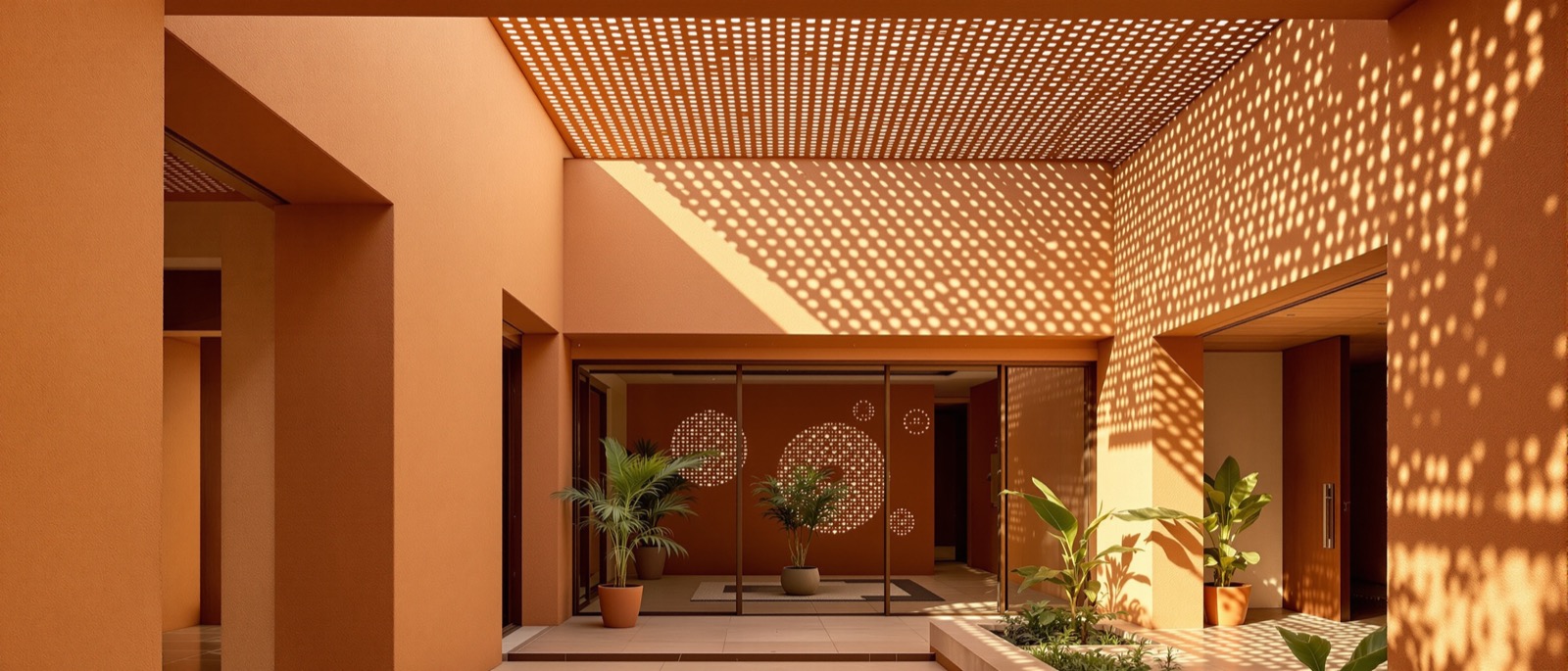
Why Vernacular Design Is Returning: Climate, Carbon & the Future of the Indian Home
How India's cooling crisis and carbon reckoning are reviving courtyards, earth walls and passive design — and how to adapt vernacular intelligence honestly, not romanticise it
It is a familiar Indian afternoon. The temperature in a Gurugram or a Hyderabad bedroom touches 44 degrees outside; inside, a split air-conditioner labours against a wall of exposed concrete, and the electricity meter spins. The flat was built fast, in reinforced cement concrete, with large unshaded glass and a flat terrace that bakes all day. It cools beautifully — for as long as the grid holds and the bill is paid. Two hundred kilometres away, in a courtyard house of mud and stone that an unnamed mason built a century ago, the same afternoon feels ten degrees gentler, and not a single watt is being spent to make it so.
That contrast is the whole argument of this guide. For three generations, the aspirational Indian home has meant concrete, glass, and an AC unit — the "pucca" house that signals having arrived. But the country is now staring at a cooling-and-carbon reckoning that makes the old vernacular intelligence look less like nostalgia and more like a blueprint. Vernacular design is returning to Indian conversation not as heritage sentiment but as low-carbon, climate-responsive engineering that we abandoned too quickly — and the smartest practitioners are adapting it, not copying it.
This is the thematic, "why now" piece of our vernacular cluster — written for the homeowner deciding how to build, the B.Arch student forming a position, and the practising architect under client pressure to "just do RCC." It assumes you have met the principles already; if not, start with the conceptual pillar, Indian Vernacular Architecture, and treat the regional guides — Kerala, Rajasthan, Gujarat, Ladakh and the others — as a sourcebook of climate solutions. Here we make the case for why these ideas matter in 2026, who is reviving them, and how to use them honestly.
We did not lose vernacular knowledge because it stopped working. We lost it because concrete was faster, AC was cheaper to install than to design around, and mud became a symbol of poverty. The reckoning is that none of those three reasons survives contact with the climate maths.
1. The present moment: the AC-and-concrete default meets its bill
Walk through any new Indian neighbourhood and you can read the default settlement style from the street: reinforced-concrete frames, brick or block infill, large single-glazed windows facing whichever way the plot does, flat terraces, and a forest of outdoor AC condenser units stapled to every façade. This is not a conspiracy; it is a rational response to cheap cement, fast construction cycles, a skills base that knows RCC, and an aspirational culture in which a "pucca" (solid, permanent, modern) house is a marker of progress and a "kuccha" (mud, thatch, "temporary") one is a marker of poverty.
The problem is that this default externalises its comfort. A poorly shaded, low-mass, glass-heavy box is thermally hostile by design; the only way to make it liveable in a 44-degree summer is to pump heat out mechanically. Comfort is therefore purchased — every hour, from the grid — rather than built in once, in the walls and the plan. As summers lengthen and intensify across the subcontinent, that purchase is becoming both an individual cost and a national one.
The vernacular house made the opposite bet. It spent its intelligence up front, in form and material, so that it could spend almost nothing afterwards. Thick walls, courtyards, verandahs, shaded openings and light-coloured surfaces are, in effect, a one-time investment in comfort that keeps paying for a century. The "return" of vernacular is really the rediscovery of that bet under conditions — a hotter climate, a carbon ceiling — that finally make it pay off again.
2. The cooling crisis: why passive design suddenly matters
The single biggest driver of renewed interest in vernacular cooling is the explosive, near-term growth of mechanical cooling demand in India.
According to the International Energy Agency's 2023 cooling analysis (as reported by Carbon Brief), India's stock of room air-conditioners is projected to grow roughly forty-fold between 2016 and 2050, passing one billion units. Air-conditioning already accounts for a very large share of peak electricity demand in the major metros — on the order of 40 to 60 per cent of summer peak load in cities such as Mumbai and Delhi. That is a structural problem: cooling demand peaks exactly when the grid is most stressed and when solar generation is already fading into the evening.
India has responded at the policy level. The India Cooling Action Plan (ICAP) — the world's first national cooling plan of its kind — sets out to reduce cooling demand, refrigerant transition, and energy consumption across sectors, and explicitly recognises the role of building design and passive measures. On the buildings side, the Energy Conservation Building Code (ECBC) sets performance standards for the envelope, lighting and systems of larger commercial buildings.
A note of intellectual honesty before we go further: cooling also carries a significant greenhouse-gas footprint — both the electricity burned and the refrigerants that leak. You will see eye-catching "million-tonne" emissions figures attached to Indian cooling. We are deliberately not printing a specific tonnage here, because the headline numbers vary by source and baseline; the authoritative figures to cite are those in the ICAP documentation itself, which the reader should verify before quoting. The directional fact is uncontested and sufficient: cooling demand is rising steeply, it is carbon-intensive, and it is grid-destabilising.
The vernacular alternative: cooling without a compressor
This is precisely where the vernacular toolkit re-enters as a serious engineering precedent rather than a folk curiosity. The traditional Indian house cooled itself through a small, repeatable kit of passive devices — each of which is a design move, not a machine:
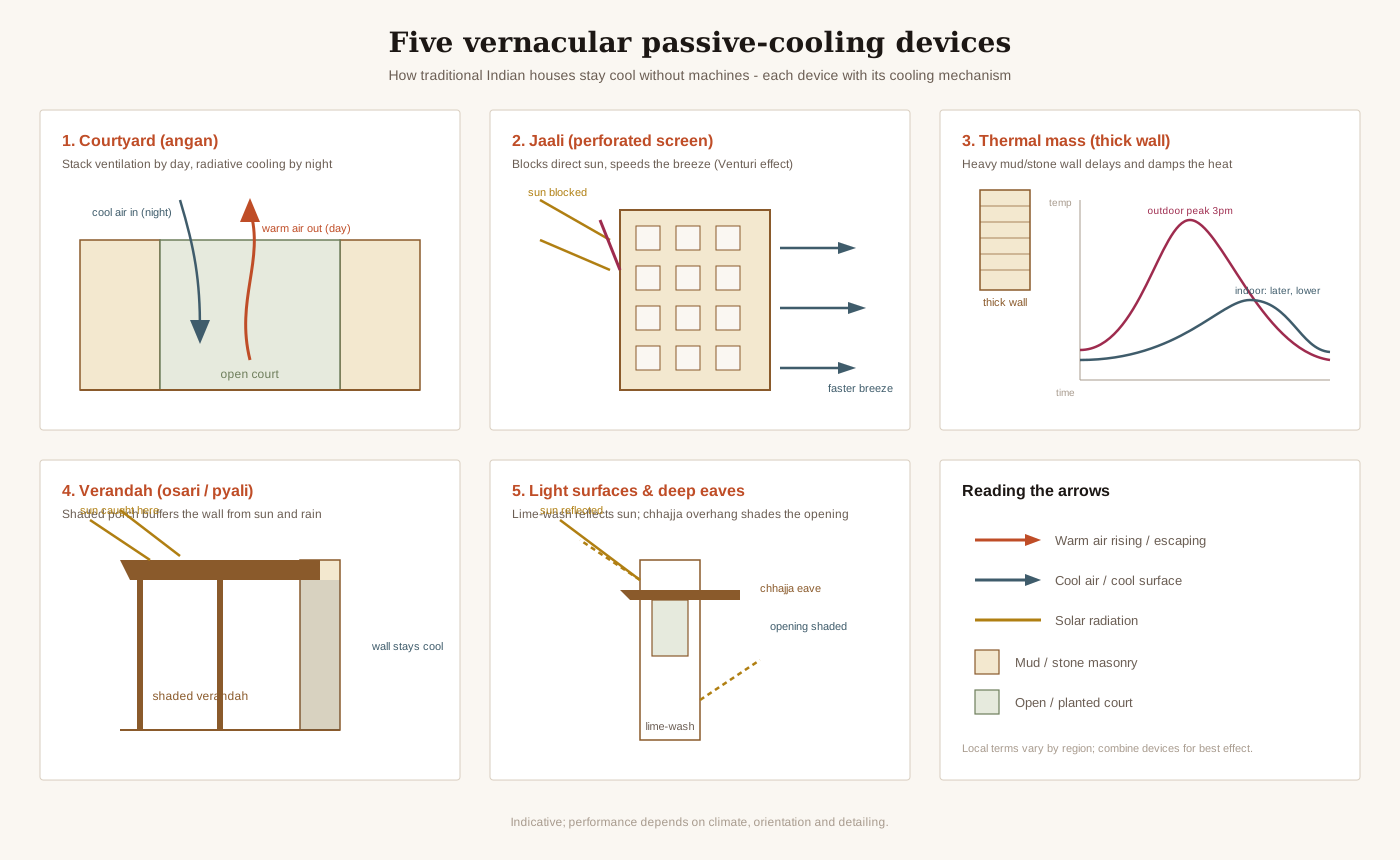
| Passive device | Local term(s) | Physical mechanism | Best climate fit |
|---|---|---|---|
| Courtyard | angan, chowk; nalukettu (Kerala), deori (Deccan) | Night-sky radiative cooling + daytime stack ventilation; protected microclimate | Hot & dry, composite |
| Perforated screen | jaali | Cuts direct sun and glare while letting air through; accelerates breeze (Venturi) | Hot & dry, composite |
| High thermal mass | thick mud, stone, lime walls | Stores and time-lags heat so interiors peak hours after, and cooler, than outside | Hot & dry, cold |
| Shaded verandah | verandah, charpoy court, thinnai (Tamil Nadu) | Buffers walls from sun and rain; creates a cool transition zone | Warm & humid |
| Light surfaces & deep eaves | lime-wash, deep chhajja | High albedo reflects solar gain; overhangs shade the wall | All hot zones |
None of these requires electricity. Together — courtyard plus jaali plus mass plus verandah plus shading — they can hold an interior several degrees below the outdoor peak, which is often the difference between needing an AC and not, or between running one for two hours instead of ten. The point is not that passive design replaces air-conditioning everywhere (it cannot, in extreme heat-humidity), but that it shrinks the load the machine has to carry, and in many climates and seasons removes it entirely. For the full regional logic of these devices, see Tropical Architecture in India and the Lessons for Modern Homes guide.
3. The embodied-carbon case: building local is building low-carbon
Cooling is the operational half of the carbon story. The other half is embodied carbon — the energy and emissions locked into the materials and the act of building itself, before anyone switches on a light.
Here the vernacular "build with what is local within a few kilometres" principle turns out to be a sophisticated carbon strategy disguised as common sense. Cement and fired brick are both energy-hungry: cement manufacture is chemically and thermally intensive, and traditional fired "country" brick is baked in kilns that burn enormous quantities of fuel. Earth, by contrast, can be stabilised and compressed without firing.
The cleanest quantified comparison comes from the Auroville Earth Institute, which has spent decades developing and testing the Compressed Stabilised Earth Block (CSEB) — local soil mixed with about five per cent cement, compressed, and cured (not fired), load-bearing up to roughly four storeys. Their figures: CSEB has about ten times less embodied energy and about thirteen times less CO2 than fired country brick.
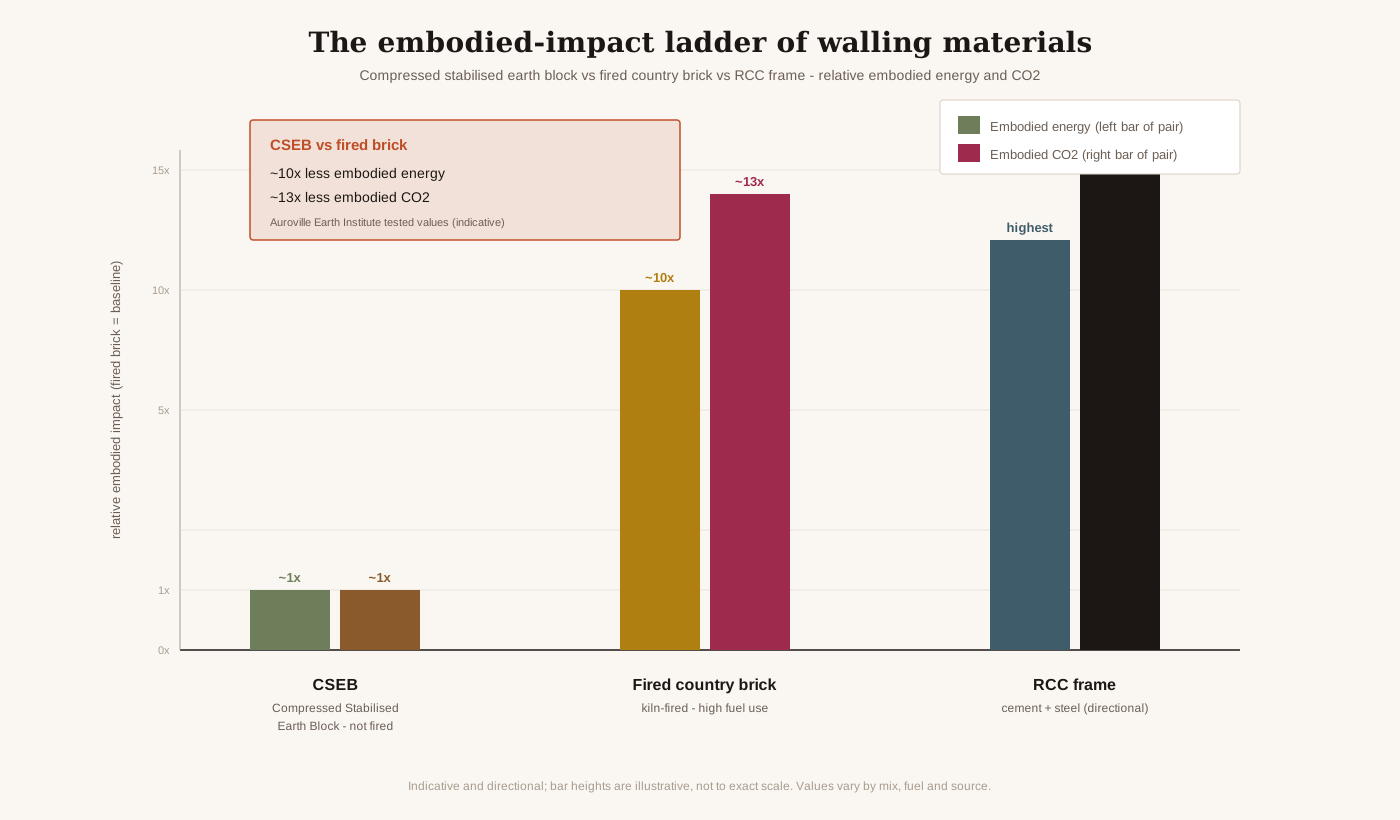
| Material / system | Firing required | Embodied energy (relative) | Embodied CO2 (relative) | Typical use |
|---|---|---|---|---|
| Compressed Stabilised Earth Block (CSEB) | No | Lowest (baseline ≈ 1) | Lowest (baseline ≈ 1) | Load-bearing walls to ~4 storeys |
| Fired country brick | Yes (kiln) | ~10x CSEB | ~13x CSEB | Walls, infill |
| Reinforced cement concrete (RCC) frame | Yes (cement) | Highest | Highest | Frame, slabs, foundations |
(Figures for CSEB versus fired brick are the Auroville Earth Institute's tested values; the RCC row is directional, indicating its higher embodied burden, not a precise multiplier.)
The lesson is not "never use concrete." Concrete is irreplaceable for foundations, for seismic-resistant frames, and for spanning. The lesson is that the default of doing everything in fired brick and RCC carries an embodied-carbon cost that a hybrid — earth or stabilised-earth walls, lime finishes, timber or bamboo where appropriate, concrete only where it earns its place — can dramatically cut, while also keeping money and labour in the local economy. That is the deeper meaning of the build-local principle.
4. The contemporary practitioners: who is reviving this, and how
Vernacular is "returning" partly because a distinguished line of Indian and India-based architects never let it leave — and a younger generation is now extending their work with contemporary tools. These are not revivalists making mud museums; they are people solving cost, climate and carbon problems with local materials and craft.
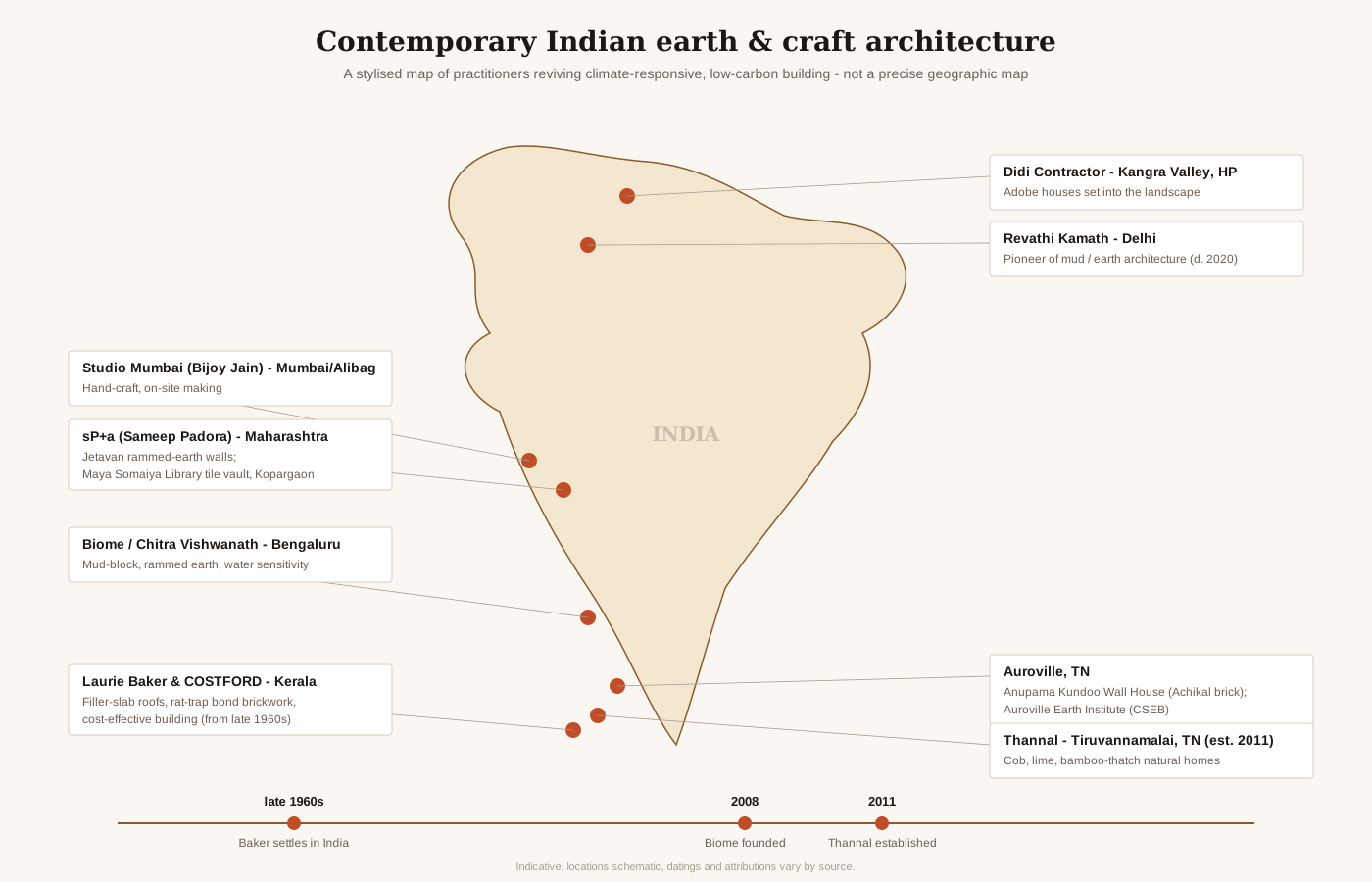
| Practitioner / studio | Base & focus | Signature approach / works |
|---|---|---|
| Laurie Baker (with COSTFORD) | Trivandrum, Kerala; settled India from the late 1960s | The "Gandhi of Architecture"; cost-effective, low-energy building — rat-trap bond brickwork, filler-slab roofs, exposed brick, jaali. Co-founded and directed COSTFORD, associated with some 20,000 buildings in Kerala |
| Didi Contractor | Kangra Valley, Himachal Pradesh | Self-taught; adobe and mud houses tuned to the Himalayan foothills; linked with the Dharmalaya Institute |
| Revathi Kamath | Kamath Design Studio, Delhi (d. 2020) | A leading proponent of mud and earth architecture in contemporary India |
| Anupama Kundoo | Auroville / international | The Wall House in Auroville, built with Achikal brick of Tamil Nadu; research into low-impact, locally sourced building |
| Bijoy Jain / Studio Mumbai | Mumbai / Alibag | Local materials, hand-craft, and on-site making as the core method |
| Biome Environmental Solutions / Chitra Vishwanath | Bengaluru | Mud-block and rammed-earth ecological architecture coupled with water design; formed 2008 alongside S. Vishwanath's Rainwater Club |
| Thannal Hand Sculpted Homes | Tiruvannamalai, Tamil Nadu | Founded 2011 by Biju & Sindhu Bhaskar; natural building — cob, stone-and-lime foundations, bamboo and coconut-thatch roofs |
| Sameep Padora / sP+a | Mumbai | Vernacular crossed with computational design — Jetavan (rammed stone-dust walls, built with Hunnarshala) and the Maya Somaiya Library at Kopargaon (a tile-vaulted brick roof) |
What unites them is a method, not a style. Laurie Baker is the patriarch of the movement: by treating cost and energy as design problems rather than afterthoughts, and by inventing techniques like the filler-slab (replacing redundant concrete in a slab's tension zone with light fillers such as tiles or pots), he showed that low-carbon could also be low-cost — the two arguments that finally persuade an Indian client. Studio Mumbai and Thannal carry the craft-and-material argument; Biome and the Auroville circle carry the earth-and-water-engineering argument; and sP+a demonstrates that vernacular logic can be coupled with digital structural optimisation to make forms — a tile vault, a rammed wall — that are both traditional in material and contemporary in geometry. You can read more architect biographies in our /architects section.
5. Movements, codes and recognition
The revival is not only individual practice; it is also institutions, standards and the highest awards the field can give.
Auroville Earth Institute is the intellectual engine. Holding a UNESCO-affiliated chair on earthen architecture and running the Auram press, it has standardised, tested and taught CSEB construction along with earth vaults, arches and domes for decades — turning "mud" from a folk material into a documented, repeatable building system.
On the green-rating side, India has two principal systems that increasingly reward exactly the choices vernacular building makes — local materials, passive cooling, low operational energy: GRIHA (Green Rating for Integrated Habitat Assessment) and IGBC (the Indian Green Building Council's ratings). They give a homeowner or developer a formal, market-recognised reason to build the low-carbon way.
There is also a standards question that students often ask: is there an Indian code for building in earth or bamboo? The honest answer is yes, with a caveat to verify the current numbers. Indian standards for earthen and bamboo construction do exist — for example, the IS 13827 / IS 13828 family of standards relating to low-strength and earthen-masonry buildings in seismic zones, alongside standards for bamboo structures. Before you cite a specific code in a drawing set or a thesis, confirm the exact current number and revision year against the Bureau of Indian Standards catalogue, because these are periodically updated.
Finally, recognition. The clearest, most verifiable signals that climate-responsive, contextual Indian architecture has arrived at the summit of the discipline are two:
- Balkrishna Doshi won the Pritzker Prize in 2018 — the first Indian laureate — cited for a humane, contextual body of work including CEPT, the Aranya housing, and Amdavad ni Gufa.
- Aranya Low-Cost Housing in Indore (completed 1989), designed by Doshi's practice for roughly 80,000 residents on incremental, owner-buildable plots, won the Aga Khan Award for Architecture in the 1993–95 cycle.
Aranya is the cleanest example to lead with because it joins both halves of this guide's argument: it is low-carbon and low-cost in its materials and incremental method, and it is socially intelligent in the vernacular sense — it gives families a serviced plot and a starter core to build out themselves, exactly as the owner-built vernacular house always grew.
6. The honest caveats: adapt, do not romanticise
A guide that only sang the praises of vernacular would be doing the reader a disservice — and would fail the test of authority. The mature position is critical, not nostalgic.
Beware physical determinism
The foundational caution comes from Amos Rapoport's House Form and Culture (1969). Rapoport argued explicitly against the idea that house form is primarily determined by climate and technology — what he called "physical determinism." Form, he showed, is shaped by "a whole range of socio-cultural factors," with climate and materials acting as modifying forces, not commanding ones. This cuts both ways for our argument. It warns us not to reduce the vernacular house to a thermal machine (it was also a social and ritual instrument), and it warns us not to assume that copying a courtyard will deliver comfort regardless of culture, use and detailing. Climate is primary-among-several, never the sole author.
Durability, scaling and sanitation are real problems
Romantics tend to skip the failure modes. Earthen and thatch construction can fail — to water, to termites, to seismic load — when poorly detailed. Mud needs "good boots and a good hat": a damp-proof stone or stabilised plinth and a generous overhanging roof. Scaling natural building to mass housing demands standardisation, quality control and trained labour that the informal vernacular never needed. And historic vernacular settlements often lacked the sanitation, water and services that a 2026 home must have. None of these is a reason to abandon vernacular principles; all of them are reasons to bring contemporary engineering to the table rather than reproducing a village house literally.
The "pucca versus kuccha" stigma
The hardest barrier is social, not technical. In much of India, mud and thatch read as kuccha — poor, temporary, something to escape — while concrete reads as pucca, arrived, permanent. A family that has finally saved for a "real" house does not want to be told to build in mud. Any honest revival has to confront this aspiration directly: by demonstrating durable, beautiful, serviced earth buildings (Aranya, the Wall House, COSTFORD homes) that visibly are not poverty, and by being clear that the goal is dignity and comfort, not a return to hardship.
The principle: adapt, never replicate
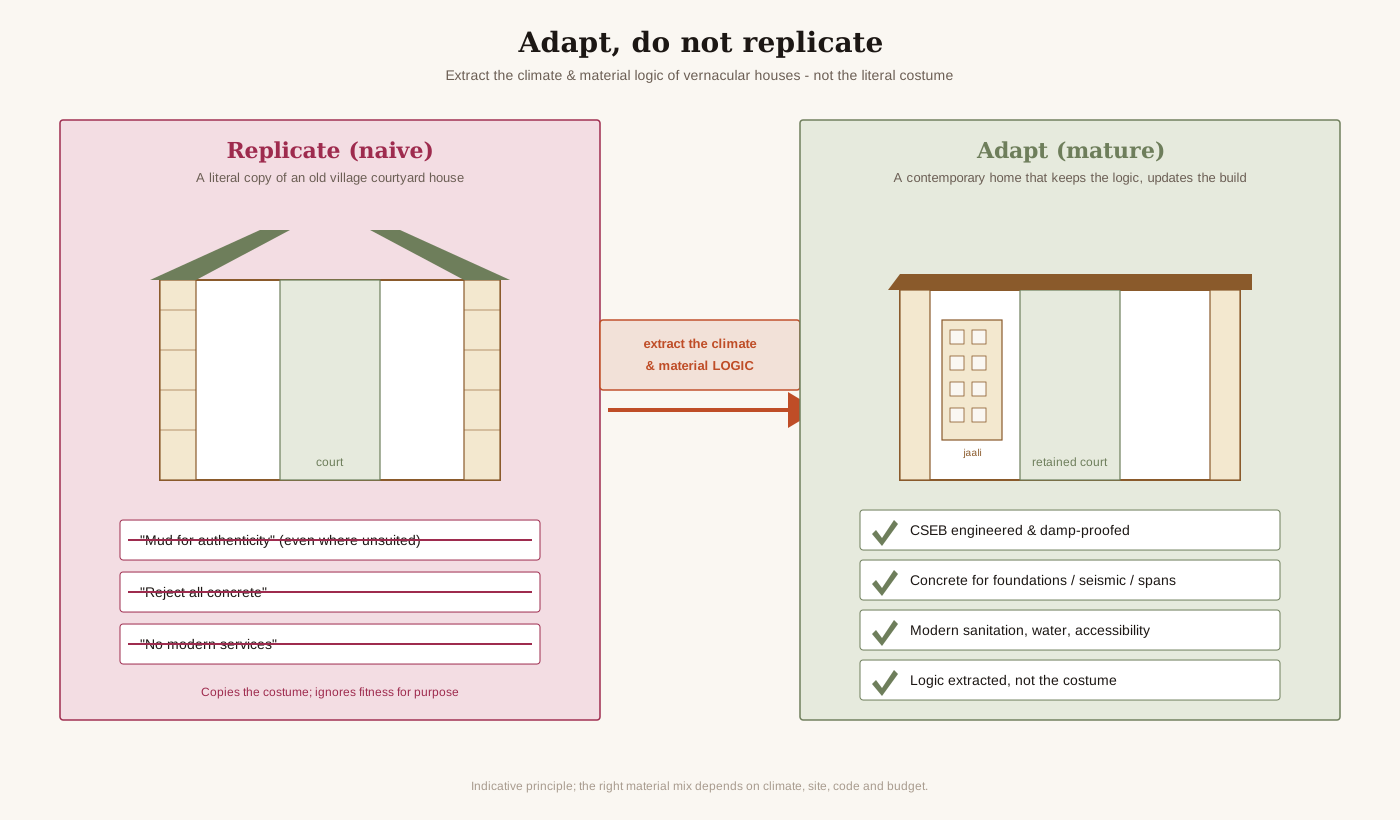
| Naïve revival (replicate) | Mature revival (adapt) |
|---|---|
| Copy the historic form and ornament | Extract the climate and material logic |
| Mud because it is "authentic" | Stabilised earth / CSEB, engineered and damp-proofed |
| Reject all concrete | Concrete where it earns its place (foundations, seismic frame, spans) |
| Romanticise the village house | Add modern sanitation, water, services, accessibility |
| Treat vernacular as a finished style | Treat it as a toolkit of principles to recombine |
The whole of this guide can be reduced to that right-hand column. Vernacular returns most usefully when it is read as a method — a way of reasoning from climate, material, craft and culture — and not as a costume.
7. How to actually apply this — homeowner, student, architect
The "why now" matters only if it changes what you build. Three short paths:
- If you are a homeowner, do not start with a style; start with your climate zone and your plot's orientation. Insist on shading, cross-ventilation, thermal mass appropriate to your zone, and light external surfaces before you size the air-conditioning. Browse climate-matched layouts in /house-plans, and read Lessons for Modern Homes for the practical translation.
- If you are a student, build a defensible position rather than a preference. Pair the climate logic of the pillar guide and regional studies with Rapoport's anti-determinism so that you can argue for vernacular and critique its naïve use. Compare directly with the Modern vs Traditional Indian House framing.
- If you are an architect, treat the regional guides as a sourcebook and the practitioners above as precedent. Use CSEB, lime, filler slabs, jaali and courtyards where the climate and brief support them; document performance; pursue GRIHA or IGBC where the client values it; and confront the pucca-versus-kuccha conversation honestly with your client at the start.
Vernacular design is returning because the climate maths finally agrees with what the unnamed masons knew. Our task is not to worship their houses but to learn how they thought — and then to build, with today's engineering, the low-carbon Indian home that the next forty summers will demand.
References & Further Reading
Foundational / Theory
- Bernard Rudofsky, Architecture Without Architects: A Short Introduction to Non-Pedigreed Architecture — the MoMA exhibition and catalogue (1964), widely regarded as the beginning of vernacular-architecture studies.
- Amos Rapoport, House Form and Culture (Prentice-Hall, 1969) — the argument against physical determinism; culture as the leading shaper of house form.
- Paul Oliver (ed.), Encyclopaedia of Vernacular Architecture of the World (Cambridge University Press, 1997); and Dwellings: The House Across the World (1987). (His 1969 book is Shelter and Society.)
Climate, cooling & carbon
- International Energy Agency, 2023 cooling analysis (India room-AC growth and peak-load share; as reported by Carbon Brief).
- India Cooling Action Plan (ICAP) — Ministry of Environment, Forest and Climate Change (verify specific emissions tonnages here before quoting).
- Energy Conservation Building Code (ECBC), Bureau of Energy Efficiency.
- Auroville Earth Institute (auroville-earth-institute.org) — CSEB technique and its tested embodied-energy and CO2 comparisons versus fired brick.
- Bureau of Indian Standards — earthen and bamboo construction standards (the IS 13827 / IS 13828 family and bamboo-structure standards; confirm current numbers against the BIS catalogue).
- GRIHA Council (grihaindia.org) and Indian Green Building Council, IGBC (igbc.in).
Indian sources, practitioners & recognition
- Gautam Bhatia, Laurie Baker: Life, Works & Writings — on Baker, COSTFORD, and cost-effective low-energy building.
- The Pritzker Architecture Prize, 2018 laureate citation — Balkrishna Doshi.
- The Aga Khan Award for Architecture, 1993–95 cycle — Aranya Low-Cost Housing, Indore (B.V. Doshi).
- Charles Correa, A Place in the Shade (Penguin India, 2010); and Vistara: The Architecture of India, ed. Carmen Kagal (Festival of India, 1986).
- V.S. Pramar, A Social History of Indian Architecture (Oxford University Press).
Companion Studio Matrx guides
- Pillar: Indian Vernacular Architecture
- Regional sourcebook: Kerala · Tamil Nadu · Karnataka · Rajasthan · Gujarat · Ladakh · Bengal · North-East India
- Applied: Lessons for Modern Homes · Tropical Architecture in India · Modern vs Traditional Indian House
- Sections: /house-plans · /architects · /guides
Author's Note: I grew up being taught that concrete meant we had finally arrived, and that the old mud-and-courtyard house was something we had escaped. It took a hot decade and an honest look at the electricity bill to see how much intelligence we left behind in those thick walls. I write this not to send anyone back to the village, but because I believe the next great Indian home will be one that thinks like the old masons and builds like a modern engineer. — Amogh N P
Disclaimer: Vernacular terms, spellings and datings vary across sources and regions; examples, attributions and conservation status change over time; quantified figures for cooling demand, emissions and embodied carbon depend on source and baseline, and specific code numbers are periodically revised. This is an educational overview — verify specifics (especially ICAP tonnages and current IS code numbers) against the cited scholarship and primary bodies before relying on them. No liability is accepted for decisions made on the basis of this article.
Export this guide
Related Guides — Deep-dive reading
Designing a Naturally Energy-Efficient Indian Home
Comfort first, gadgets last — passive design, orientation, insulation, ventilation and the climate wisdom that cuts Indian energy bills
SustainabilityLaurie Baker's Façade Signature: Brick Jaali, Rat-Trap Bond and the Honest Low-Cost Indian Wall
How India's "Gandhi of architecture" turned cheap, honest, climate-wise materials — exposed brick, the perforated brick jaali, rat-trap bond and curved walls — into the most affordable and most beautiful façade in the country.
Building FacadesCompressed Stabilised Earth Blocks (CSEB): A Specify-and-Select Guide for India (2026)
What CSEB is - local soil plus a small percentage of cement or lime, compressed in a press and cured, never kiln-fired - its low-carbon and thermal-mass strengths, its real limits around soil, quality control and water, and how it compares with fired clay brick and fly-ash brick. A specify-and-select guide.
Building MaterialsRelated Tools — Try Free
Brise-Soleil Visualizer
Interactive horizontal-louvre cut-off angle calculator — sun altitude, louvre depth, and spacing inputs with a live shadow preview. Computes θ = arctan(spacing/depth) for façade shading, ECBC envelope compliance, hospital daylight design, and tropical sun-control detailing.
Sun Shading ToolCross-Ventilation Analyzer
Estimate airflow and air changes per hour (ACH) from room size, window areas, layout, and local wind — with NBC 2016 Part 8 compliance check.
Ventilation CalculatorWindow Orientation Planner
Pick the best window type, glass and shading by wall direction — north, east, south and west.
Window Tool