
Laurie Baker's Façade Signature: Brick Jaali, Rat-Trap Bond and the Honest Low-Cost Indian Wall
How India's "Gandhi of architecture" turned cheap, honest, climate-wise materials — exposed brick, the perforated brick jaali, rat-trap bond and curved walls — into the most affordable and most beautiful façade in the country.
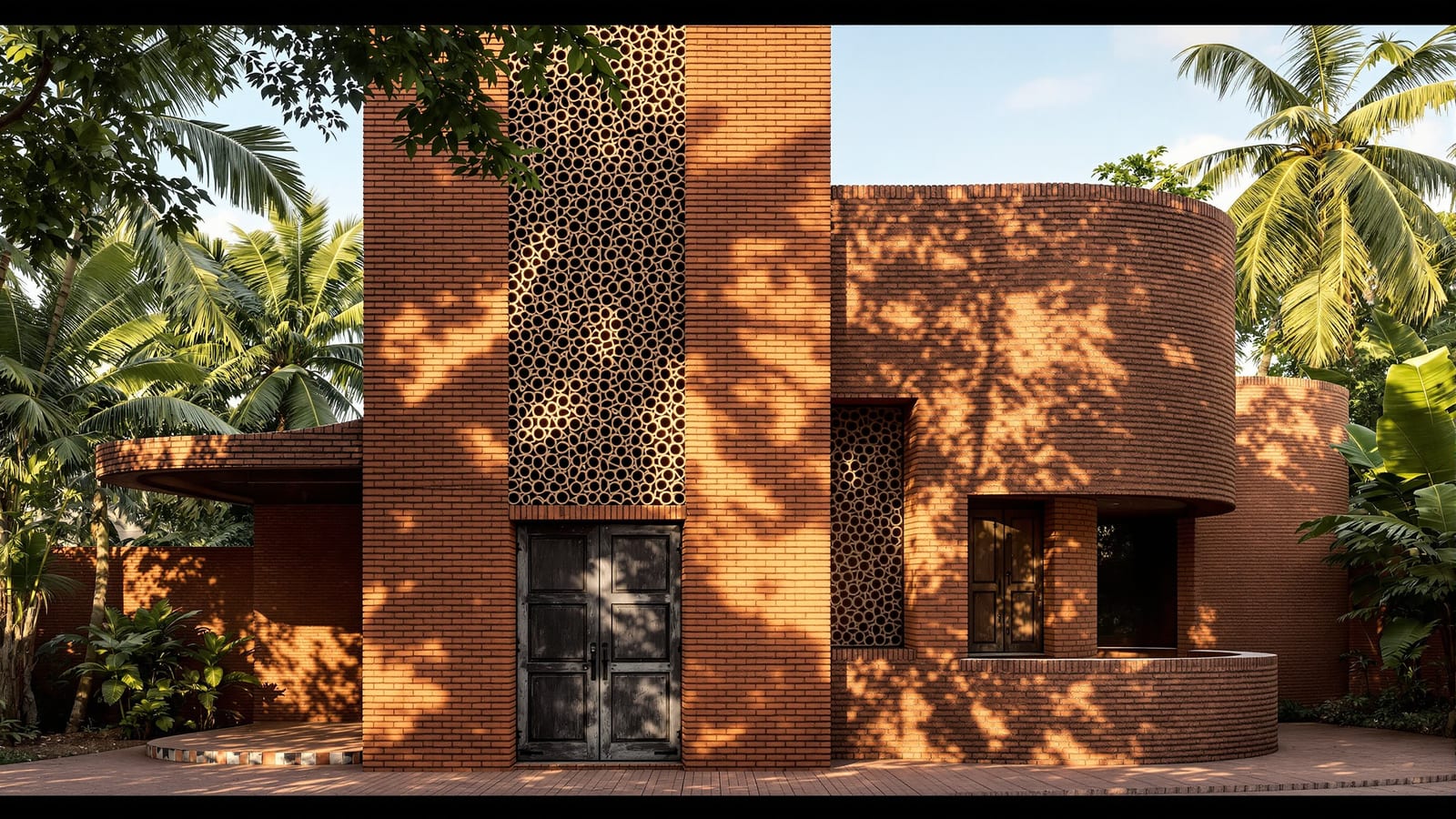
Walk up to a Laurie Baker building and the first thing you notice is that nothing is hiding. The brick is just brick — raw, warm, red, laid by hand and left exactly as it is. There is no plaster smoothing it over, no paint pretending it is something else, no granite cladding bolted on to make it look expensive. And yet it is one of the most beautiful walls you will ever stand in front of, because the ornament is not added on top of the structure — the ornament is the structure. The pattern in the brick, the curve of the wall, the perforated screen that throws coins of light across the floor: all of it comes free, out of the way the wall is built.
This is the radical thing about Baker's façades, and the reason an ordinary Indian homeowner should care about them more than about almost any other architect's work. Baker did not make cheap buildings that looked cheap. He made genuinely affordable buildings that looked, and felt, richer than the plastered-painted boxes going up around them — because he understood that frugality, done with skill, is beautiful. "Why hide a good material," he asked, "and then pay extra to do it?" A Baker wall is finished, insulated, ornamented and breathing in a single move, for a fraction of the cost of a conventional one.
Laurie Baker (1917–2007) was British-born, trained in Birmingham, and came to India in 1945; he was naturalised Indian and spent most of his working life in Trivandrum, Kerala. People called him the "Gandhi of architecture" because his whole project was the dignified, affordable, climate-correct house for ordinary people. This article is not his life story — for that, read his biography, Laurie Baker. Here we look at one thing only: how he designed façades.
This is part of our Building Façades series — specifically our Masters of the Façade set, where we study how a single great architect handled the face of a building. If you want the techniques in full, read alongside our guide to exposed brick façades, our guide to the jaali and traditional Indian façade, the façade cost guide (Baker is its patron saint), and the climate-responsive façades guide. He is the natural companion to his fellow low-cost Indian master — see the B. V. Doshi façade signature, who also worked in brick, jaali and frugality.
1. Exposed brickwork: the wall that needs nothing added
Baker's starting point was exposed brickwork — brick laid as the finished façade, never plastered and never painted. In a conventional Indian house the brick wall is only the skeleton: you then pay for plaster on both faces, then putty, then primer, then two coats of paint, then repainting every few years as it fades and flakes. Baker simply deleted all of that. A well-laid brick wall, he argued, is already weatherproof, already textured, already coloured, and already finished. Spending money to bury it is paying to make a good thing worse.
The saving is real and it is large. You remove the cost of plaster (material plus the skilled plasterer's time on both faces of every wall), the cost of paint, and the entire lifetime cost of repainting. What you get back is honest construction — a façade that tells the truth about how it is made. The texture of the brick, the rhythm of the joints, the slight variations from one brick to the next: these read as ornament because they are the genuine grain of the building, not a decorative skin. This is the bedrock idea everything else sits on.
2. The brick jaali: the free, breathing façade (in brief)
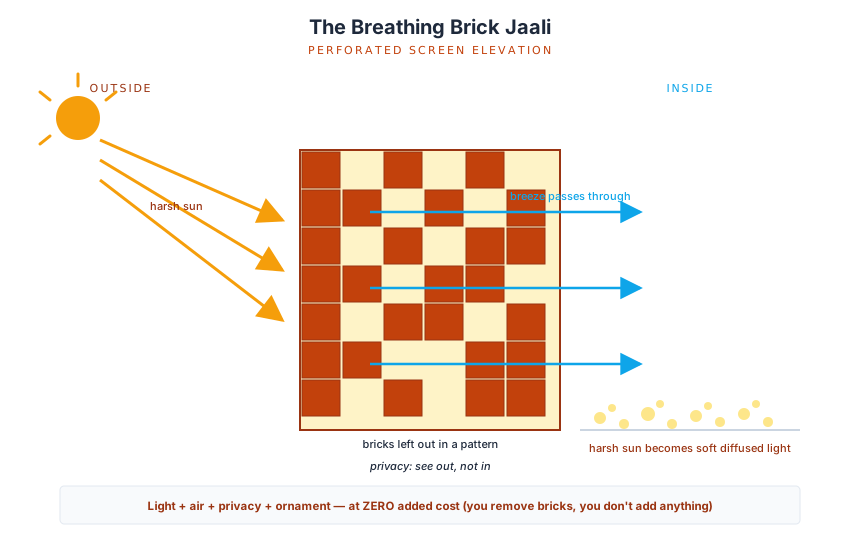
The brick jaali, or perforated brick screen, is Baker's single most beautiful and most useful façade idea, and it deserves its own section below. The principle is almost shockingly simple: as you lay the wall, you leave bricks out in a deliberate pattern, so the wall becomes a perforated screen instead of a solid block. You are not adding anything — you are removing material — and yet that removal does four jobs at once: it lets in soft diffused light, it lets breeze pass straight through, it gives privacy (you can see out far more easily than others can see in), and it creates a pattern of light and shadow that is pure ornament. Light, air, privacy and beauty, all from the bricks you didn't lay.
3. Rat-trap bond: cheaper, cooler and finished in one move
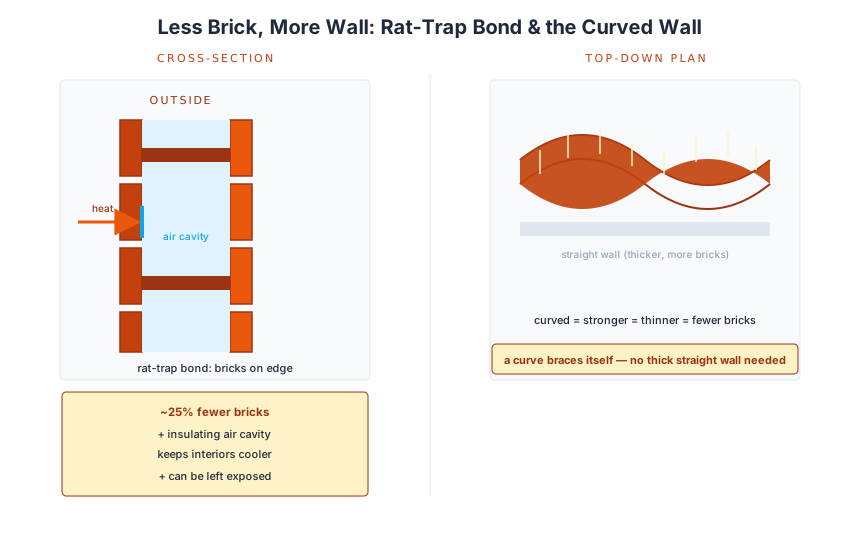
If the jaali is Baker's most beautiful idea, rat-trap bond is his most quietly clever. In a normal wall, bricks lie flat. In a rat-trap bond wall, the bricks are laid on edge in a way that leaves a continuous hollow cavity running through the middle of the wall. That cavity does two things. First, it means you need roughly a quarter to a third fewer bricks (and less mortar) to build the same wall — published figures put the material saving around 25–30%. Second, the trapped air in the cavity is an insulator: the wall stays cooler inside in Kerala's heat, like a thermos. And like all Baker walls, rat-trap bond can be left exposed as the finished face. So a single technique makes the wall cheaper, cooler and finished — three wins from one decision. (More on the method in our exposed brick façades guide.)
4. The curved and serpentine wall: stronger, so thinner
Baker loved a curved wall, and not just because it looks alive. A curved or serpentine wall is structurally stronger than a straight one of the same thickness — the curve braces it against buckling, the way a sheet of paper stands up if you bend it. Because it is stronger, it can be built thinner: fewer bricks for the same stability. So the curve is a cost saving and a structural improvement and a way to make a façade that moves and breathes rather than sitting as a flat, dead plane. At his own house, Hamlet, he curved walls around existing trees rather than cutting them down — frugality and the curve solving the same problem at once.
5. Reclaimed and waste materials: the façade from the salvage heap
Baker built with whatever was local and whatever was being thrown away. His façades incorporate reclaimed and waste materials: old bricks rescued from demolished buildings, salvaged timber doors and window frames (some, at Hamlet, taken from an old boat jetty), broken roof tiles, and — his signature flourish — discarded glass bottles and broken-tile fragments set into the wall, where they catch light like rough stained glass. Local laterite, mud and lime did the rest. Every reused element is money saved and waste avoided, and it gives the façade a richness and individuality that no catalogue cladding can buy.
6. The filler slab: cost-cutting in the roof
The filler slab is not strictly a façade element — it shows on the soffit overhead, not the wall — but it belongs to the same logic, so it is worth knowing. A concrete roof slab is over-engineered in its middle zone, where the concrete carries little load. Baker filled those low-stress zones with light, cheap fillers — Mangalore tiles, terracotta pots, even coconut shells — displacing concrete and steel he didn't need. The slab uses less material, weighs less, and the exposed tiles make a patterned ceiling. It is the same instinct as the jaali: remove what isn't doing work, and let what remains be the decoration.
7. Frugality as ornament: where the beauty actually comes from
The thread tying all of this together is frugality treated as a design language, not a compromise. Baker refused plaster, paint, false ceilings and applied decoration not out of poverty but out of conviction that they were dishonest and wasteful. The corbel where the brick steps out to carry a beam, the corbelling that frames an arch, the bond pattern of the brickwork, the jaali screen, the bottle set in the wall — these are the ornament, and they come from the act of building, at no extra cost. Nothing is stuck on. The building is decorated by being well made.
8. Tuned to the Kerala climate: the breathing wall
Every device above is also a climate device, because Baker built for hot-humid Kerala, where the enemy is not cold but heat, glare, and stagnant moist air. Deep overhangs and verandahs throw shade onto the walls. Curved plans and well-placed openings drive cross-ventilation so air moves through the house. And the jaali is, above all, a breathing wall — a permanently open but shaded screen that lets the monsoon-season breeze pass through continuously while keeping the harsh sun out. In a humid climate, a wall that breathes is worth more than any air conditioner, and it costs nothing to run. This is the heart of climate-responsive façade thinking, decades before the phrase existed.
The brick jaali: the free, breathing façade
This is the technical heart of Baker's façade language and the one idea every Indian homeowner can steal tomorrow.
A brick jaali is made by leaving gaps in the brickwork in a regular pattern — bricks set with deliberate spaces, or laid at an angle, so the wall becomes a lattice. Crucially, you build it the way you build any wall; you just lay fewer bricks. So it costs less than a solid wall of the same area, not more. There is no glass, no frame, no motor, no electricity. The "technology" is the absence of bricks.
What that absence buys you is remarkable. The gaps admit diffused daylight — not a harsh beam but a soft, even glow, because the brick edges scatter the sun. They admit air: in hot-humid Kerala the jaali works as a continuous, shaded vent, pulling breeze through the building so interiors stay cool without machinery. They give privacy, because the eye reads the pattern of the screen before it reads through it — you can sit behind a jaali and see out while passers-by see only brick. And they throw a shifting pattern of light and shadow across the floor and walls all day, which is the ornament. Light, ventilation, privacy and decoration, from one move that saves money.
The icon is the library tower at the Centre for Development Studies (CDS) in Trivandrum. Baker wrapped a circular, multi-storey library in an external perforated brick-jaali skin around a central staircase shaft. The jaali floods the reading floors with soft, glare-free daylight, while the open shaft up the middle works as a stack-effect chimney — warm air rises and escapes out of the open top, drawing fresh air in through the jaali at every level. The building cools and lights itself, passively, in one of India's hottest, most humid cities. It is the clearest proof that a perforated wall is not decoration or engineering — it is both at once.
You do not need a tower to use this. A single jaali panel — over a stairwell, beside a front door, along a bathroom or a hot west wall, as a compound-wall screen, as a balcony rail — brings the same diffused light, air and pattern into an ordinary house, and it costs less than the solid wall it replaces. See our dedicated jaali façade guide for patterns and detailing.
Baker's signature façade devices
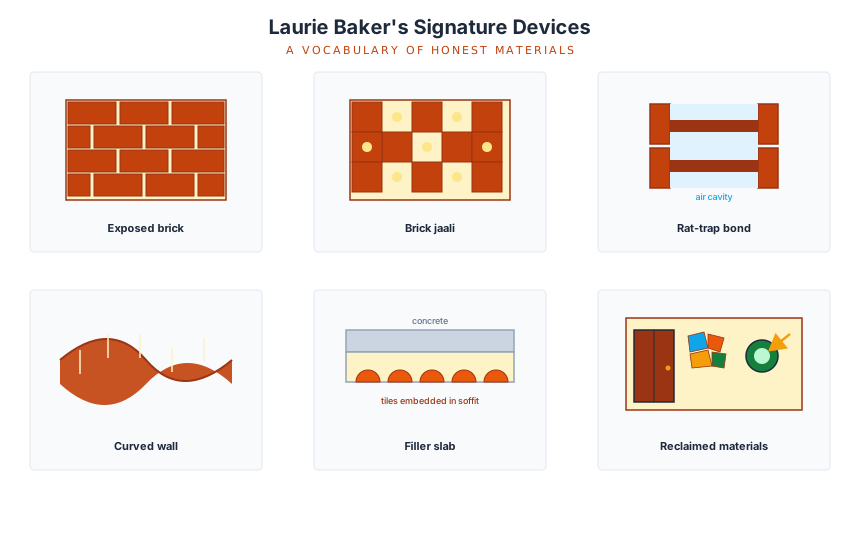
| Device | What it is | Why it works | Cost effect | How to use it today |
|---|---|---|---|---|
| Exposed brickwork | Brick laid as the finished face, never plastered or painted | Brick is already weatherproof, textured and coloured; nothing to add | Deletes plaster + paint + lifetime repainting | Use a good-quality brick and a genuinely skilled mason; leave it raw |
| Brick jaali / perforated screen | Bricks left out in a pattern to make a lattice wall | Diffused light + ventilation + privacy + ornament, all at once | Costs less than a solid wall (fewer bricks) | A jaali panel at a stair, hot wall, bathroom or compound wall |
| Rat-trap bond | Bricks laid on edge to leave an internal air cavity | ~25–30% fewer bricks; cavity insulates against heat | Cheaper to build and cooler to live in | Specify rat-trap bond for external walls; leave exposed |
| Curved / serpentine wall | A wall that bows or snakes in plan | Curve is stronger, so it can be thinner | Fewer bricks; lively façade | Curve garden, stair or screen walls; bend around trees |
| Filler slab | Roof slab with low-stress zones filled by tiles/pots | Less concrete and steel where they do no work | Cuts roof material cost | Use Mangalore tiles or pots as void formers; expose the soffit |
| Reclaimed / waste materials | Old bricks, salvaged timber, broken tile, bottle inserts | Free or cheap material; unique texture and light | Major saving; reduces waste | Reuse old doors/bricks; set bottles or tile fragments in walls |
Real buildings, not renders
Centre for Development Studies (CDS), Trivandrum (1971). Baker's masterpiece and the icon of the brick jaali. Its circular library tower is sheathed in a perforated brick-jaali skin around a central spiral staircase and ventilation shaft. The jaali gives soft, glare-free reading light; the shaft works by stack effect, venting hot air out the top and drawing cool air in through the screen at every floor. A whole complex of rat-trap bond, jaali and filler-slab buildings that stays comfortable by passive means.
Indian Coffee House, Trivandrum (designed 1958). A red-brick spiralling tube: the whole building is a continuous ramp winding around a central service core, the diners seated on platforms that step up along the spiral. Built in exposed local brick with jaali screens for light and ventilation and a simple stack-effect cooling system — one of the most recognisable structures in the city, and proof that low-cost brick can make unforgettable architecture.
Hamlet, Nalanchira, Trivandrum (his own home, from around 1970). Built into a steep rocky hillside without cutting the trees — Baker curved the walls around them. Mud brick, salvaged timber (some from an old boat jetty), broken tiles, bottle and tile inserts in the walls, and brick jaali screens that cool the interior and scatter patterned light. The clearest demonstration of his curved-wall and reclaimed-material instincts in one place.
Loyola Chapel and Auditorium and Chitralekha Film Studio (Trivandrum / Aakulam, 1970s). Larger public works in the same language — exposed brick, jaali, curved and corbelled brickwork — showing that the cost-cutting method scaled up to institutional buildings without losing its character. (Baker also helped seed the Nirmithi Kendra / COSTFORD movement that carried these methods across Kerala.)
A typical Baker low-cost house. The real legacy is the thousands of ordinary houses: rat-trap bond walls for cheaper, cooler structure; a brick jaali panel or two for light and air; a curved wall where the site asked for one; reclaimed doors and bricks; exposed brick throughout, no plaster, no paint. A finished, insulated, breathing, ornamented house for dramatically less money than the plastered box next door.
What this means for India
Baker is the patron saint of the affordable, beautiful, climate-correct Indian façade, and his lesson runs in exactly the opposite direction to every expensive trend. While glass towers import their entire skin and then fight the sun with air conditioning, Baker's wall is cheaper, cooler and finished in a single move. Stack his devices together — exposed brick (no plaster or paint), rat-trap bond (fewer bricks, insulating cavity), a brick jaali (light, air, privacy and ornament for free), curved walls (stronger so thinner), filler slabs and reclaimed materials — and you get a façade that is genuinely less money than a plastered-painted or clad wall, yet better looking and better in the heat. For most Indian homeowners that is the single most useful sentence in architecture, and it is why Baker is the patron saint of our façade cost guide.
But honesty cuts both ways, and Baker would be the first to insist on the caveats. Exposed brickwork is unforgiving: there is no plaster to hide a sloppy joint, so it demands a genuinely skilled mason, and bad brickwork stays visible forever. In heavy-monsoon coastal Kerala and the Western Ghats, a single-skin exposed brick wall can let driven rain push through — so generous roof overhangs, verandahs and correct detailing are not optional; they are what keep the method working (our exposed brick façades guide covers the detailing). And jaali openings, being permanently open, need thought about driving rain, insects and security — a deep overhang above, mesh where needed, and placement away from easy reach. None of these is a reason not to build this way. They are the small price of the cheapest route to a genuinely beautiful Indian façade.
What this means for you
If you are building or renovating a home in India, take three things from Baker. First, stop paying to hide good materials: a well-laid exposed brick wall, with no plaster and no paint, can be your finished façade and will save you money for the rest of the building's life — provided you hire a mason who can actually lay it. Second, remove material to make beauty: a single brick jaali panel will bring soft light, real ventilation and a moving pattern of shadow into your home, and it costs less than the solid wall it replaces. Third, ask for rat-trap bond and a curved wall where the site allows — cheaper, cooler and stronger, all at once. Add reclaimed doors and bricks where you can. Do that, detail your overhangs for the monsoon, and you will have done what Baker spent his life proving: that the most affordable Indian façade and the most beautiful one can be the very same wall.
Sources
- Laurie Baker — biography and honours (Member of the Order of the British Empire, 1983; Padma Shri, 1990; he was nominated for the Pritzker Prize in 2006, not awarded it); Trivandrum-based from 1969.
- The Laurie Baker Centre / official archives and COSTFORD (Centre of Science and Technology for Rural Development), which he co-founded — cost-effective and sustainable building methods.
- Centre for Development Studies (CDS), Trivandrum (1971) — ArchEyes and project documentation on the brick-jaali library tower and stack-effect ventilation.
- Indian Coffee House, Trivandrum (designed 1958) — Re-Thinking The Future on the spiral red-brick form, jaali screens and stack-effect cooling.
- The Hamlet, Trivandrum (Baker's own home) — Re-Thinking The Future on the curved walls built around trees, salvaged timber and reclaimed materials.
- Rat-trap bond masonry — engineering references on the ~25–30% material saving and the insulating air cavity.
- "Construction techniques used by Laurie Baker" — Re-Thinking The Future (rat-trap bond, brick jaali, filler slab, exposed brickwork, curved walls).
- Studio Matrx in-house: Laurie Baker biography, exposed brick façades, jaali and traditional Indian façades, façade cost guide.
Export this guide
Related Guides — Deep-dive reading
Brick House, Wada: How iSTUDIO Bent an Ancient Craft into a Curve
A 2,500-square-foot farmhouse in rural Maharashtra bends the poorest, most ordinary building material — the fired clay brick — into free-flowing curved walls, and proves that low-cost, low-carbon, hand-built architecture can be as spatially ambitious as anything made of steel and glass. A close reading of its rat-trap-bond masonry, earthen-pot filler slabs, ferrocement roofs, and the Laurie Baker lineage it carries forward.
The Future of ArchitectureClimate-Responsive Facades for India: Designing Your Home's Skin for Your Weather
A homeowner's plain-language guide to the facade strategy for every Indian climate zone — what your walls, windows, shading, and colours should actually do where you live
Building FacadesLouis Kahn's Façade Signature: Wrapping Ruins, Brick Arches, and Monumental Light
How Louis Kahn shaded the glass behind giant geometric screen walls, asked the brick to be an arch, and built monumental façades of fair-faced concrete and light — and what that hot-climate logic teaches Indian builders today.
Building FacadesRelated Tools — Try Free
Cross-Ventilation Analyzer
Estimate airflow and air changes per hour (ACH) from room size, window areas, layout, and local wind — with NBC 2016 Part 8 compliance check.
Ventilation CalculatorBrise-Soleil Visualizer
Interactive horizontal-louvre cut-off angle calculator — sun altitude, louvre depth, and spacing inputs with a live shadow preview. Computes θ = arctan(spacing/depth) for façade shading, ECBC envelope compliance, hospital daylight design, and tropical sun-control detailing.
Sun Shading ToolFalse Ceiling Cost Estimator
Live ₹/sqft across 8 ceiling types — POP, gypsum, designer, metal, PVC, wooden — with cove and spot lighting for 20 Indian cities.
Cost Calculator