
Vernacular Architecture of Gujarat: The Pol House, the Bhunga & the Carved City
How Gujarat answered heat, scarcity and earthquakes with the timber-framed pol house of Ahmedabad, the round earthen bhunga of Kutch, and the stepwell
Walk into the walled city of Ahmedabad at first light and the lanes seem to lean toward one another. Carved timber balconies almost touch across the street; a man sips chai on a raised stone seat at his doorstep; a slatted bird-tower throws a freckled shadow on the ground while pigeons quarrel over grain. Push deeper and the lane suddenly opens — a small square with a community well, a tree, a shrine — then narrows again into another tight run of houses that share their very walls. This is a pol, the gated residential cluster that gives the old city its grain, and it has organised neighbourhood life here for centuries.
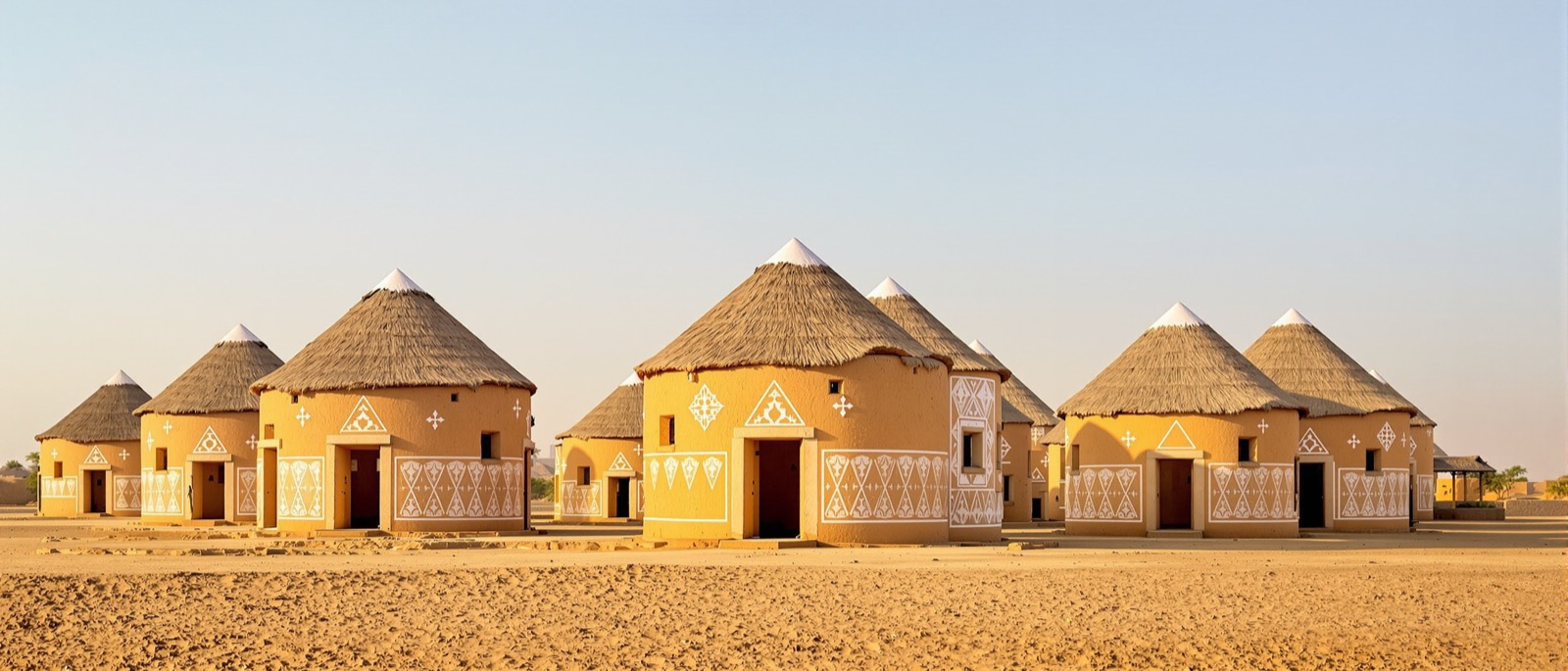
Now cross 350 kilometres of dust and salt to the Banni grasslands of Kutch, on the lip of the Great Rann. The land flattens to a shimmering white horizon. Out of it rise clusters of round, whitewashed huts with neat conical thatch roofs, their inner walls glittering where tiny mirrors are pressed into mud relief. These are bhunga — cornerless earthen rooms built by pastoral craft communities, and when the catastrophic Bhuj earthquake struck on 26 January 2001, many of them stood while modern concrete buildings nearby collapsed.
Gujarat's vernacular is the story of two great answers to two harsh climates — the dense, timber-framed carved city of the plains, and the round earthen hut of the desert — bound together by a third tradition that went underground to find cool water and shade: the stepwell.
This guide is for B.Arch students, teachers, conservation-minded homeowners and anyone trying to understand how Gujarat built itself before the age of cement. We move from climate to typology to materials to plan to social life to real surviving examples and, honestly, to what is being lost. It sits within our pillar on Indian vernacular architecture; read it alongside its arid-west sibling, the vernacular architecture of Rajasthan, and our distillation of lessons for modern Indian homes.
In Gujarat the wall is never just a wall. In the pol it is shared with a neighbour and carried by carved timber; in the bhunga it is curved so the earth itself can dance through an earthquake; in the vav it descends, storey by storey, to keep a whole town cool.
1. Three climates, one state
Gujarat is not a single climate but a gradient, and its vernacular reads almost like a transect across that gradient. To understand why a pol house and a bhunga look nothing alike, you first have to understand that they answer different problems.
The plains around Ahmedabad and north Gujarat are hot semi-arid — long, fierce summers, strong sun, dust-laden winds, modest and concentrated monsoon rain. Kutch, to the west, is properly arid: a salt desert of the Rann and the Banni grassland, with extreme heat, scant rain, saline groundwater and the constant possibility of seismic shaking, as this is one of India's most earthquake-prone zones. Along the coast, Saurashtra is more humid, tempered by the sea.
Each setting rewards a different strategy. In the dense plains city, the cheapest shade is your neighbour's wall, so houses crowd together and mutually shade one another and the lane. In the open desert, there is no neighbour to borrow shade from and the ground itself shakes, so the dwelling becomes a low, self-contained, cornerless form. Underground, where the rock holds last night's coolness through the worst of the afternoon, the stepwell offers a third kind of shelter that no above-ground building can.
| Region | Climate | Core problem | Vernacular response |
|---|---|---|---|
| Ahmedabad & north Gujarat | Hot semi-arid | Sun, heat, dust winds | Dense mutually-shading row houses (pols), narrow lanes, internal courtyards, deep carved-timber overhangs |
| Kutch (Rann / Banni) | Arid salt-desert | Extreme heat, scarce water, earthquakes, wind | Low round earthen huts (bhunga), thick walls plus light thatch roof, cornerless seismic-friendly geometry |
| Saurashtra coast | Humid | Heat plus humidity | Ventilated courtyard houses, shaded verandahs |
The unifying instinct across all three is introversion — turning the building's openings inward, to a courtyard, a sheltered interior or the depth of the earth, rather than presenting large windows to a punishing sun.
2. The logic of the dense city
Before we meet the individual house, it helps to see the pol as an urban idea, because the pol house cannot really be understood as a free-standing object. It is a piece of a tightly woven fabric.
A pol (the word is used both for the cluster and, loosely, for its main gateway) is a gated residential precinct, often 50 to 100 houses, entered through one or more shared pol gateways — substantial framed openings that could be closed and guarded at night. Inside, the houses share party walls: each home presses against its neighbours on either side, so only the front and rear façades are exposed. This is brilliant climatic economics. Two of every four walls of a typical house are shaded from the sun simply by being shared, and the lanes between pols are kept so narrow that the carved timber balconies above shade the street through most of the day.
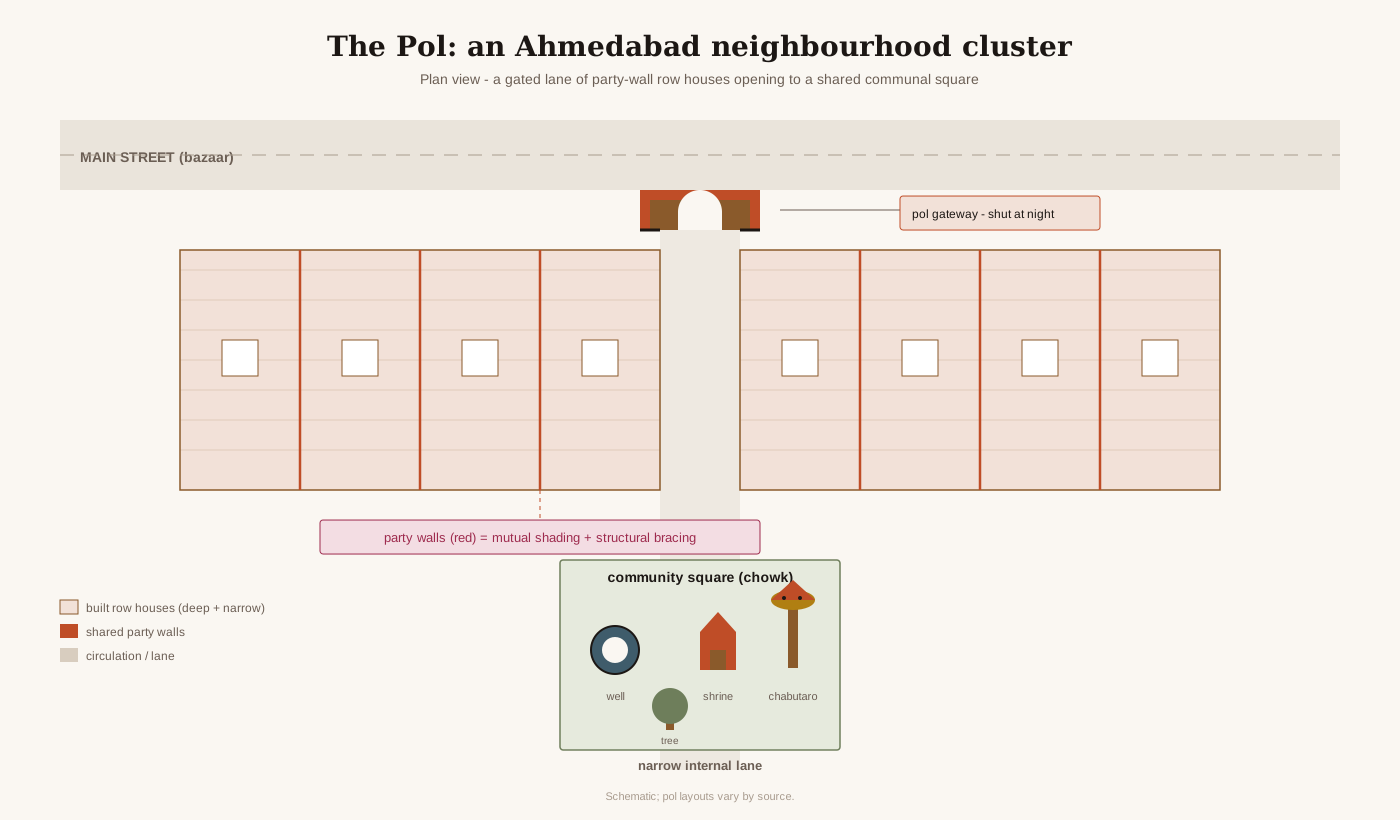
Within this fabric, certain shared elements anchor community life: a communal well or cistern, a small temple or shrine, a tree, and the chabutaro (also spelt chabutra) — an ornamental free-standing tower built specifically to feed birds, a quiet expression of Jain and Hindu compassion for living creatures that doubles as a neighbourhood landmark. The result is a dense, cooperative, self-managing micro-town, repeated hundreds of times across the walled city.
This grain — narrow lanes, shared gateways, mutual shading, pocket squares — is the reason the Historic City of Ahmedabad became, in 2017, India's first UNESCO World Heritage City, with the pols cited as a defining attribute. We will return to that listing and what it has meant for survival.
3. The pol house: typology and glossary
Now to the house itself. A pol house is deep and narrow — the plot squeezes inward from a slender street frontage and runs a long way back, because frontage on a shaded community lane is precious and depth is cheap. The plan reads as a sequence from public to private, front to back.
You arrive first at the otla (also otlo), a raised stone or timber plinth-cum-seat built into the house front. The otla is one of the most socially intelligent details in Indian domestic architecture: it lifts the threshold above the dust of the street, gives the household a place to sit and watch the lane, and forms a semi-public seam where neighbours meet — neither fully street nor fully home. Step up and across the otla and you enter the front room.
The spatial heart of the house is the chowk — an internal courtyard, open to the sky, usually placed in the middle of the deep plan. The chowk admits light and air into a house that has windows on only two of its four sides, and at night it lets warm air rise and escape while cooler air settles in, ventilating the rooms around it. Crucially, many chowks contain a tanka — an underground rainwater cistern — so the courtyard is also the household's water-harvesting and storage core. Rooms wrap around the chowk; the rear of the house holds the most private functions, including the kitchen.
| Term | Gloss | Role |
|---|---|---|
| Pol | Gated residential cluster (and its gateway) | Urban unit of the walled city; community-scale enclosure |
| Otla (otlo) | Raised front plinth/seat | Street-to-home transition; semi-public social seam |
| Chowk | Internal open courtyard | Light, ventilation, the climatic and social centre |
| Tanka | Underground water cistern | Rainwater harvesting, often set within the chowk |
| Chabutaro (chabutra) | Ornamental bird-feeder tower | Communal landmark; compassion to birds |
| Jharokha | Projecting carved timber balcony/oriel | Shade, ventilation, screened viewing, status |
Above the street, projecting jharokha balconies — corbelled out on carved timber brackets — both shade the lane and let the household see down into it. The whole front façade becomes a layered, deeply modelled screen of carved wood that performs the same shading and privacy work that stone jaali screens perform in neighbouring Rajasthan.
4. Building in timber: the carved frame
What makes the pol house unusual among Indian vernacular types — and what links it to the great wooden mansions of the wider region — is that it is fundamentally a timber post-and-beam structure, not a load-bearing masonry box.
Vertical timber posts and horizontal beams form a frame that carries the building; the walls between them are infill of local brick, mud mortar and limestone. The structural logic is the opposite of a Rajasthani sandstone haveli, where thick masonry both encloses and carries. Here the frame does the work and the infill merely fills. Tellingly, almost everything for the house could be sourced locally except the structural timber, which had to be imported — a measure of how much value the builders placed on the frame.
That frame is then carved with extraordinary richness. Columns, brackets, beam-ends, door surrounds, balcony fronts and ceiling panels carry deep relief — floral scrolls, deities, peacocks, elephants, geometric lattices — turning structure into ornament and ornament into status. This is the tradition the scholar V.S. Pramar documented in Haveli: Wooden Houses and Mansions of Gujarat, still the foundational study of the type.
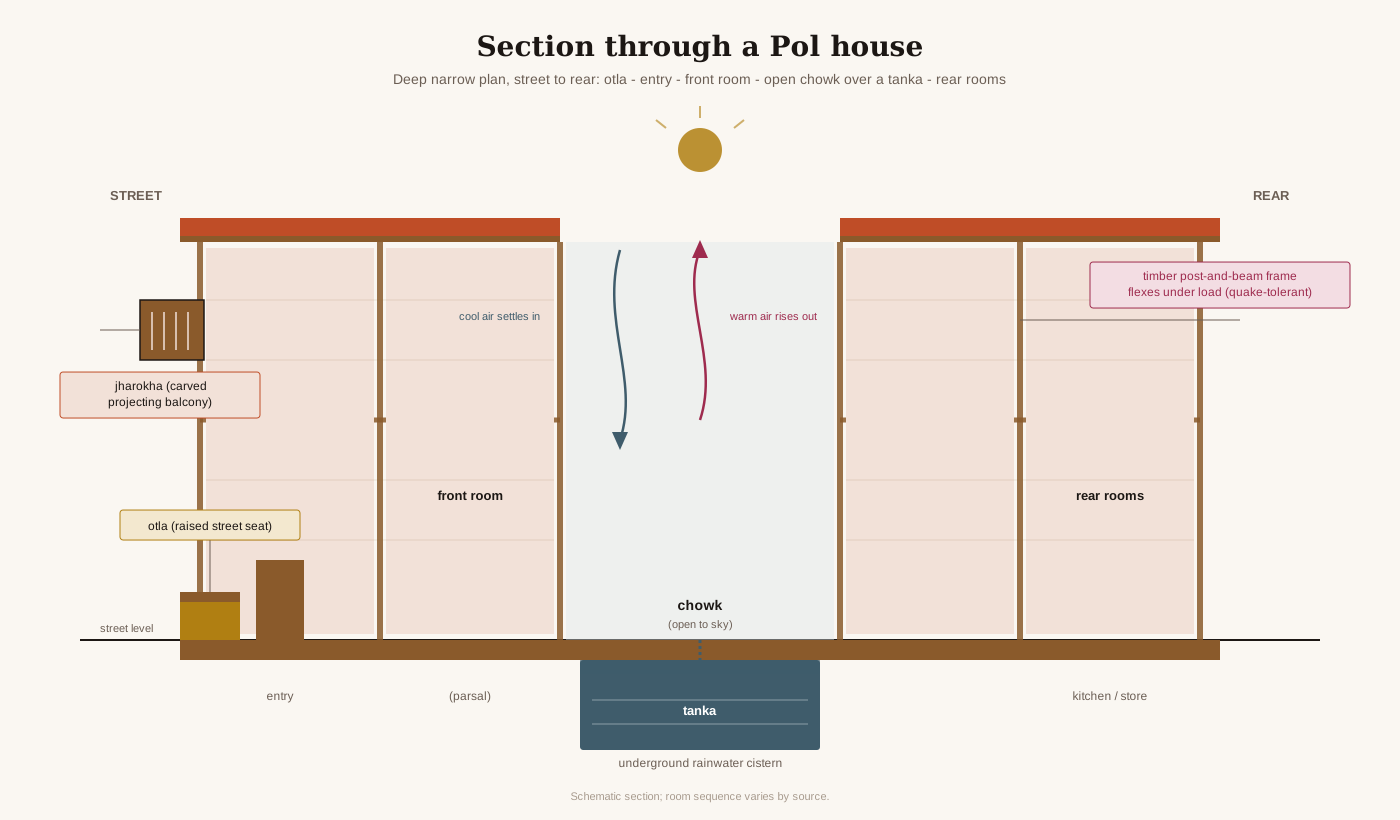
There is also a structural pay-off that deserves careful framing. A jointed timber frame, unlike rigid masonry, can flex and absorb movement, and engineers studying historic timber-framed construction across seismic India have noted that such ductile, energy-dissipating frames tend to behave better under earthquake loading than brittle unreinforced masonry. So the pol house's timber frame plausibly carried a degree of seismic resilience as a by-product of its construction logic. The honest caveat: this is an inference from the structural type and from general earthquake-engineering principles, not a claim that every old pol house is earthquake-safe today. Centuries-old timber decays, joints loosen, and the densest documented evidence of earthen vernacular outperforming concrete in Gujarat comes not from the pols but from the bhungas of Kutch, to which we now turn.
| Element | Pol house | Why it works |
|---|---|---|
| Structure | Timber post-and-beam frame | Spans the deep plan; flexes rather than cracks |
| Wall infill | Brick / mud mortar / limestone | Local, low-cost, fills the frame |
| Façade | Deeply carved timber, jharokhas | Shades lane, screens privacy, signals status |
| Roof | Pitched/flat tiled over timber | Sheds the concentrated monsoon |
| Water | Tanka cistern in the chowk | Harvests and stores rain on the plot |
5. The bhunga: a round room against the desert and the earthquake
The bhunga could hardly be more different, and yet it answers its climate with the same economy of means.
A bhunga is a circular single-room mud hut of Kutch, typically 3 to 6 metres in diameter, with thick cylindrical earthen walls and a separate conical thatched roof. It is built by the pastoral and semi-nomadic communities of the Banni and Pachham grasslands — Meghwal, Rabari and Jat among them — using almost entirely local materials: mud for the walls, bamboo or timber ribs to frame the roof, grass thatch for the cover, and cow dung as a plaster and binder.
The genius of the bhunga is its geometry. A cornerless, circular plan has no weak corners to concentrate stress, and under both wind and earthquake shaking it distributes loads evenly around its ring rather than tearing at sharp angles the way a rectangular box does. The walls are heavy and stabilising; the roof is light and separate, so even if it is displaced, it does not bring the walls down with it. This is why the bhungas of Banni and Pachham became a celebrated case study after the magnitude-7.7 Bhuj earthquake of 26 January 2001: close to the epicentre, many traditional bhungas survived largely intact while engineered concrete buildings failed catastrophically. Post-earthquake reconnaissance work by engineering bodies such as EERI and NICEE examined exactly this contrast, and it became a touchstone in arguments for the seismic merit of well-built earthen vernacular.
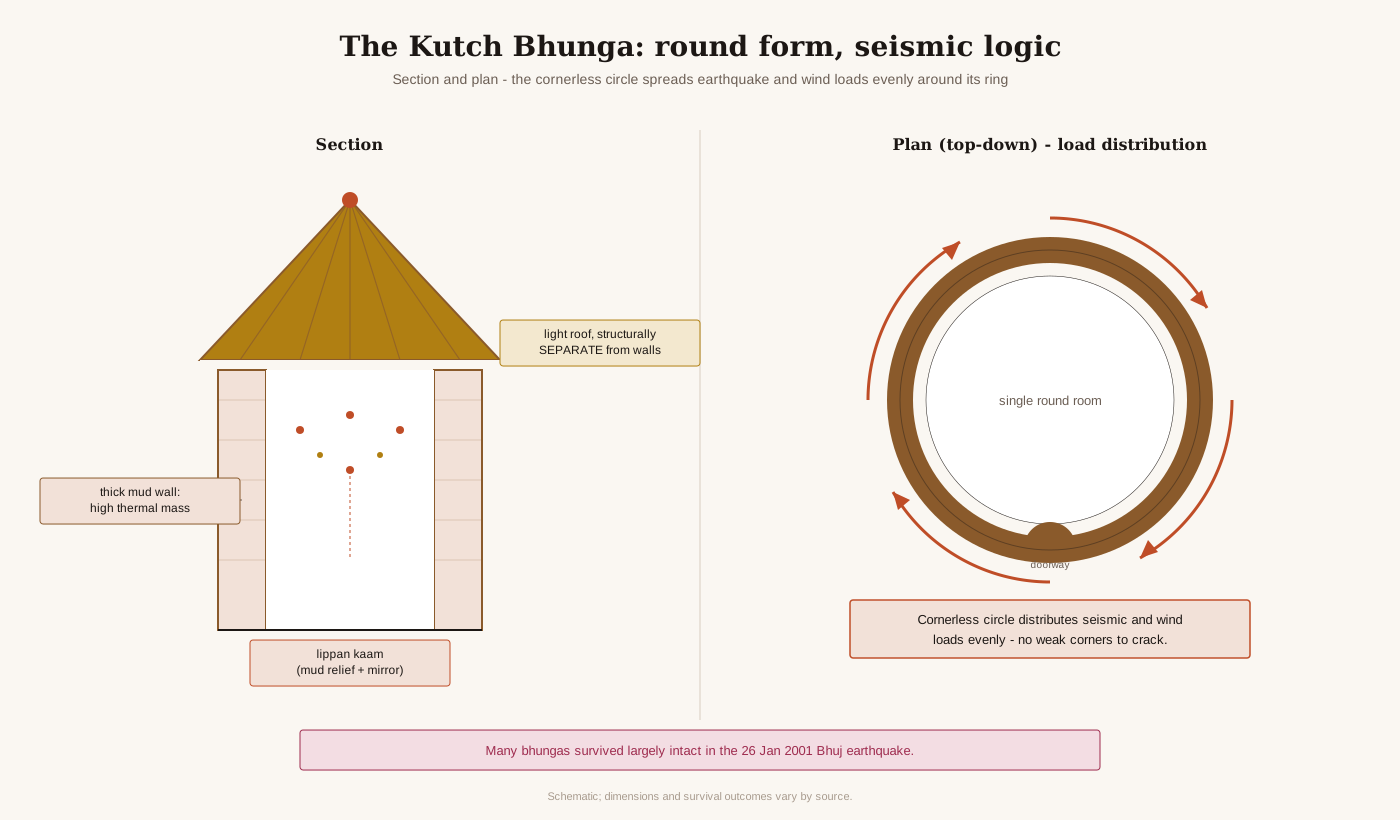
The bhunga is also a canvas. Its interior and outer walls carry lippan kaam — a mud-and-mirror relief decoration in which clay (mixed with dung) is built up into raised patterns and studded with tiny mirrors, called abhla. The work is traditionally done by women, especially of the Meghwal community, and it turns the dim interior into something that glitters with every lamp and shaft of light. The mirror-and-mud craft is inseparable from the region's celebrated embroidery: house-making and textile-making are one continuous tradition of decoration.
| Element | Bhunga | Why it works |
|---|---|---|
| Plan | Circular single room, 3–6 m dia. | No corners to concentrate seismic/wind stress |
| Walls | Thick earthen (mud), dung-plastered | High thermal mass; cool interior; stabilising base |
| Roof | Conical, bamboo/timber ribs + thatch | Light, separate, sheds little but insulates well |
| Decoration | Lippan kaam (mud + mirror relief) | Light-catching interior; collective women's craft |
| Resilience | Cornerless geometry + light roof | Notable performance in the 2001 Bhuj earthquake |
6. Going underground: the vav
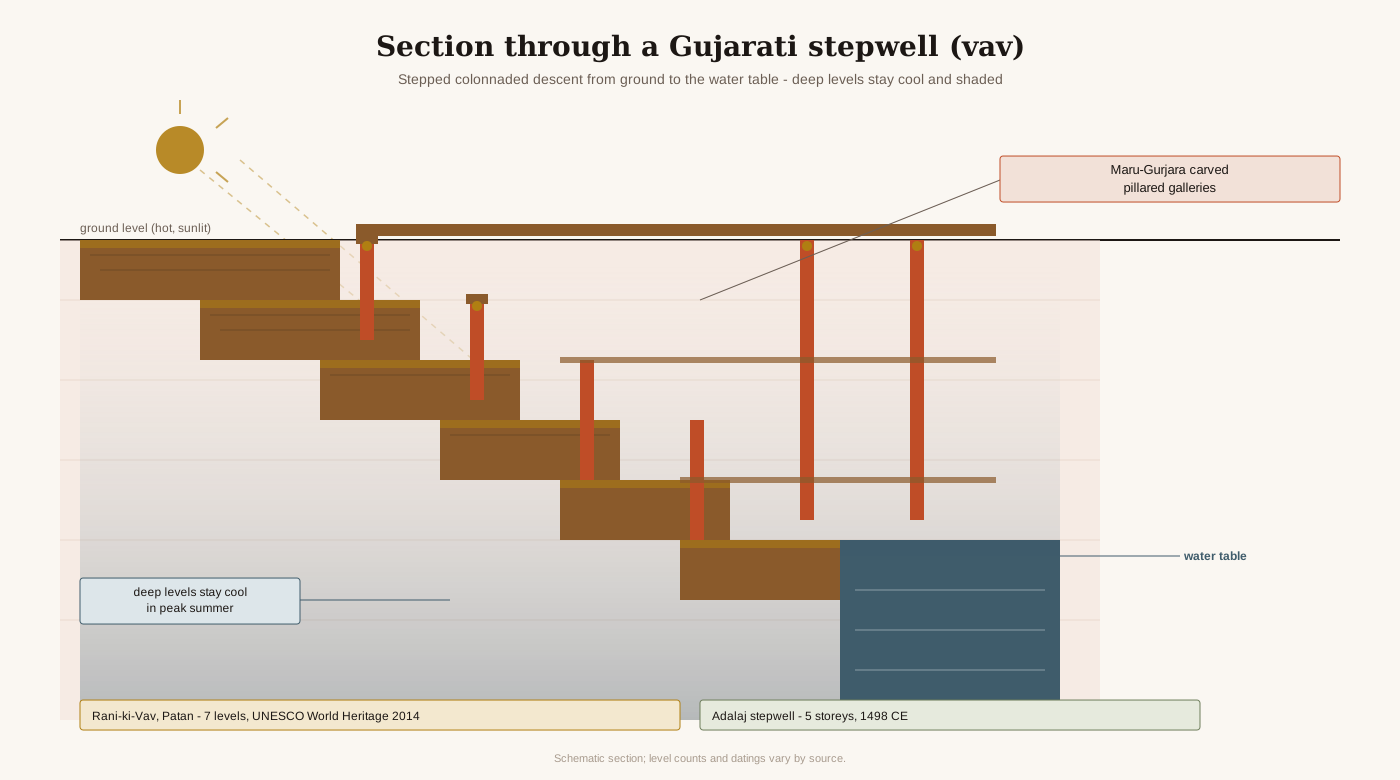
The third Gujarati tradition does not rise; it descends. A vav is a Gujarati stepwell — a deep, stepped structure that walks you down, flight by flight, through cool colonnaded storeys to reach the water table, and that doubles as a shaded subterranean refuge from the heat above.
Stepwells solved a real climatic and social problem in a land of concentrated rain and a falling water table: they reached water year-round, they harvested and stored it, and the deeper levels stayed strikingly cool even at the height of summer, so they became gathering places, resting points for travellers, and sites of ritual. They were frequently female-patronised socio-religious public works — acts of merit and memory commissioned by queens and noblewomen — which gives them a distinctive place in the social history of Indian building.
Two examples define the type. Rani-ki-Vav ("the Queen's Stepwell") at Patan is the masterpiece: built in roughly the 11th century, attributed to Queen Udayamati in memory of King Bhima I of the Solanki (Chaulukya) dynasty, it descends seven levels and carries more than five hundred principal sculptures in the ornate Maru-Gurjara style of the Solanki period. It became a UNESCO World Heritage Site in 2014, the first stepwell to be listed. The slightly later Adalaj ni Vav, near Gandhinagar, is a five-storey stepwell completed in 1498 CE, associated with Queen Rudabai and the Sultan Mahmud Begada — a building where Hindu, Jain and Islamic decorative idioms meet. Adalaj is protected by the Archaeological Survey of India; it is not, contrary to a common assumption, a UNESCO site.
| Example | Type | Date / period | Patron & style | Status |
|---|---|---|---|---|
| Historic City of Ahmedabad | Walled city of pols | Founded 15th c. | Trade/caste communities | UNESCO World Heritage City, 2017 (India's first) |
| Bhungas of Banni / Pachham | Round earthen huts | Living tradition | Meghwal, Rabari, Jat | Notable survival in 2001 Bhuj earthquake |
| Rani-ki-Vav, Patan | Stepwell (vav) | c. 11th century | Queen Udayamati; Maru-Gurjara / Solanki | UNESCO WHS, 2014 (first stepwell listed) |
| Adalaj ni Vav | Stepwell (vav) | 1498 CE | Queen Rudabai / Mahmud Begada | ASI-protected (not UNESCO) |
7. The social life of the Gujarati house
Architecture in Gujarat is never just shelter; it is social structure made solid.
The pol is the clearest case. It was a gated, largely self-governing community, frequently organised around caste or trade, whose shared gateways were closed at night for security and whose communal wells, temples and chabutaros knit the residents into a single cooperative body. The otla mediated between household and street; the chowk gathered the joint family inward; the shared gateway gathered the whole pol inward again. It is, in effect, a nested set of courtyards — house within pol within walled city — each level balancing privacy against community. This graded, introverted, cooperative model is one of the richest lessons the old city offers contemporary urban design.
The bhunga compound encodes a different social order: the pastoral, often semi-nomadic life of Kutch's craft communities. Bhungas cluster as family compounds; the building of walls and the embroidering of cloth and the laying of lippan mirror-work are continuous, collective acts, largely carried by women, that bind household, craft and identity together. Here the house is the loom of community as much as its shelter.
The vav, finally, was civic and devotional at once — a public utility that was also a religious offering, very often given by women of standing. To descend a stepwell was to move through a sequence of cool, sculpted, semi-sacred spaces toward water; the building dignified an everyday act and recorded the piety of its patron in stone.
8. Decline, survival and what it teaches
The honest part of any vernacular story is what is being lost, and here Gujarat's three traditions diverge.
The pols face out-migration as families leave the cramped old city for modern flats; redevelopment pressure; the slow decay of irreplaceable carved timber; and serious fire risk in densely packed wooden fabric. Against this, the 2017 UNESCO World Heritage City inscription has been a real catalyst — driving heritage walks, conservation regulation and a growing culture of adaptive reuse, in which old pol houses are restored as homes, guesthouses and cafés rather than demolished. The danger of adaptive reuse is gentrification and façade-deep restoration; the opportunity is a living, inhabited heritage rather than a museum.
The bhunga is declining for a different reason: aspiration. Concrete and brick read as "progress," and earthen building as poverty, so families increasingly abandon mud for cement — ironically often for less seismically forgiving construction. The 2001 earthquake cut both ways: it spurred advocacy for the bhunga's proven performance and seeded rural-tourism homestays that give the form new economic value, but it also brought a wave of concrete reconstruction. The lesson is not to freeze the bhunga in amber but to carry its principles forward: cornerless or well-tied geometry, separated light roofs, high-thermal-mass walls, and the dignity of craft.
The stepwells, no longer needed for water, survive as ASI- and UNESCO-protected monuments — magnificent, but largely emptied of the daily life that made them.
| Tradition | Main threats | What is helping |
|---|---|---|
| Pol houses | Out-migration, redevelopment, timber decay, fire | UNESCO 2017 listing, heritage walks, adaptive reuse |
| Bhungas | Shift to concrete, "progress" stigma | 2001 seismic advocacy, rural-tourism homestays, NGO craft revival |
| Stepwells | Loss of original water function | ASI / UNESCO protection, tourism |
For anyone designing in Gujarat today, the takeaways are concrete and unromantic. Let neighbours shade neighbours; pull a courtyard into the centre of a deep plan and harvest its rain; build a transitional seat at the threshold; respect cornerless or well-tied geometry in seismic zones; separate a light roof from heavy walls; and treat craft as structure, not decoration applied at the end. These are not nostalgia. They are tested responses to heat, scarcity and seismic risk — to be adapted intelligently, not copied wholesale. Explore how these ideas translate into buildable layouts in our house-plans library and our guide to modern versus traditional Indian house architecture.
References & Further Reading
Foundational / Theory
- V.S. Pramar, Haveli: Wooden Houses and Mansions of Gujarat (Mapin / Grantha, 1989) — the foundational study of Gujarat's carved timber domestic architecture.
- V.S. Pramar, A Social History of Indian Architecture (Oxford University Press) — on building as social structure.
Regional / Indian sources
- Kulbhushan Jain & Minakshi Jain, Mud Architecture of the Indian Desert (AADI Centre, 1992); Indian City in the Arid West (1994); Thematic Space in Indian Architecture (2002) — on Kutch, mud building and the arid-west city.
- UNESCO World Heritage Centre — Historic City of Ahmedabad (inscribed 2017) and Rani-ki-Vav, the Queen's Stepwell at Patan (inscribed 2014); whc.unesco.org.
- Archaeological Survey of India — on Adalaj ni Vav and protected stepwells.
- Post-2001 reconnaissance reports by EERI (Earthquake Engineering Research Institute) and NICEE (National Information Centre of Earthquake Engineering) — the authoritative engineering source on bhunga seismic behaviour in the Bhuj earthquake.
- INTACH (Indian National Trust for Art and Cultural Heritage) — on conservation of Gujarat's built heritage.
Companion Studio Matrx Guides
- Pillar: Indian Vernacular Architecture
- Sibling region: Vernacular Architecture of Rajasthan
- Vernacular Lessons for Modern Indian Homes
- Why Vernacular Design Is Returning in India
- Tropical Architecture in India · Modern vs Traditional Indian House Architecture
- Sections: House Plans · Architects · All Guides
Author's Note: I keep coming back to the otla — that simple raised step where a Gujarati house meets its street. It refuses the modern choice between "inside" and "outside," and insists instead on a seam, a place to sit and belong to both your home and your neighbourhood at once. The pol, the bhunga and the vav are all, in their way, about that generosity: building so that climate, family and community are served by the same wall. We have a great deal to relearn from it.
Disclaimer: Vernacular terms, spellings and datings vary across sources and regions; the examples and conservation statuses described here change over time. This is an educational overview, not a structural, conservation or seismic-safety assessment — historic earthen and timber buildings require expert evaluation before reuse. Verify specifics against the cited scholarship and the relevant heritage authorities. No liability is accepted for actions taken on the basis of this article.
Export this guide
Related Guides — Deep-dive reading
Louis Kahn's Façade Signature: Wrapping Ruins, Brick Arches, and Monumental Light
How Louis Kahn shaded the glass behind giant geometric screen walls, asked the brick to be an arch, and built monumental façades of fair-faced concrete and light — and what that hot-climate logic teaches Indian builders today.
Building FacadesOrientation, Light & Views: Designing With Your Space, Not Against It
How reading your plot's sun, breeze and views — and placing each room on the right face — gives an Indian home that is cooler, brighter and quietly right, instead of one that fights its site forever.
Design PrinciplesGasometer City: How Four Architects Built a Town Inside Four Gas Tanks
In Vienna's Simmering district, four decommissioned 19th-century gas holders were kept as empty brick drums and filled from within — Jean Nouvel, Coop Himmelb(l)au, Manfred Wehdorn and Wilhelm Holzbauer each inserting a self-supporting building inside a protected shell. A deep study of the 'house within a house', its structural logic, and what industrial reuse at city scale really costs.
The Future of ArchitectureRelated Tools — Try Free
Brise-Soleil Visualizer
Interactive horizontal-louvre cut-off angle calculator — sun altitude, louvre depth, and spacing inputs with a live shadow preview. Computes θ = arctan(spacing/depth) for façade shading, ECBC envelope compliance, hospital daylight design, and tropical sun-control detailing.
Sun Shading ToolRainwater Tank Sizer
How big should your rainwater tank be? Computes annual harvest, recommended tank capacity in litres, water-bill savings, and payback — for 10 Indian cities.
RWH CalculatorCross-Ventilation Analyzer
Estimate airflow and air changes per hour (ACH) from room size, window areas, layout, and local wind — with NBC 2016 Part 8 compliance check.
Ventilation Calculator