
Vernacular Architecture of North-East India: Bamboo, the Morung & Building for Earthquakes
How the high-rainfall, earthquake-prone hills of the North-East produced lightweight bamboo-and-timber houses that sway instead of crack — from the Assam-type house and the chang ghar to the Naga morung and Meghalaya's living root bridges.
A monsoon morning in the hills above the Brahmaputra: rain comes down in sheets, drums on a steep tin roof, and runs off the deep eaves of a house that stands a little above the wet ground on a low plinth. The walls are not brick. They are panels of woven reed and split bamboo, plastered with mud and cow dung, framed by stout timber posts. The whole house is light. And when the ground moves — as it does often here, in one of the most seismically violent regions on earth — this light house does not shatter. It leans, it flexes, it gives a little, and it stays standing.
That is the central insight of North-East Indian building, and it runs counter to almost everything heavy masonry teaches us. In a land of very high rainfall and Zone-V seismicity — the highest earthquake-hazard band in India — the safe house is not the strong, rigid, immovable one. It is the light, flexible one that absorbs a shock and dissipates it.
In North-East India, vernacular architecture solved two extreme problems at once — relentless monsoon and violent earthquakes — with a single strategy: build light, build flexible, lift the floor, and pitch the roof steep.
This guide is for B.Arch students, teachers, practitioners and curious homeowners who want to understand how the eight states of the North-East built — and why those methods matter again today. We will cover the climate and seismic context; the climate-and-earthquake response logic; the signature dwelling typologies (the Assam-type house, the chang ghar, the Naga morung, Apatani bamboo houses); materials and construction; the remarkable seismic history behind it all; Meghalaya's living root bridges as community bio-engineering; the social and ritual life of these structures; notable surviving examples; and what is being lost and saved. It is a regional sibling to our Ladakh and Bengal deep-dives, and sits under the Indian vernacular architecture pillar. If you only read this region for one lesson in resilience, read it for the earthquake story.
The heavy house resists the earthquake and loses. The light house agrees with it, and survives.
1. The Region & Its Climate: Rain Without End, Ground That Will Not Hold Still
"North-East India" is a convenient shorthand for a region of enormous diversity — the Brahmaputra and Barak valleys of Assam, the high ranges of Arunachal Pradesh, the hill states of Nagaland, Manipur, Mizoram and Meghalaya, and Tripura. Hundreds of distinct communities live across plains, river islands, and steep forested hills. What unites their building traditions is not a single culture but a shared pair of environmental pressures.
The first is water. The southern slopes of the Meghalaya plateau record some of the highest rainfall on earth; across the region the monsoon is long, heavy and humid. Rivers swell and braid; the Brahmaputra floods its valley annually; damp is a constant. A roof here must shed water fast, and a floor must stay above the wet.
The second pressure is seismic. The North-East lies where the Indian plate grinds beneath the Eurasian plate, and most of it falls within Zone V, the highest seismic-hazard category in the Indian seismic code. This is not a region of occasional tremors; it is a region that has been reshaped by great earthquakes. Any building tradition that survived here had to answer the ground as seriously as it answered the sky.
| Environmental pressure | What it demands of a building | Vernacular response |
|---|---|---|
| Very high rainfall, long humid monsoon | Shed water fast; keep interiors dry and ventilated | Steep pitched roofs, deep overhanging eaves, breathable bamboo/reed walls |
| Annual flooding, damp ground | Keep the living floor dry and above water | Raised plinths; stilts (the chang ghar) |
| Zone-V seismicity, great earthquakes | Survive violent ground motion without collapse | Lightweight, flexible timber-and-bamboo frames that sway, not crack |
| Abundant forest, bamboo, cane | Use what grows fast and renews | Bamboo, cane and timber as primary structure |
The genius of the region's vernacular is that one set of moves answers all four lines of that table at once. A light bamboo frame is cheap, fast-growing, breathable, and earthquake-friendly. A steep roof sheds rain and keeps the structure light up top. A raised floor beats flood and damp. There is very little waste in this logic.
2. The Response Logic: Build Light, Build Flexible, Lift the Floor
Before we name individual house types, it is worth stating the design principles plainly, because they recur in every typology that follows.
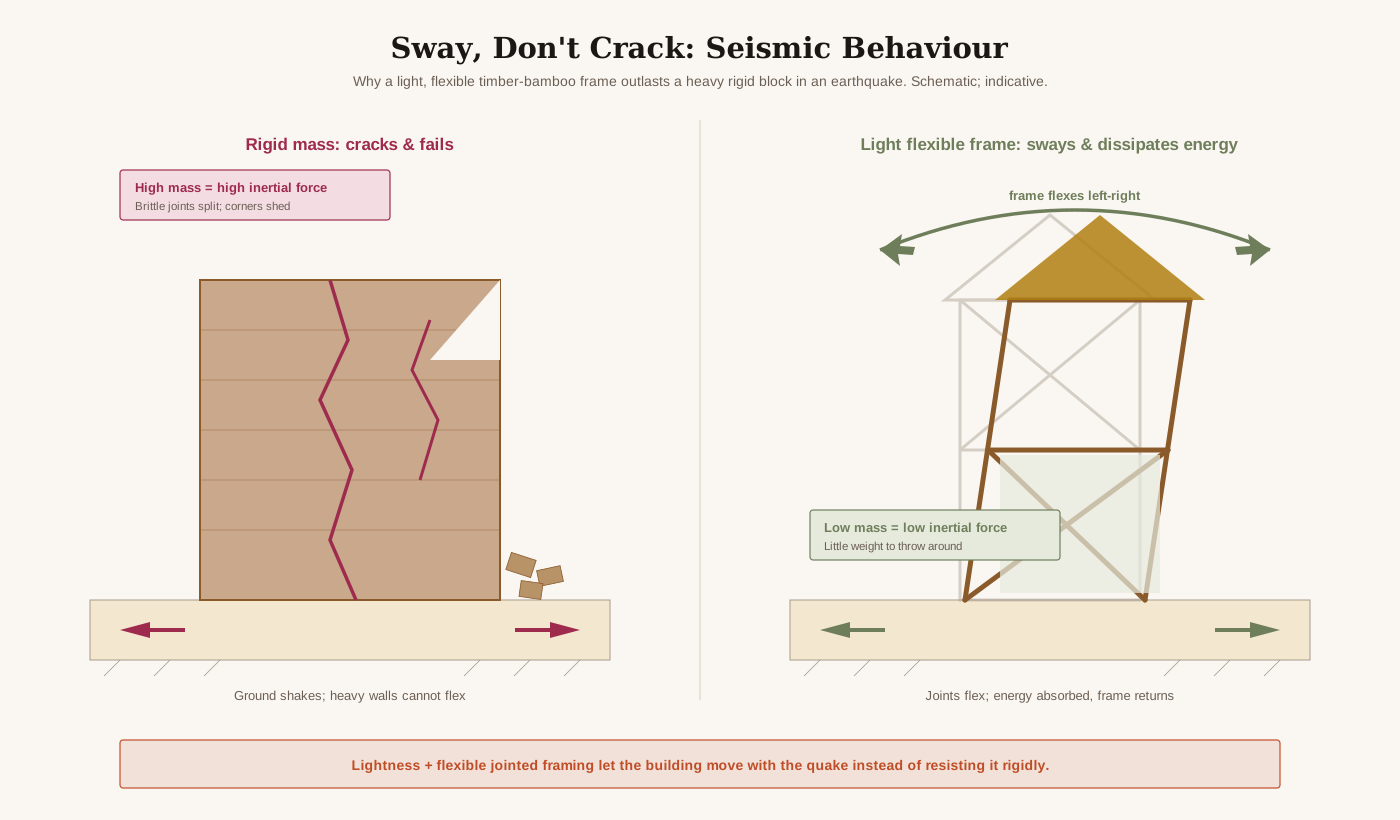
Build light. Mass is the enemy in an earthquake. The inertial force a building must withstand is roughly proportional to its weight; a heavy masonry wall carries enormous inertia and, being brittle, cracks and collapses when that force exceeds its strength. A bamboo-and-timber wall weighs a fraction as much, so the forces it must resist are far smaller to begin with.
Build flexible. A lightweight timber-and-bamboo frame is not only light, it is ductile — its lashed and pegged joints can deform and move without snapping. Instead of resisting the earthquake head-on, it deflects, sways and returns, dissipating the energy of the shaking through dozens of small movements at its joints. The technical phrase architects use today is "energy dissipation through flexible jointing"; the villager's phrase was simpler — the house "dances" and stands.
Lift the floor. Whether by a raised earthen plinth (the Assam-type house) or by stilts (the chang ghar), the living floor sits above the flood line and away from ground damp, rot and vermin.
Pitch the roof steep. A steep roof sheds torrential rain before it can pool or penetrate, and the deep eaves throw run-off well clear of the breathable earth-plastered walls below.
This is the opposite of the Ladakhi strategy, where thick high-mass earthen walls store heat in a cold dry desert that rarely floods. The two regions sit at opposite ends of the Indian vernacular spectrum — heavy-mass versus light-flexible — and comparing them is one of the clearest ways to understand that vernacular is always a precise answer to a specific climate, never a universal style.
3. The Signature Typologies
3.1 The Assam-type house
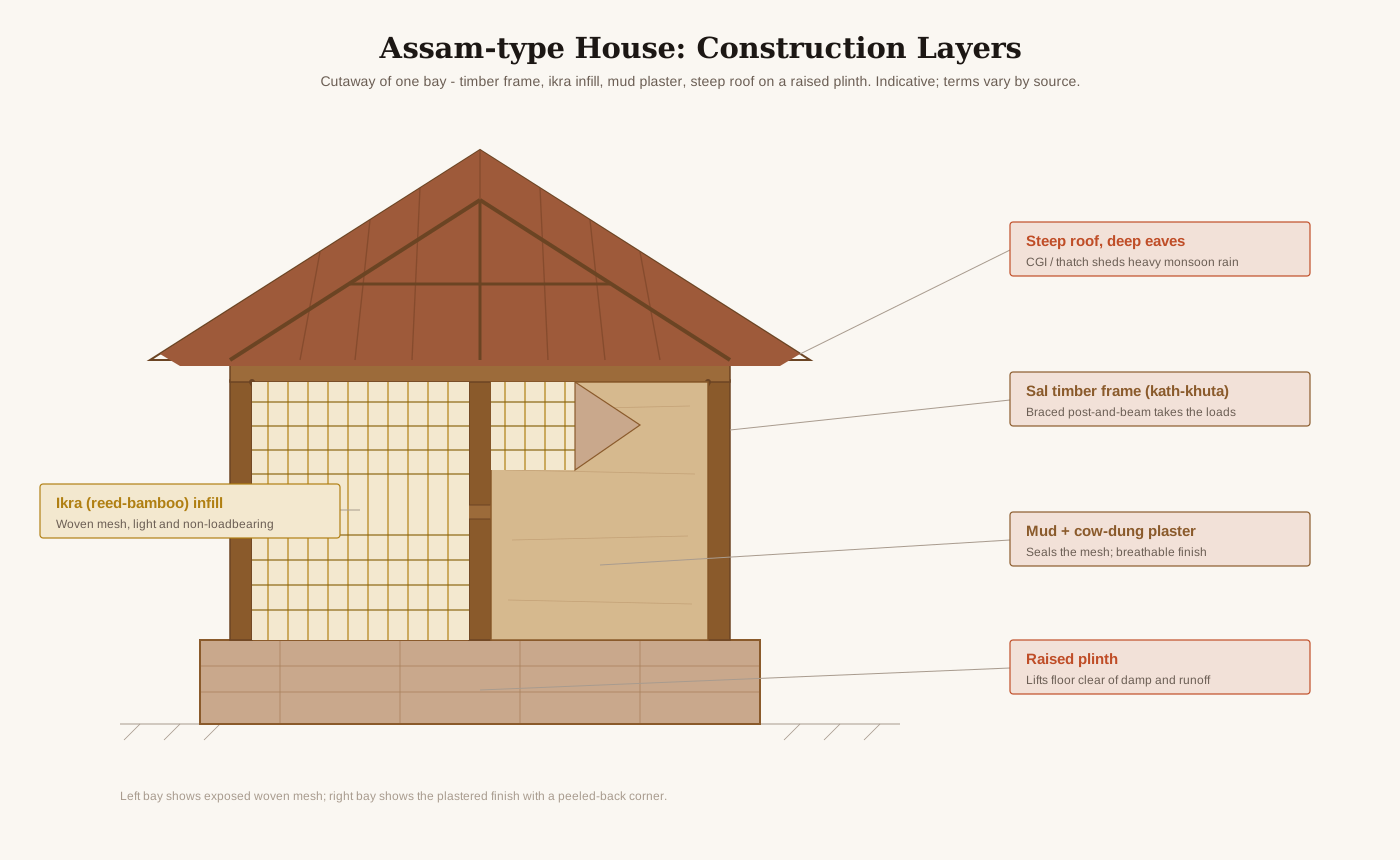
The Assam-type house is the defining domestic form of the Brahmaputra valley and far beyond — a hybrid that, as we will see in Section 5, was deliberately developed and spread after a catastrophic earthquake. Its anatomy is consistent and instructive:
- A load-bearing timber frame of posts (locally kath-khuta, the wooden posts) and beams forms the skeleton.
- The wall panels between the frame are an infill of woven reed and split bamboo called ikra (you will also see it spelt ikora or ekra) — a mesh of reed and bamboo lashed into the openings.
- That mesh is then plastered with mud and cow dung, giving a smooth, breathable, repairable wall surface.
- The roof is steep, originally thatch and now most often corrugated galvanised iron (CGI) sheeting, with deep eaves.
- The whole sits on a raised plinth, a short masonry or rammed-earth base that lifts the timber off the wet ground.
The result is a house that is structurally light, flexible at its joints, breathable in the humid heat, cheap to build with local materials, and — crucially — easy to repair after a tremor. Cracks in mud plaster are patched, not catastrophic.
3.2 The chang ghar (stilt house)
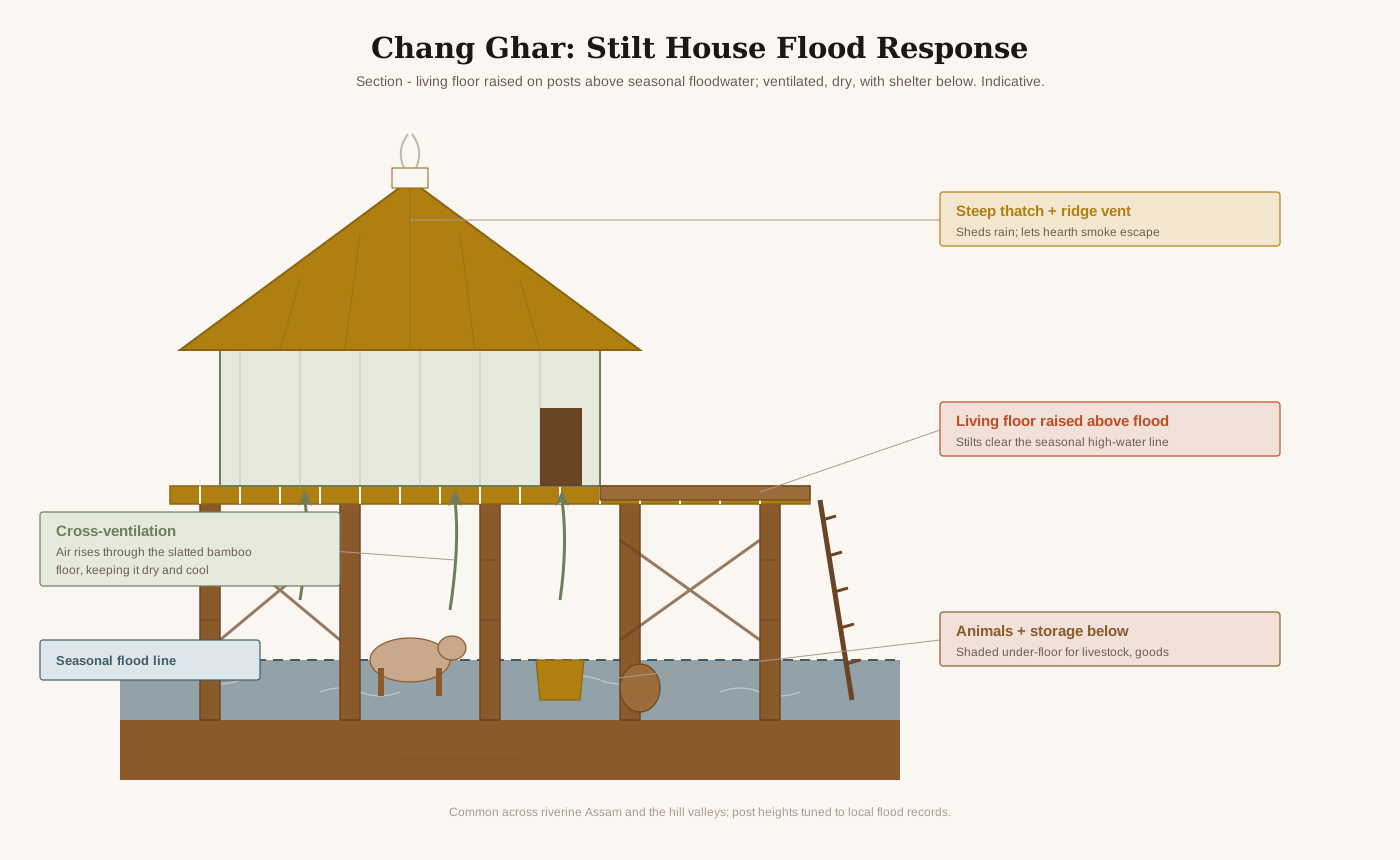
Where flooding and damp are most relentless — riverbanks, low valleys, and among many hill communities — the floor is lifted not on a plinth but on posts. The chang ghar is a stilt house: a bamboo-and-timber platform raised clear of the ground on stilts, with the living quarters above and the open, shaded space beneath used for livestock and storage. Air moves up through the slatted bamboo floor, keeping it dry and ventilated; the flood passes harmlessly below. It is the same light, flexible frame as the Assam-type house, simply lifted higher and adapted to standing water rather than merely damp soil.
3.3 The Naga morung (bachelors' / youth dormitory)
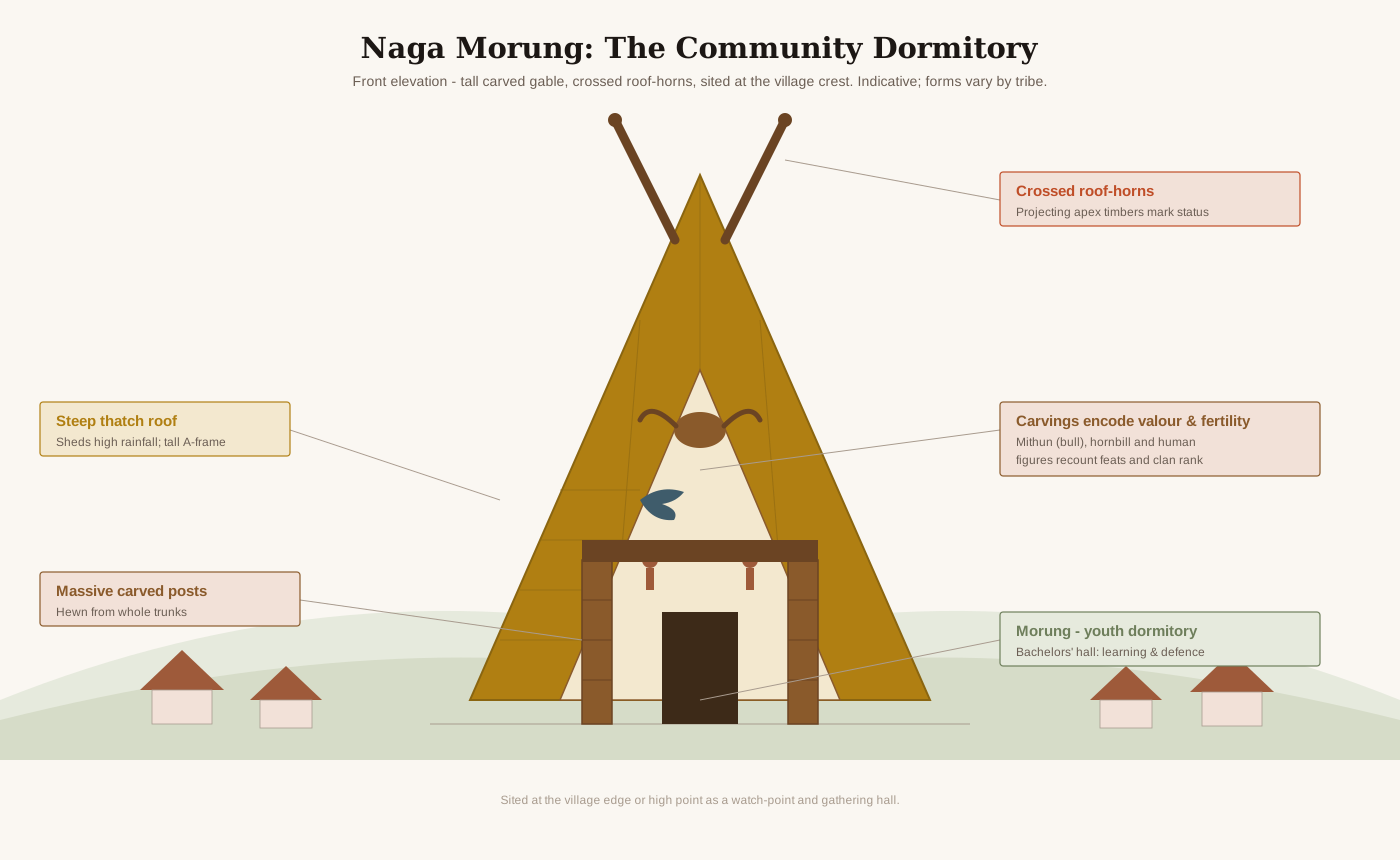
No structure expresses the social architecture of the region better than the morung — the bachelors' or youth dormitory of the Naga communities. The morung was where young men of the village slept, and where they learned warfare, craft, custom, oral history and discipline; it functioned at once as a school, a barracks and a ceremonial centre. It was sited at the edge or highest point of the village, partly for defence in the headhunting era, and its poles, beams and gable boards were elaborately carved.
Each Naga community has its own name for the institution. To gloss the principal ones recorded in the sources:
| Community | Local name for the morung |
|---|---|
| Ao | ariju |
| Sumi | apuki |
| Konyak | ban |
| Angami | kichuki |
| Rongmei | khangchiu |
| Lotha | champo |
The morung is, in effect, a community building rather than a dwelling — the architectural heart of village life — and we return to its social meaning in Section 7.
3.4 Apatani bamboo and cane houses
In the Ziro Valley of Arunachal Pradesh, the Apatani community builds almost entirely in bamboo and cane, using many species — including a locally endemic variety often called "Apatani bamboo" — alongside an intricate, much-studied agroforestry and wet-rice system. Their settlements are dense, ordered villages of bamboo houses, and the whole Apatani Cultural Landscape is recognised on the UNESCO World Heritage Tentative List for exactly this integration of building, bamboo cultivation and sustainable land use.
4. Materials & Construction: The Bamboo Economy
If one material defines North-East building, it is bamboo — fast-growing, strong in tension, light, flexible, and abundant across the region — used together with cane for lashings and finer work. Around this grow the rest of the palette.
| Material | Role in construction | Why it suits the region |
|---|---|---|
| Bamboo | Frames, floors, walls, mats, lashing, scaffolding | Fast-renewing, light, strong, flexible — ideal for seismic flex |
| Cane | Bindings, lashings, fine weaving | Tough, pliable, locally abundant |
| Sal timber | Main posts and beams of the Assam-type frame | Strong, durable hardwood for the load-bearing skeleton |
| Ikra (reed-bamboo) | Woven infill wall panels | Light, breathable, easily plastered and repaired |
| Mud + cow dung | Plaster over the ikra mesh | Breathable, repairable, locally free, finishes the wall |
| Thatch / CGI | Steep roof covering | Thatch sheds rain and insulates; CGI is now the durable modern substitute |
The construction sequence of an Assam-type house follows naturally from these materials: raise the plinth; erect the sal timber post-and-beam frame and brace it; weave the ikra panels into the wall openings; plaster them with mud and dung; frame and cover the steep roof. Every step uses materials a village can grow or gather, and tools a village owns. Repair is continuous and cheap — a quality that matters enormously where the ground regularly tests every joint.
5. The Seismic Story: How an Earthquake Designed a House
Here is the most remarkable fact about North-East vernacular, and the one every architecture student should carry away: the Assam-type house was, in part, deliberately developed in response to an earthquake.
On 12 June 1897, the Great Assam earthquake — one of the largest ever recorded, with violent shaking across the region — devastated masonry buildings throughout the Shillong and Brahmaputra-valley area. In the aftermath, the Japanese seismologist Fusakichi Omori, among others, helped develop a hybrid timber–reed–mud house designed to ride out future shaking, and the British Public Works Department (PWD) adopted this form from 1897 onwards, spreading the standardised "Assam-type" house across the region. In other words, an indigenous instinct — build light and flexible — was studied, formalised and disseminated by engineers as official policy after the disaster proved heavy masonry deadly.
The light frame works for reasons we set out in Section 2: low mass means low inertial force, and ductile, lashed-and-pegged joints flex and dissipate energy instead of fracturing. The proof, by wide reckoning, came half a century later. The 1950 Assam–Tibet earthquake, of roughly magnitude 8.4 — among the largest continental earthquakes on record — is widely cited as having confirmed the resilience of these lightweight houses. (One should be careful here: the often-repeated claim that "no Assam-type building collapsed" comes from secondary press accounts rather than rigorous academic survey, and is best treated as a strong popular tradition rather than a verified statistic. The 1897 earthquake, Omori's involvement and the PWD's adoption from 1897, by contrast, are well documented.)
This is engineering wisdom that the modern world is only now formally rediscovering — that for high-seismic zones, lightweight ductile construction can outperform heavy rigid construction. The Assam-type house is a rare, documented case of vernacular and formal seismic engineering meeting and reinforcing each other.
The 1897 earthquake did not just destroy buildings — it taught the region, and its engineers, how to build the next ones.
6. The Living Root Bridges of Meghalaya: Community Bio-Engineering
If the Assam-type house shows the region answering the ground, the living root bridges of Meghalaya show it answering the rain — and doing so with one of the most extraordinary pieces of vernacular engineering anywhere.
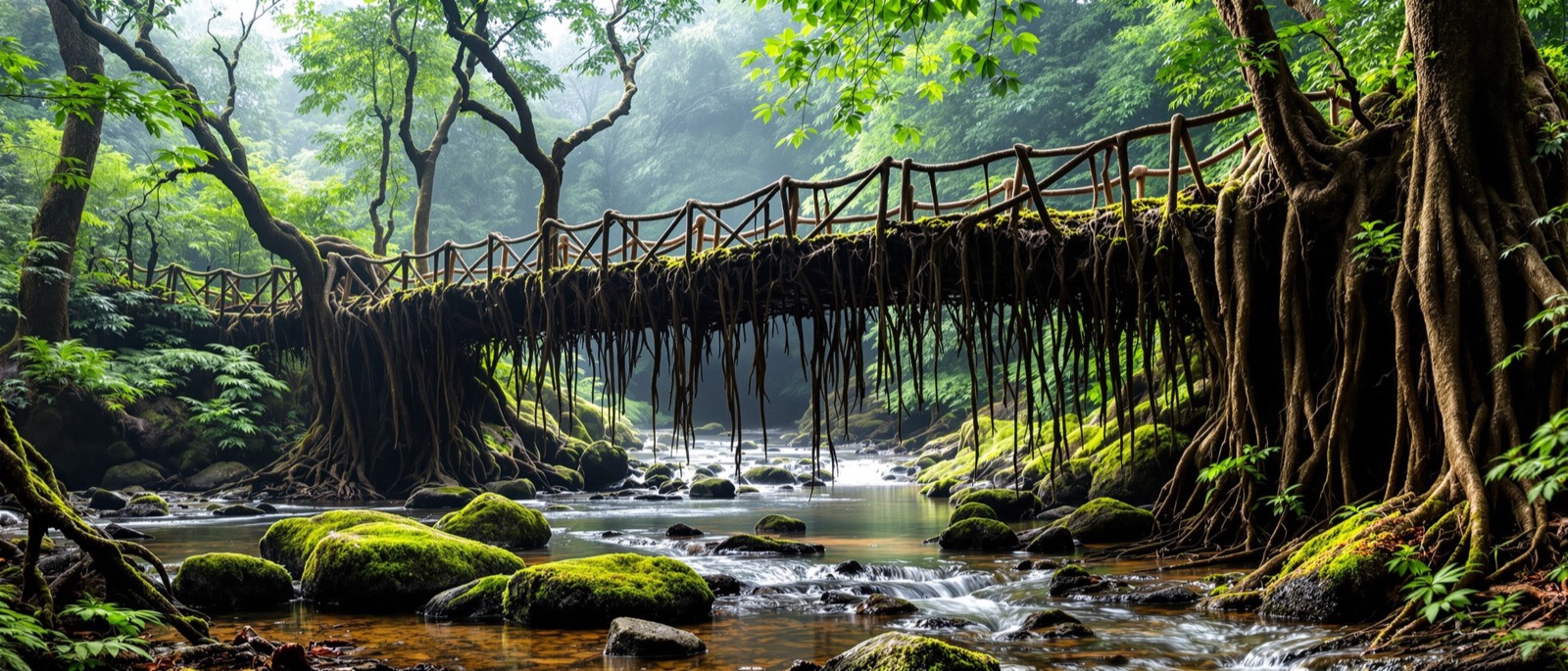
In the deep, perpetually wet gorges of the East Khasi Hills and West Jaintia Hills, conventional bamboo or timber footbridges rot quickly in the relentless damp. So the Khasi and Jaintia communities grow their bridges instead. Using the aerial roots of the rubber fig, Ficus elastica, they train the pliable young roots across a stream — traditionally guided along a hollowed betel-palm trunk or bamboo scaffold — until, year by year, the roots reach the far bank, take hold, thicken and fuse into a living root bridge (in Khasi, jingkieng jri).
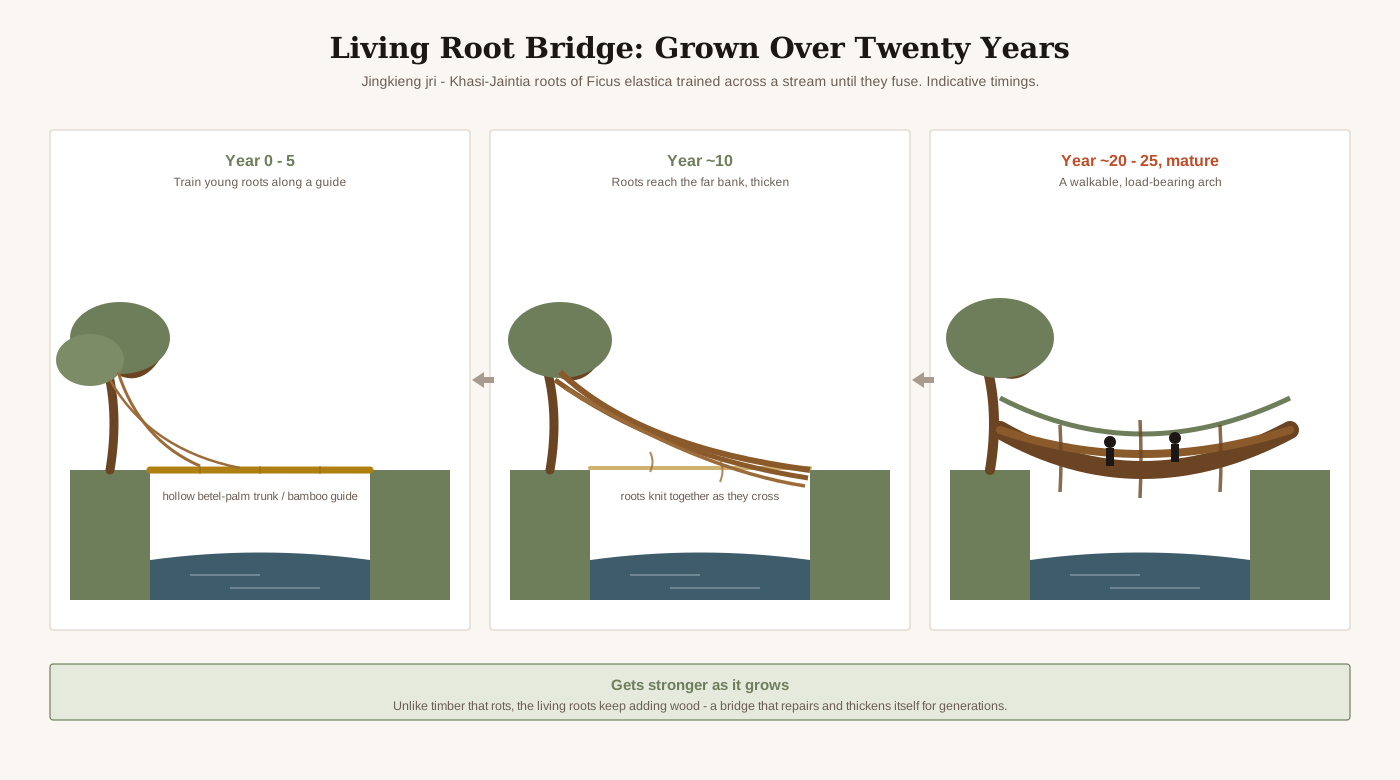
The numbers are humbling. A bridge takes roughly 20 to 25 years to mature into a functional, load-bearing span — which means the person who plants and trains it is rarely the person who will fully use it. Around 100 such bridges are known across the region; the most celebrated is the two-tier "Double Decker" bridge at Nongriat, near Cherrapunji. Unlike every built structure that begins decaying the day it is finished, a living root bridge gets stronger as it grows, and several are believed to be well over a century old. The phenomenon is now on the UNESCO World Heritage Tentative List.
This is bio-engineering as community infrastructure: a technology measured in generations, built by patience rather than force, and perfectly suited to a climate that destroys everything dead and rewards everything alive.
7. The Social & Cultural Life of the Structure
Architecture in the North-East is rarely "just" shelter; it carries the social and spiritual order of the community.
The morung is the clearest example. More than a dormitory, it was the institution through which a Naga village reproduced itself culturally — the place where boys became men, learning the skills of warfare and craft, the customs and oral histories of the people, and the discipline of communal life. It served as school, barracks and ceremonial centre at once. Its carving was not decoration but text: the motifs on its posts and gable boards — mithun (bull) heads, human figures, hornbills, and others — encoded valour and fertility, status and lineage, readable by those who knew the code. To build and maintain a morung was to assert and transmit the identity of the village.
The living root bridges carry a different but equally deep social meaning. Because a bridge takes two decades or more to mature, building one is necessarily an act of inter-generational community infrastructure — one generation plants and trains the roots so that the next may cross. Maintenance, too, is communal and continuous. The bridge is a covenant between people who will never meet, mediated by a tree.
Even the ordinary Assam-type house and chang ghar embed social logic — the raised verandah as the threshold where the household meets the village, the space beneath the stilts shared with livestock, the continuous communal labour of re-plastering and re-thatching. In each case, the building is a verb as much as a noun: something done together, repeatedly, rather than merely owned.
8. Notable Examples & Settlements
| Example / typology | Where | Significance |
|---|---|---|
| Assam-type houses | Across the Brahmaputra valley (Assam & beyond) | The region's defining seismic-resistant domestic form; timber frame, ikra walls, raised plinth |
| Naga morungs (Ao ariju, Sumi apuki, Konyak ban, Angami kichuki, Rongmei khangchiu, Lotha champo) | Naga villages, Nagaland | Carved community dormitories; school, barracks and ceremonial centre of the village |
| Apatani Cultural Landscape, Ziro Valley | Arunachal Pradesh | Bamboo-and-cane settlements with integrated agroforestry; UNESCO Tentative List |
| Living root bridges (jingkieng jri) | East Khasi Hills & West Jaintia Hills, Meghalaya | ~100 grown Ficus elastica bridges; community bio-engineering; UNESCO Tentative List |
| Nongriat "Double Decker" root bridge | Near Cherrapunji, Meghalaya | The most famous two-tier living root bridge |
| Chang ghar stilt houses | Riverine and hill areas across the region | Flood-and-damp response; living floor raised on stilts |
Two of these — the Apatani Cultural Landscape and the Meghalaya living root bridges — sit on the UNESCO World Heritage Tentative List, a recognition that these are not quaint survivals but globally significant achievements in sustainable, climate-responsive building.
9. Decline & What Survives
The familiar story of Indian vernacular plays out here too. Reinforced cement concrete (RCC) has steadily displaced the Assam-type house and the morung, carrying associations of permanence, status and modernity. Many surviving Assam-type houses are reported to be "falling apart" from neglect as families move into concrete; many morungs survive now chiefly as revived or symbolic structures rather than living institutions.
The irony is sharp. In a Zone-V region, a heavy RCC building — if poorly detailed, which much informal construction is — can be more dangerous in an earthquake than the light, flexible vernacular it replaced. The vernacular answer to the ground is being abandoned just as its logic is being formally validated.
Yet much survives and is being actively defended. There are morung revival efforts that rebuild and reanimate these structures as centres of cultural identity. The living root bridges are protected and proposed for UNESCO inscription, drawing conservation attention and pride. And across the region, designers and communities are rediscovering bamboo, cane, raised floors and flexible framing as exactly the climate-and-seismic-smart toolkit a warming, water-stressed, earthquake-prone future demands. This is the larger argument we make in why vernacular design is returning to India and in our companion on lessons for modern homes.
The lesson, as always with vernacular, is to adapt rather than copy. We need not romanticise the thatch-and-mud house or pretend it meets every modern need. But its underlying logic — light and flexible against earthquakes, raised against flood, breathable against humidity, grown rather than mined — is precisely the logic a responsible architecture for the North-East should carry forward, whatever the materials. If you are planning a home in this region, our house-plans library and the broader guides index are good next stops, alongside the work of regionally grounded architects.
References & Further Reading
Vernacular terms, spellings and datings vary across communities and sources; the works below are where to verify specifics.
Foundational / Theory & seismic
- EERI / IAEE, World Housing Encyclopedia, Report No. 154 — "Assam-type House" — the standard technical description and seismic assessment of the timber-frame ikra house.
- Seismic-assessment literature on lightweight timber-frame and bamboo construction in high-hazard zones (energy dissipation through flexible jointing).
Regional / Indian sources
- Wikipedia, Assam-type architecture — for ikra (ikora/ekra) construction, the 1897 Great Assam earthquake, Fusakichi Omori's role, and British PWD adoption from 1897.
- Wikipedia, Living root bridge — for Ficus elastica, the Khasi and Jaintia builders, the Nongriat Double Decker, and maturation timeframes.
- UNESCO World Heritage Tentative List — Apatani Cultural Landscape (Ziro Valley) — for the bamboo-and-agroforestry settlement system; the living root bridges are likewise on the Tentative List.
- Morung Express, "The Naga Morung" — for the social role and community-specific names of the morung.
Companion Studio Matrx guides
- The pillar: Indian Vernacular Architecture
- Regional siblings: Ladakh · Bengal
- Thematic: Why Vernacular Design Is Returning in India · Lessons for Modern Homes · Tropical Architecture in India
- Plan your own: House Plans
Author's Note: I keep returning to the image of a house that "dances" with an earthquake rather than fighting it — and to the Khasi who plants a bridge he may never finish crossing. The North-East taught me that strength is not always stiffness, and that the most advanced engineering can be the most patient. We chase permanence in concrete; these traditions found a deeper permanence in lightness, flexibility, and the willingness to repair, regrow and renew. — Amogh N P
Disclaimer: Vernacular terms, spellings (for example ikra / ikora / ekra) and historical datings vary across communities, languages and sources; named examples and their conservation status change over time. The "no building collapsed in 1950" tradition is widely cited but not rigorously verified academically and is presented as such. This is an educational overview, not a construction or seismic-safety specification; verify specifics against the cited scholarship and qualified professionals before building. No liability is assumed.
Export this guide
Related Guides — Deep-dive reading
Living Root Bridges: How Meghalaya Grew the Architecture of the Future
For centuries the Khasi and Jaintia communities of north-east India have not built their river crossings but grown them — training the aerial roots of Ficus elastica across gorges until the living tree becomes a load-bearing bridge that gets stronger every year. This deep study reads their botany, their structural logic, and why an ancient vernacular now sits at the frontier of where architecture is going.
The Future of ArchitectureMETI Handmade School: How Anna Heringer Made Mud and Bamboo Modern
In a flood-prone Bangladeshi village, Anna Heringer and Eike Roswag built a two-storey school from earth mixed by water buffalo and bamboo cut nearby — and, by adding a damp-proof course and a brick plinth, proved that the cheapest local materials could carry a durable, joyful, dignified public building. A case study in resilience made from what is already there.
The Future of ArchitectureKantana Film and Animation Institute: How 600,000 Handmade Bricks Built a School of Light
Boonserm Premthada's film school outside Bangkok is a low-tech answer to the digital age — eight-metre undulating walls laid from more than 600,000 hand-pressed bricks, a double skin that fends off the tropical heat, and a shaded 'inserted forest' that teaches the eye to read light and shadow. A close study of its craft, its structure, and the community it kept alive.
The Future of ArchitectureRelated Tools — Try Free
Cross-Ventilation Analyzer
Estimate airflow and air changes per hour (ACH) from room size, window areas, layout, and local wind — with NBC 2016 Part 8 compliance check.
Ventilation CalculatorRainwater Tank Sizer
How big should your rainwater tank be? Computes annual harvest, recommended tank capacity in litres, water-bill savings, and payback — for 10 Indian cities.
RWH CalculatorMonsoon-Readiness Checklist
Pre-rain home audit across 9 categories — terrace, drains, waterproofing, electrical, HVAC, pest, vehicles, documents.
Seasonal Audit