
Vernacular Architecture of Kerala: The Nalukettu, the Courtyard & the Carpenter's Craft
How Kerala's steep-roofed, courtyard-centred houses solved the monsoon — and what the nalukettu still teaches us
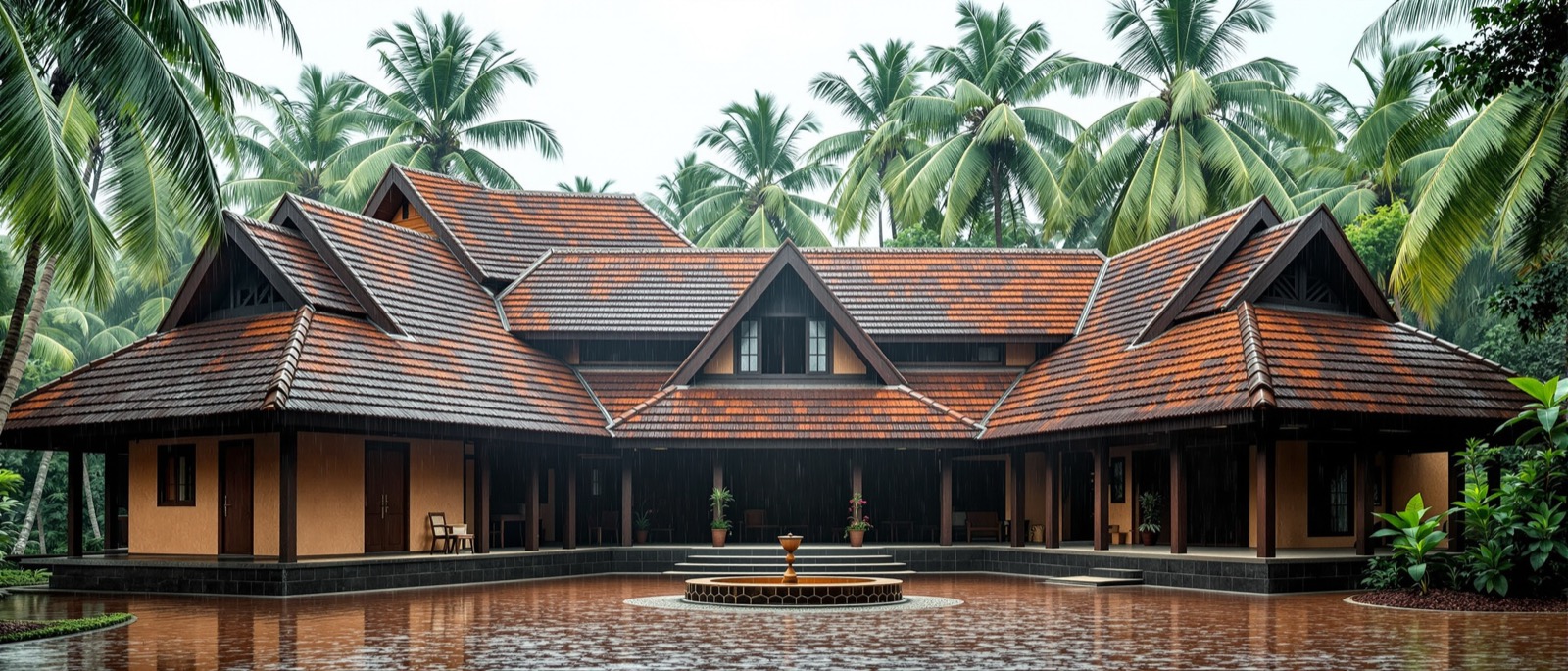
When the south-west monsoon breaks over the Malabar coast, the rain does not fall so much as it descends — sheets of warm water hammering down for days, the air thick enough to drink. Walk into an old Kerala homestead in that weather and something remarkable happens: the noise softens, the light cools to a green-gold hush, and at the centre of the house you find a square of open sky, the rain pouring cleanly into a sunken stone court while you stand dry under a deep timber eave, watching it. This is the nadumuttam, the open-to-sky courtyard, and the house built around it is the nalukettu — the four-block house that is the signature dwelling of Kerala.
The nalukettu is not a style someone designed. It is a climate solved, a family housed, and a craft tradition made visible in carved jackwood and rosewood. It is the answer a community of carpenters arrived at, over centuries, to one of the most difficult building problems in India: how to live well in heat, humidity, and relentless rain. The answer they gave was so good that we are still learning from it.
Kerala's vernacular house is, at its heart, a steep timber roof and an open courtyard working as one machine — to shed monsoon water and pull air and light through the body of the dwelling.
This guide is for B.Arch students, teachers, conservation-minded homeowners, and anyone curious about how Kerala built before air-conditioning. We cover the climate and the response, the typologies and their correct names, the laterite-and-timber material logic, the plan and roof and courtyard science, the matrilineal joint family the house was built to hold, the great surviving examples, and what has been lost and saved. It sits within our wider study of Indian vernacular architecture, and reads well alongside its southern siblings — Tamil Nadu and Karnataka — and our guide to tropical architecture in India.
In Kerala the architect was the carpenter, the treatise was carried in the hand, and the house was a thing grown around a square of sky.
1. The Land & the Climate: Building Inside the Monsoon
Kerala is a narrow strip of land pressed between the Arabian Sea and the Western Ghats, and its climate is humid tropical with one dominating fact: the south-west monsoon. For weeks at a stretch the rain is heavy, continuous, and warm. The air carries high humidity almost year-round; temperatures are not extreme by Indian standards, but the combination of heat and moisture makes still, trapped air deeply uncomfortable and makes any unprotected material — earth, timber, lime — vulnerable to rot, mould, and erosion.
In the national framework of climate zones, Kerala sits squarely in the warm-and-humid zone. The vernacular brief in this zone is fundamentally different from the hot-dry brief of Rajasthan or Kutch. Where the desert house wants thick mass, small openings, and a court that traps cool night air, the humid-coast house wants the opposite: lightness, shade over thermal mass, large cross-ventilating openings, a raised floor to escape ground damp, and above all a roof engineered to throw monsoon water far clear of the walls.
| Climate factor | Kerala condition | What the house must do |
|---|---|---|
| Rainfall | Very heavy, prolonged SW monsoon | Steep roof, wide eaves, raised plinth, fast drainage |
| Humidity | High, near year-round | Move air constantly; ventilate the attic; keep timber dry |
| Temperature | Warm, not extreme; high diurnal moisture | Shade, not mass; cross-ventilation over heavy walls |
| Ground moisture | Saturated soils, monsoon flooding | Raised granite/laterite plinth, lifted timber floors |
| Sunlight | Strong, but rain-bearing cloud cover | Deep eaves for shade; courtyard for controlled daylight |
The genius of Kerala's vernacular is that it does not fight any one of these in isolation. The same steep roof that sheds the rain also overhangs deeply to shade the walls; the same courtyard that lets in light also vents hot air; the same raised plinth that escapes the damp also lifts the precious timber clear of rot. Every element does several jobs at once.
2. The Climate-Response Logic: Roof, Eave, Plinth, Court
Before naming the types of house, it is worth understanding the four moves that make every Kerala dwelling work, from a one-room farmhouse to a sixteen-block palace. These are the grammar; the typologies are the sentences.
The steep pyramidal roof
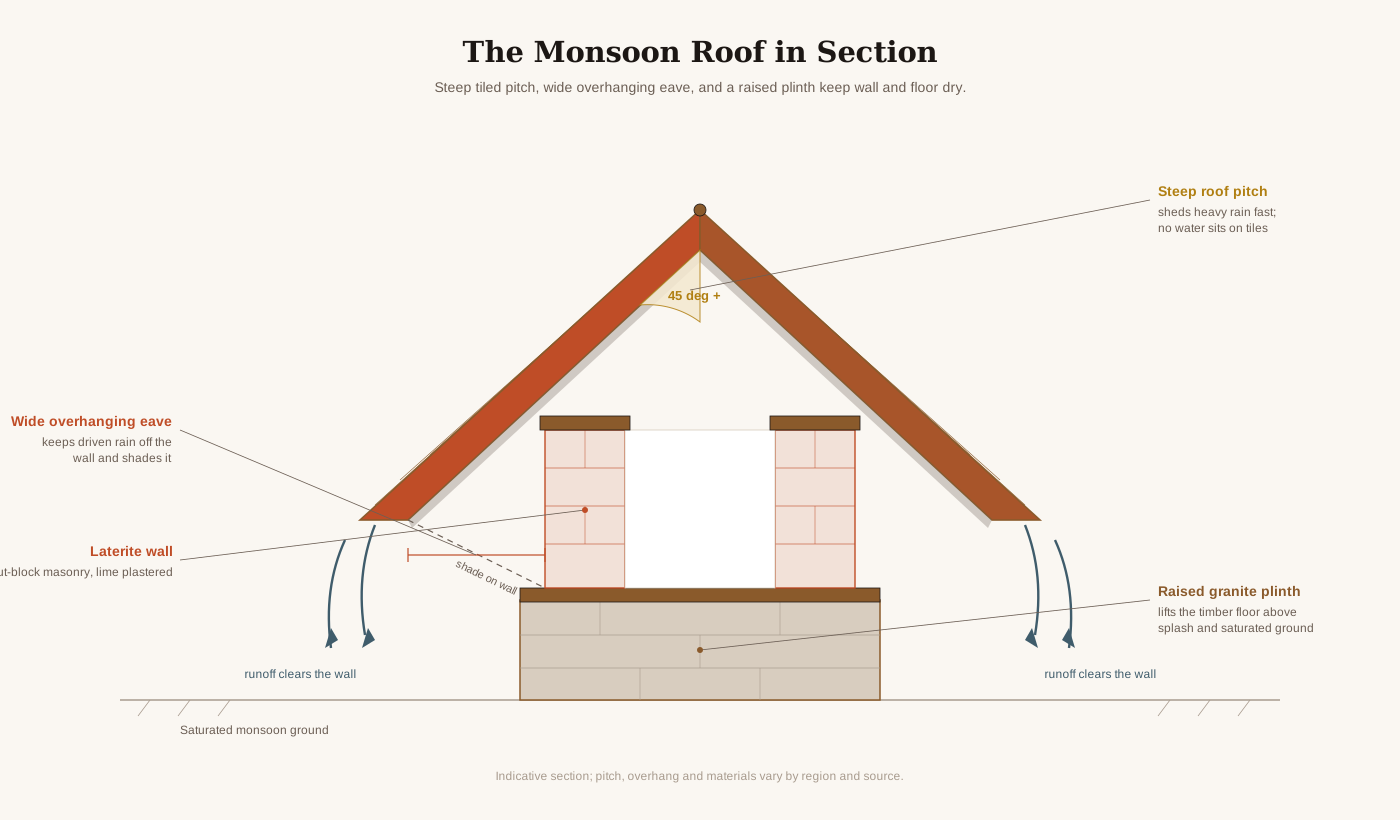
The defining gesture of Kerala building is the steeply sloping roof, pitched far harder than anything you see in dry India. Clad in clay tiles — later the famous fired Mangalore-type interlocking tiles — or in earlier and humbler houses in thatch, the roof sheds the monsoon almost instantly. Its slopes rise to a ridge, and over a square courtyard house the roof forms a pyramidal mass of planes draining outward and inward. The pitch is not decorative; it is hydraulic.
The deep overhanging eave
The roof does not stop at the wall — it flies well past it. These wide overhanging eaves keep driving rain off the walls and openings, and shade the wall surface from direct sun, so that the wall stays dry and cool. Under the eave runs a sheltered edge where one can sit, work, or pass in the rain, and where windows and the carved timber gable can stay open to the breeze without letting water in.
The raised plinth
Kerala houses sit on a raised plinth, often of dressed granite or laterite, lifting the living floor and the timber structure clear of saturated ground and monsoon run-off. This is both a moisture defence and a status gesture — the higher and more finely dressed the plinth, the grander the house.
The open courtyard
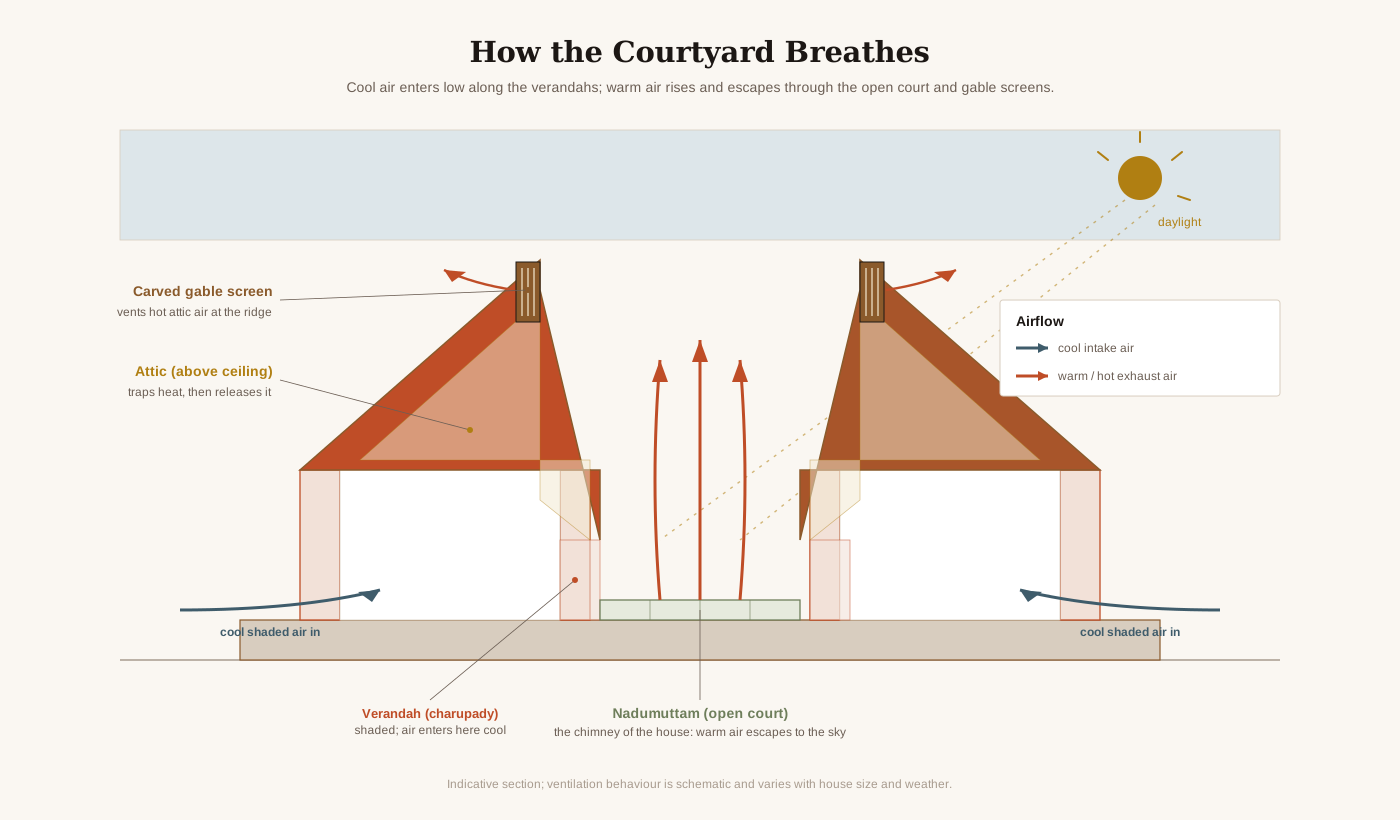
At the centre sits the nadumuttam, the open-to-sky court. It is the lung and the light-well of the house: warm air rising off the inner rooms escapes upward through the open square while cooler air is drawn in along the shaded verandahs, and daylight reaches deep into a plan that, from the outside, looks closed and introverted. We return to its physics in Section 5.
3. The Typologies: From Nalukettu to Pathinarukettu
Kerala's courtyard houses are classified, with beautiful directness, by counting their blocks and courts. The unit of counting is the kettu — a "block" or structural enclosure — and the house is named for how many of them ring how many courtyards.
Nalukettu — the four-block house
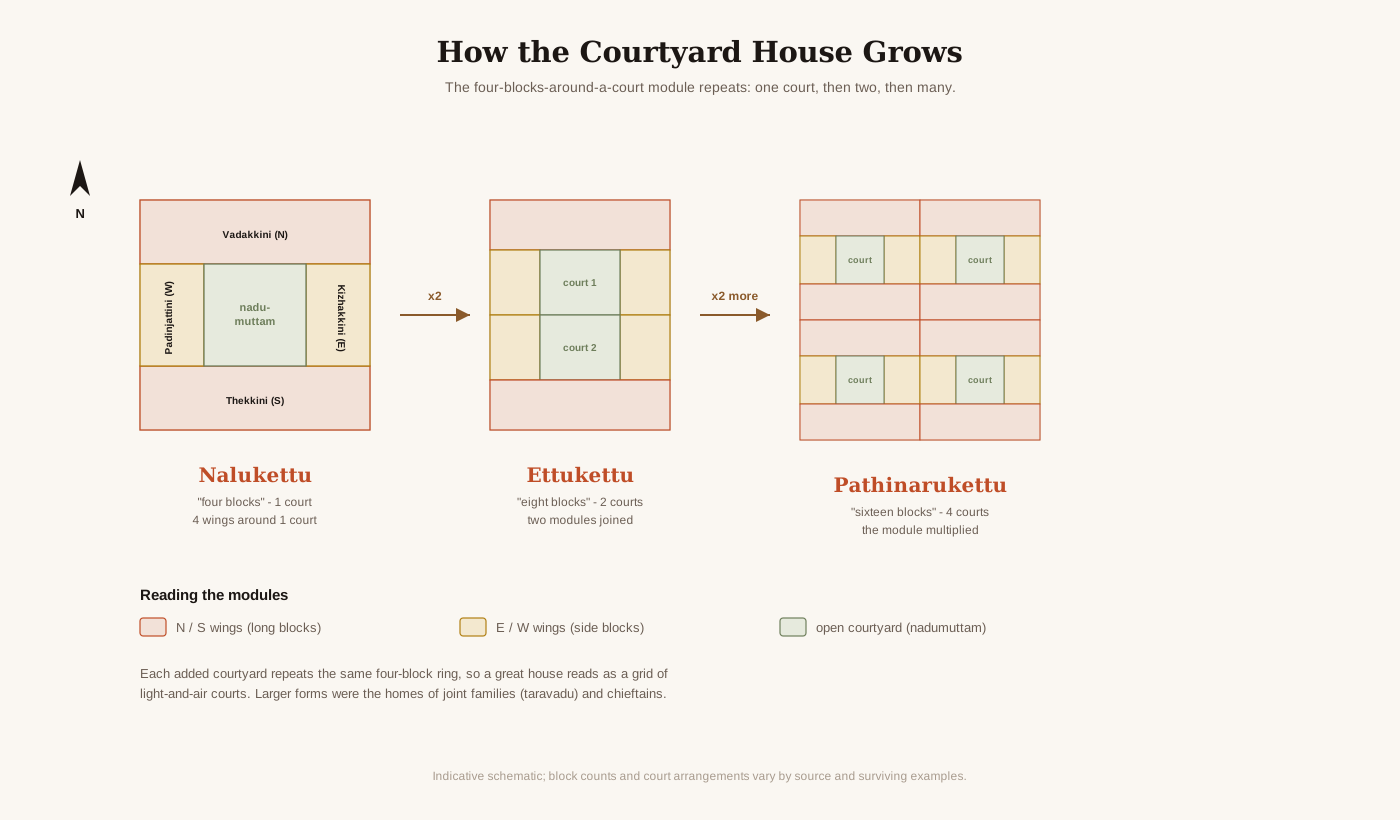
The nalukettu (from nalu, four, and kettu, block) is the foundational type: four wings or blocks arranged around a single central courtyard, the nadumuttam. It is the complete, self-sufficient dwelling — four ranges of rooms looking inward onto one square of sky. When people speak of "the Kerala traditional house," this is almost always the form they mean.
Ettukettu — the eight-block house
When a family grew wealthier or larger, the nalukettu was doubled. The ettukettu (ettu, eight) is the eight-block house, organised around two courtyards rather than one — in effect two nalukettus joined, giving more rooms, more ranges, and a clearer separation of zones.
Pathinarukettu — the sixteen-block house
The grandest type is the pathinarukettu (pathinaru, sixteen): sixteen blocks around multiple courtyards, the dwelling of the wealthiest families and the largest joint households. These are rare and imposing, the upper limit of a system that scaled simply by repeating its basic module.
| Type | Literal meaning | Courtyards | Who built it |
|---|---|---|---|
| Nalukettu | Four blocks | One (single nadumuttam) | The standard ancestral homestead |
| Ettukettu | Eight blocks | Two | Larger / wealthier joint families |
| Pathinarukettu | Sixteen blocks | Multiple | The wealthiest households |
The elegance of this system is that it is additive and modular. The nalukettu is the cell; the larger houses are simply more cells around more courts, repeating the same roof-and-court logic at greater scale.
The four named wings
Within the nalukettu, each of the four wings has a name and an assigned role, arranged by orientation:
- Vadakkini — the northern wing
- Thekkini — the southern wing
- Kizhakkini — the eastern wing
- Padinjattini — the western wing
Each was given functions according to traditional ideas of orientation and ritual — storage, sleeping, cooking, worship, and ceremony distributed around the court by compass direction. The point to hold onto is that the four-block plan is not abstract: each side has an identity, a name, and a job.
The parts of the house: tharavadu, padippura, poomukham
Three more terms complete the vocabulary of the Kerala home:
- Tharavadu — the ancestral joint-family homestead, both the building and the social-and-property unit it embodies. To belong to a tharavadu was to belong to a lineage and an estate, not merely a house.
- Padippura — the gatehouse or entrance gateway, a roofed threshold in the compound wall through which one passes to approach the house. It marks the boundary between the public world and the family's domain.
- Poomukham — the front porch or entrance veranda, the formal face of the house where guests are first received, raised and roofed and often the most finely finished timber space of the exterior.
The sequence — padippura, then grounds, then poomukham, then the inner courtyard — moves a visitor gradually from public to private, a privacy gradient written into the plan.
4. Materials & the Carpenter's Craft
If Tamil Nadu's Chettinad mansions are a story of imported marble and merchant cosmopolitanism, Kerala's vernacular is a story of two local materials worked to perfection: laterite below and timber above. Kerala is, more than any other Indian region, a carpentry-led tradition.
Laterite
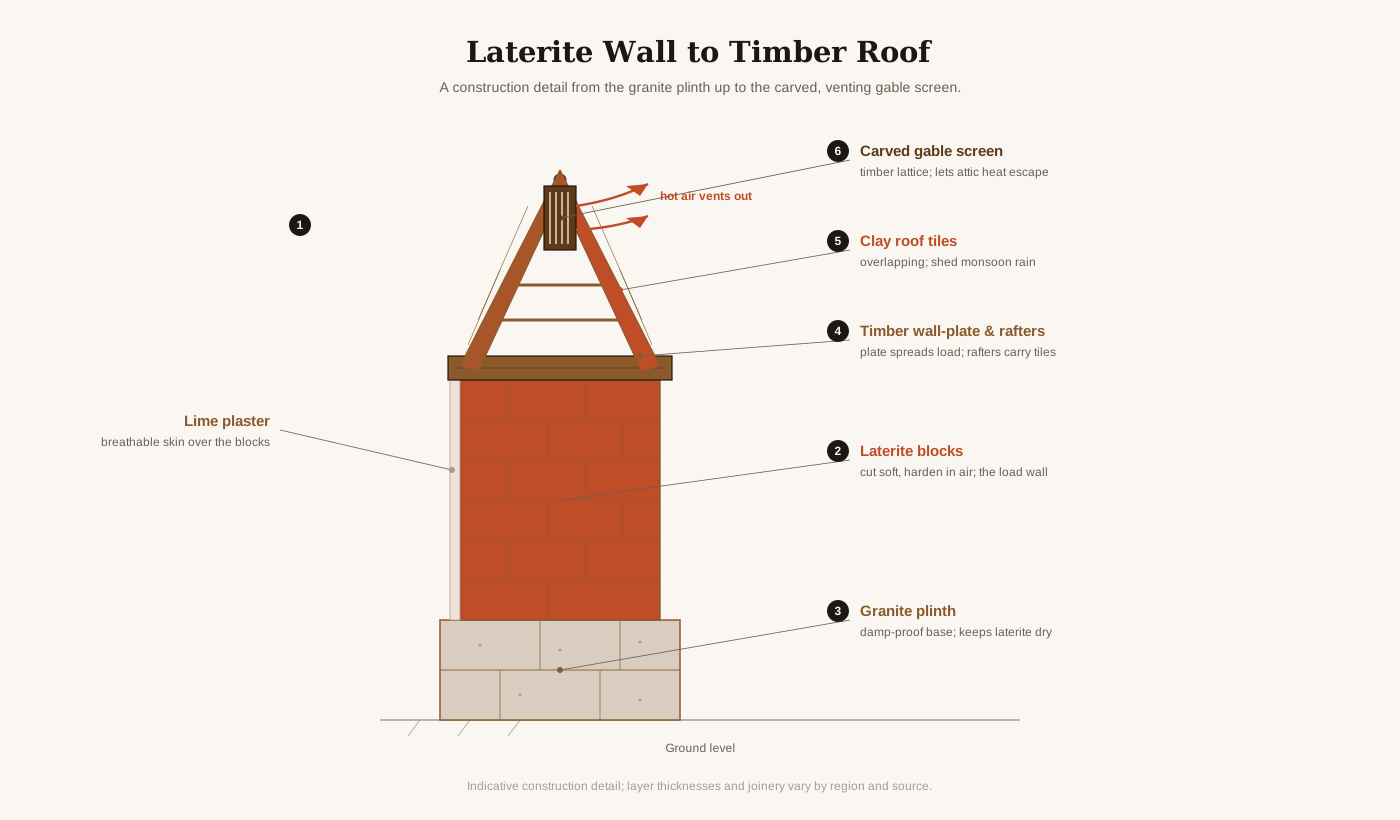
The walls and plinths rest on laterite — an iron-rich soil that is soft enough to be cut from the ground in blocks with simple tools, yet hardens on exposure to air. This single property makes it an almost ideal vernacular material: it is quarried locally, shaped easily when fresh, and grows durable in place. Laterite blocks, often plastered with lime, form the load-bearing masonry; granite is reserved for the strongest plinths and foundations where the house meets the wet ground.
Timber and joinery
Above the masonry, the house is timber. Kerala's forests gave its carpenters superb hardwoods, and the framing, the columns, the floors, the gable screens, the ceilings, and the joinery are all worked in wood — frequently assembled with precise timber joints rather than relying on metal fasteners. The carved timber gable screens at the roof ends are not only ornament: they ventilate the attic, letting hot air escape from the highest point of the roof. The richness of a tharavadu was read in its woodwork.
Roof and finish
The roof was clad in clay tiles — in later and grander houses the fired, interlocking Mangalore-type tile — or, in humbler and earlier dwellings, in thatch. Walls were finished in lime plaster. The result is a layered palette, each material in its right place.
| Element | Material | Why |
|---|---|---|
| Plinth / foundation | Granite, laterite | Strength, resistance to monsoon damp |
| Walls | Laterite blocks, lime plaster | Local, easily cut, hardens in air |
| Structure / floors / joinery | Timber (carpentry-led) | Abundant local hardwood; humidity-tolerant when detailed well |
| Gable screens | Carved timber | Attic ventilation + ornament |
| Roof | Clay (Mangalore-type) tiles, or thatch | Sheds heavy monsoon rain |
Thachu Shastra & Manushyalaya Chandrika
Kerala's building knowledge was codified. The craft was governed by the Thachu Shastra — literally the "science of the carpenter," from thachu, carpentry — the body of knowledge that guided proportion, joinery, and construction. The master-builder who carried it was the Thachan, the carpenter-architect at the centre of the whole enterprise.
For the house specifically, Kerala had its own treatise: the Manushyalaya Chandrika, a sixteenth-century Sanskrit work on domestic architecture attributed to Thirumangalath Neelakanthan Musath, composed in 170 slokas (verses). That a region produced a dedicated manual on the dwelling — distinct from the temple treatises — tells you how seriously the house was taken as a designed object.
The Thachan did not draw the house on paper so much as he held it in proportion, verse, and the memory of his hands.
5. Plan, Section & the Physics of the Courtyard
The nalukettu plan is introverted — closed and protective on the outside, open and luminous on the inside. The four wings turn their backs to the world and their faces to the court. At the centre lies the nadumuttam, the open square, traditionally understood as the Brahmasthan — the sacred centre — left deliberately open to the sky.
How the courtyard cools and lights
The courtyard is the engine of the house's comfort, and it works through simple, robust physics:
- Stack ventilation. Air warmed by the rooms and by daytime heat rises and escapes upward through the open court, drawing cooler, shaded air in along the surrounding verandahs. The house breathes continuously — exactly what a humid climate needs, where the enemy is stagnant moist air.
- Daylight without glare. The open square delivers daylight deep into a plan that has few external windows, and the surrounding eaves and verandahs keep that light soft and shaded rather than harsh.
- Microclimate. Rain falls cleanly into the sunken court; the wet stone and the shaded edges cool the air immediately around the heart of the house.
The roof and the attic
Above, the pyramidal steep tiled roofs with their deep eaves complete the system. The roof's height creates an attic volume, and the carved timber gable screens at the roof ends let hot air vent from the very top — so the section, read from floor to ridge, is a continuous chimney for heat and moisture. The deep eaves keep the walls and openings dry and shaded throughout.
Put plan and section together and you have a single integrated machine: the court draws air up and light down through the middle, while the roof sheds water, shades the walls, and vents the attic at its peak.
6. The Social House: Matriliny, the Joint Family & Ritual
A nalukettu was built to hold a particular kind of family, and you cannot understand the building without it. Among Kerala's Nair and Namboodiri communities, descent and property passed through the female line — a system called marumakkathayam, matrilineal inheritance. The tharavadu was therefore not just a house but a matrilineal property and descent unit, the home of an extended joint family related through its women.
The household was headed by the karanavar — the senior maternal male, typically the eldest brother or uncle of the women of the lineage — who managed the tharavadu's affairs and estate. The many rooms of an ettukettu or pathinarukettu were not a luxury but a necessity: they housed a large, multi-generational family living together under one extended roof, with the courtyard as its shared social and ritual heart.
| Social element | Meaning | Architectural consequence |
|---|---|---|
| Marumakkathayam | Matrilineal descent & inheritance (Nair, Namboodiri) | The tharavadu as a lineage property unit, built to last and grow |
| Tharavadu | Ancestral joint-family homestead | A large, additive, multi-generational house |
| Karanavar | Senior maternal male, head of household | A managed estate; rooms and zones for an extended family |
| Nadumuttam | Open sacred centre (Brahmasthan) | Ritual and social focus left open to the sky |
The privacy gradient from padippura (gate) through poomukham (front porch) to the inner court mapped the family's social world: where outsiders could come, where guests were received, and where the family's private life unfolded around the courtyard.
7. Notable Examples
Kerala's vernacular survives in its grandest form in royal and aristocratic complexes, and in countless tharavadus across the central districts — many now reborn as heritage homestays.
Padmanabhapuram Palace
The supreme surviving example of the Kerala timber tradition is Padmanabhapuram Palace at Thuckalay, the seat of the Travancore royal house. It is one of the largest and finest surviving wooden palace complexes in Asia, a sprawling assembly of timber halls, pillared spaces, carved ceilings, and tiled pyramidal roofs roughly four centuries old, and it appears on India's UNESCO World Heritage tentative list. It shows the nalukettu logic — courts, steep roofs, deep eaves, masterful joinery — carried to a royal scale.
Surviving tharavadu nalukettus
Across the central districts — Thrissur, Palakkad, and Kottayam — survive Nair and Namboodiri tharavadu nalukettus, the ancestral homesteads of joint families. Many have been adapted into heritage homestays, which has given them an economic reason to be maintained.
DakshinaChitra
At DakshinaChitra, the living-history museum run by the Madras Craft Foundation near Chennai, relocated South Indian vernacular houses — including Kerala types — have been re-erected for the public to walk through, preserving structures that would otherwise have been lost.
| Example | Location | Significance |
|---|---|---|
| Padmanabhapuram Palace | Thuckalay | Travancore royal seat; one of the largest surviving wooden palace complexes in Asia; c.400 years; UNESCO tentative list |
| Tharavadu nalukettus | Thrissur, Palakkad, Kottayam | Surviving Nair/Namboodiri ancestral homesteads; many now heritage homestays |
| DakshinaChitra | Near Chennai | Relocated & reconstructed South Indian houses, incl. Kerala types |
For more on how these courtyard plans translate into homes you could build today, see our house plans library.
8. Decline & What Survives
The nalukettu declined for reasons that were social before they were architectural. As the matrilineal system broke down through the twentieth century and land reform redistributed and fragmented large estates, the great joint households that the tharavadus existed to shelter dissolved. A house built for forty people related through a matriline made little sense for a nuclear family holding a fragment of the old estate.
The buildings followed the families. Fragmented tharavadus fell into disrepair; in many cases the carved timber — the most valuable thing in the house — was sold off or relocated, the joinery dismantled and carried away, leaving the laterite shell to decay.
But much survives, and some is being actively revived:
- Heritage homestays. Converting tharavadu nalukettus into homestays has given owners a reason to keep them standing and maintained.
- DakshinaChitra and museum relocation. Whole houses have been documented, dismantled, and re-erected for preservation and public learning.
- Scholarly documentation. Miki Desai's Wooden Architecture of Kerala (2018) is a major scholarly record of the tradition, ensuring that even what is lost is understood.
- The Laurie Baker revival. The British-born architect Laurie Baker, who settled in Kerala, revived the use of laterite, lime, and low-cost local methods in a contemporary idiom — proof that the material intelligence of the vernacular could be carried forward rather than merely preserved.
| Pressure / loss | Cause | What endures or revives |
|---|---|---|
| Joint family dissolved | Breakdown of matriliny | Smaller adaptive reuse; homestays |
| Estates fragmented | Land reform | Some tharavadus maintained as heritage |
| Timber sold / relocated | Disrepair, high value of carving | Museum relocation (DakshinaChitra) |
| Knowledge at risk | Decline of the craft | Scholarly documentation (Miki Desai) |
| Materials forgotten | RCC modernisation | Laurie Baker's laterite/lime revival |
The lesson Kerala offers the present is not to copy the nalukettu wholesale — few of us live in matrilineal joint families of forty — but to carry forward its principles: the steep shading roof, the deep eave, the breathing courtyard, the raised plinth, and the discipline of building with what is local. For how these ideas translate into contemporary Indian homes, see Lessons for Modern Homes and modern versus traditional Indian house architecture, and the broader case in why vernacular design is returning in India.
References & Further Reading
Foundational / Theory
- Manushyalaya Chandrika, attributed to Thirumangalath Neelakanthan Musath (16th century) — the primary Sanskrit treatise on Kerala domestic architecture, in 170 slokas.
- Thachu Shastra — the traditional Kerala "science of the carpenter," the body of knowledge governing timber construction and proportion.
Regional / Indian sources
- Miki Desai, Wooden Architecture of Kerala (Mapin, 2018) — the major scholarly documentation of Kerala's domestic and wooden vernacular.
- Ronald M. Bernier, Temple Arts of Kerala: A South Indian Tradition (S. Chand, 1982).
- Laurie Baker — practitioner; the laterite, lime, and low-cost building revival in Kerala (see also Gautam Bhatia, Laurie Baker: Life, Works & Writings).
- INTACH and DakshinaChitra (Madras Craft Foundation) — documentation, conservation, and relocation of South Indian vernacular houses.
Companion Studio Matrx Guides
- Indian Vernacular Architecture: the pillar guide
- Vernacular Architecture of Tamil Nadu
- Vernacular Architecture of Karnataka
- Tropical Architecture in India
- Vernacular Lessons for Modern Indian Homes
- Why Vernacular Design Is Returning in India
Author's Note: I find it hard to stand in the nadumuttam of an old nalukettu and not feel slightly humbled. There is no machine in the room, no power running, and yet the air moves, the light is kind, and the rain is held at arm's length. The carpenters who built these houses left no signatures and wrote no manifestos; they left the houses themselves. To learn from them is the least we owe them. — Amogh N P
Disclaimer: Vernacular terms, spellings, and datings vary across sources and regions, and the names and roles given to wings, parts, and family structures can differ between communities and scholars. Conservation status and the use of named buildings change over time. This is an educational overview; verify specifics against the cited scholarship before relying on them. No liability is accepted for decisions made on the basis of this article.
Export this guide
Related Guides — Deep-dive reading
The Kerala Traditional Roof: Steep Timber-and-Tile Roofs for the Monsoon Coast
Kerala and the Malabar coast answered one of India's heaviest monsoons with a steep, sloping, deeply-overhanging roof: an elaborate timber frame carrying clay tiles, wide eaves that shade the wall and throw rain clear, and the pitched roofs of the nalukettu sloping in around a central open courtyard. This guide tells the story, the craft and how to live with or restore one today.
RoofingOrientation, Light & Views: Designing With Your Space, Not Against It
How reading your plot's sun, breeze and views — and placing each room on the right face — gives an Indian home that is cooler, brighter and quietly right, instead of one that fights its site forever.
Design PrinciplesVernacular Architecture — Lessons for Modern Homes
Regional Building Traditions of India and Their Architectural Logic — A Reference for Contemporary Practice
Design StylesRelated Tools — Try Free
Cross-Ventilation Analyzer
Estimate airflow and air changes per hour (ACH) from room size, window areas, layout, and local wind — with NBC 2016 Part 8 compliance check.
Ventilation CalculatorWindow Orientation Planner
Pick the best window type, glass and shading by wall direction — north, east, south and west.
Window ToolBrise-Soleil Visualizer
Interactive horizontal-louvre cut-off angle calculator — sun altitude, louvre depth, and spacing inputs with a live shadow preview. Computes θ = arctan(spacing/depth) for façade shading, ECBC envelope compliance, hospital daylight design, and tropical sun-control detailing.
Sun Shading Tool