
Vernacular Architecture of Karnataka: Totti Mane, the Guthu House & Three Climates
How one state bred three traditions — the courtyard Guttu houses of the Tulu coast, the timber Totti Mane of the Malnad, and the flat-roofed stone houses of the dry Deccan north
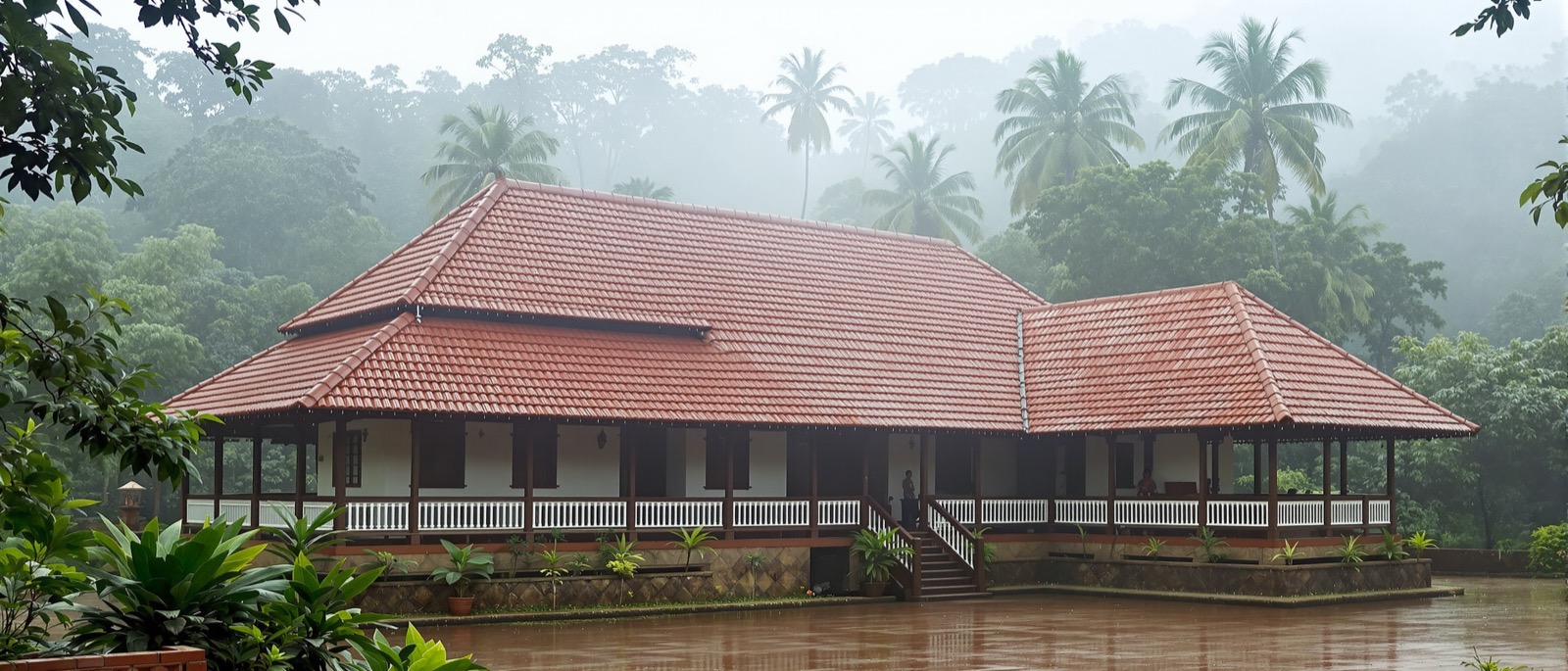
Stand on the wet laterite plinth of an old Guttu house in Dakshina Kannada at the first crack of the southwest monsoon, and you understand the building before anyone explains it. The rain does not fall so much as arrive — sheets of it, drumming on a vast skirt of red interlocking tiles that runs almost to the ground. Step through the enormous timber door, the aanebaagilu or "elephant door", and the noise drops away. You are suddenly in a still, dim square of open sky at the heart of the house — the chowka, the inner court — where the water sluices down four tiled slopes into a channel at your feet and the air is cool and green. Drive three hundred kilometres north-east, onto the dry Deccan plateau around Bagalkot, and the same word "Karnataka" produces an entirely different house: low, flat-roofed, built of heavy stone and packed mud, its few windows small, its roof pierced not by chimneys but by little open-ended terracotta pots that drop coins of light onto the floor below.
These are not two versions of one tradition. They are two traditions, separated by the wall of the Western Ghats and by roughly two metres of annual rainfall. Karnataka is the rare Indian state whose vernacular architecture cannot be summed up in a single house-type, because the land itself refuses to be summed up: a drenched western coast, a forested mountain spine, and a parched eastern plateau, each of which bred its own answer to the question every house must answer — how to keep a family dry, cool, fed, and together.
Karnataka's domestic vernacular splits cleanly along its geography into three climates and three responses — the courtyard-and-tiled-roof houses of the coastal Tulu country, the timber-rich Totti Mane of the Malnad highlands, and the flat-roofed stone-and-mud dwellings of the dry northern Deccan.
This guide is for the B.Arch student mapping India's climate-responsive traditions, the homeowner near Mangaluru or Hubballi wondering what their grandparents' house was actually doing, and anyone who loves how a single state can hold so many ways of living. It is part of our series on Indian vernacular architecture; read it alongside its southern siblings on Kerala and Tamil Nadu, and with Lessons for Modern Indian Homes and Tropical Architecture in India when you want to translate any of this into a buildable plan.
A house on the Tulu coast is built against the rain; a house on the Deccan plateau is built against the sun. The same family name, "Kannadiga", lives under both — and that is the whole story of Karnataka's vernacular.
1. Three Karnatakas: The Geography That Made Three Houses
Karnataka runs from the Arabian Sea to the dry interior of the Deccan, and its building traditions track that transect almost exactly. To read the architecture, you first have to read the rain.
The coast — Dakshina Kannada and Udupi, the old land called Tulunadu after the Tulu language spoken there — sits in the direct path of the southwest monsoon. The Malnad, literally "rain country" (male/malé = rain, naadu = land), is the forested western face of the Western Ghats, where the same monsoon clouds pile up against the mountains and empty themselves before crossing. Both are wet, humid, and green for much of the year. The northern Deccan plateau — districts like Vijayapura, Bagalkot and the country around them — sits in the rain shadow east of the Ghats: hot, dry, with low and unreliable rainfall and a fierce summer sun.
Two distinct climate problems produce two distinct architectural logics. On the wet side, the enemy is water — water that must be shed fast, kept off the walls, and drained away before it rots the timber or floods the floor. On the dry side, the enemy is heat — heat that must be kept out by sheer mass, with the building hoarding the cool of the night deep in its stone and mud.
| Sub-region | Old / local name | Climate | Core problem | First architectural move |
|---|---|---|---|---|
| Coastal Karnataka | Tulunadu (Dakshina Kannada, Udupi) | Humid, very heavy SW monsoon | Shed water fast; keep timber dry | Steep tiled roof, deep eaves, raised plinth |
| Malnad | "Rain country" (Western Ghats belt) | High rainfall, forested, cooler | Shed water; use abundant timber | Steep tiled roof + heavy timber court house |
| Northern Deccan | Vijayapura / Bagalkot interior | Hot-dry, low rainfall, rain-shadow | Keep heat out; store night-cool | Flat stone-and-mud roof, thick mass, few openings |
The shorthand is worth memorising: on the wet west, the roof does the work; on the dry north-east, the wall does the work. Almost everything else — the courtyard, the materials, the social life inside — follows from that single divergence.
2. The Climate Response: Roof Versus Mass
A vernacular house is, at bottom, a climate machine, and Karnataka offers a textbook contrast between two strategies for building one.
2.1 The wet-coast / Malnad strategy: shed and ventilate
Where rain is the problem, the dominant element is the roof. Coastal and Malnad houses carry steep, four-sloped (hipped) tiled roofs whose pitch throws monsoon water off quickly so it cannot pool or seep. The eaves project far beyond the wall line — sometimes nearly to the ground — to keep the driving rain off the laterite and timber, and to shade the verandahs that wrap the house. The plinth is raised well above grade so the floor stays dry when the compound runs like a stream.
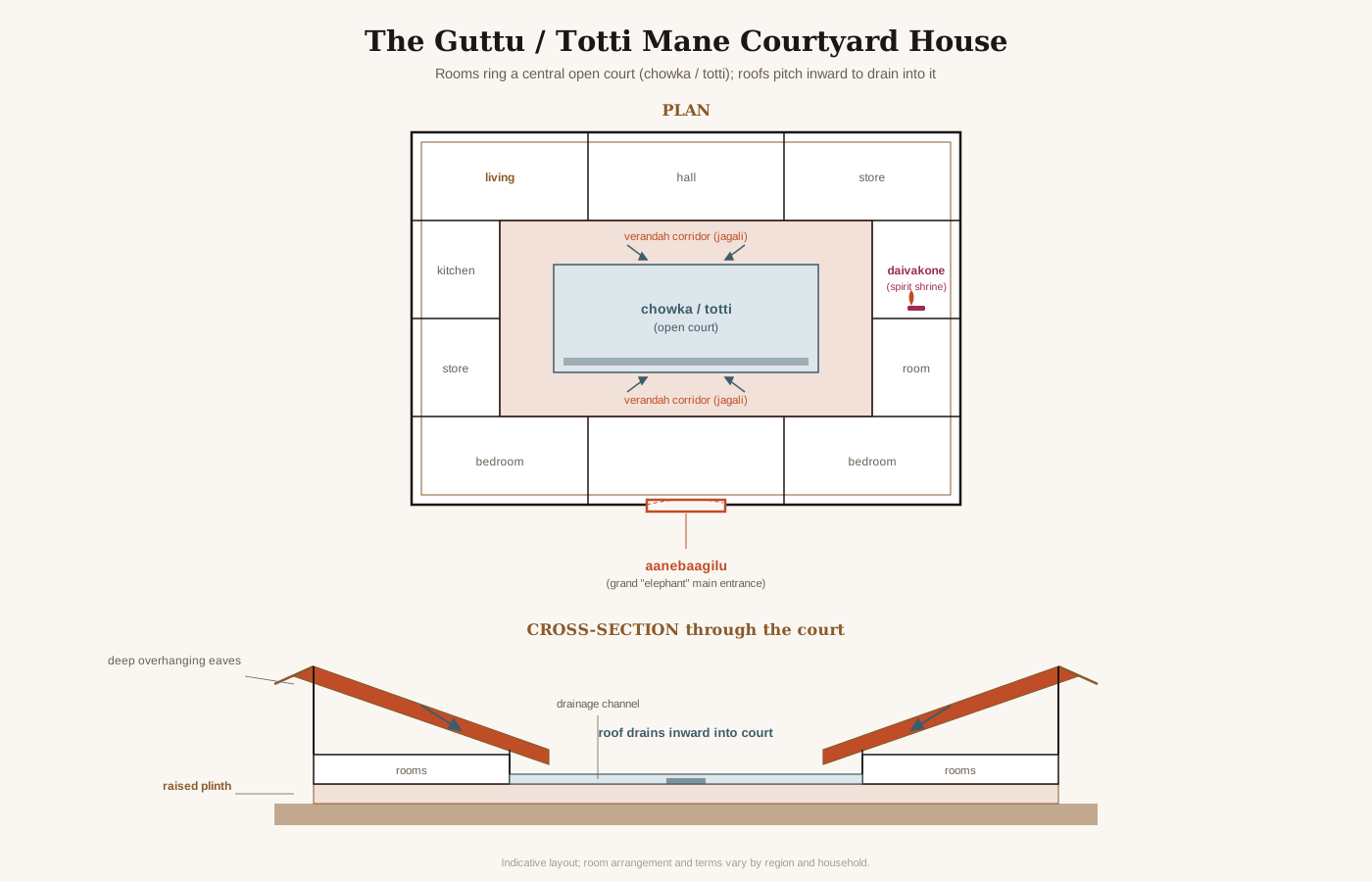
Inside, the open courtyard does the work of ventilation and light. In a deep, introverted house with thick walls and few external windows (kept small to keep rain out), the court is the lung: it admits daylight into the centre, lets hot air rise and escape, and pulls a gentle draught of cooler air across the rooms that ring it. The same court is a working rainwater feature — the four roof slopes drain inward into it, channelling the monsoon into drains and, often, a well.
2.2 The dry-north strategy: mass and shade
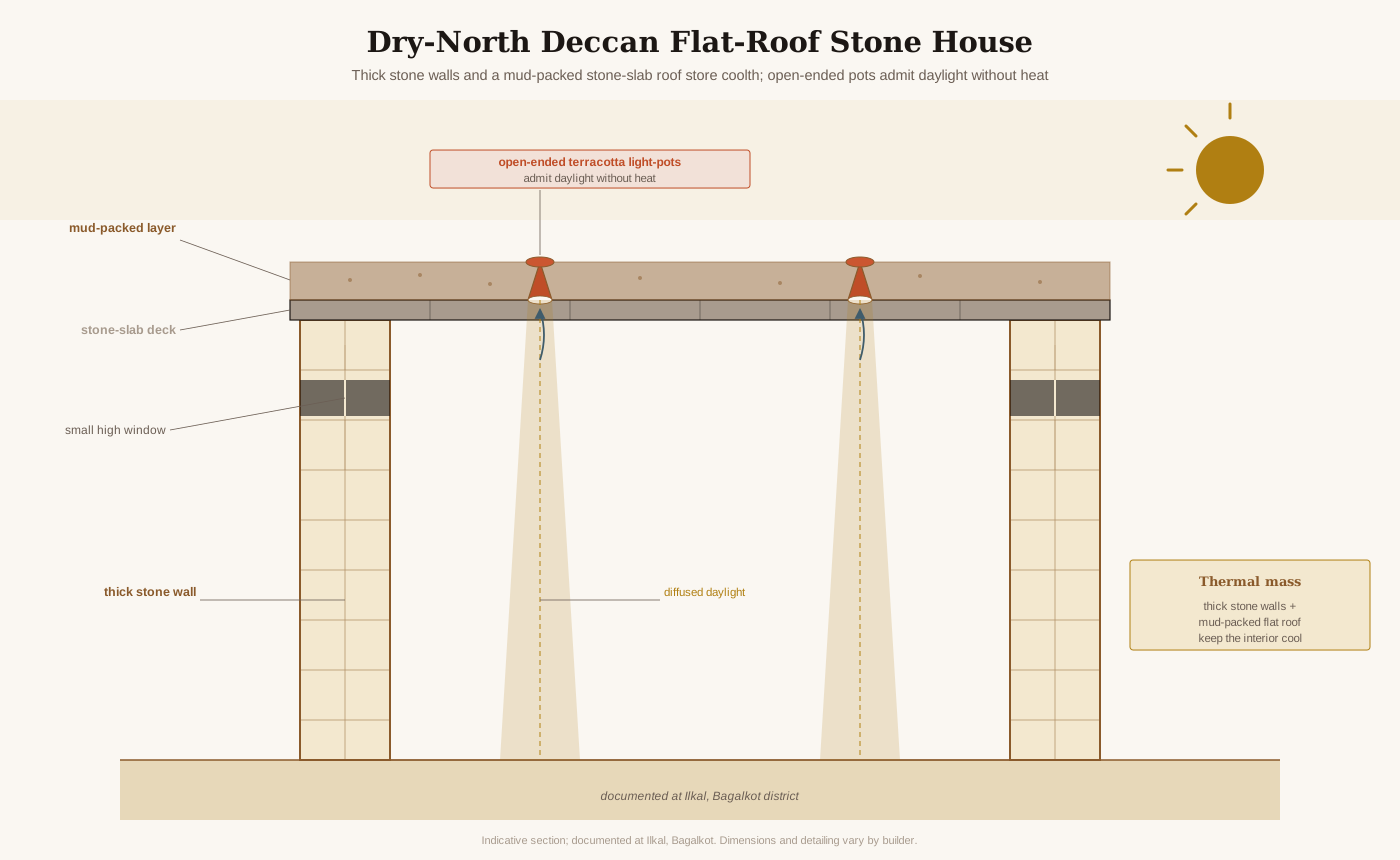
Where heat is the problem, the dominant element is the wall. Northern Deccan houses are built of heavy stone masonry and earth, with the flat roof itself a thick sandwich of stone slabs packed over with mud. This is high thermal mass doing its classic job: the thick walls and heavy roof absorb the day's heat slowly, keeping the interior cool through the afternoon, then release it slowly through the cold desert-edge night.
Openings are few and small — every window is a hole that lets heat in. The cleverness lies in how such a sealed, massive house is daylit at all. The answer, documented in the stone houses of Ilkal in Bagalkot district, is a quiet piece of vernacular genius: small open-ended terracotta pots set into the flat mud roof, acting as tiny rooflights that drop diffused daylight and a trickle of ventilation into the dim interior without opening the building to the sun's full glare.
| Climate response | Wet coast / Malnad | Dry northern Deccan |
|---|---|---|
| Dominant element | Steep tiled roof | Thick wall + flat roof |
| Roof | Hipped, steep, deep overhanging eaves | Flat: stone slabs packed with mud |
| Strategy | Shed water + ventilate | Thermal mass + shade |
| Daylight / ventilation | Open central courtyard | Small windows + roof terracotta light-pots |
| Plinth | Raised high above grade | Low; building hugs the ground |
| Openings | Few, small (rain) — court does the work | Few, small (heat) — mass does the work |
3. The Typologies: Totti Mane, the Guttu House & the Ilkal Stone House
Three signature dwelling types map onto the three climates. Each carries its own name in its own language, and each name is worth learning, because the name usually describes the plan.
3.1 Totti Mane — the courtyard house of the Malnad and Mysore interior
The Totti Mane (also written Thotti Mane) takes its name plainly: totti = courtyard, mane = house — literally "the house with a courtyard". It is the classic joint-family dwelling of the Malnad highlands and the inland Mysore region, organised around one or more open central courts. The court anchors family life: rooms for the several married brothers and their families open onto it, the verandahs around it carry the daily traffic, and the open square admits the light and air that a deep, rain-tight house would otherwise lack. The Totti Mane is the inland cousin of the coastal court house — the same courtyard logic, expressed in the timber-rich vocabulary of the Western Ghats.
3.2 The Guttu / Guthu house — the manor of the coastal Bunt landlords
On the Tulu coast, the grand version of the court house is the Guttu Mane or Guthu house — in Tulu, the "house of prestige" or "house of authority". These were not ordinary dwellings but the manors of the Bunt landlord community — families bearing surnames such as Shetty, Hegde and Rai — who held land and local power across Tulunadu. A Guttu house is a statement of standing as much as a shelter, and three features in particular announce that:
- The chowka — the inner courtyard, the open-to-sky heart of the house around which the rooms are arranged.
- The aanebaagilu — literally the "elephant door", the grand, oversized main entrance door, a threshold scaled to declare the household's importance.
- The daivakone — the dedicated spirit-shrine room, which houses the stones and seats of the family's daiva or bhuta (guardian spirit). In Tulu households the daivakone is not a decorative niche but the ritual centre of the home (more on this in section 6).
A Guttu house is therefore three things at once: a climate response (court, tiled roof, raised plinth), a social hierarchy made visible (the elephant door, the scale), and a sacred precinct (the daivakone).
3.3 The Ilkal stone house — the flat-roofed dwelling of the dry north
The dry-north counterpart is best represented by the stone houses of Ilkal in Bagalkot district. These are low, heavy, flat-roofed dwellings of stone-masonry walls and stone-slab-and-mud roofs — the antithesis of the soaring tiled coast house. Here there is no courtyard-as-lung and no steep roof; the architecture is one of mass, enclosure and the ingenious terracotta roof-pots that light the interior.
A crucial caution for students: the famous monuments of the northern Deccan — the Gol Gumbaz and the other great domed tombs and mosques of Vijayapura (Bijapur) — are Adil Shahi monumental Indo-Islamic architecture, the work of a sultanate court, not domestic vernacular. They belong to the region's context, not to its house-building tradition. When we speak of the dry-north vernacular, we mean the modest stone house of a place like Ilkal, not the imperial dome on the skyline.
| Typology | Region / climate | Name meaning | Signature features | Community / use |
|---|---|---|---|---|
| Totti Mane / Thotti Mane | Malnad & inland Mysore (wet, forested) | totti (court) + mane (house) | Central courtyard, timber framing, joint-family rooms | Inland joint families |
| Guttu / Guthu house | Coastal Tulunadu (humid, heavy monsoon) | "house of prestige / authority" | Chowka court, aanebaagilu (elephant door), daivakone shrine | Bunt landlord families |
| Ilkal stone house | Northern Deccan (hot-dry) | (place-name type) | Flat stone-slab + mud roof, thick stone walls, terracotta light-pots | Dry-plateau households |
4. Materials & Construction: Laterite, Timber, the Mangalore Tile — and Stone-and-Mud
If you want to tell a coastal Karnataka house from a Deccan one with your eyes closed, run your hand along the wall. The palette of materials is the clearest signature of all.
4.1 The wet west: laterite, timber and the Mangalore tile
Coastal and Malnad construction begins with laterite and stone for the plinths and lower walls — laterite being the iron-rich red rock that can be cut soft from the ground and hardens on exposure to air, the same workhorse stone that defines neighbouring Kerala. Above the plinth, the structure is carried by heavy timber posts and framing, drawing on the abundant forests of the Ghats; the carpentry tradition here is rich, and the timber columns, brackets and the great aanebaagilu doors are where craftsmanship is concentrated.
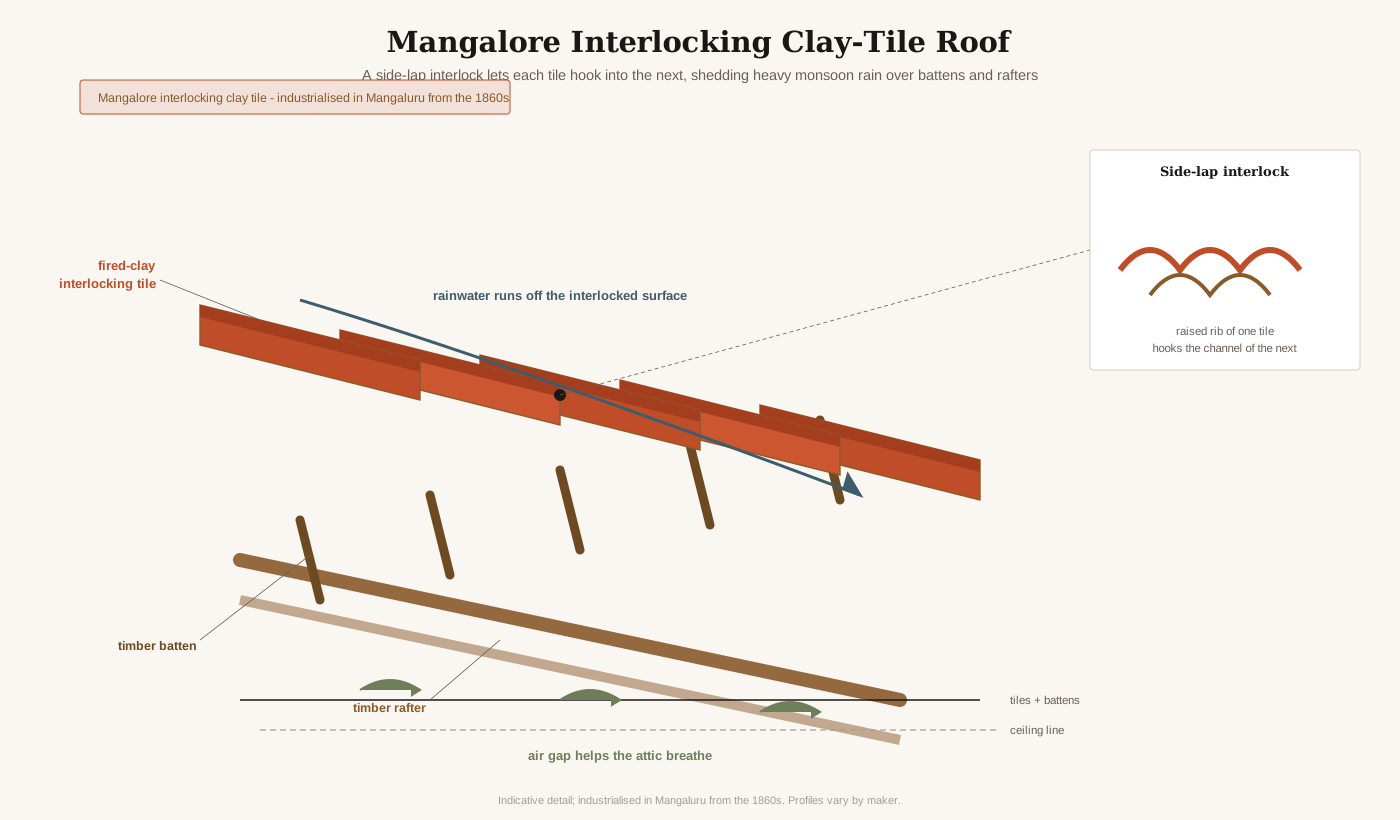
The crowning material — and the single most recognisable element of the entire western Karnataka skyline — is the Mangalore tile: the fired-clay interlocking roof tile that became an industry in Mangaluru. Its story is specific and worth telling correctly. The interlocking clay tile was industrialised in Mangaluru from the 1860s, with origins in the Basel Mission, whose tile factories turned the local clay into a standardised, machine-pressed product. From Mangaluru these tiles were exported across India and beyond, and the deep terracotta-red interlocking roof became the visual default not just of the Karnataka coast but of much of peninsular and even northern India. The interlocking profile is itself a piece of climate engineering — it sheds heavy rain reliably while the air gap beneath a tiled roof helps the attic breathe.
4.2 The dry north: stone, mud and the terracotta light-pot
The northern Deccan house is built from what the dry plateau gives: stone masonry walls and flat roofs of stone slabs packed with mud. There is little timber to spare and no monsoon to shed, so the roof is flat and massive rather than steep and light. The one refinement that lifts these houses out of pure utility is the small open-ended terracotta pot set into the roof — the light-and-air device documented at Ilkal — which lets a sealed, heat-resisting house admit a measured amount of daylight without surrendering its thermal advantage.
| Element | Wet coast / Malnad | Dry northern Deccan |
|---|---|---|
| Plinth / lower wall | Laterite, stone | Stone masonry |
| Structure | Heavy timber posts & framing | Load-bearing stone + earth |
| Roof | Mangalore interlocking clay tiles (steep, hipped) | Stone slabs packed with mud (flat) |
| Daylighting trick | Open central court | Terracotta roof light-pots |
| Craft focus | Timber columns, brackets, aanebaagilu doors | Stone masonry, mud roofing |
5. The Plan: Courtyard Logic on the Coast, Mass Logic on the Plateau
The way these houses are organised in plan and section is the climate response made into rooms.
5.1 The chowka and the introverted plan
A Guttu house or a Totti Mane turns its back on the street and faces inward, onto the chowka or totti — the central open court. The court is the organising void: the major rooms wrap around it, the verandahs running around its edge are the circulation and the living space, and the open square overhead delivers the light, the air and (on the coast) the rainwater that a deep house could not get any other way. The four roof slopes pitch inward toward the court, so that the building gathers the monsoon into its own centre and drains it away in a controlled channel — the opposite of a roof that throws water outward. This inward-draining, court-centred plan is one of the most elegant ideas in Indian domestic architecture: a single move that solves light, ventilation, social organisation and drainage at once.
5.2 The mass plan of the dry north
The Deccan stone house has no such void. Its logic is solid, not hollow: thick stone walls enclose compact, low rooms, and the flat stone-and-mud roof caps the whole as a continuous mass. Daylight is rationed through small openings and the roof light-pots rather than handed in through an open court. Where the coast house is a ring of rooms around a hole, the plateau house is a heavy block with cool, dim interiors hollowed into it.
6. The Life Inside: Matrilineal Households, the Guttu as Village Centre, and Spirit Worship
A Guttu house is impossible to understand as architecture alone, because its plan is the plan of a particular kind of family and a particular kind of belief.
6.1 Aliyasantana — the matrilineal joint family
The coastal Bunt community traditionally followed aliyasantana, a system of matrilineal descent and inheritance in which property and lineage passed through the female line — so a man's heirs were not his own children but his sister's children (the word literally invokes inheritance through the nephew/niece line). The Guttu house was the physical seat of such a matrilineal joint family: a large household of related kin living together around the chowka, its rooms expanding to hold the branches of the lineage. The scale of the great court houses — the many rooms, the generous verandahs — is the scale of an extended family that did not split into separate nuclear units. (Compare Kerala's marumakkathayam, the closely parallel matrilineal system that produced the tharavadu joint-family homestead — a striking case of two neighbouring coastal cultures arriving at similar architecture from similar social roots.)
6.2 The guttu as a unit of village administration
The Guttu house was not merely a private home; it was an institution. The leading Guttu households were seats of local authority and centres of village administration — by tradition something on the order of four guttus to a village — so the house functioned as a node of governance, justice and patronage for the surrounding land and people. The "house of authority" was authority's address.
6.3 The daivakone and bhuta / daiva worship
At the ritual heart of the Tulu house sits the daivakone, the spirit-shrine room. Tulu culture is famous for bhuta / daiva worship — the veneration of guardian spirits, expressed most spectacularly in the masked, costumed possession-dance ritual of the region. The daivakone within the Guttu house keeps the family's guardian-spirit stones and is the focus of this household devotion; the spirits are understood as protectors of the lineage and the land. To build a daivakone into the plan is to recognise that, for the Bunt household, the house was a sacred precinct as well as a dwelling — the lineage, the land and its protecting spirits all sheltered under one tiled roof.
The Guttu house gathered three things under one roof that we now keep apart: a family, a government office and a temple. Its architecture is the architecture of that gathering.
7. Notable Examples & Where to See Them
Much of Karnataka's domestic vernacular has been lost, but enough survives — in the field and in museums — to study it firsthand.
| Example / site | Where | What it is | Status / note |
|---|---|---|---|
| Surviving Guttu / Guthu houses | Tulunadu (Dakshina Kannada, Udupi) | Bunt landlord court houses with chowka, aanebaagilu, daivakone | Roughly 300 survive; many under pressure |
| Reconstructed Guthu house, Pilikula | Pilikula Nisargadhama (Heritage Village), Mangaluru | A Guthu house reconstructed for public study | Visitable — the best accessible introduction |
| Ilkal stone houses | Ilkal, Bagalkot district | Flat-roofed stone-and-mud dry-north dwellings with terracotta roof light-pots | The reference example of dry-north vernacular |
| Vijayapura (Bijapur) monuments | Northern Deccan | Adil Shahi domed tombs/mosques (e.g. Gol Gumbaz) | Monumental Indo-Islamic context only — NOT vernacular |
If you can visit only one place, make it the reconstructed Guthu house at Pilikula Nisargadhama near Mangaluru, where the chowka, the aanebaagilu and the daivakone can be walked through and read in three dimensions. To see the dry-north tradition, Ilkal in Bagalkot remains the touchstone for the flat-roofed stone house and its terracotta light-pots.
8. Decline & What Survives: Land Reform, RCC, and the Conservation Effort
The forces that hollowed out Karnataka's great houses were social and economic before they were architectural.
The first blow was land reform. The Guttu and Totti Mane were built for landed joint families; when land-tenure reforms redistributed holdings, the economic basis of the large landlord household eroded, and with it the means to maintain a manor of fifty rooms. The second blow was the breakup of the joint family itself — as aliyasantana and the extended household gave way to nuclear families, the very plan of the court house, sized for many married kin around one chowka, no longer matched how people lived. The third blow was reinforced cement concrete (RCC): the flat concrete slab became the universal modern roof, cheaper and quicker to maintain than a vast field of clay tiles, and old houses were demolished or remodelled in concrete. The same shift hollowed out the Mangalore-tile industry, which contracted sharply as RCC displaced the tiled roof it had defined for a century.
What survives, survives largely through documentation and museum reconstruction. The reconstructed Guthu house at Pilikula lets the public encounter the type intact. DakshinaChitra, the Madras Craft Foundation's heritage village near Chennai, has relocated and reconstructed South Indian vernacular houses for study. Bodies such as INTACH document and advocate for what remains in the field. None of this can replace a living tradition of joint families building court houses — but it keeps the knowledge legible for the architects and homeowners who will adapt it next.
| Driver of decline | Effect on the vernacular |
|---|---|
| Land reform | Eroded the landed-household economic basis of the Guttu / Totti Mane |
| Joint-family breakup | Court-house plan no longer matched nuclear living |
| RCC roofing | Demolition / remodelling; old tiled houses replaced |
| Mangalore-tile industry contraction | Loss of the craft and supply chain for the signature roof |
| Conservation response | Pilikula reconstruction; DakshinaChitra relocations; INTACH documentation |
What we should actually take from it
The lesson of Karnataka's vernacular is not to copy a Guttu house in a city plot — its scale and society are gone. It is to carry forward the principles that three climates taught these builders: pitch and overhang the roof where it rains hard; bring light and air through a court rather than a wall of windows; use mass and small openings where it is hot and dry; light a sealed interior cleverly rather than puncturing it; and let the materials of the place — laterite, timber, fired clay, stone — set the palette. For how to translate these moves into a contemporary plan, see Lessons from Vernacular for Modern Indian Homes, Tropical Architecture in India, and the worked plans in our house-plans library.
References & Further Reading
Foundational / Theory
- INTACH (Indian National Trust for Art and Cultural Heritage) — documentation and advocacy for India's built vernacular heritage.
- DakshinaChitra (Madras Craft Foundation) — heritage village near Chennai that relocates and reconstructs South Indian vernacular houses for public study.
Regional / Indian sources
- Sahapedia, "The Many Facets of Guttumanes of Tulunadu" — the best accessible study of the coastal Karnataka Guthu house, its chowka, aanebaagilu and daivakone, and the Bunt aliyasantana household.
- Field and museum reference: the reconstructed Guthu house at Pilikula Nisargadhama (Heritage Village), Mangaluru, and the surviving stone houses of Ilkal, Bagalkot, as primary built examples of the coastal and dry-north traditions respectively.
Companion Studio Matrx Guides
- Pillar: Indian Vernacular Architecture
- Southern siblings: Vernacular Architecture of Kerala · Vernacular Architecture of Tamil Nadu
- Thematic & applied: Why Vernacular Design Is Returning in India · Lessons for Modern Indian Homes · Tropical Architecture in India · Modern vs Traditional Indian House Architecture
- Explore further: /house-plans · /architects · /guides
Author's Note: I have always found Karnataka the most honest teacher of vernacular, precisely because it refuses to give you one answer. Walk west to east across the state and the house turns inside out — from a hollow ring of rooms around a sky-lit court that drinks the monsoon, to a solid block of stone that hoards the night's cool against the plateau sun. Neither is more "Kannadiga" than the other. Both are simply what an intelligent builder does when handed a specific sky. That, in the end, is the whole of vernacular: not a style to be copied, but an argument with the climate, won locally, every time. — Amogh N P
Disclaimer: Vernacular terms, spellings and datings vary across sources and across the regions of Karnataka; surviving examples and their conservation status change over time. This is an educational overview, not a survey document or a construction specification. Verify specific terms, dates and building details against the cited scholarship and against current field documentation before relying on them. No liability is assumed for decisions made on the basis of this article.
Export this guide
Related Guides — Deep-dive reading
Roofing for Heavy Monsoon Areas
Kerala, the Konkan coast, the Western Ghats and the North-East get some of the heaviest rain on earth. A plain-language, India-grounded guide to designing and detailing a roof that sheds it fast, throws it clear of the walls, drains it away and never lets it in.
RoofingIndian Vernacular Architecture: A Field Guide to the Architecture Without Architects
How to read India's anonymous, climate-tested, culture-shaped building — five climate zones, the local-materials palette, the great pan-Indian courtyard, and a region-by-region map of the tradition.
Vernacular ArchitectureJawahar Kala Kendra: How Charles Correa Turned a City's Horoscope into a Building
In Jaipur, Charles Correa organised a national arts centre as nine squares of the navagraha mandala — the same cosmic diagram that laid out the eighteenth-century city around it — then prised one square loose and hollowed out the centre. A study of the plan as argument: how an 'archaic notion of the Cosmos' became a working piece of contemporary civic architecture, and what its inward, fortress-walled world tells us about where architecture goes when it stops copying tradition and starts thinking with it.
The Future of ArchitectureRelated Tools — Try Free
Cross-Ventilation Analyzer
Estimate airflow and air changes per hour (ACH) from room size, window areas, layout, and local wind — with NBC 2016 Part 8 compliance check.
Ventilation CalculatorWindow Orientation Planner
Pick the best window type, glass and shading by wall direction — north, east, south and west.
Window ToolBrise-Soleil Visualizer
Interactive horizontal-louvre cut-off angle calculator — sun altitude, louvre depth, and spacing inputs with a live shadow preview. Computes θ = arctan(spacing/depth) for façade shading, ECBC envelope compliance, hospital daylight design, and tropical sun-control detailing.
Sun Shading Tool