
Vernacular Architecture of Tamil Nadu: Chettinad Mansions, the Agraharam & the Madras Terrace
How Tamil Nadu's hot-dry interior and hot-humid coast produced a mass-and-shade architecture of merchant palaces, temple streets, courtyards and beaten-lime roofs.
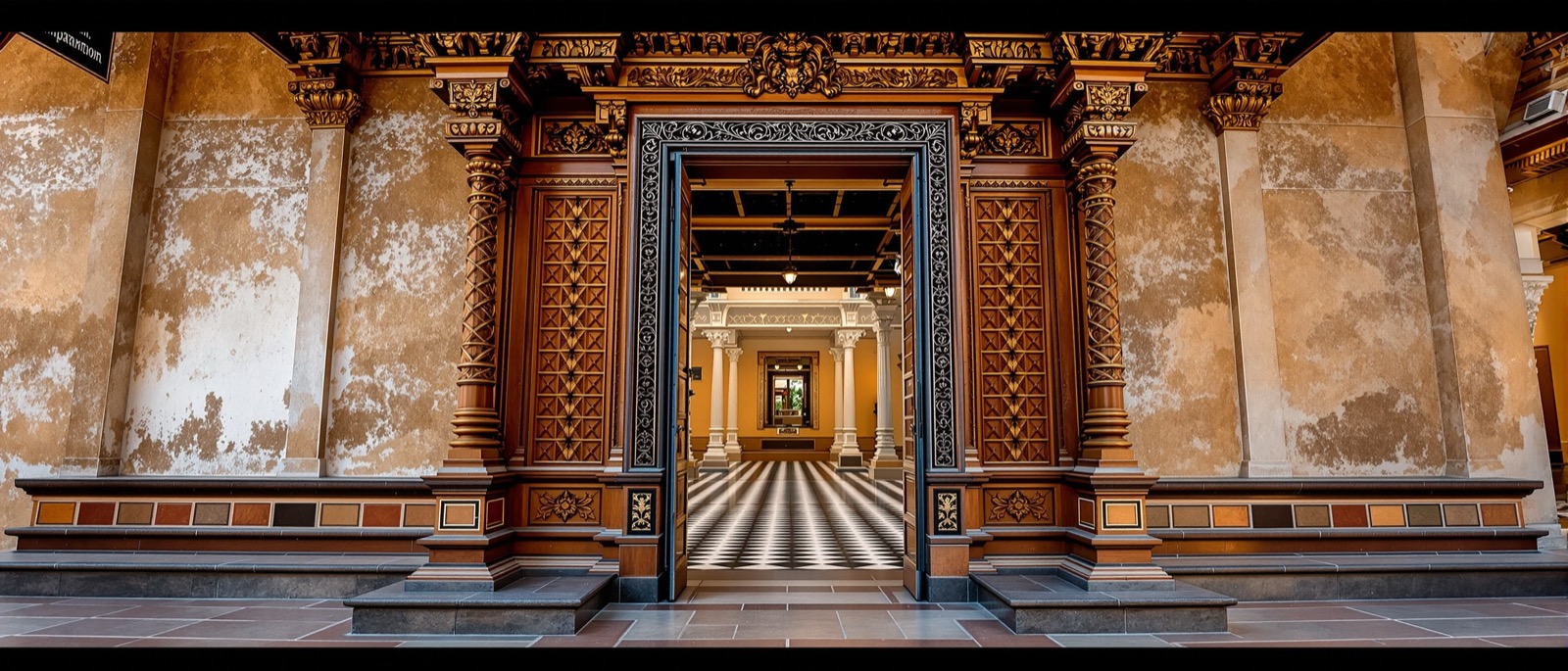
Walk into Kanadukathan at dusk and the street tells you everything before you reach a single door. The road is wide, dead-straight, lined on both sides by walls that rise like the flanks of small forts & meet the dust in long unbroken bands of lime-washed plaster. Then a gateway breaks the rhythm — a teak portal carved within an inch of its life, flanked by two raised stone platforms where the men of the house once sat to read the morning's accounts. Step through and the heat of the Sivaganga plain falls away. You are in a courtyard open to the sky, the floor a carpet of jewel-bright tiles, a colonnade of carved pillars running off into a sequence of further courts, each cooler and more private than the last. This is a Chettinad mansion: a merchant-banker's palace built on profits earned a thousand miles away in Rangoon & Penang, raised in the driest corner of Tamil Nadu, and engineered — every wall thickness, every shaded verandah, every sunken court — to defeat the sun.
Tamil Nadu's vernacular is the architecture of two climates and two great social worlds. Inland, on the hot-dry interior plains, the Nattukottai Chettiar merchants built mansions of enormous thermal mass & deep shade. Along the Kaveri delta and the temple towns, Brahmin communities laid out the agraharam — the ordered street-settlement that wraps itself around a temple. Both are courtyard architectures; both treat the flat Madras-terrace roof, the deep verandah and the internal court as instruments for managing heat, light & the monsoon.
Tamil vernacular is a mass-and-shade architecture: thick walls and thick flat lime roofs store the day's heat, while deep verandahs, internal courtyards and processional plans move air, light and rainwater through the house without ever letting the sun in.
This guide is for B.Arch students, teachers & homeowners who want to understand Tamil Nadu's domestic traditions accurately — the typologies, the materials, the climate logic & the social order that produced them. It is one of a regional series under our pillar, Indian Vernacular Architecture, and reads naturally alongside its southern siblings on Kerala & Karnataka. If you want the design takeaways for a contemporary home, pair it with Lessons for Modern Homes and Tropical Architecture in India.
A Chettinad mansion was never just a dwelling. It was a ledger written in teak & lime — every imported beam and tile a line of credit drawn on a trading empire that stretched from Karaikudi to Burma.
1. The Region & Its Two Climates
Tamil Nadu is not climatically of a piece, and its vernacular splits cleanly along that fault. To understand why a Chettinad mansion looks nothing like a coastal Chennai house, you have to start with the weather.
The interior plains — the dry Sivaganga belt where Chettinad sits — are hot and dry. Long fierce summers, intense direct sun, modest and unreliable rainfall. Here the design problem is heat: how to keep a large house cool through a punishing day without mechanical help.
The coast around Chennai (the old Madras) is hot and humid. The problem shifts from raw heat to humidity & the monsoon: moving air to carry away moisture, and shedding heavy seasonal rain.
| Sub-region | Climate | Core design problem | Vernacular response |
|---|---|---|---|
| Interior plains (Sivaganga / Chettinad) | Hot-dry | Intense heat, sparse rain | Massive walls, thick flat lime roofs, deep verandahs, internal courts |
| Coast (Chennai / Madras) | Hot-humid | Humidity, heavy monsoon | Cross-ventilation, deep shading, courtyards moving air; rainwater management |
What unites both responses is thermal mass & shade. Unlike Kerala's lightweight, steep-roofed timber houses that shed monsoon water fast (see the Kerala guide), Tamil Nadu's signature dwellings are heavy. They bank heat in dense walls & flat roofs by day and release it slowly by night, and they shade their occupants behind layers of verandah & court.
2. The Climate-Response Logic
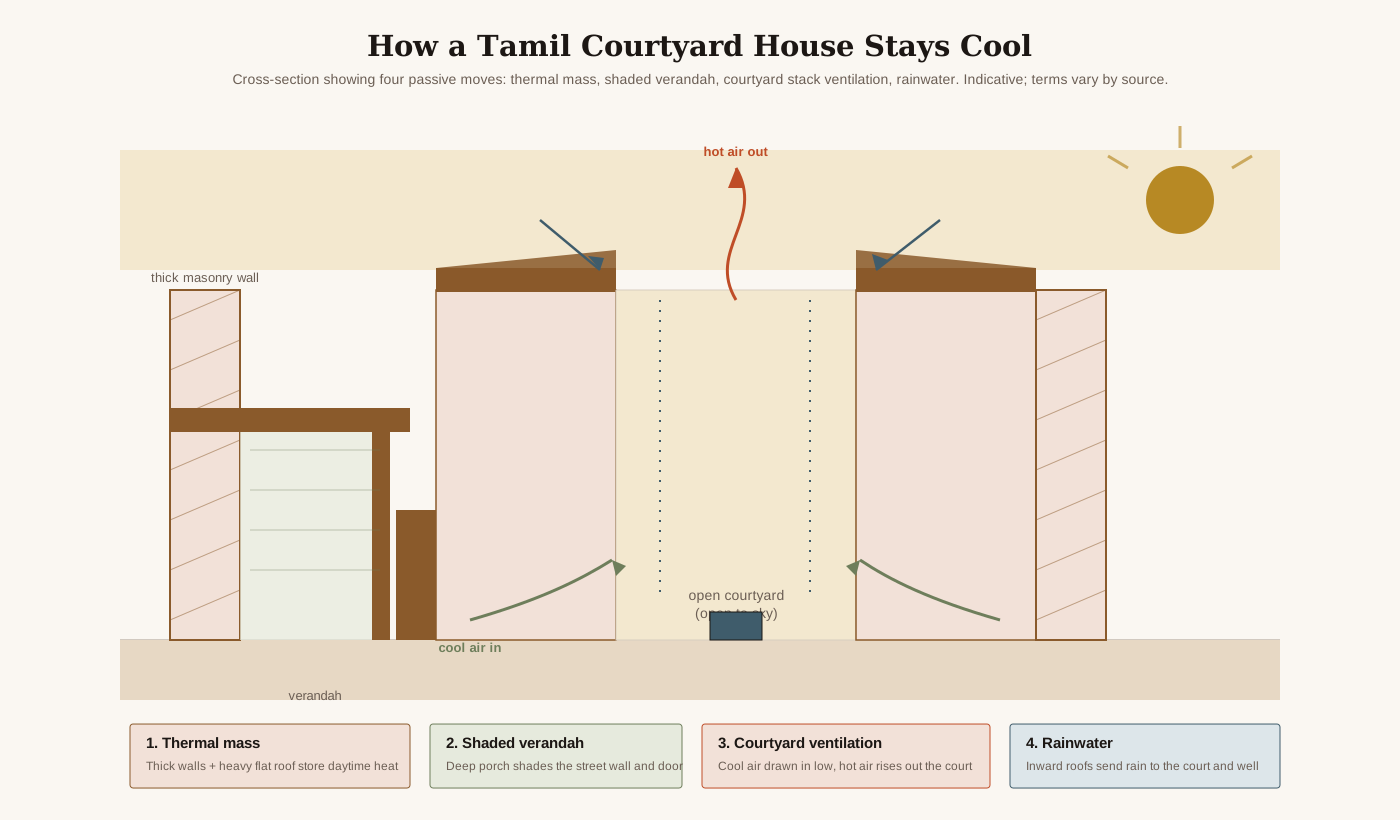
Before naming the typologies, it helps to see the toolkit the Tamil builder used. Four moves recur, and almost every feature of a Chettinad mansion or an agraharam house is one of them.
- Mass. Thick masonry walls and the heavy Madras-terrace flat roof — a slab of brick & lime concrete (described in detail below) — give the building enormous thermal inertia. The roof and walls soak up the day's heat slowly, keeping interiors cool through the hottest hours.
- The deep verandah. A shaded transitional zone wraps the public faces of the house. It keeps direct sun off the walls & doorways and gives the family a cool, open-air room.
- The internal courtyard. One or more courts open to the sky sit at the heart of the plan. They draw daylight & air deep into a house that presents almost blank walls to the street, and they drive ventilation: hot air rises out of the court while cooler air is drawn in from shaded rooms around it.
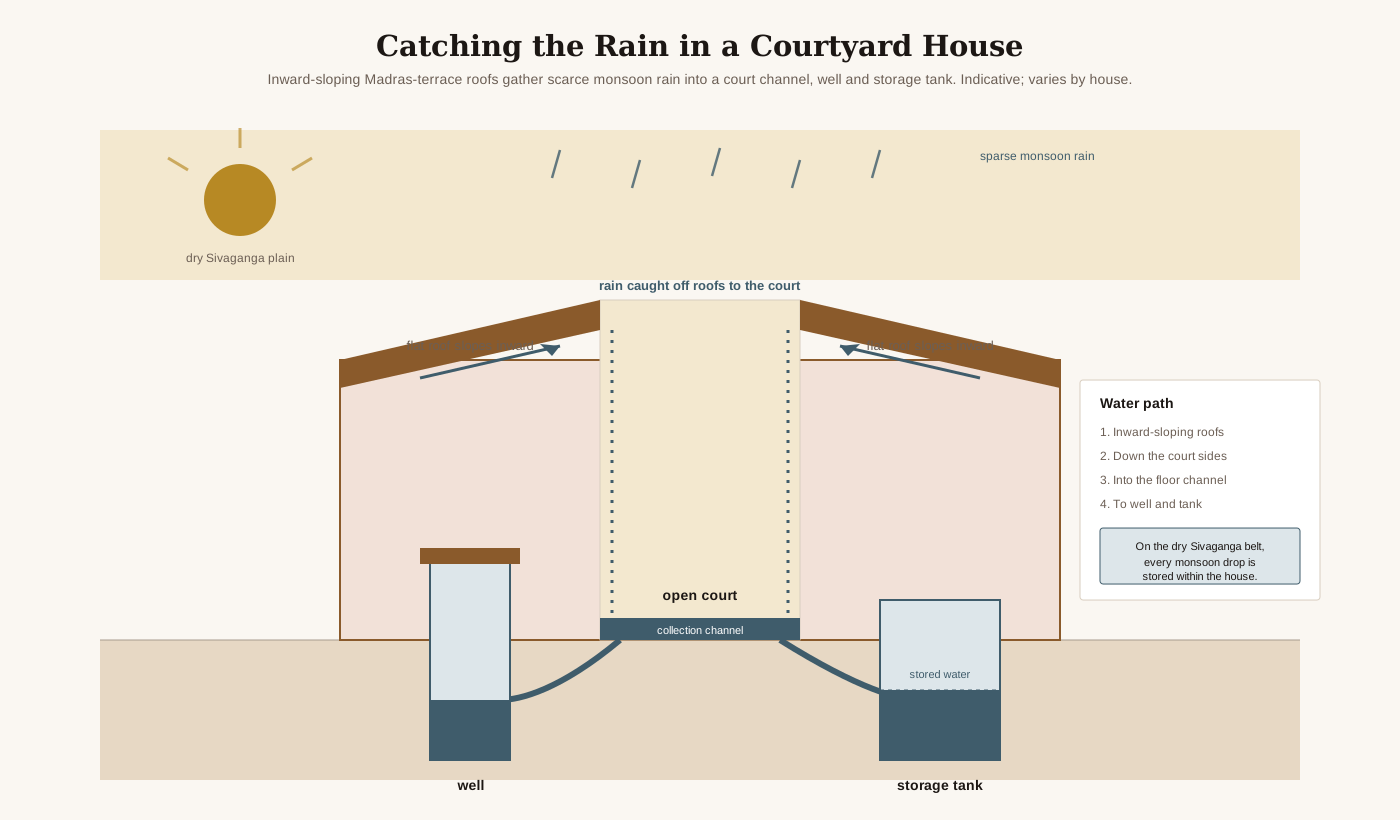
- Rainwater logic. The roofs slope inward to the courts; rain is gathered & channelled into wells & tanks rather than wasted — vital on the dry interior plains.
Look at any Tamil courtyard house in section and you see a single idea repeated: turn your back on the street and the sun, and open your heart to the sky.
3. The Signature Typologies
Tamil Nadu's domestic tradition centres on two very different building cultures: the mercantile Chettinad mansion and the ritual-ordered agraharam street. A handful of recurring elements — the thinnai, the mitham — stitch them to the wider South Indian courtyard family.
3.1 The Chettinad mansion
The Chettinad mansion is the house-type of the Nattukottai Chettiar — also known as the Nagarathar — a merchant-banker community whose trade & banking networks ran across Burma, Malaya & Ceylon in the colonial period. The name Nattukottai is often glossed as "fort on land" (natu = land/country; kottai = fort), and the mansions live up to it: from the street they read as fortified blocks, walls high & nearly windowless, presenting prestige and security to the world while reserving all openness for the interior.
These are not modest farmhouses scaled up. They are deliberately monumental statements of mercantile prestige & patrilineal joint-family standing, built largely between roughly 1850 and 1945 on wealth earned abroad. A large mansion could occupy close to an acre, hold fifty or more rooms across three or four courtyards, and run clear from one street to the next.
3.2 The agraharam
The agraharam is a Brahmin street-settlement: two parallel rows of row-houses, ideally aligned north–south, with a temple closing one end of the street. The whole arrangement is sometimes described as a "garland around the temple" — the houses garland the deity, and ritual life flows along the single shared street. Agraharams were granted to Brahmin communities by ruling dynasties — Chola, Pallava, Pandya, and later Maratha rulers — as caste-quarters tied to temple service.
Where the Chettinad mansion is a freestanding palace, the agraharam house is a unit in a tightly ordered terrace: narrow-fronted, deep, sharing party walls with its neighbours, its life organised around the street & the temple at its head.
3.3 The shared elements: thinnai & mitham
Two terms recur across Tamil houses & deserve glossing once and for all.
- Thinnai — a raised masonry platform or porch flanking the front door, a semi-public threshold between street & home. It is where guests are received, where business is transacted, where elders sit to watch the street. In a Chettinad mansion the thinnai is a grand pair of platforms beside the carved portal; in humbler houses it is a simple bench-like ledge.
- Mitham — the central open court of an agraharam house; the same courtyard idea that the Chettinad mansion deploys at much larger scale and multiple times over.
| Typology | Community | Form | Key feature | Glossed terms |
|---|---|---|---|---|
| Chettinad mansion | Nattukottai Chettiar (Nagarathar) | Freestanding fort-like block, multiple courts | Deep axial plan, ~1 acre, 50+ rooms | Nattukottai ("fort on land"); thinnai (porch platform) |
| Agraharam house | Brahmin (temple community) | Row-house in a two-row street, temple at end | Shared street, temple focus, central court | Agraharam (street-settlement); mitham (central court) |
4. Materials & Construction
Tamil Nadu's two house-cultures sit at opposite ends of a spectrum. The agraharam house is built of local masonry & lime in a regional idiom. The Chettinad mansion is famously, almost defiantly, cosmopolitan — a building assembled from the spoils of a global trading life.
4.1 The cosmopolitan palette of Chettinad
The Nagarathar merchants imported the finest materials their trade routes could supply, and the mansions became showcases of that reach:
- Burma teak for columns, beams, doors & the elaborate carved portals — shipped from the very lands where the family fortunes were made.
- Ceylon satinwood for fine joinery.
- Italian & Belgian marble for floors and surfaces.
- Belgian glass and chandeliers for the formal halls.
- Imported tiles alongside locally made ones.
And against all this imported splendour, one proudly local material: the Athangudi tile.
4.2 Athangudi tiles
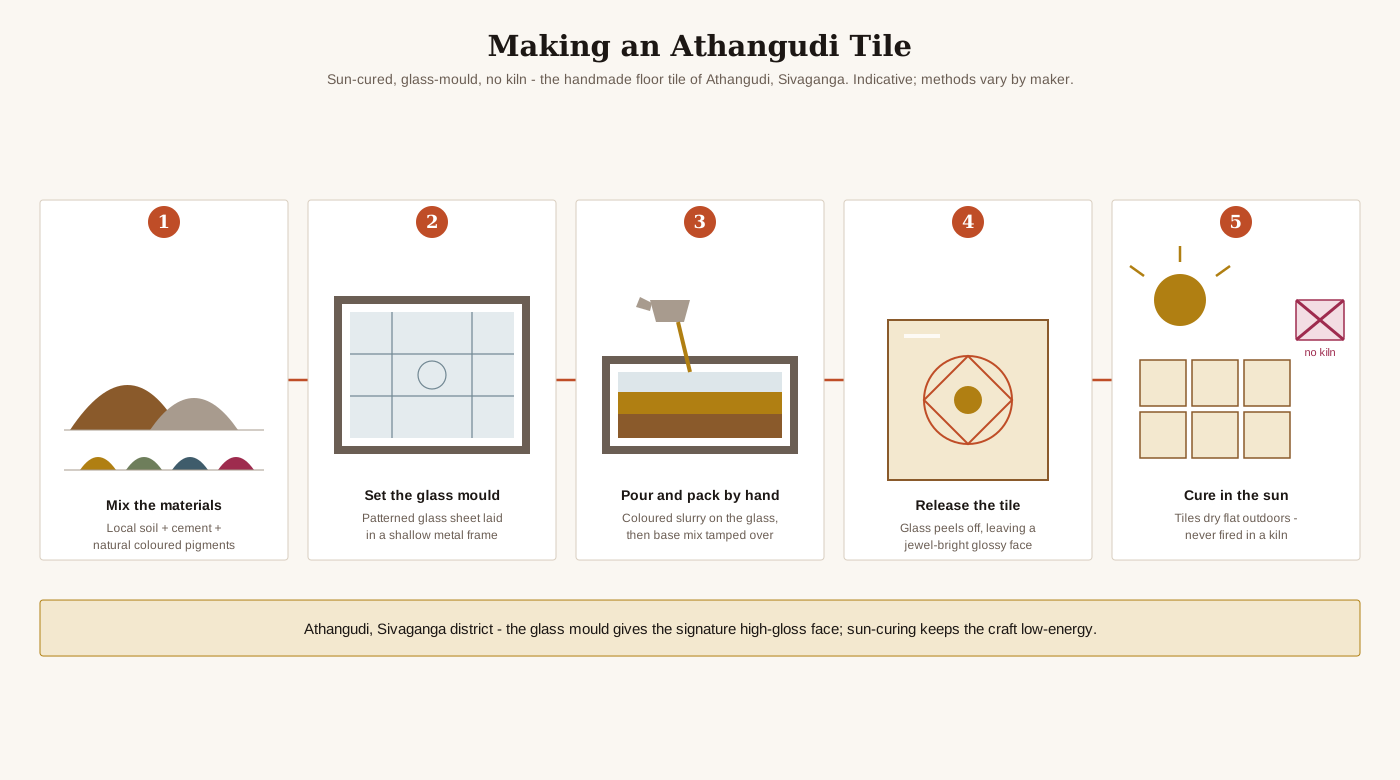
Athangudi tiles are hand-cast floor tiles made in Athangudi village in Sivaganga district. They are made from local soil mixed with cement & natural pigments, cast by hand against a patterned glass mould that gives the finished tile its characteristic glossy, jewel-bright surface, and then sun-cured rather than kiln-fired. Because there is no firing, the process is low-energy & entirely artisanal; each tile carries the slight irregularity of the hand. The result is the riotous, colourful flooring that is the visual signature of Chettinad interiors.
4.3 The Madras terrace roof
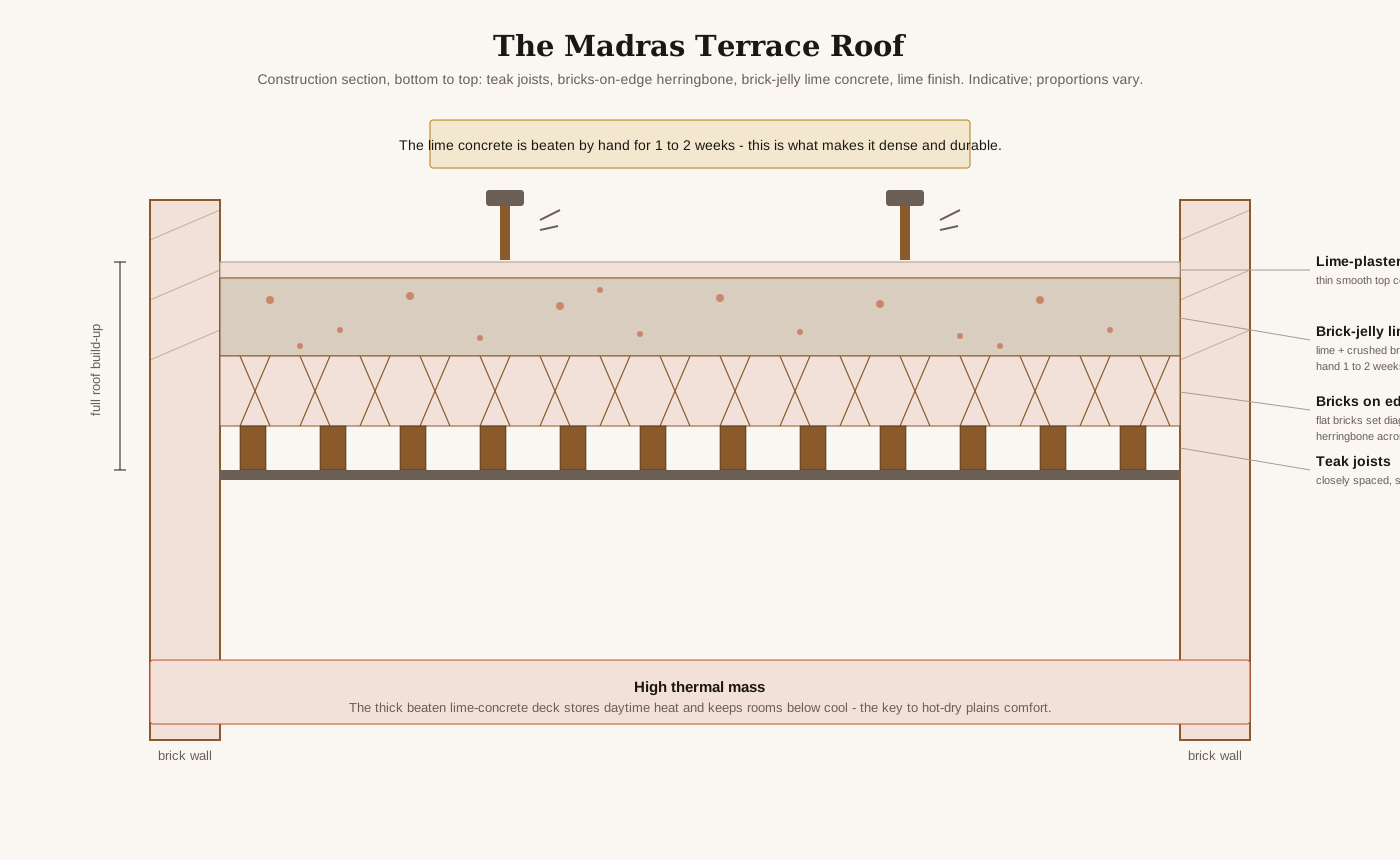
The flat roof that defines so much Tamil building is the Madras terrace roof, and its construction is a small marvel of pre-industrial engineering. Closely spaced teak joists span the room. Across them, flat bricks are laid on edge, diagonally, in a herringbone pattern. Over this brick bed goes a thick layer of brick-jelly lime concrete (lime mixed with crushed brick), which is beaten by hand for one to two weeks to compact it into a dense, water-resistant mass. A final coat of lime plaster finishes the surface. The labour is enormous, but the result is a heavy, durable, weatherproof flat roof with the thermal mass to hold off the interior heat.
4.4 Madras chunnam
The walls & finest surfaces were dressed in Madras chunnam — a fine, polished shell-lime plaster, burnished to an almost marble-like sheen. It is the lime finish that gives old Madras & Chettinad walls their smooth, luminous quality.
| Material / element | What it is | Origin | Role |
|---|---|---|---|
| Burma teak | Hardwood timber | Imported (Burma) | Columns, beams, carved portals |
| Italian / Belgian marble | Stone flooring | Imported (Europe) | Formal floors & surfaces |
| Belgian glass | Glass & chandeliers | Imported (Belgium) | Lighting, formal halls |
| Athangudi tiles | Hand-cast cement-and-glass-mould tiles | Local (Athangudi village, Sivaganga) | Colourful sun-cured floor tiles |
| Madras terrace roof | Teak joists + diagonal bricks + beaten brick-jelly lime concrete + lime plaster | Local | Heavy, weatherproof flat roof with high thermal mass |
| Madras chunnam | Polished shell-lime plaster | Local | Smooth, luminous wall & surface finish |
5. Plan, Court Sequence & the Rainwater Logic
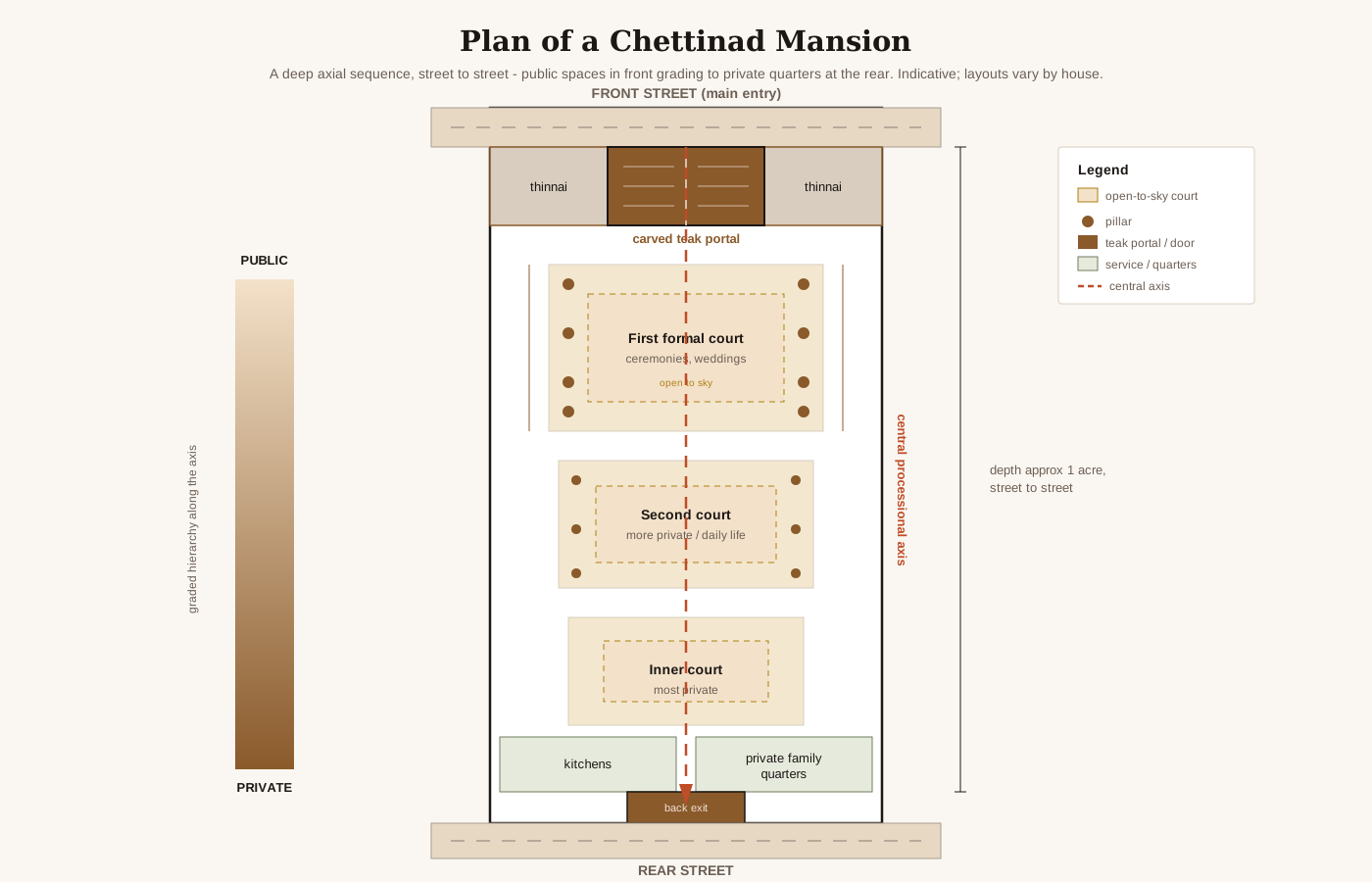
The genius of the Chettinad mansion is in its plan — a long, deep, axial and processional layout that turns the simple act of entering into a graded journey from public to private.
You begin in the street. You step up onto the thinnai, the raised threshold platform. You pass through an ornate carved portal of Burma teak. And then you enter a sequence of courtyards, one behind another, strung along the central axis and flanked by pillared halls.
The hierarchy is precise. The first court is the most formal — the grandest, most ornamented space, reserved for weddings & ceremonies, where the family displayed its wealth to the wider community. Move deeper and the courts become more private & domestic, the pillared halls giving way to family rooms, with the kitchens & private quarters at the rear. A great mansion runs street-to-street, so that the processional axis pierces the entire block.
This courtyard sequence does double duty. Socially, it choreographs the move from public reception to family privacy. Climatically, each open court is a light-well & ventilation chimney, drawing air & daylight into the deep plan.
And the courts manage water. On the dry Sivaganga plain, rain is precious. The roofs slope inward so that the monsoon is gathered off the terraces & channelled — through the courts — into wells & tanks within the house. The same court that cools the house in summer harvests its water in the rains.
6. The Social Life of the House
Architecture this deliberate is always a social diagram, and Tamil Nadu's two house-cultures encode two very different orders.
6.1 The Chettinad mansion: mercantile, patrilineal
The Chettinad mansion is the architecture of the Nagarathar trading & banking community, whose menfolk ran financial & commercial operations across Burma, Malaya & Ceylon. The house is the seat of a patrilineal joint family & a permanent statement of mercantile prestige. Its grandeur is partly competitive display — wealth earned abroad, brought home & built into teak, marble & tile — and partly functional: the great first court hosted the weddings & ceremonies through which the community renewed its bonds. The house was the family's anchor while its men were scattered across the trade routes.
6.2 The agraharam: caste-quarter, ritual order
The agraharam encodes a different logic entirely: the ritual order of a Brahmin caste-quarter clustered around a temple. The settlement was granted by ruling dynasties — Chola, Pallava, Pandya, Maratha — to Brahmin communities tied to temple service, and its single shared street, aligned to the temple at its head, organised a communal religious life. Where the Chettinad mansion turns inward to a private family, the agraharam turns its shared street toward the deity.
7. Notable Examples & Settlements
Tamil Nadu's vernacular survives in a handful of towns & villages where you can still read these traditions in the fabric.
| Place | District / region | What survives | Significance |
|---|---|---|---|
| Karaikudi | Sivaganga | Chettinad mansions, many now heritage hotels | Core Chettinad heritage town |
| Kanadukathan | Sivaganga | Grand Chettinad mansions | Core Chettinad heritage town |
| Athangudi | Sivaganga | Living tile-making craft | Home of the Athangudi tile |
| Kumbakonam | Kaveri delta | Agraharam streets | Temple-town Brahmin settlements |
| Thanjavur | Kaveri delta | Agraharam streets | Temple-town Brahmin settlements |
Karaikudi & Kanadukathan in Sivaganga district are the core Chettinad heritage towns; their mansions are increasingly conserved as heritage hotels, which has given many of them a second life. Athangudi village keeps the tile craft alive as a working tradition. And in the Kaveri delta, the temple towns of Kumbakonam & Thanjavur preserve the agraharam street-form around their great temples. For house-plan ideas drawn from courtyard logic, see our house-plans library.
8. Decline & What Survives
The Chettinad mansions were built on a colonial-era trading economy, and when that world contracted, so did the means to sustain the houses. Of the more than ten thousand Chettinad mansions raised between roughly 1850 and 1945, an estimated thirty percent have been destroyed and only around ten percent adaptively reused. The reasons are familiar & human: inheritance disputes fragment ownership of houses built for undivided joint families, and the sheer upkeep cost of an acre of teak, marble & beaten-lime roof is beyond most descendants. Many mansions were stripped of their carved teak & tiles, which were sold off.
The agraharams faded for a different reason: as Brahmin families migrated to cities & abroad through the twentieth century, the streets simply emptied, leaving rows of shuttered houses around temples whose ritual communities had dispersed.
| Tradition | Scale | Loss | What survives |
|---|---|---|---|
| Chettinad mansions | ~10,000+ built (c.1850–1945) | ~30% destroyed | ~10% adaptively reused (heritage hotels) |
| Athangudi tile craft | Village-based | Industrial flooring competes | Living craft, still produced by hand |
| Agraharams | Temple-town streets | Emptied by migration | Surviving street-forms in delta towns |
Yet the tradition is not dead. Adaptive reuse as heritage hotels has saved a slice of the Chettinad mansions and made them economically viable again. The Athangudi tile craft survives as a living, hand-made tradition — and has found new admirers among architects seeking low-energy, characterful flooring. And Tamil Nadu's Chettinad has been recognised on the UNESCO World Heritage tentative list, a step toward fuller protection. The lessons — thermal mass, deep shade, the cooling court, the harvested raindrop — are precisely the ones a warming India needs to relearn; see Why Vernacular Design Is Returning to India and Modern vs Traditional Indian House Architecture.
References & Further Reading
Foundational / Theory
- INTACH (Indian National Trust for Art & Cultural Heritage) — documentation & conservation advocacy for India's built vernacular, including Chettinad.
- DakshinaChitra (Madras Craft Foundation), Chennai — a living-history museum that has documented & relocated South Indian vernacular houses, a key public resource on Tamil domestic building.
Regional / Indian sources
- Documentation of the Chettinad mansions & their building traditions (Nattukottai Chettiar / Nagarathar heritage; the UNESCO tentative-list nomination materials).
- Studies of the Athangudi tile craft of Sivaganga district — its materials, glass-mould casting & sun-curing process.
- Surveys of agraharam settlement form in the Kaveri delta temple towns of Kumbakonam & Thanjavur.
Companion Studio Matrx Guides
- Pillar: Indian Vernacular Architecture
- Regional siblings: Kerala · Karnataka
- Thematic: Why Vernacular Design Is Returning to India
- Related: Lessons for Modern Homes · Tropical Architecture in India · Modern vs Traditional Indian House Architecture
- Sections: House Plans · Architects · Guides
Author's Note: I keep returning, in my mind, to that beaten-lime roof — one to two weeks of hands rhythmically compacting brick-jelly until it becomes a single waterproof stone. There is no machine in it, only patience, climate sense & a community's surplus. The Chettinad mansion was extravagant, yes, but its extravagance was spent on the right things: mass against the heat, courts for air & light, wells to catch the rain. We air-condition our way around problems these houses solved with geometry & lime.
Disclaimer: Vernacular terms, spellings & datings vary across sources and regions; named examples and their conservation status change over time. This is an educational overview — verify specifics against the cited scholarship & primary documentation before relying on them for design, conservation or academic work. No liability is assumed for decisions taken on the basis of this article.
Export this guide
Related Guides — Deep-dive reading
The Madras Terrace Roof: The Flat Roof That Built Old South India
The distinctive lime-brick-and-timber flat roof of Tamil Nadu and old South India - closely spaced timber joists, flat bricks laid on edge across them, a beaten lime-concrete topping and a smooth lime finish. How it was built, why it stays cool, and how to live with, repair or conserve one today. Plain language, India-grounded.
RoofingCharles Correa's Façade Signature: How India's Master Made the Climate-Correct Wall
How Charles Correa eroded the flat sealed wall into deep, shaded, porous layers — verandahs, terraces, pergolas and open-to-sky courts — so the Indian façade filters sun and drives air instead of sealing it out.
Building FacadesFrom Space to Place: Turning Empty Rooms into a Home
How to transform a bare builder flat into a warm, lived-in home — through scale, zones, layering, retreat corners and flow
Design EducationRelated Tools — Try Free
Cross-Ventilation Analyzer
Estimate airflow and air changes per hour (ACH) from room size, window areas, layout, and local wind — with NBC 2016 Part 8 compliance check.
Ventilation CalculatorHome Building & Interior Cost Calculator — 20 Cities
Construction + interior costs for 20 Indian cities across kitchen, wardrobes, flooring, painting, ceiling.
Cost CalculatorRainwater Tank Sizer
How big should your rainwater tank be? Computes annual harvest, recommended tank capacity in litres, water-bill savings, and payback — for 10 Indian cities.
RWH Calculator