
Vernacular Architecture of Rajasthan: The Haveli, the Jharokha & Building for the Desert
How thick stone walls, inward courtyards, jharokhas and jaali screens turned the brutal heat and cold of the Thar into a liveable home.
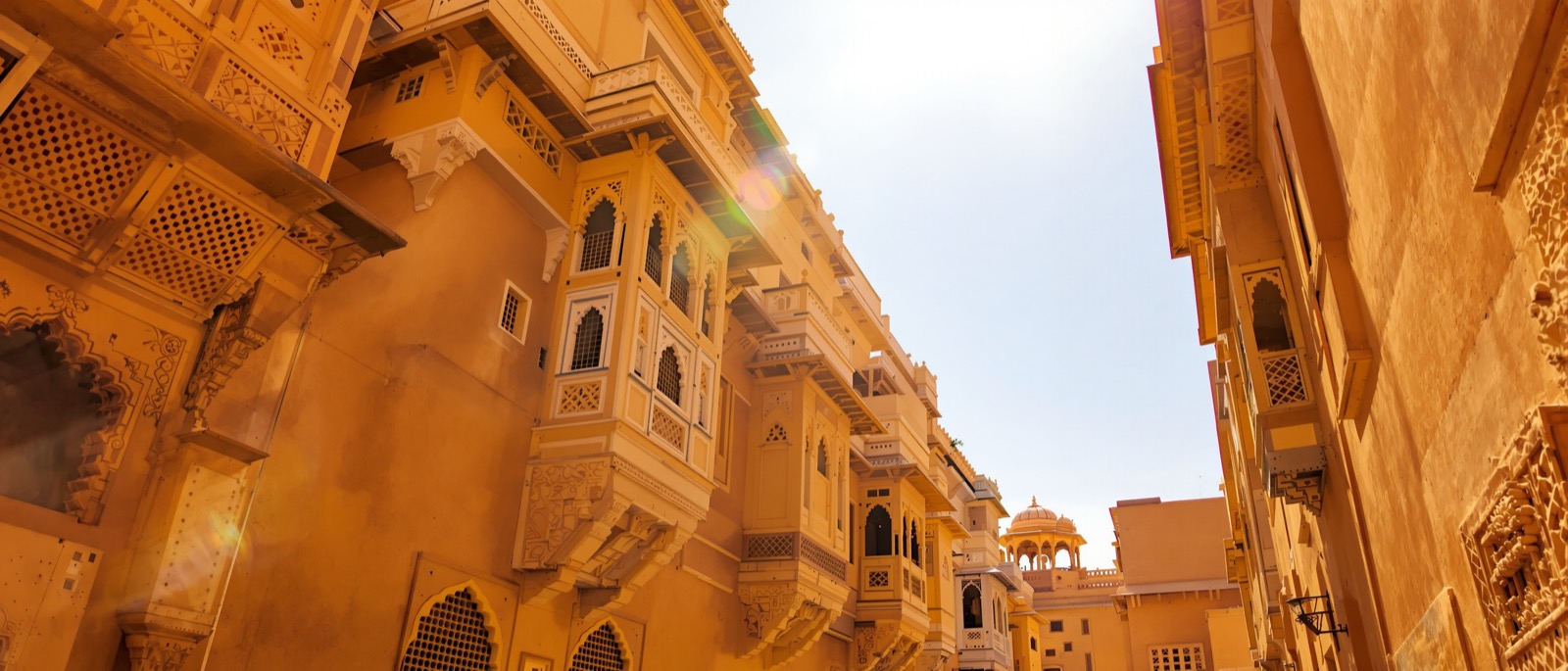
Stand in a lane of old Jaisalmer at noon and the first thing you notice is the silence of the heat — and then the shade. The street is narrow, barely wide enough for two laden camels to pass, and the tall walls of golden sandstone lean toward one another so that the sun reaches the ground only for an hour at midday. Step through a carved doorway and the temperature seems to drop without anyone having spent a watt of electricity. You are inside a haveli, a courtyard mansion, and the cool air pooling in its chowk (courtyard) is the residue of last night's cold, stored in walls thick enough to outwit the desert.
This is the central insight of Rajasthani vernacular architecture: in a land of brutal sun, scarce water, and a temperature that can swing thirty degrees between afternoon and dawn, the building itself becomes the climate machine. Not by trapping coolness — nothing stays cool for long in the Thar — but by being heavy enough, shaded enough, and introverted enough to lag a full half-day behind the weather outside.
The vernacular house of Rajasthan is a desert survival manual written in stone, mud, lime, and shadow — a high-mass, inward-turning, self-shading instrument tuned to the extreme diurnal swing of an arid land.
This guide is for the B.Arch student trying to understand desert building science, the homeowner curious about why Jodhpur is blue and Jaisalmer is gold, and the designer who wants to borrow from this tradition honestly rather than decoratively. We will move from the climate to the response, through the great typologies — the haveli, the jharokha, the jaali, the chhatri — to the materials, the plan, the social life of the house, and the real settlements where you can still see all of it standing. It sits within our broader survey of Indian vernacular architecture; read it alongside its arid-west sibling, the vernacular architecture of Gujarat, and the contrasting humid traditions of Kerala.
In the desert, a wall is not a divider. It is a battery — charging with cool at night, holding back the heat by day.
1. The Region & Its Climate: Living in the Thar
Rajasthan is India's largest state, and its built character is shaped almost entirely by aridity. The land runs along a gradient. In the far west — Jaisalmer and Barmer — lies the hot-arid heart of the Thar desert: searing sun, dust-laden winds, and rainfall so meagre that water, not land, is the limiting resource. Move east into the Marwar belt around Jodhpur, and into the Shekhawati region of the north, and the climate softens into hot semi-arid — still ferociously hot, but slightly less absolute.
What unites the whole region is not just heat but the extreme diurnal swing. A summer day can be punishing, yet the same desert night can turn genuinely cold, because dry air holds little heat once the sun is gone. This single fact drives almost every design decision that follows. A building here does not need to reject heat the way a humid coastal house sheds rain; it needs to store and delay, smoothing the violent daily oscillation into something the body can live with.
| Climate factor | Desert condition | Architectural consequence |
|---|---|---|
| Solar radiation | Intense, near-vertical sun | Self-shading masses, narrow streets, deep openings |
| Diurnal swing | Hot days, cold nights | High thermal mass to lag and store |
| Rainfall | Very low | Flat/terraced roofs; water harvesting and storage |
| Wind | Hot, dust-laden | Small recessed openings; filtered with jaali |
| Glare & dust | High | Lattice screens, limewash, shaded courts |
The desert, in short, punishes the lightweight and the exposed. It rewards mass, shade, and introversion — and Rajasthani builders learned this over centuries.
2. The Climate-Response Logic: How the Desert House Stays Liveable
Before we name a single building type, it is worth understanding the physics, because every typology that follows is simply this logic made visible.
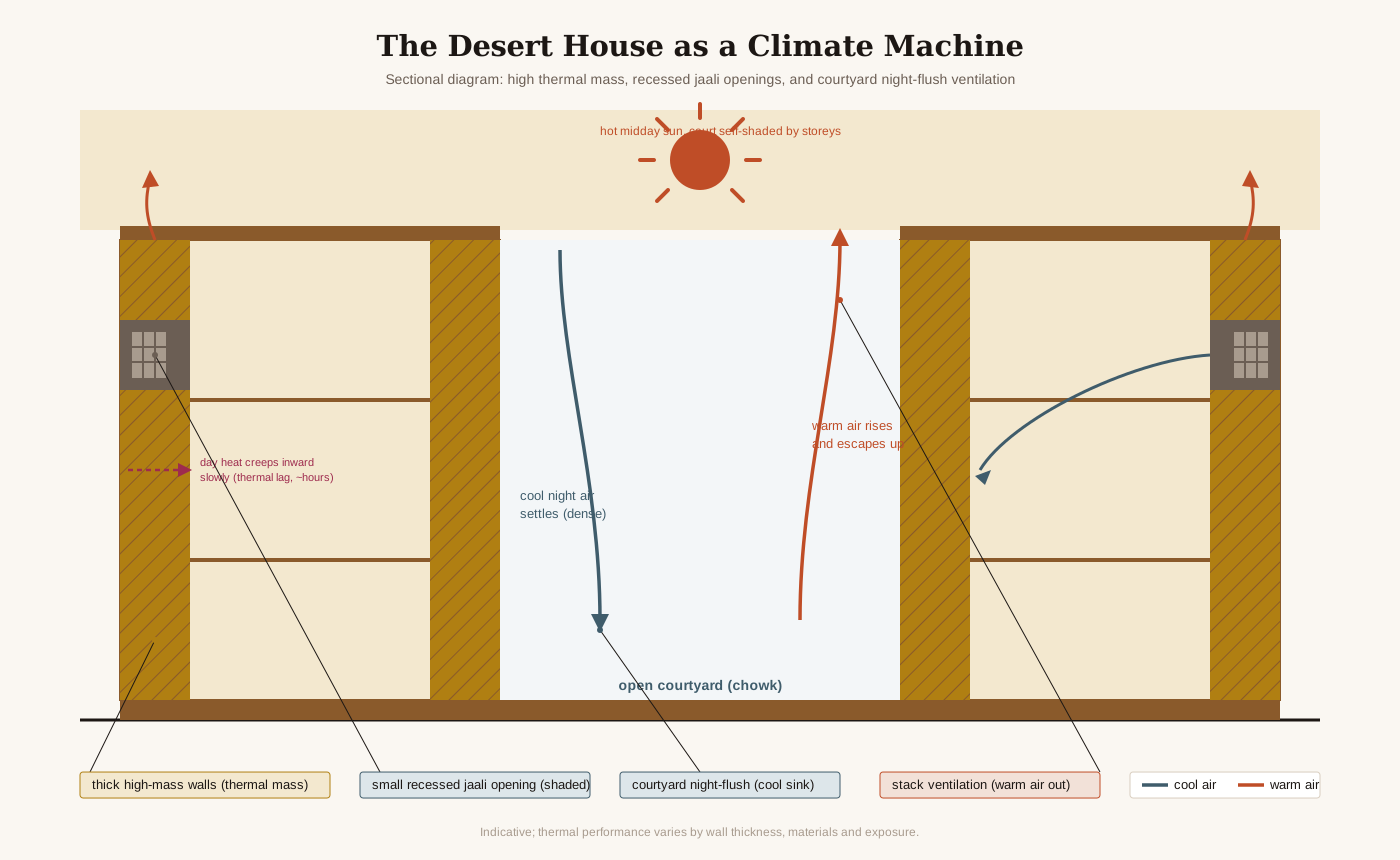
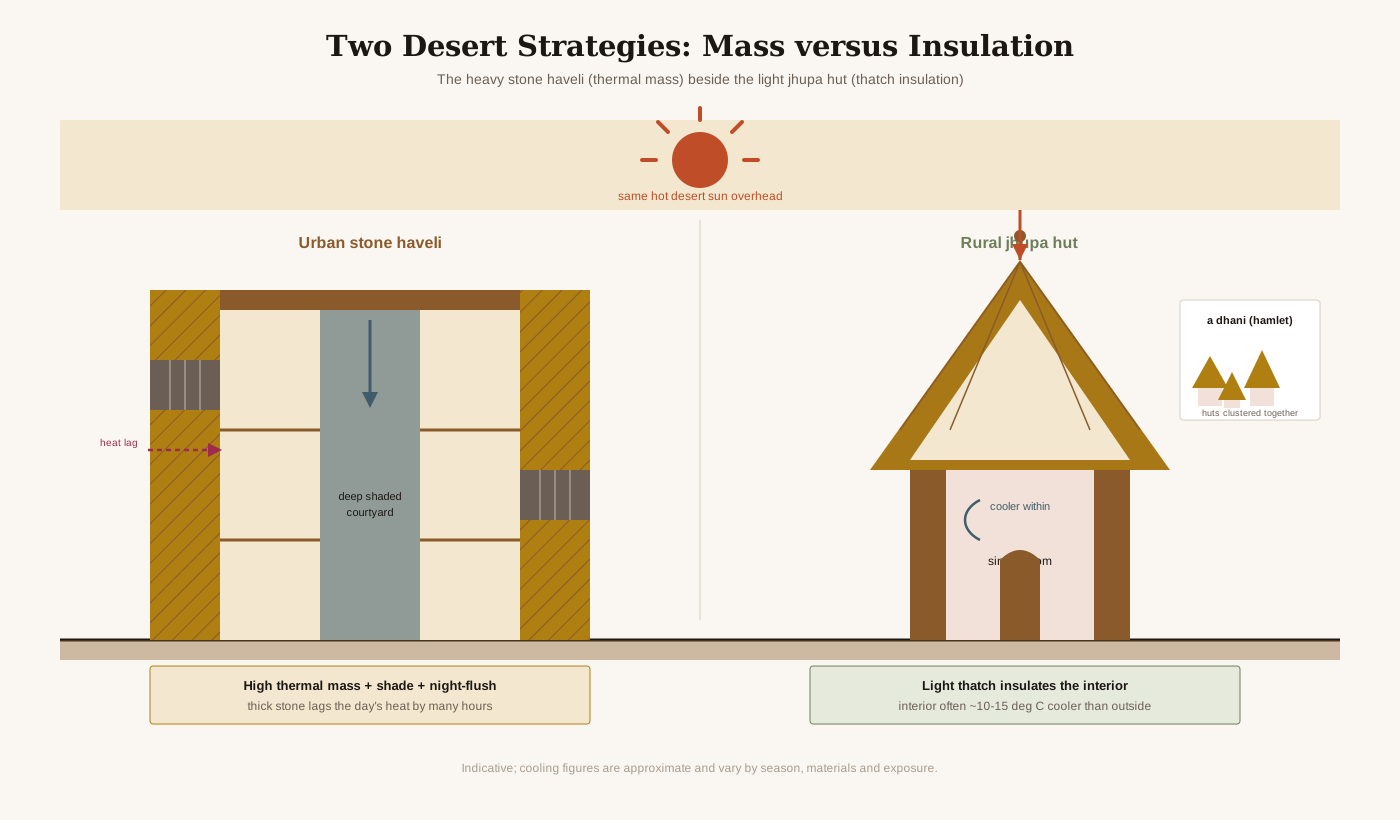
High thermal mass. Thick masonry or mud walls absorb the day's heat slowly and release it slowly. By the time the stored heat works its way through a wall a half-metre thick, the cool of evening has arrived to flush it away. The wall acts as a thermal flywheel, and the interior never experiences the peaks and troughs that the outdoor air does.
Small, recessed, shaded openings. Windows are kept small and set deep into the wall, so the opening is in shadow for most of the day. Where larger apertures are needed for air and light, they are screened — which brings us to the jaali.
Self-shading masses and narrow streets. Houses are built tall and close, so that buildings shade one another and shade the lanes between them. A narrow Jaisalmer street is, in effect, an outdoor room kept in shadow by its own walls.
The courtyard as a night-flush engine. The internal courtyard, or chowk, is the heart of the system. By night, cool dense air settles into the open court and into the rooms around it; the heavy walls give up their stored heat to the night sky. By day the court is shaded by its own surrounding storeys, and the cool air lingers low. The court also drives stack ventilation — warm air rising and escaping upward draws cooler air through the rooms.
Light surfaces. Pale stone and limewash reflect solar radiation rather than absorbing it — the reason the desert cities read as gold and white and blue rather than dark.
| Strategy | Mechanism | Comfort outcome |
|---|---|---|
| High thermal mass | Heat stored, released ~12 hrs later | Indoor temperature lags & flattens |
| Courtyard night-flush | Cool air settles after dark | Morning interior stays cool |
| Stack ventilation | Warm air rises & escapes | Continuous gentle air movement |
| Jaali screens | Filter light, dust & sun; admit breeze | Glare-free, ventilated, private |
| Self-shading street walls | Mutual shading of facades | Lanes & rooms stay shaded |
3. The Signature Typologies
Rajasthan's vernacular vocabulary is unusually rich and unusually consistent, because the same merchant and princely patrons built across the region. Here are its defining elements.
The Haveli & the Chowk
The haveli is the grand courtyard house — the urban mansion or townhouse of merchants and nobles. Its defining feature is that it is organised entirely around one or more chowk, or internal courtyards. The rooms look inward onto these courts rather than outward onto the street, which is both a climate strategy (shade, night-flush, privacy from dust and sun) and a social one. A modest haveli might have a single chowk; a great merchant haveli could have two or more, graded from public to private.
The Jharokha
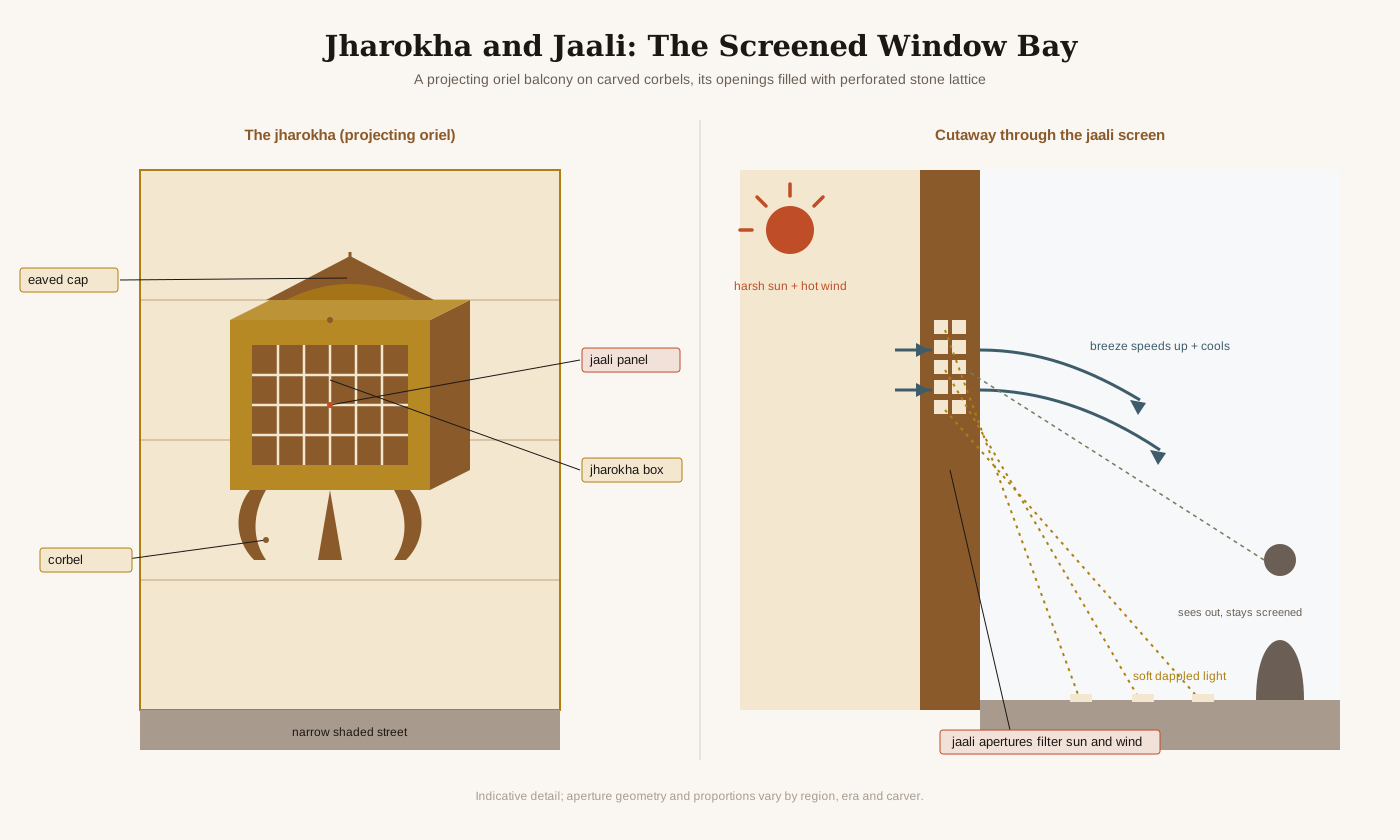
The jharokha is perhaps the most recognisable Rajasthani element: a projecting, corbel-supported enclosed balcony or oriel window, leaning out over the street. Often filled with jaali screens, it served several purposes at once — it caught and funnelled breeze into the upper rooms, it allowed surveillance of the street below, it let the women of the house view the world while remaining screened from it, and, not least, it announced the family's status through the richness of its carving.
The Jaali
The jaali (also spelled jali) is the perforated lattice screen — carved in stone, wood, or even alabaster — that is everywhere in Rajasthani building. It is a piece of environmental genius: it filters harsh light into soft patterned shade, slows and cools the breeze passing through it (small apertures accelerate and cool moving air), keeps out dust, and provides privacy without blocking ventilation. It is, in one element, sunshade, window, air conditioner, and veil.
The Chhatri
A chhatri literally means "umbrella" — an elevated, domed pavilion raised on columns. In Rajasthan it appears as a rooftop ornament crowning haveli terraces and gateways, but it is most characteristically a cenotaph: a memorial pavilion raised over the cremation site of a notable person. The domed chhatri silhouette against the desert sky is one of Rajasthan's signature images.
The Baithak & the Tibari
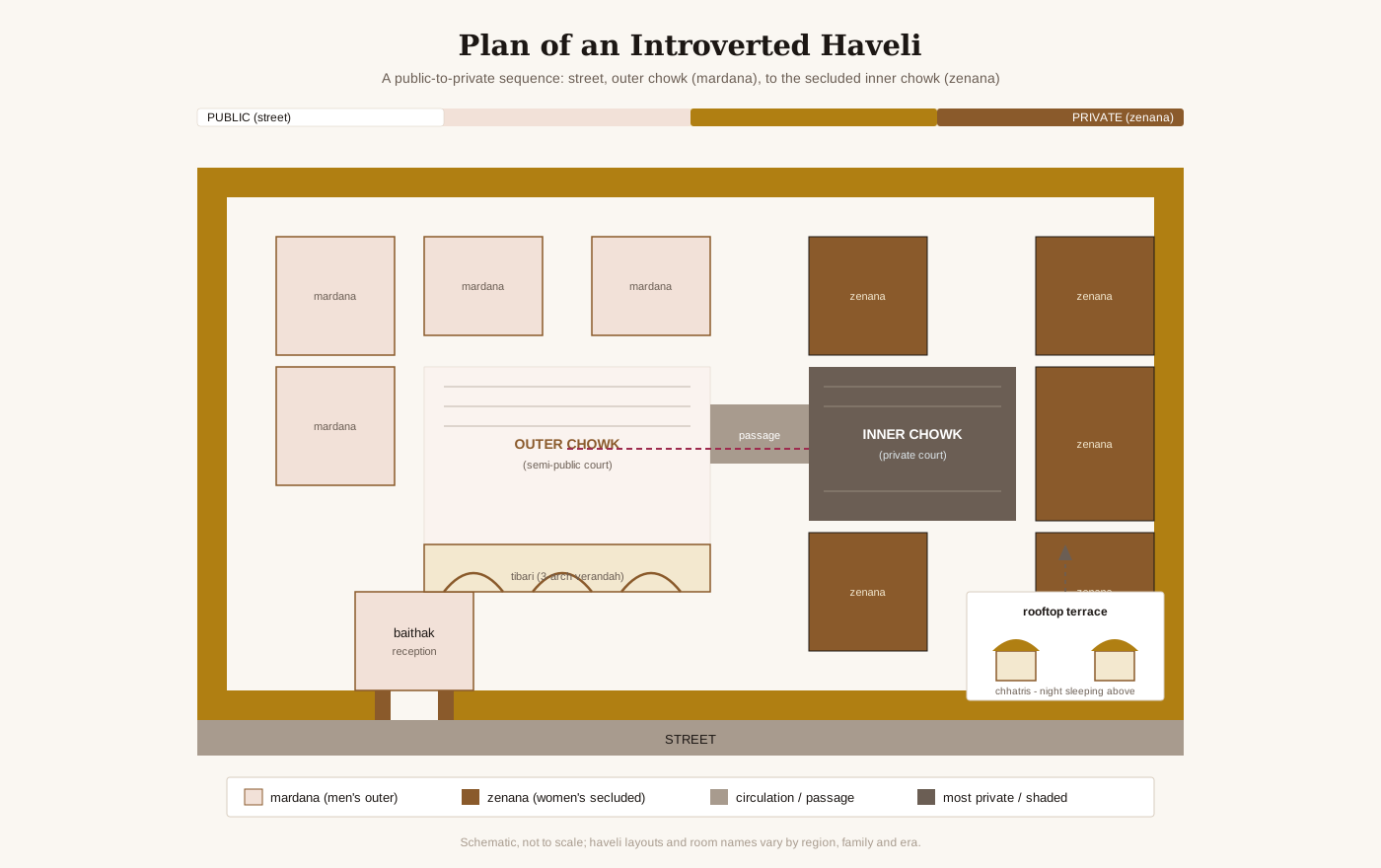
The baithak is the reception and business sitting-room, typically opening off the outer, more public courtyard — the stage on which a merchant received guests and conducted trade. The tibari (also spelled tibara) is a three-arched columned verandah or hall opening onto a courtyard, named for its three (tin) bays — a shaded, semi-open transitional space between court and enclosed room.
The Gendered Zones: Mardana & Zenana
The Rajasthani haveli was explicitly divided by gender. The mardana was the men's outer realm — the public, business-facing zone around the outer court. The zenana was the women's inner realm — the private, secluded zone around the inner court, screened from outside eyes. This division was not incidental; it shaped the entire plan.
| Term | Gloss | Role |
|---|---|---|
| Haveli | Courtyard mansion / townhouse | The house itself |
| Chowk | Internal courtyard | Climate & social core |
| Jharokha | Projecting enclosed balcony / oriel | Breeze, surveillance, screened viewing, status |
| Jaali (jali) | Perforated lattice screen | Filtered light, breeze, dust, privacy |
| Chhatri | Domed columned pavilion | Roof ornament; memorial cenotaph |
| Baithak | Reception / business sitting room | Off the outer court |
| Tibari (tibara) | Three-arched columned verandah/hall | Court-facing transitional space |
| Mardana | Men's outer zone | Public / business |
| Zenana | Women's inner zone | Private / secluded |
4. Materials & Construction
If one material defines Rajasthan, it is sandstone. The state's geology gave its builders a stone that was both abundant and superbly carvable, and the regional palette is essentially a map of which quarry was nearby.
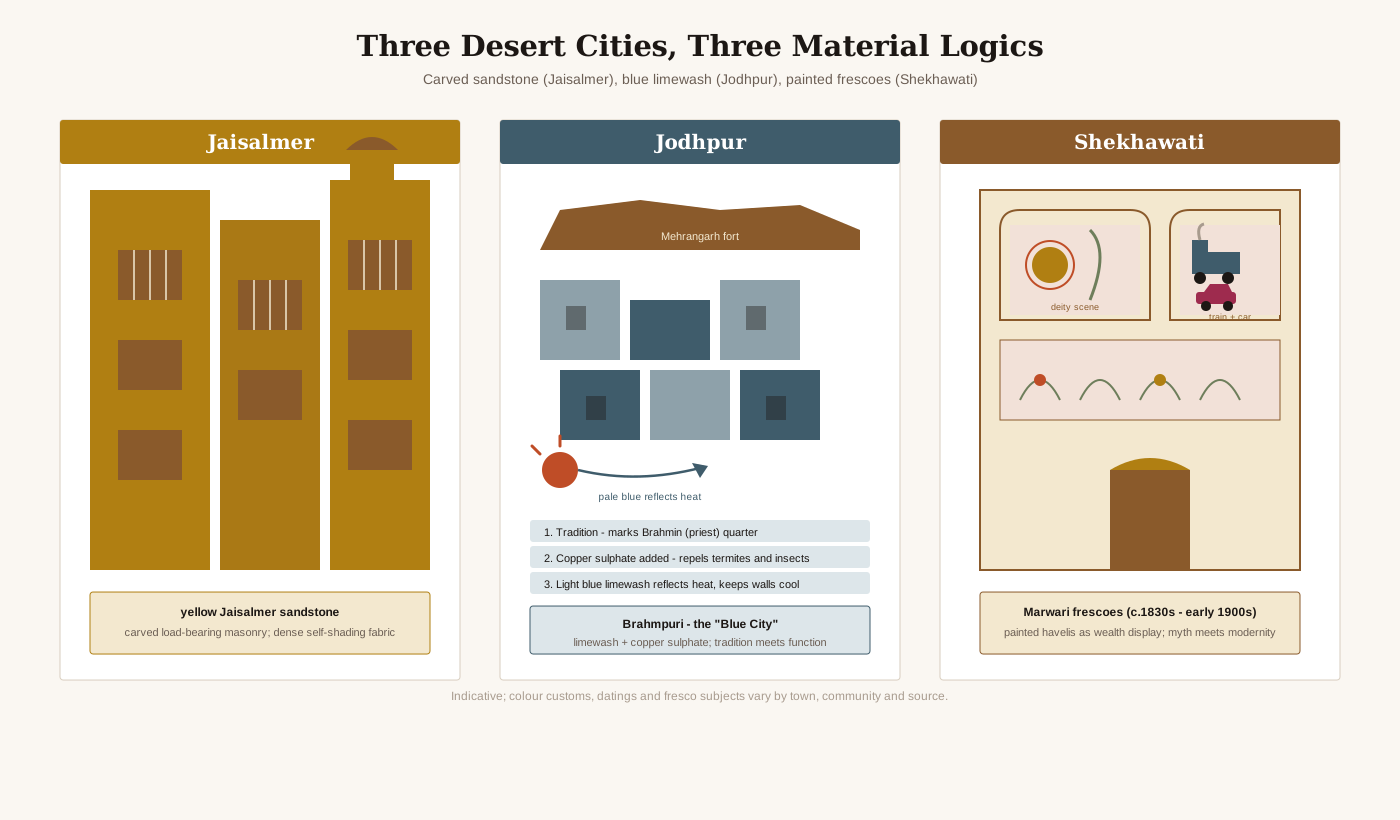
The most famous is the yellow, or "golden", sandstone of Jaisalmer, which gives the desert city its honeyed glow and earned it the name the Golden City. Jodhpur sandstone is the other great building stone of the region. In both cases the stone is worked as carved load-bearing masonry — walls, columns, brackets, screens, and jharokhas all cut from the same material, which is why a Jaisalmer haveli reads as a single carved monolith rather than an assembly of parts.
Away from the stone cities, in the villages, the everyday material is mud and adobe — abundant, free, and an excellent thermal mass. In the towns, lime was the binder and the finish. And the prize of the lime tradition is araish: a burnished lime plaster made from slaked lime and marble dust, polished with stone tools to a glossy, near-waterproof sheen. Araish is the Rajasthani cousin of Moroccan tadelakt — a hand-laboured finish that turns a humble wall into something that gleams like marble and sheds water.
| Material | Where used | Properties |
|---|---|---|
| Jaisalmer yellow ("golden") sandstone | Jaisalmer havelis & forts | Carvable, load-bearing, honey-gold |
| Jodhpur sandstone | Jodhpur region | Durable carved masonry |
| Mud / adobe | Rural Thar & villages | Free, high thermal mass |
| Lime | Urban building & plaster | Binder & breathable finish |
| Araish (burnished lime + marble dust) | Fine interiors & surfaces | Glossy, near-waterproof, polished sheen |
| Limewash | Walls everywhere | Reflective, protective, recoatable |
5. Plan, Section, Roof & Water Logic
The Rajasthani urban house is fundamentally introverted — it turns its back on the street and faces inward to its courtyards. This is the organising principle of the plan.
Entry from the street leads first to the outer chowk, the semi-public court around which the baithak and the men's mardana rooms are arranged. This is the zone of business and hospitality. Penetrating deeper, one reaches the inner chowk, the private court of the zenana, secluded from outside view. The graded sequence — street to outer court to inner court — is a journey from public to private, and the deeper you go, the more protected, both socially and climatically, the space becomes.
Vertically, the section stacks living rooms over store and service rooms, with the flat or terraced roof serving as essential living space. In a desert with cold nights, the roof is where families sleep in the hot season, taking advantage of the night sky and the breeze. Rooftop chhatris crown the terraces, providing shaded pavilions up in the air.
Shading is achieved at every scale: tall street walls shade the lane, jharokhas shade the facade beneath them, and deep jaalis shade the openings themselves.
Water, in this driest of regions, is architecture in its own right. Houses harvested and stored rainwater in tanks. At the scale of the settlement, the great water structures were the stepwells — baori (also spelled baoli) — and tanks: deep, descending masonry wells that reached down to the water table and doubled as cool, shaded subterranean gathering places, a relief from the heat above.
| Zone | Court | Character | Climate role |
|---|---|---|---|
| Baithak | Outer chowk | Public, business, hospitality | Shaded reception |
| Mardana | Outer chowk | Men's outer realm | Buffer to private core |
| Zenana | Inner chowk | Women's private realm | Deepest, most protected |
| Tibari | Court edge | Semi-open three-arched hall | Shaded transition |
| Terrace & chhatri | Roof | Night sleeping, pavilions | Night cooling, breeze |
| Baori / baoli & tank | Settlement / house | Water storage | Cool subterranean refuge |
6. The Social & Cultural Life of the House
A Rajasthani haveli is not merely a climate response; it is a diagram of a society. Its plan encodes the joint family and the merchant or caste structure of its occupants.
The graded sequence of courtyards — public outer to private inner — maps directly onto the social order. The outer court and its baithak were the stage for the world: a merchant received clients, conducted trade, and displayed his standing here. The baithak as a business and hospitality stage is one of the most telling features of the type — commerce and architecture fused into one room.
The segregation of mardana and zenana reflected the social separation of men's and women's worlds. The jharokhas and jaalis were the architectural instruments of this separation: they allowed the women of the household to see without being seen, to watch a wedding procession or a festival in the street below while remaining screened from public view. What reads to a modern eye as ornament was, in its time, a precise social technology.
The lattice screen is a paradox in stone — it admits the breeze and the world's image, while withholding the body. To see without being seen was, for centuries, the architecture of a woman's day.
And then there are the frescoes. In the Shekhawati region especially, the Marwari trading families competed in conspicuous display, covering the walls of their havelis — inside and out — with painted frescoes. These were a direct expression of mercantile wealth, and their subject matter is a fascinating record of a changing world: alongside the traditional Hindu mythological scenes appear trains, steamships, motorcars, and European portraits, painted by local artists encountering the new technologies of the colonial age. To walk Shekhawati is to read the diary of a merchant class at the moment it met the modern world.
7. Notable Examples & Settlements
The tradition is best understood through its surviving masterpieces. Rajasthan offers three distinct showcases — the golden stone of Jaisalmer, the painted havelis of Shekhawati, and the blue city of Jodhpur — plus the rural hut tradition of the deep desert.
In Jaisalmer, the Golden City, the great havelis are carved from yellow sandstone. The Patwon ki Haveli is in fact a cluster of five havelis, begun in the early nineteenth century by the trader Guman Chand Patwa, and famous for its roughly sixty jharokhas. The Salim Singh ki Haveli, also early nineteenth century, is celebrated for its dramatic upper facade — variously read as peacock or ship-shaped — and its many balconies, said to number around thirty-eight. The Nathmal ki Haveli, dated 1885 and built for Diwan Mohata Nathmal, is guarded by life-size stone elephants flanking its entrance.
In Shekhawati, the painted-haveli towns of Nawalgarh, Mandawa, Fatehpur, and Jhunjhunu preserve the great fresco boom that ran from roughly the 1830s into the early twentieth century, funded by Marwari trading wealth.
In Jodhpur, the Blue City, the houses of the Brahmin quarter of Brahmpuri, below the towering Mehrangarh Fort, are washed in blue. The colour has been explained several ways — as a marker of Brahmin tradition, as the effect of a copper-sulphate additive thought to repel termites, and as a heat-reflecting surface — and the truth is likely a blend of custom and practicality.
Out in the deep desert, the rural tradition is the round thatched hut — the jhupa (also jhompa), built of mud and thatch with a conical roof and plastered in mud, straw, and dung. Several such huts cluster together to form a dhani, or hamlet. The thatched roof is a remarkably effective insulator, keeping interiors something like ten to fifteen degrees cooler than the air outside.
| Example | Place | Date / period | Notable feature |
|---|---|---|---|
| Patwon ki Haveli | Jaisalmer | Begun early 19th c. (Guman Chand Patwa) | Cluster of 5; ~60 jharokhas |
| Salim Singh ki Haveli | Jaisalmer | Early 19th c. | Peacock/ship-shaped upper facade; ~38 balconies |
| Nathmal ki Haveli | Jaisalmer | 1885 (Diwan Mohata Nathmal) | Life-size stone elephants at entrance |
| Painted havelis | Nawalgarh, Mandawa, Fatehpur, Jhunjhunu (Shekhawati) | c.1830s – early 20th c. | Marwari frescoes mixing myth & modernity |
| Brahmpuri quarter | Jodhpur (below Mehrangarh) | Traditional | Blue limewashed houses |
| Jhupa hut / dhani | Rural Thar | Vernacular tradition | Round mud-and-thatch hut; cool interiors |
The rural and urban traditions are worth setting side by side, because they solve the same desert problem with opposite means — one with massive carved stone, the other with light, breathing thatch.
8. Decline & What Survives — Lessons for Today
The story of Rajasthan's vernacular is, like much of India's, one of partial loss and hopeful recovery.
The Shekhawati havelis have suffered the most. As the Marwari trading families migrated to Bombay, Calcutta, and beyond in pursuit of commerce, the great painted houses were widely abandoned. Many have decayed; some have been stripped of their fittings and even their frescoes. What was once a living merchant townscape is now, in places, a beautiful ruin — though one that increasingly draws heritage tourism and restoration interest.
The Jodhpur blue is fading too, as traditional limewash is replaced by synthetic paints that hold the colour differently and break the old continuity of the quarter.
Yet much survives, and much is being saved. The Indian National Trust for Art and Cultural Heritage (INTACH) has been active in documentation and conservation. Heritage-hotel adaptive reuse has given many havelis a second economic life — a use that funds their upkeep. And several of the great Jaisalmer havelis now operate as museums, preserving the carved stone and the way of life it housed.
For the contemporary designer, the lessons are concrete and transferable — but they must be adapted, not copied. The principles travel; the literal forms often do not.
| Vernacular principle | Modern application | Caveat |
|---|---|---|
| High thermal mass | Heavy walls / insulated mass in arid zones | Only works with the diurnal swing; wrong in humid climates |
| Courtyard night-flush | Internal courts, stack ventilation | Needs cool nights to recharge |
| Jaali screens | Perforated facades, shading screens | Detail for dust & glare, not just decoration |
| Light reflective surfaces | Pale renders, cool roofs | Maintenance matters; synthetic paint behaves differently |
| Self-shading dense fabric | Compact, mutually shading urban form | Density must still allow ventilation |
| Water harvesting & storage | Rooftop & tank harvesting | Essential where it always was — the desert |
The danger is romanticism. A jaali bolted onto a glass tower, or a chhatri stuck on a villa roof, borrows the image without the logic. The honest path is to understand why the desert house worked — mass, shade, introversion, night-flush, water care — and to rebuild that intelligence in contemporary materials and forms. For a fuller treatment of how to do this responsibly, see our guide on the lessons of vernacular architecture for modern Indian homes and the discussion of why vernacular design is returning in India. For how arid logic differs from coastal logic, compare tropical architecture in India, and for the broader debate, modern versus traditional Indian house architecture. You can also browse climate-aware layouts in our house plans library.
References & Further Reading
Foundational / Theory
- Kulbhushan Jain & Minakshi Jain, Mud Architecture of the Indian Desert (AADI Centre, 1992) — the key study of the desert's earthen building tradition.
- Kulbhushan Jain & Minakshi Jain, Indian City in the Arid West (1994) and Thematic Space in Indian Architecture (2002).
- V.S. Pramar, A Social History of Indian Architecture (Oxford University Press) — on how plan and society interlock.
Regional / Indian sources
- Ilay Cooper, The Painted Towns of Shekhawati (Mapin, 1994) — the standard reference on the frescoed havelis of Nawalgarh, Mandawa, Fatehpur, and Jhunjhunu.
- The Indian National Trust for Art and Cultural Heritage (INTACH) — documentation and conservation of Rajasthan's havelis and historic quarters.
Companion Studio Matrx Guides
- Indian Vernacular Architecture — the pillar guide
- Vernacular Architecture of Gujarat — the arid-west sibling, with the pol house and the Kutch bhunga
- Vernacular Architecture of Kerala — the humid-tropical contrast
- Lessons of Vernacular Architecture for Modern Indian Homes
- Tropical Architecture in India
- Why Vernacular Design Is Returning in India
Author's Note: I keep returning to the narrow lanes of Jaisalmer because they teach a kind of humility. There is no machinery in that coolness — only the patient intelligence of people who read their climate honestly and built within its terms. To design for the desert today is not to copy the jharokha, but to inherit the attentiveness that made it. — Amogh N P
Disclaimer: Vernacular terms, spellings, and datings vary across sources and regions — tibari and tibara, baori and baoli, jhupa and jhompa are all in use, and dates for individual havelis are sometimes given differently by different authorities. Named examples and their conservation status change over time. This is an educational overview; verify specifics against the cited scholarship before relying on them. No liability is assumed for decisions made on the basis of this article.
Export this guide
Related Guides — Deep-dive reading
Charles Correa's Façade Signature: How India's Master Made the Climate-Correct Wall
How Charles Correa eroded the flat sealed wall into deep, shaded, porous layers — verandahs, terraces, pergolas and open-to-sky courts — so the Indian façade filters sun and drives air instead of sealing it out.
Building FacadesJaali & Traditional Indian Façades: India's Original Climate-Smart Screen
Guide to the jaali and traditional Indian façades: history from Mughal and Rajasthani stone screens to Hawa Mahal and Sidi Saiyyed, the building physics of daylight, heat, privacy and breeze, materials from sandstone to GRC and metal, the parametric revival at Pearl Academy Jaipur, and how a homeowner can use a jaali.
Building FacadesLouis Kahn's Façade Signature: Wrapping Ruins, Brick Arches, and Monumental Light
How Louis Kahn shaded the glass behind giant geometric screen walls, asked the brick to be an arch, and built monumental façades of fair-faced concrete and light — and what that hot-climate logic teaches Indian builders today.
Building FacadesRelated Tools — Try Free
Cross-Ventilation Analyzer
Estimate airflow and air changes per hour (ACH) from room size, window areas, layout, and local wind — with NBC 2016 Part 8 compliance check.
Ventilation CalculatorBrise-Soleil Visualizer
Interactive horizontal-louvre cut-off angle calculator — sun altitude, louvre depth, and spacing inputs with a live shadow preview. Computes θ = arctan(spacing/depth) for façade shading, ECBC envelope compliance, hospital daylight design, and tropical sun-control detailing.
Sun Shading ToolRainwater Tank Sizer
How big should your rainwater tank be? Computes annual harvest, recommended tank capacity in litres, water-bill savings, and payback — for 10 Indian cities.
RWH Calculator