
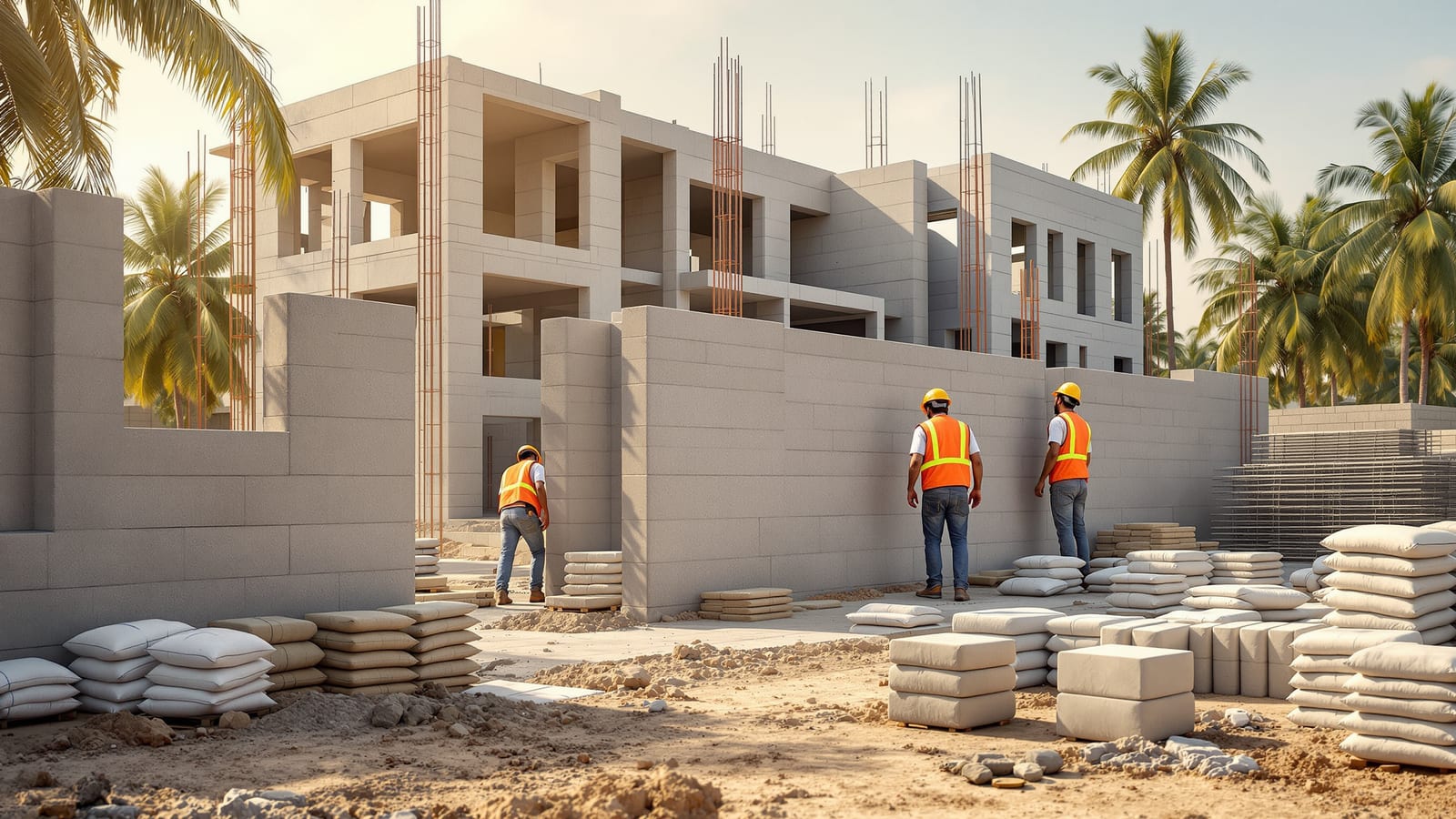
Embodied Carbon in Construction: Cutting the Carbon Locked Into Your Indian Home
The CO2 baked into your cement, steel and bricks is paid up front and can never be undone. Here is where it hides in an Indian home, and the low-cost choices that cut it by roughly a quarter.
When you think about a "green" home, you probably picture solar panels, LED lights, and a low electricity bill. All of that matters. But there is a second, quieter carbon footprint that is decided before you ever switch on a light, and once it is set you cannot change it: the carbon locked into the bricks, cement, steel and tiles that make up the building itself.
This is called embodied carbon. On a typical Indian home, it can equal many years of the home's running emissions, and it is paid up front, in a single burst, at the moment of construction. The good news is that an informed homeowner and architect can cut it substantially with choices that often cost the same or even less. This guide explains what embodied carbon is, where it hides in an Indian home, and the practical decisions that reduce it.
1. Embodied carbon vs operational carbon: two different bills
Every building has two carbon footprints, and confusing them is the most common mistake.
Operational carbon is the emissions from running the building over its life: the electricity for your air conditioner, fans, geyser, lights and pumps, plus any gas you burn for cooking. It is paid month after month, for decades. This is what energy-efficiency measures and the energy codes target.
Embodied carbon is the emissions to extract raw materials, manufacture them into building products, and transport them to your site. The cement kiln that fired your cement, the blast furnace that made your steel, the kiln that baked your bricks, the truck that hauled them all there: those emissions are released during construction and are then "locked in." Strictly, embodied carbon also includes the emissions to maintain, repair and eventually demolish the building, but the bulk of it, usually 90 percent or more, is upfront, at the product and construction stage.
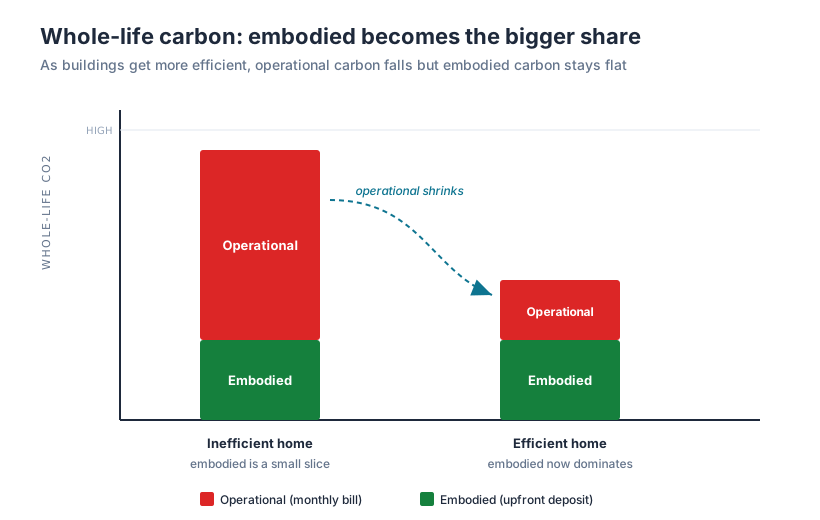
A useful way to picture it: operational carbon is your monthly bill, embodied carbon is the deposit you pay on day one. We cover the running side in detail in what makes a building sustainable; this guide is about the deposit.
2. Why embodied carbon matters more every year
For a long time, embodied carbon was ignored because operational carbon dwarfed it. A leaky, inefficient building burned so much electricity over 50 years that the materials seemed like a rounding error.
That logic is now reversing, for one simple reason: buildings are getting far more energy-efficient. As India tightens residential energy rules through the Eco-Niwas Samhita (the residential energy code) and as homes add solar and better insulation, the operational footprint shrinks. But the embodied footprint does not shrink with it; if anything, more insulation and more equipment can add material. So embodied carbon's share of a building's whole-life carbon keeps rising.
There is also a timing argument. Operational emissions are spread over decades, during which the grid is expected to get cleaner. Embodied emissions happen now, in the next two to three years of construction, exactly the window in which climate scientists say cuts matter most. A tonne of CO2 avoided today is worth more than a tonne avoided in 2050.
3. Where the carbon hides in an Indian home
If you measure embodied carbon across real Indian homes, the answer is strikingly consistent: two materials dominate, and they are the two you cannot easily see once the building is finished.
A 2024 study of 26 recent multi-family homes across South and West India found a median upfront embodied carbon of roughly 367 kgCO2e per square metre of built-up area, with most buildings falling between about 334 and 415. Across those buildings, concrete and steel together accounted for 60 to 91 percent of the embodied carbon. (Treat these as a credible India baseline, not a law of nature; your home will differ.)
Why these two? Cement, the binder in concrete, is made by heating limestone in a kiln, which both burns fuel and chemically releases CO2 from the rock itself; producing one tonne of cement releases on the order of 0.8 to 0.9 tonnes of CO2. Steel is smelted from iron ore at very high temperatures, mostly using coal. Both are wonderful, indispensable materials. They are also carbon-heavy by their very chemistry.
The next contributor in many Indian homes is fired clay brick, baked in kilns that often burn coal and biomass. After that come finishes, tiles, glass, aluminium windows and so on, individually smaller but adding up.
The practical lesson: if you want to cut embodied carbon, you go after concrete, steel and brick first. Fiddling with the paint will not move the needle.
4. How embodied carbon is measured (kept simple)
You will see embodied carbon expressed two ways, and you only need to understand the idea, not do the maths yourself.
- kgCO2e per kg of material: how carbon-heavy a material is per kilogram. The "e" means CO2-equivalent, bundling other greenhouse gases into one number. This lets you compare cement against timber against steel on a like-for-like basis.
- kgCO2e per square metre of building: the whole-home figure, useful for comparing one house design against another. The 367 figure above is of this type.
A few honest cautions. These numbers come from databases (the widely used Inventory of Carbon and Energy, or ICE, is the global reference) and from manufacturer declarations called EPDs (Environmental Product Declarations). India-specific EPDs are still limited, so many Indian assessments borrow international figures and adjust them. That means any single number is an estimate with a range around it, not a precise reading. Use embodied carbon figures to compare options and rank choices, not to claim a building emits exactly X tonnes.
5. The lower-carbon material swaps that actually work
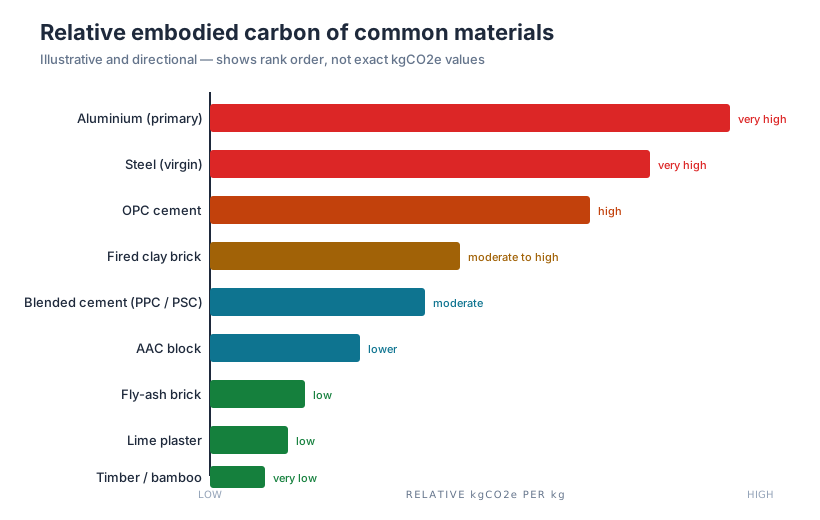
Here is the core of it. Most of these swaps are already common in India, code-friendly, and frequently cheaper. The relative-carbon column below is illustrative and directional, meant to show the rank order, not to be quoted as exact.
| Material / element | Relative embodied carbon | Lower-carbon swap | Notes |
|---|---|---|---|
| Ordinary Portland cement (OPC) | Very high | Blended cement: PPC (with fly ash) or PSC (with slag/GGBS) | Widely sold, often cheaper, code-accepted; replaces a share of clinker, the carbon-heavy part |
| Concrete (high cement content) | High | Mix design with fly ash or GGBS replacing 30 to 50 percent of cement | A real project cut a building's embodied carbon about 14 percent using up to ~47 percent GGBS |
| Reinforcing / structural steel | Very high | Specify steel with high recycled (scrap) content; avoid over-design | Recycled-route steel is a fraction of virgin steel's footprint |
| Fired clay brick | Moderate to high | AAC blocks, fly-ash bricks, or compressed stabilised earth blocks | Fly-ash bricks can use a small fraction of the energy of kiln-fired brick |
| Aluminium (windows, cladding) | Very high per kg | Use less; choose recycled-content aluminium or timber/UPVC frames | Secondary aluminium is a small fraction of primary |
| Plaster / binders | Moderate | Lime-based plaster where suitable | Lower-temperature, traditional, breathable |
| Imported stone / tiles | Variable (transport adds up) | Local stone and locally fired/finished products | Cuts transport emissions and supports local supply |
| Hardwood from unknown sources | Low if responsibly sourced, but risk of deforestation | Certified/responsibly sourced timber, bamboo, engineered wood | Wood stores carbon; sourcing integrity is the catch |
A word on each family:
Blended cements (PPC and PSC) replace part of the clinker (the kiln-fired, high-carbon ingredient) with fly ash from power plants or GGBS, a by-product of steelmaking. They are sold in every cement shop, accepted in Indian standards, and usually no more expensive. This is the single easiest win for most homes.
AAC blocks and fly-ash bricks replace fired clay brick for walls. AAC (autoclaved aerated concrete) is light, insulating and made with fly ash; it cuts both wall weight (so you may need less steel and concrete in the frame) and brick-kiln emissions. We compare wall systems in modern construction materials for Indian homes.
Timber and bamboo are special: a growing tree pulls CO2 out of the air and locks it into the wood. Used for structure or interiors, responsibly sourced wood and bamboo can be genuinely low-carbon, provided the sourcing does not drive deforestation. See sustainable interiors India.
6. The cheapest carbon is what you never build
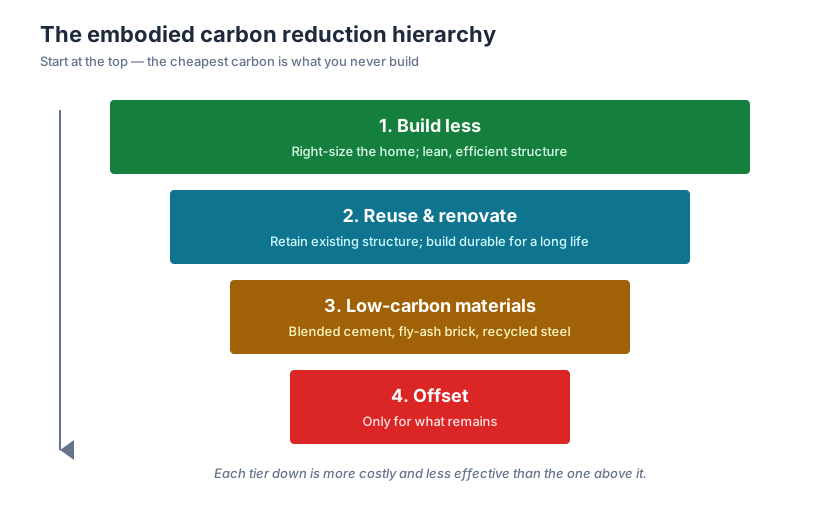
Material swaps matter, but the biggest lever is upstream of them: build less, build durable, and reuse what exists. Carbon you never pour, fire or smelt is carbon you never have to offset.
- Build less. Right-size the home. A thoughtfully planned 1,500 sq ft house has less than half the embodied carbon of an oversized 3,000 sq ft one. Every square metre carries its own concrete, steel and brick.
- Build efficient structure. Over-conservative engineering, beams and slabs heavier than they need to be, wastes steel and concrete invisibly. A good structural engineer optimising the design can quietly remove tonnes of embodied carbon.
- Build durable. A building that lasts 100 years spreads its embodied carbon over twice the life of one that is demolished and rebuilt at 50. Durability is climate action.
- Reuse and renovate. Retaining and upgrading an existing structure, rather than demolishing and rebuilding, avoids almost all the embodied carbon of a new frame. This is the heart of the circular economy in construction.
7. Decisions you can make at design and procurement
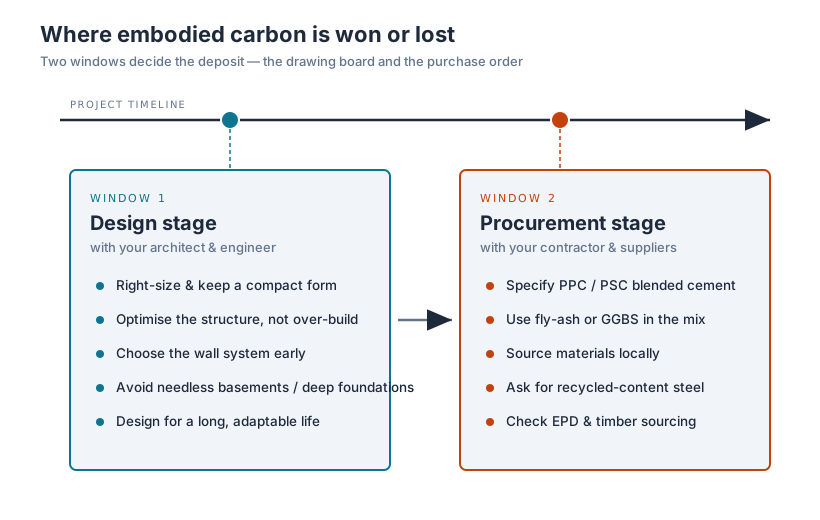
Embodied carbon is won or lost in two phases: the drawing board and the purchase order.
At design (with your architect and engineer):
- Ask for the structure to be optimised, not over-built. Question every oversized beam and thick slab.
- Choose a wall system early (AAC, fly-ash brick, stabilised earth) so the structure can be sized for it.
- Favour a compact form and avoid wasteful basements or deep foundations unless the site demands them; excavation and retaining structures are carbon-heavy.
- Design for a long life and for future change, so the building is renovated rather than demolished.
At procurement (with your contractor and suppliers):
- Specify PPC or PSC blended cement instead of plain OPC unless there is a technical reason not to.
- Ask the contractor to use fly-ash or GGBS in the concrete mix where the structural design allows.
- Source materials locally to cut transport emissions, and ask suppliers whether they have any EPD or recycled-content data.
- For steel, ask about recycled content; for timber, ask about the source.
8. How India's rules and ratings treat embodied carbon
This is where policy is catching up, and being honest about the gaps helps you set expectations.
India's mandatory energy codes, the Energy Conservation Building Code (ECBC) for commercial buildings and the Eco-Niwas Samhita (ENS) for homes, were built around operational energy. The National Building Code and these energy codes have so far had a blind spot for embodied carbon, though that is changing: ENS 2021 added an appendix on annualised embodied energy, a first step toward formally accounting for it.
On the voluntary side, the rating systems are ahead of the law:
- GRIHA, India's national rating system, has long given credit for low embodied energy and for using low-impact and local materials.
- IGBC awards points for materials with recycled content, regional sourcing and lower environmental impact.
- International tools used in India, such as IFC's EDGE, increasingly let you account for material choices.
If you are pursuing a green rating, embodied-carbon-friendly choices earn you credits. If you are not, they are simply good practice. Either way, see green building certifications for how the schemes compare, and watch the future of green building materials for where this is heading.
What this means for you
Embodied carbon is the part of a building's footprint that is paid up front and can never be undone, so the decisions are made once and matter forever. The encouraging part is that the biggest reductions come from choices that are already available in India and often cost nothing extra.
If you do only three things: first, build only as much as you need and keep the structure lean, because the cheapest carbon is what you never build. Second, switch to blended cement (PPC or PSC) and ask for fly-ash or GGBS in your concrete, the easiest single win. Third, choose AAC blocks or fly-ash bricks over kiln-fired clay for your walls. Together, real Indian studies suggest measures like these can cut a home's upfront embodied carbon by roughly a quarter, with no loss of quality.
Treat the carbon numbers in this guide as directional, not exact; India-specific data is still maturing. Use them to rank your options and ask better questions of your architect and contractor. Pair these material choices with the operational measures in what makes a building sustainable, and you address both halves of your home's footprint, the deposit and the monthly bill.
Sources
- Conserve Consultants, "India's Embodied Carbon Baseline for Urban Housing" (study of 26 multi-family homes, median ~367 kgCO2e/m2, concrete and steel 60 to 91 percent of embodied carbon).
- Inventory of Carbon and Energy (ICE) database, Circular Ecology / GlobalABC, embodied carbon factors for cement, steel, GGBS, timber.
- Lodha Group, "Embodied Carbon Reduction through GGBS concrete mixes" (~14 percent reduction with up to ~47 percent GGBS).
- Bureau of Energy Efficiency, Eco-Niwas Samhita (ENS) 2018 and 2021, including the annualised embodied energy appendix; Energy Conservation Building Code (ECBC).
- GRIHA Council and Indian Green Building Council (IGBC) rating criteria for embodied energy, local and recycled materials.
- IFC EDGE green building standard, materials module.
- The Wire Science, "India's Building Code Has a Blind Spot for a Whole Category of Emissions" (embodied emissions in NBC/codes).
- Peer-reviewed studies on fly-ash bricks and low-carbon concrete (NCBI/PMC).
Export this guide
Related Guides — Deep-dive reading
Green Building Materials Guide (India): Low-Carbon, Healthy & Sustainable Choices (2026)
What actually makes a building material green - low embodied carbon and energy, recycled and renewable content, local sourcing, durability, recyclability, low VOC and water efficiency - mapped honestly across the whole Indian building, with the lifecycle nuance no label can give you.
Building MaterialsLow-Carbon Construction Materials in India: Cutting Embodied Carbon (2026)
What embodied carbon is in plain terms, why cement and steel dominate it, and the practical levers to cut it in Indian building - blended cement and SCMs, material efficiency, lower-carbon walling, local sourcing, durability, timber and bamboo, and recycled content. A specify-and-select guide.
Building MaterialsEnergy-Efficient Facades in India: How the Building Skin Cuts Your Cooling, Heating & Lighting Bills
How a building facade drives cooling, heating and lighting energy in India, the three levers of solar-heat-gain control, insulation and daylighting, U-value, SHGC, VLT and WWR in plain terms, ECBC and Eco-Niwas expectations, and real Indian green buildings.
Building FacadesRelated Tools — Try Free
Cross-Ventilation Analyzer
Estimate airflow and air changes per hour (ACH) from room size, window areas, layout, and local wind — with NBC 2016 Part 8 compliance check.
Ventilation CalculatorWindow Material Comparison Tool
Compare uPVC, aluminium, wood, steel and composite windows on cost, life, upkeep and insulation.
CompareMaterial Decision Framework (M-Score)
Score 30+ Indian construction materials across cost, durability, climate fit, maintenance, and sustainability.
Materials