
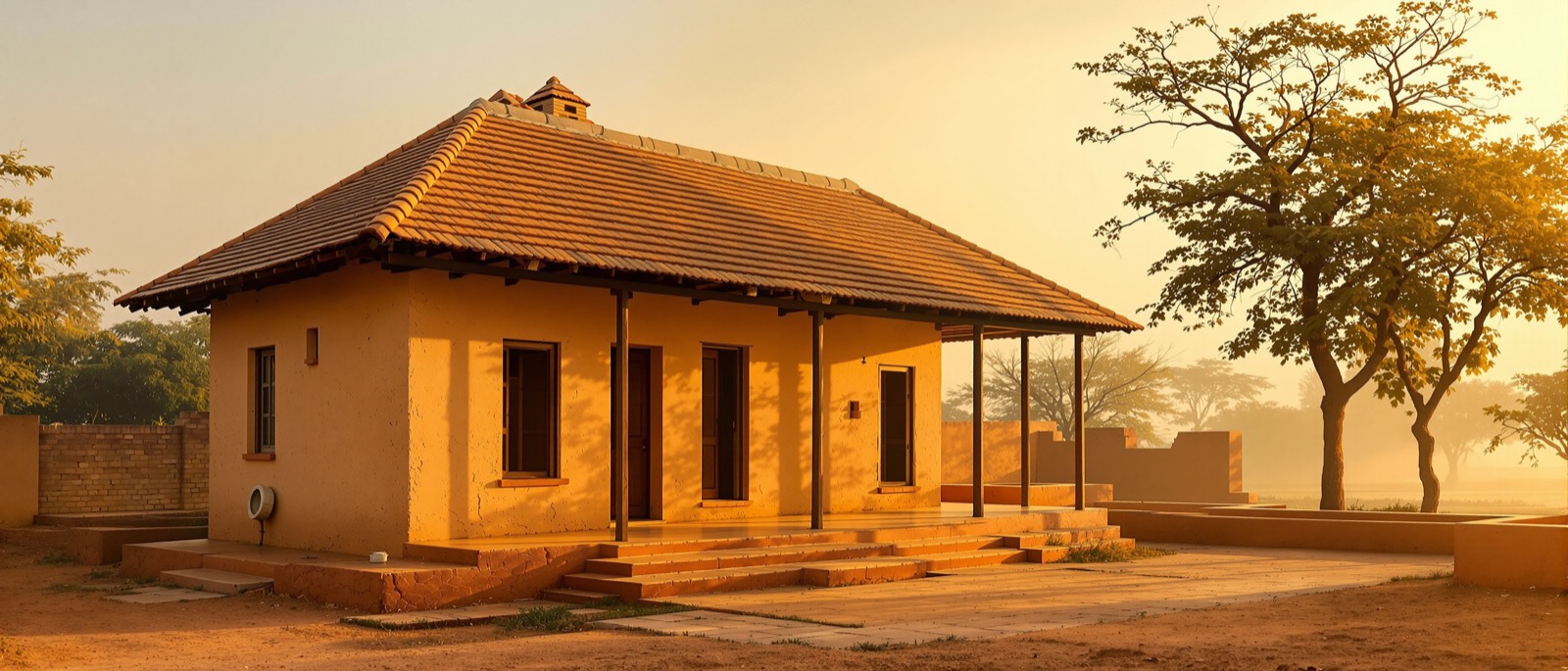
Indian Vernacular Architecture: A Field Guide to the Architecture Without Architects
How to read India's anonymous, climate-tested, culture-shaped building — five climate zones, the local-materials palette, the great pan-Indian courtyard, and a region-by-region map of the tradition.
Walk into the inner courtyard of an old Nalukettu house in Kerala on a June afternoon and you feel it before you understand it: the air is moving, the light is soft, the heat of the laterite walls has been left outside. No mechanical system is running. No architect signed a drawing. Yet the house breathes with a competence that a great deal of air-conditioned modern building never achieves. Drive a thousand kilometres north-west to a Kutch settlement and you meet the opposite climate met with equal intelligence — thick mud walls, a courtyard again, deep shade, a building that stays cool by holding still rather than by letting the breeze through.
These two houses were built by carpenters and masons working within an inherited tradition, for the families who would live in them, out of materials gathered within a few kilometres. They are separated by climate, language, religion, and craft, and yet they belong to one enormous, loosely-knit family of building. That family is what we call vernacular architecture — and India holds one of the richest collections of it on Earth.
Vernacular architecture is building made by and for a community, using local materials, inherited construction knowledge, and a deep reading of the local climate and culture — rather than the drawings of a formally-trained, "pedigreed" architect. It is the architecture of the ordinary, and it is extraordinary.
This is the pillar guide for our cluster on Indian vernacular architecture: the "what is it and how do I read it" overview. If you are a B.Arch student building a foundation, a teacher looking for a clean framework, or a homeowner who has noticed that old buildings often feel better than new ones, start here. From this page we link out to eight regional deep-dives — Kerala, Tamil Nadu, Karnataka, Rajasthan, Gujarat, Ladakh, Bengal, and the North-East — and to two thematic guides on why vernacular design is returning and the practical lessons it offers modern homes.
"There is much to learn from architecture before it became an expert's art." — the animating idea behind Bernard Rudofsky's 1964 exhibition, and a fair motto for this entire field.
1. What Vernacular Architecture Actually Is
The modern study of vernacular building has a surprisingly precise birthday. In 1964, the Austrian-American architect Bernard Rudofsky (1905–1988) mounted an exhibition at the Museum of Modern Art in New York titled Architecture Without Architects: A Short Introduction to Non-Pedigreed Architecture (11 November 1964 to 7 February 1965). It was, deliberately, just photographs — villages, granaries, cliff dwellings, terraced hillsides from around the world — and it is largely regarded as the official beginning of vernacular architecture studies as a field. Rudofsky's own preferred phrase was "non-pedigreed architecture," and that adjective is the key. He was contrasting the anonymous, communal, tradition-governed building of the world's majority with the named, canonical, professionally-authored "pedigreed" architecture that art history had until then treated as the only architecture worth studying.
The field's great cataloguer was the British scholar Paul Oliver, who spent a career documenting it. His monumental Encyclopaedia of Vernacular Architecture of the World (Cambridge University Press, 1997, three volumes) remains the standard global reference, and his earlier Dwellings: The House Across the World (1987, later reissued as Dwellings: The Vernacular House Worldwide) is a superb single-volume entry point. (A small but worth-getting-right note for students: Oliver's 1969 book was titled Shelter and Society, a different work — the two are sometimes wrongly conflated.)
If Rudofsky gave the field its dramatic opening and Oliver gave it its archive, the architect-anthropologist Amos Rapoport gave it its sharpest idea. In House Form and Culture (Prentice-Hall, 1969), Rapoport argued against a tempting but lazy explanation called physical determinism — the notion that house form is simply dictated by climate and available technology. Not so, he said. House form is shaped first by "a whole range of socio-cultural factors" — how a family is organised, how privacy and gender and ritual work, what a community believes a dwelling should be — with climate, materials, and construction acting as powerful modifying forces rather than sole authors.
This nuance matters enormously, and we will hold onto it throughout this guide. Climate is one of the most useful lenses for reading vernacular India, but it is not the only one, and it is not destiny. Two communities in the same climate can build very differently because they live, worship, and organise themselves differently.
Vernacular versus its cousins
The word "vernacular" sits inside a small family of terms that are easy to muddle. Here is how this guide uses them.
| Term | What it means | Indian examples |
|---|---|---|
| Vernacular (umbrella term) | Anonymous, community-built, tradition-governed building using local means | The courtyard house, the village dwelling, the regional farmhouse |
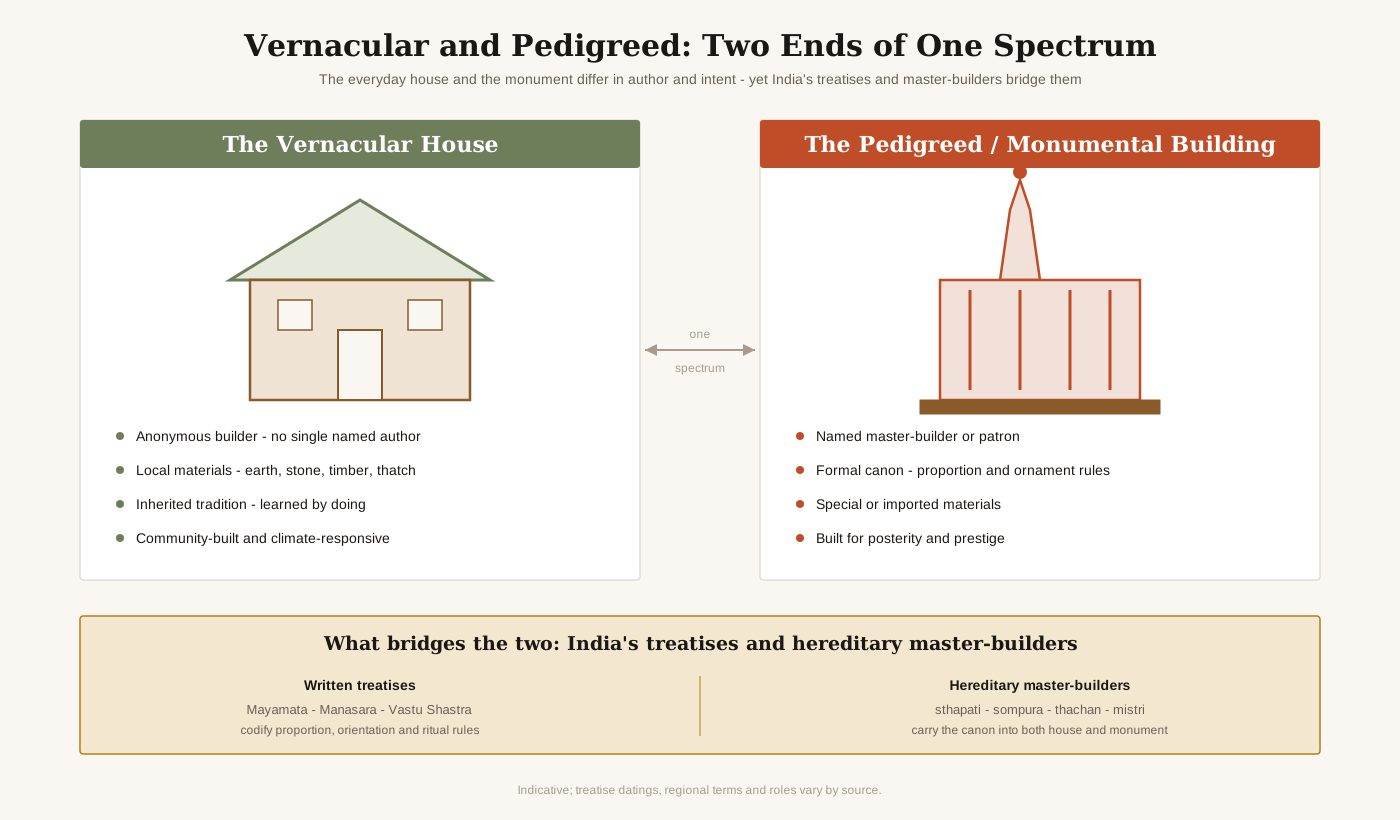
| Classical / monumental / "pedigreed" | Building by named master-builders to formal canons | Temples, palaces, forts — note that temple architecture follows the shastras yet belongs to a "high," elite tradition, not the vernacular |
| Adivasi / tribal | Building by indigenous communities — a subset of vernacular, reserved for indigenous specificity | Many North-East and central-Indian dwelling traditions |
| Folk | A near-synonym of vernacular | Used loosely and interchangeably |
Throughout this cluster we use vernacular as the umbrella, and reserve tribal / Adivasi for the more specific case of indigenous communities. The temple is a useful boundary case: it is built to written rules (the shastras), but by specialist master-builders to a "high" canon — so it is not vernacular, even though it shares roots and craftsmen with the houses around it.
2. Why India Is Exceptionally Rich
Almost every country has a vernacular tradition. Very few have anything like India's. Three diversities compound here:
- Climatic diversity. India spans five recognised climate zones, from the snow-bound cold deserts of Ladakh to the warm-humid coasts of Kerala and Bengal. Each zone poses a different problem to a builder, and each has been answered.
- Cultural and linguistic diversity. Caste and community settlement patterns, the joint family, gender and privacy gradients, and the ritual framework of Vastu all shape the house. A Rapoport reading of India is almost unavoidable: culture leads.
- Materials diversity. Earth, stone, timber, bamboo, thatch, terracotta and lime are all available somewhere in abundance — and the vernacular faithfully reflects whatever lies underfoot in each region.
The rest of this guide gives you three lenses for reading that richness — climate, materials, and social/cultural logic — and then a region-by-region overview that points you to the deep-dives.
3. Lens A — Climate: Five Zones, Five Logics
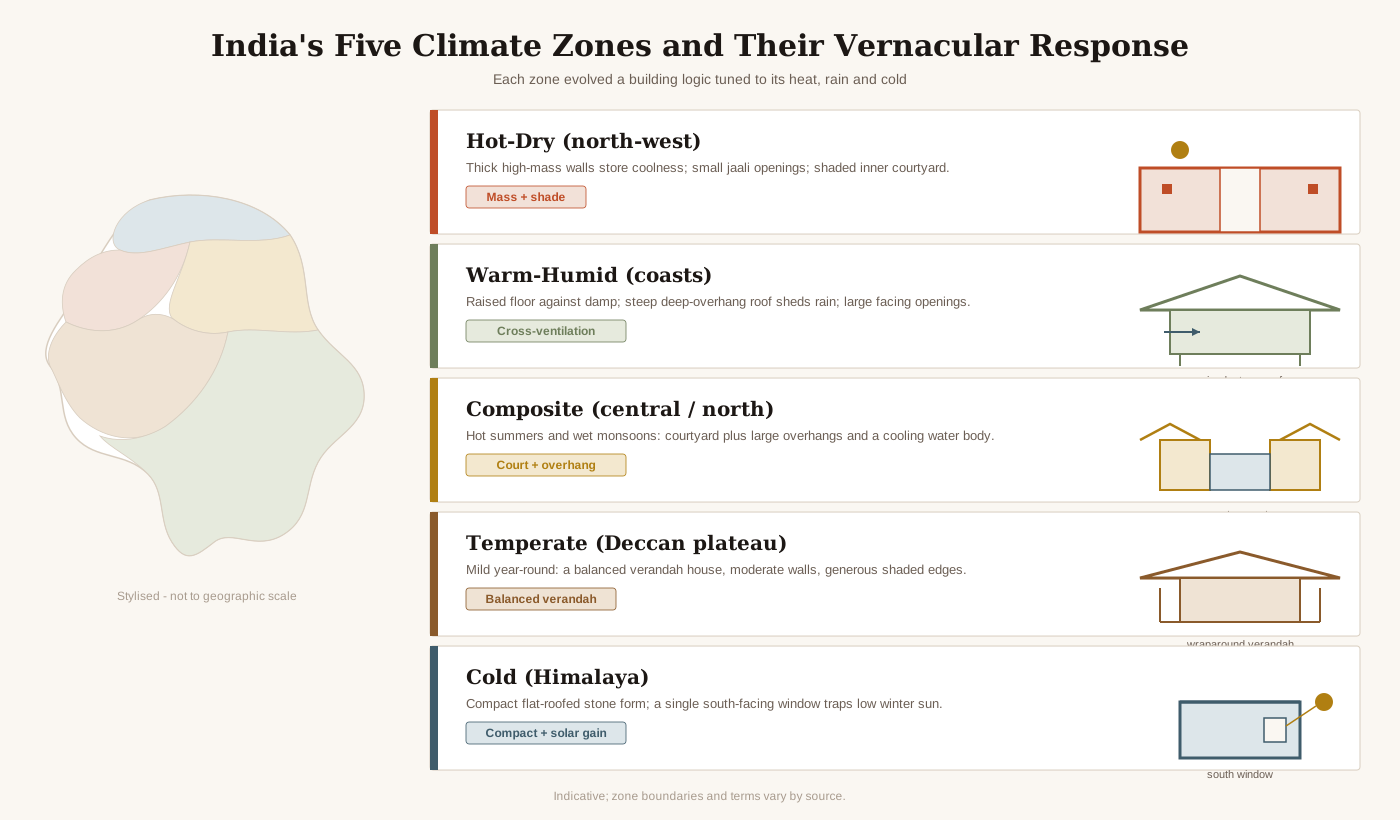
The cleanest way to begin reading any Indian building is to ask: what climate was it answering? India's standard framework, used by the National Building Code (NBC 2016) and the older SP:41 handbook, recognises five climate zones: hot & dry, warm & humid, composite, temperate (moderate), and cold. (NBC 2016 unified the older "cold and sunny" and "cold and cloudy" categories into a single cold zone. A station is assigned to a zone if its climate matches that zone for at least six months of the year; otherwise it is classed as composite.)
Each zone produces a recognisable vernacular logic.
| Zone | Where (examples) | Characteristic vernacular response |
|---|---|---|
| Hot & dry | Rajasthan, Kutch, interior Deccan | Compact massing, courtyard, thick mud or stone walls (high thermal mass), small openings, jaali (perforated screens), light-coloured surfaces, narrow shaded streets |
| Warm & humid | Kerala, coastal Karnataka, the Bengal coast, Goa | Verandahs, deep and steep pitched roofs for monsoon, raised plinth or floor, large cross-ventilating openings, lightweight timber and thatch — shading prioritised over mass |
| Composite | Delhi, Uttar Pradesh, Madhya Pradesh (central/north) | A hybrid: courtyards plus large overhangs, water bodies and landscaping; both mass and ventilation, deployed seasonally |
| Temperate / moderate | The Bangalore plateau, parts of the Deccan | Moderate massing, balanced openings, verandahs |
| Cold | The Himalayas — Ladakh, Himachal, Kashmir, Sikkim | Thick mass with small openings, south-facing solar gain, timber systems (kath-kuni, dhajji-dewari), compact form, the "stable below, living above" arrangement |
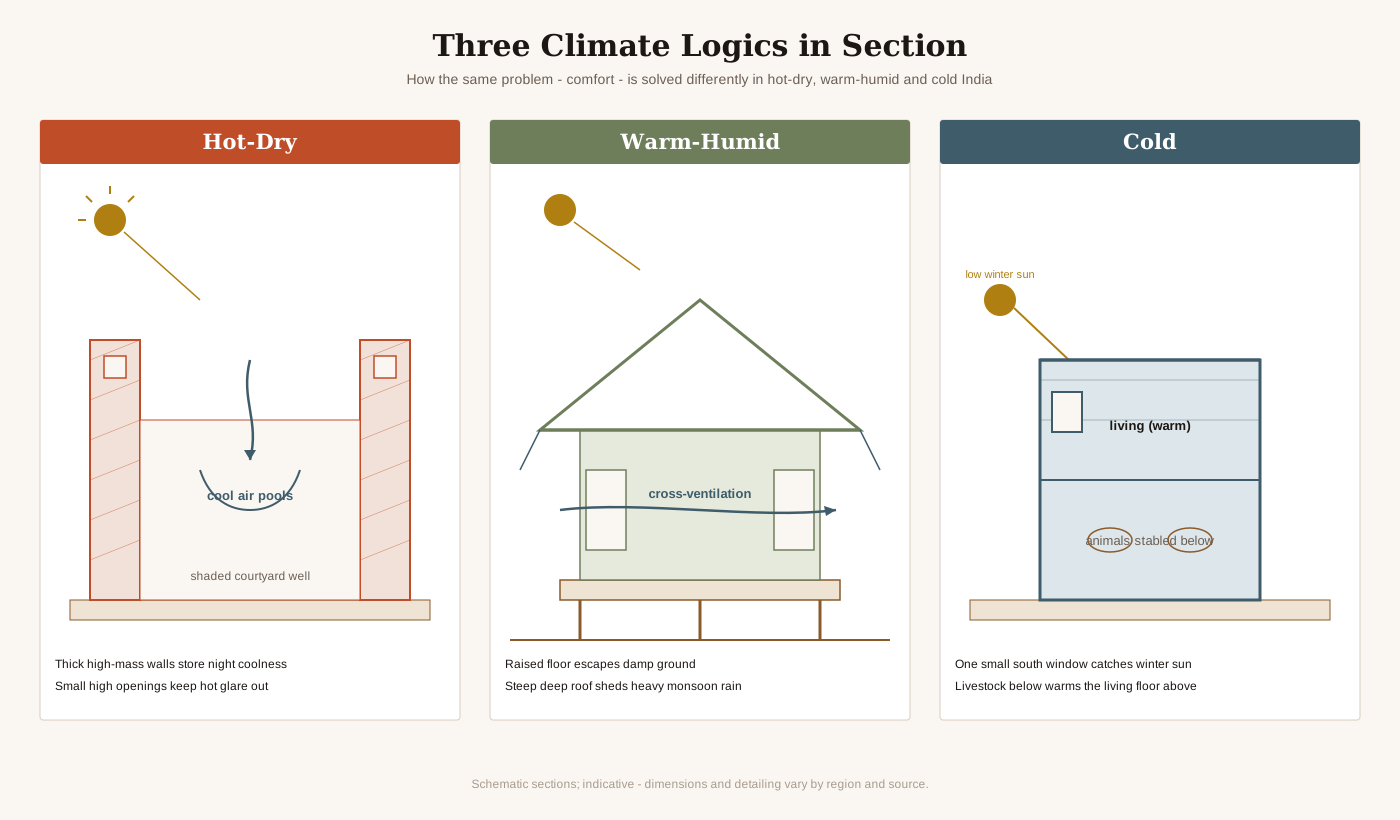
Two opposite logics anchor the whole spectrum, and they are worth fixing in your mind because most of India sits somewhere between them.
In the hot & dry zone, the enemy is daytime heat and there is little useful breeze, so the building holds still: heavy mud or stone walls store the day's heat and release it slowly, openings are kept small, and a shaded courtyard becomes a cool well at the heart of the house. In the warm & humid zone, the enemy is humidity and the building must let the air through: walls go light, the house is lifted off the wet ground, openings grow large and face each other for cross-ventilation, and a big overhanging roof throws off both monsoon rain and direct sun. The cold zone inverts both — here the building hoards warmth, with thick mass, tiny openings, and a south face turned to the low winter sun.
This is exactly the territory our companion guide on tropical architecture in India develops in depth for the warm-humid case.
4. Lens B — Materials: Build Local, Build Light on the Earth
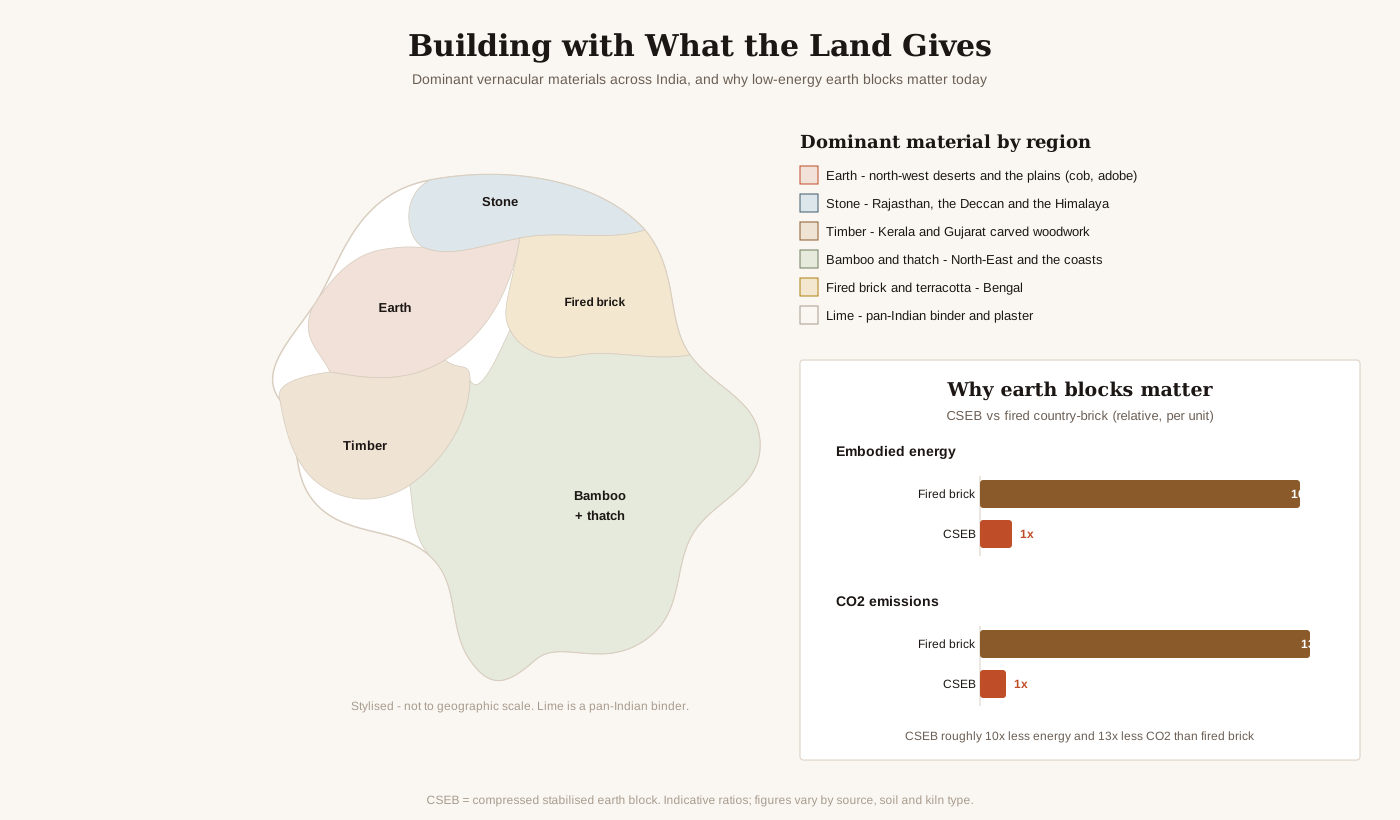
The second lens is the simplest to state and the most quietly radical: build with what is local within a few kilometres. Before lorries and cement, a builder used what the land offered, and the vernacular map of India is, to a remarkable degree, just a geological and botanical map redrawn in walls and roofs.
| Material family | Forms | Where it dominates |
|---|---|---|
| Earth | Mud and adobe, cob, rammed earth, wattle-and-daub | Rajasthan, Kutch, the plains; the most widespread of all |
| Stone | Rajasthan sandstone, Deccan basalt and granite, Himalayan stone | Rajasthan, the Deccan, the mountains |
| Timber | Structural and carved woodwork | Kerala, the carved havelis of Gujarat, Himalayan kath-kuni |
| Bamboo & thatch | Frames, walls, roofing | The North-East, coastal belts, many tribal traditions |
| Terracotta & fired brick | Tiles, bricks, the famed terracotta temples | Bengal and the brick-building plains |
| Lime | Lime mortar and plaster, known as chunam (a lime finish) | Across India — and crucially, it predates cement |
This is not nostalgia. Local, natural materials carry very low embodied energy — the energy locked up in extracting, processing and transporting a material before it ever does any work. The contrast with modern materials is stark. The Auroville Earth Institute's measurements for CSEB (compressed stabilised earth blocks — soil mixed with roughly five per cent cement and compressed unfired) are often cited as a benchmark: a CSEB block carries about ten times less embodied energy and around thirteen times less CO2 than a fired country-brick of the same size. In a country building at India's scale, that ratio is not a footnote — it is one of the strongest arguments for the vernacular's modern relevance, and we develop it fully in the guide on why vernacular design is returning.
5. Lens C — Social and Cultural Logic, and the Great Pan-Indian Device
Now we return to Rapoport's point. Climate and materials modify the house, but culture leads it. The Indian vernacular house is, above all, a social diagram.
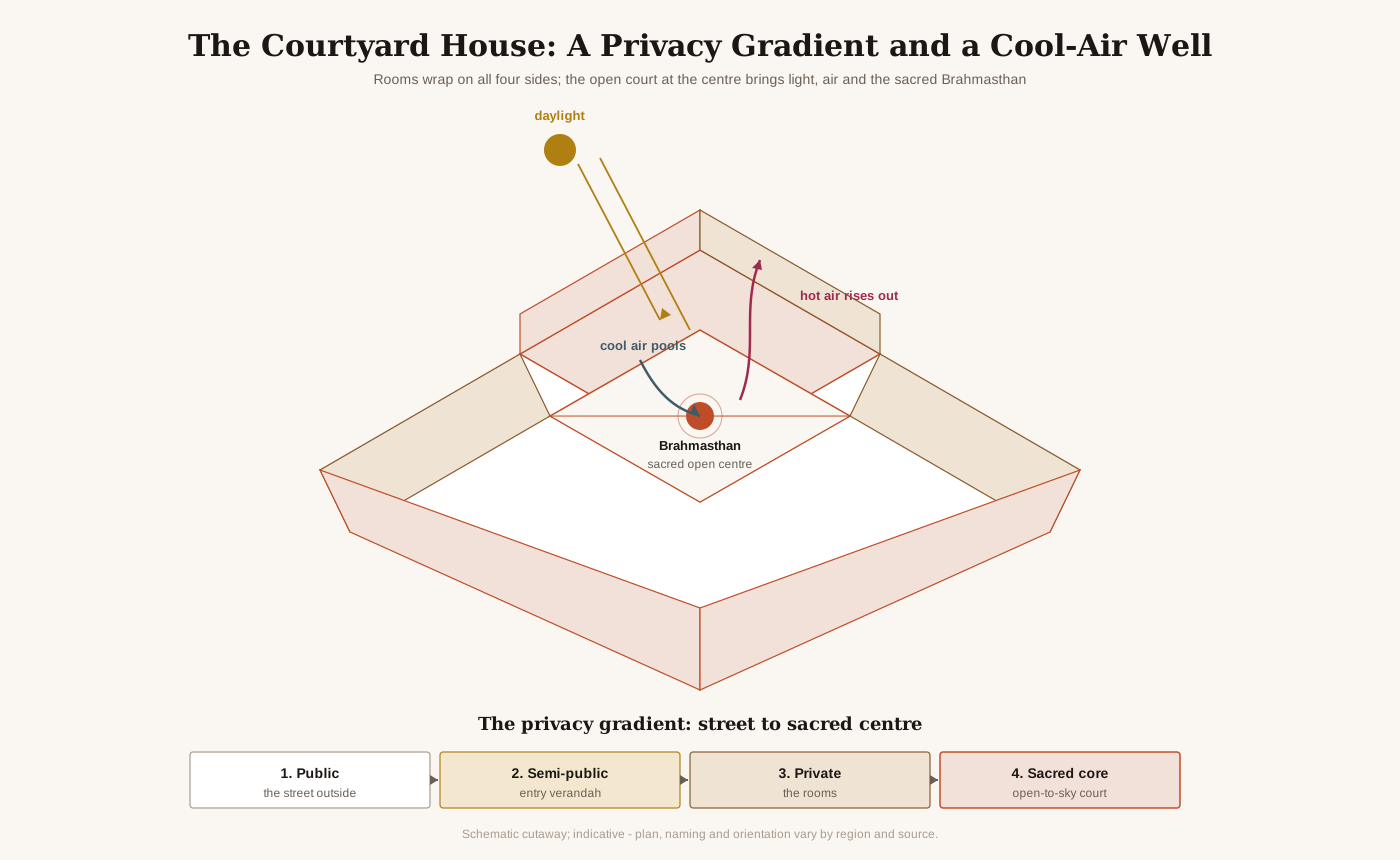
The joint family needs a building that can hold several generations under one roof while still granting privacy. Indian society is organised around gradients — from the public street, to the semi-public verandah where guests are received, to the private interior, and on to the most protected zone of all (historically the zenana, the women's quarters, in many traditions). Settlement itself often followed caste and community patterns, producing the distinct street grain of an old Indian town. And over all of it lies the ritual framework of Vastu Shastra, the doctrine that orients a house to the cardinal directions and the cosmos. Its diagram, the Vastu Purusha Mandala, places a sacred open centre — the Brahmasthan — at the heart of the plan, a centre that is frequently left literally open to the sky. Much of this building was incremental, the family adding rooms as it grew, owner-built across generations.
The courtyard: India's master-stroke
If there is one device that unites the Indian vernacular across climate and culture, it is the courtyard — an open-to-sky space held within the house. It is at once a climatic instrument (a shaded cool-air well in the heat, a light-well, a place the hot air can escape upward) and a social instrument (a safe interior world for the family, a stage for ritual, work and festival, the multi-generational heart of the home). It is the physical form of the Brahmasthan idea. Almost every region evolved its own courtyard house, and tellingly, each gave it its own name.
| Region | Local name for the courtyard house / court |
|---|---|
| Kerala | Nalukettu (literally a four-block house around a central court) |
| Rajasthan & North India | Haveli (the courtyard mansion) |
| Maharashtra | Wada |
| Bengal | Rajbari (the grand courtyard manor) |
| Hyderabad / Deccan | Deori |
| The Hindi belt (generic) | Angan or chowk (the courtyard itself) |
The courtyard is the one room with no roof — and in India it is often the most important room in the house.
Craft and the treatises
This intelligence was carried not in textbooks but in living craft traditions and, at the elite end, in written treatises. India produced a remarkable body of architectural-ritual literature. The Mayamata is a Vastu-shastra of South Indian origin covering site selection, orientation, dimensions, materials, and the laying-out of villages, houses, palaces and temples (the modern scholarly edition is by Bruno Dagens, published by IGNCA and Motilal Banarsidass). The Manasara is a comprehensive Sanskrit treatise on architecture, also of South Indian origin, in circulation by around the fifth to seventh centuries CE. Over them all sits Vastu Shastra as the umbrella doctrine. Kerala, characteristically, had its own domestic manual — the Manushyalaya Chandrika, a Kerala manual on the architecture of the dwelling-house specifically.
These texts were realised by hereditary master-builders, who carried different titles across India:
- Sthapati — the highest title, the temple-and-house master-architect, associated with Tamil Nadu and the Vishwakarma community.
- Sompura — the temple-building lineage of Gujarat and Rajasthan.
- Thachan — the Kerala carpenter and master-builder, in whose hands timber became architecture.
- Mistri — the mason of North India.
It is worth holding the tension here: the treatises and the master-builders sit at the "high" end, shading into the pedigreed temple tradition, while the everyday house was built by villagers within inherited custom. The vernacular runs continuously between the two.
6. Region by Region — A Reader's Overview
With the three lenses in hand, here is the eight-region map of this cluster. Each row is a doorway: read down for the quick characterisation, then follow the link into the dedicated guide for the full study of typologies, materials, plans and settlements.
| Region | Climate | Signature in one line | Deep-dive |
|---|---|---|---|
| Kerala | Warm & humid | The timber-and-tile Nalukettu courtyard house — steep roofs, deep verandahs, raised plinth, the carpenter (thachan) as artist | Kerala guide |
| Tamil Nadu | Hot, with a warm-humid coast | The courtyard house and the sthapati tradition of South Indian building and temple craft | Tamil Nadu guide |
| Karnataka | Temperate plateau & humid coast | Plateau courtyard houses and a distinct warm-humid coastal vernacular | Karnataka guide |
| Rajasthan | Hot & dry | The sandstone-and-mud haveli — thick walls, jaali, courtyards, the hot-dry logic at its finest | Rajasthan guide |
| Gujarat | Hot & dry to composite | Carved timber havelis, the pol neighbourhoods — and, in Kutch, the circular mud bhunga | Gujarat guide |
| Ladakh | Cold (high-altitude desert) | Compact flat-roofed stone-and-mud houses, south-facing, "stable below, living above" | Ladakh guide |
| Bengal | Warm & humid | The curved-roof bangla hut (ancestor of the word "bungalow"), terracotta brick, the rajbari | Bengal guide |
| North-East India | Warm-humid to cold hills | Bamboo, timber and thatch tribal and community dwellings, often raised on stilts | North-East guide |
A note worth carrying across the cluster, because it is commonly confused: the circular mud-and-mirror-work house called the bhunga belongs to Kutch in Gujarat, not to Rajasthan — its rounded form is a brilliant response to both the desert heat and the region's seismic risk.
7. How to Read — and Learn From — Vernacular Today
The point of all this is not to build mud copies of old houses. The vernacular is a body of principles to be adapted, not a catalogue of forms to be photocopied — and Rapoport's anti-determinism cuts both ways here. Just as climate did not fully make these houses, climate alone will not justify reviving them; the social and economic life they grew from has changed. There are honest difficulties to face: durability, scaling, sanitation and seismic safety all demand good detailing and real engineering. And there is a stubborn cultural problem — the aspirational reading of "pucca" (the solid, modern, concrete house) against "kuccha" (the mud or temporary house), which wrongly codes earth as the material of poverty.
So how should you actually read a vernacular building when you stand in front of one? Run the three lenses, in order:
1. Climate. Which zone is this, and is the building holding still (mass) or letting the air through (lightness and ventilation)? Where is the shade coming from?
2. Materials. What is local here, and how does the building reflect what lies within a few kilometres? What is its likely embodied-energy story?
3. Culture. Where is the privacy gradient — street, verandah, interior, courtyard? Where is the open centre? What does the plan tell you about the family and the rituals it housed?
Read this way, vernacular India stops being a picturesque relic and becomes what it always was — a vast, distributed, field-tested body of design intelligence. The mature position, and the one this cluster argues for, is to carry its principles forward with contemporary engineering: the courtyard and the cross-vent, the thermal mass and the deep verandah, the light surface and the local material. Our two thematic companions take this the rest of the way — why vernacular design is returning in India makes the cooling-and-carbon case and profiles the practitioners reviving it, and vernacular lessons for modern Indian homes translates the principles into things you can actually do in a new house. If you want to see where the old and the new meet head-on, modern versus traditional Indian house architecture sets them side by side.
References & Further Reading
Foundational / Theory
- Bernard Rudofsky, Architecture Without Architects: A Short Introduction to Non-Pedigreed Architecture (Museum of Modern Art, 1964) — the field's founding exhibition and catalogue.
- Paul Oliver (ed.), Encyclopaedia of Vernacular Architecture of the World, 3 vols (Cambridge University Press, 1997); and Dwellings: The House Across the World (1987, reissued as Dwellings: The Vernacular House Worldwide). (His 1969 Shelter and Society is a separate, earlier work.)
- Amos Rapoport, House Form and Culture (Prentice-Hall, 1969) — the case that culture, not climate alone, shapes the house.
Regional / Indian sources
- V. S. Pramar, A Social History of Indian Architecture (Oxford University Press); and Haveli: Wooden Houses and Mansions of Gujarat.
- Kulbhushan Jain, Thematic Space in Indian Architecture; and Mud Architecture of the Indian Desert (CEPT).
- Miki Desai, Wooden Architecture of Kerala (Mapin, 2018); and (with Madhavi Desai) Architecture and Independence (Oxford University Press, 1997).
- G. H. R. Tillotson, The Tradition of Indian Architecture (Yale University Press, 1989).
- Charles Correa, A Place in the Shade (Penguin India, 2010).
- Vistara: The Architecture of India — exhibition catalogue, ed. Carmen Kagal (Festival of India, 1986; introduction by Charles Correa).
- On the treatises: the Mayamata, scholarly edition by Bruno Dagens (IGNCA / Motilal Banarsidass); the Manasara; and the Kerala domestic manual Manushyalaya Chandrika.
Companion Studio Matrx guides
- Regional deep-dives: Kerala · Tamil Nadu · Karnataka · Rajasthan · Gujarat · Ladakh · Bengal · North-East India
- Thematic: Why vernacular design is returning in India · Vernacular lessons for modern Indian homes
- Related: Tropical architecture in India · Modern versus traditional Indian house architecture
- Explore further: house plans · architects · all guides
Author's Note: I have spent a good part of my life standing in courtyards — listening to the way the air changes as you step in from the street — and I have never stopped being moved by how much these unsigned builders knew. They were not primitive. They were precise. We dishonour them when we romanticise their houses into folklore, and we dishonour them again when we dismiss mud as the material of the poor. The truth in between is the interesting one: an inheritance of climate-tested, culture-shaped, low-carbon intelligence, waiting to be read carefully and carried forward with the engineering we now have. — Amogh N P
Disclaimer: Vernacular terms, spellings and datings vary considerably across sources, regions and languages; named examples and their conservation status change over time. This is an educational overview, not a technical or conservation specification — verify specifics against the cited scholarship and local authorities before relying on them. No liability is assumed for decisions made on the basis of this article.
Export this guide
Related Guides — Deep-dive reading
Vernacular Architecture — Lessons for Modern Homes
Regional Building Traditions of India and Their Architectural Logic — A Reference for Contemporary Practice
Design StylesOrientation, Light & Views: Designing With Your Space, Not Against It
How reading your plot's sun, breeze and views — and placing each room on the right face — gives an Indian home that is cooler, brighter and quietly right, instead of one that fights its site forever.
Design PrinciplesJawahar Kala Kendra: How Charles Correa Turned a City's Horoscope into a Building
In Jaipur, Charles Correa organised a national arts centre as nine squares of the navagraha mandala — the same cosmic diagram that laid out the eighteenth-century city around it — then prised one square loose and hollowed out the centre. A study of the plan as argument: how an 'archaic notion of the Cosmos' became a working piece of contemporary civic architecture, and what its inward, fortress-walled world tells us about where architecture goes when it stops copying tradition and starts thinking with it.
The Future of ArchitectureRelated Tools — Try Free
Cross-Ventilation Analyzer
Estimate airflow and air changes per hour (ACH) from room size, window areas, layout, and local wind — with NBC 2016 Part 8 compliance check.
Ventilation CalculatorBrise-Soleil Visualizer
Interactive horizontal-louvre cut-off angle calculator — sun altitude, louvre depth, and spacing inputs with a live shadow preview. Computes θ = arctan(spacing/depth) for façade shading, ECBC envelope compliance, hospital daylight design, and tropical sun-control detailing.
Sun Shading ToolWindow Orientation Planner
Pick the best window type, glass and shading by wall direction — north, east, south and west.
Window Tool