
Rural Housing Layout Design
Planning a village housing layout from the land up — the gram-sabha process, clustered agrarian homesteads, the commons, cart lanes and decentralised services, funded through PMAY-G and SPMRM
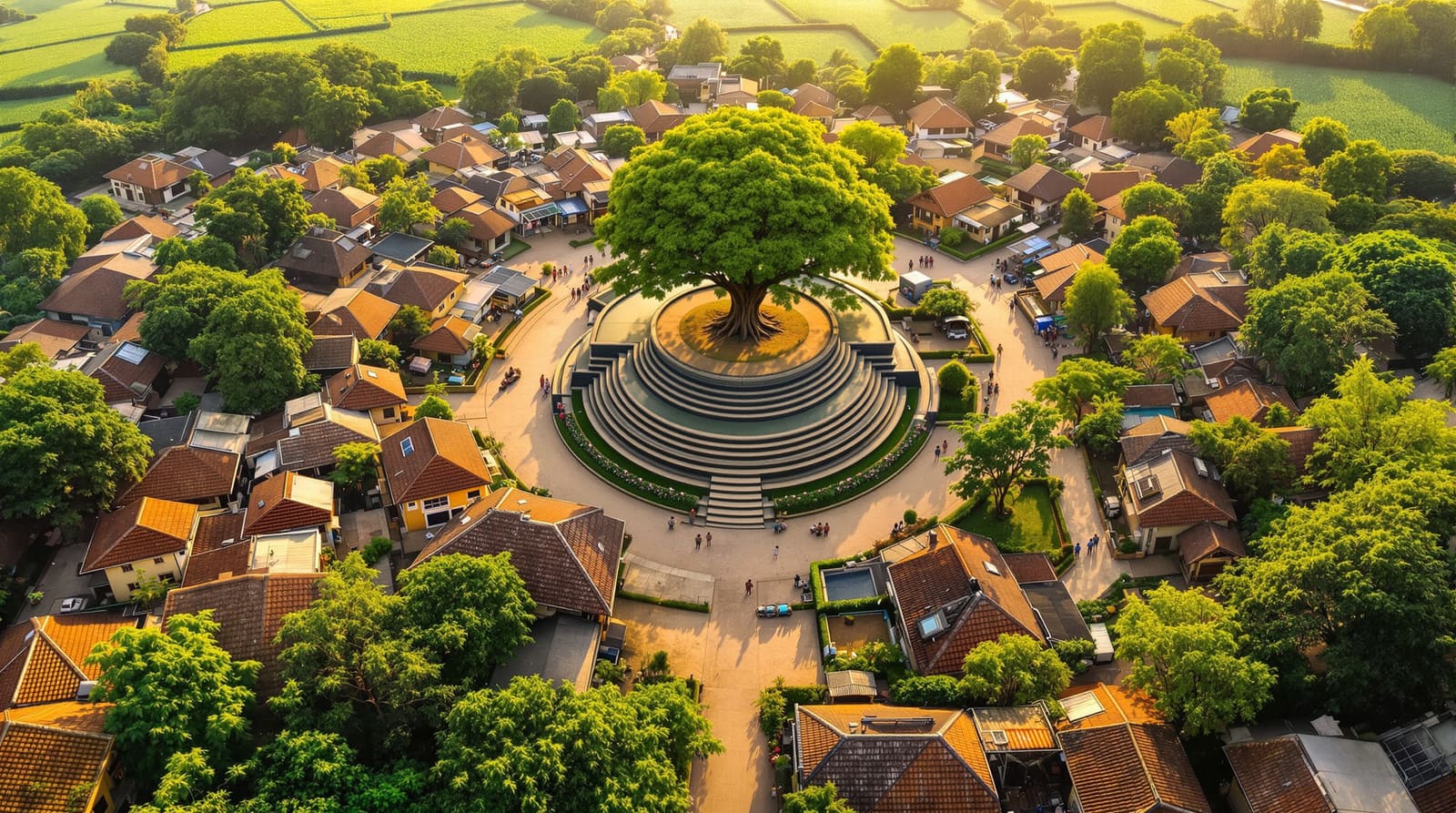
Before the sun is fully up over a village in the Deccan, the day's geometry is already drawn in motion. Cattle move out of low courtyards toward the grazing ground; a tractor noses down a lane just wide enough for it; women carry pots from the stepped tank near the peepal tree where, by mid-morning, the old men will sit on the chabutara and the day's small disputes will be settled. The temple marks one edge of the open square, the school another, and beyond the last ring of houses the fields begin without ceremony. Nobody planned this. It accreted over generations, each homestead added where land, kinship and the water source allowed.
Now imagine a planner is asked to lay out a new habitation for fifty resettled families on the village's abadi land, or to extend an existing gram under a Rurban grant. The temptation is to reach for the urban toolkit — a grid of plots, a road hierarchy, a park — and stamp it onto the fields. That toolkit will fail here, because it solves the wrong problem. A rural housing layout is not a small town; it is a working agrarian landscape with homes in it, and the layout succeeds only when it keeps the farm, the cattle, the water and the commons working together.
Why the village scale is a different discipline
The urban how to design a residential layout guide is built around a subdivision logic: maximise sellable plots within a road network, hit a density target, provide reticulated water and sewerage, set aside a regulated percentage of open space. Every one of those assumptions bends or breaks in a village.
In a village, the plot is not a product to be sold; it is a homestead that has to house a family, its cattle, its grain and its kitchen garden. The "open space" is not a manicured park; it is the threshing floor, the cattle ground and the tank that the settlement cannot function without. Services are not piped from a distant plant; they are decentralised, low-cost and locally maintained, because there is no municipal utility to bill. And the layout is not approved by a development authority but legitimised through the gram sabha — the assembly of all adult villagers — under the powers the 73rd Constitutional Amendment gave to panchayats.
So the rural layout designer works less like a subdivider and more like a careful reader of an existing system. The process below is the spine of this guide, and each step opens onto a sibling article that goes deeper.
Step one: read the land, the water and the existing settlement
Before a single line is drawn, walk the land in the dry season and again imagining the monsoon. Where does water collect and where does it run off? Where is the water table — and is it falling, as it is across so much of peninsular and northern India where borewells have outrun recharge? The natural drainage, the high ground safe from flood, the existing tank or johad, the sacred grove that must not be touched: these are fixed points the layout obeys, not obstacles it clears.
Equally, read the existing settlement. A new habitation almost never sits on empty land; it extends or relates to a living village with its own street grain, its caste and kinship clustering, its temple and burning ground. The Indian vernacular architecture of the region — the courtyard house of the hot-dry plains, the verandah-and-pitched-roof house of the wet coast — already encodes a climate-tested answer to form. Good rural planning extends that grain rather than overwriting it, which is also why vernacular design is returning in serious rural work.
Step two: the gram sabha, abadi land and SVAMITVA
Rural land tenure is the part urban planners most often underestimate. Much village habitation sits on abadi or lal-dora land — the inhabited area historically outside revenue survey, where residents had possession but frequently no formal title. The SVAMITVA scheme (Survey of Villages and Mapping with Improvised Technology in Village Areas) is now drone-mapping these abadi areas and issuing property cards, which for the first time gives many households a recordable asset and gives planners a reliable base map.
Procedurally, a rural layout lives or dies in the gram sabha. The panchayat may allot common land for housing, but the assembly must endorse it; the threshing floor, the cattle ground (gauthan) and the tank are commons whose reallocation is contentious and rightly so. Treat this not as a clearance to obtain but as a design input — what the community will defend tells you what the layout must protect.
Step three: the homestead, not the plot
This is where the rural unit diverges most sharply from the urban plot. A village homestead is a small working compound, and the layout has to give it room to be one.
A functioning homestead typically wants: the dwelling itself, often single-storey and courtyard-centred; the courtyard (aangan) as an outdoor work-and-sleep room; a cattle shed and fodder corner with separate, ideally rear, access so dung and animals do not cross the living space; a grain store or small storage structure; and a kitchen garden or a few trees — the best trees for Indian homes double as shade, fruit and fodder. A PMAY-G dwelling unit is modest (the scheme funds a pucca house of roughly 25 sq m as a minimum core), but the plot around it must allow the agrarian functions to fit, or families will improvise them into the lanes and commons anyway.
This is why rural plots are generally larger and lower in density than urban ones, and why density targets borrowed from residential density planning for towns simply do not translate.
Step four: the agrarian logic — design the threshing floor in, not out
The single most common planning failure in rural layouts is designing out the things that look "untidy" to an urban eye: the threshing floor (khalihan), the cattle ground, the open storage. These are not blight; they are the economy. A layout that erases the threshing floor forces it back onto a road or the tank bund, where it does real harm.
So the agrarian functions are first-class elements of the plan. Farm plots need cart and tractor access from the habitation — which means at least some lanes carry farm vehicles, not just two-wheelers and pedestrians. Dairy cattle need a route to the grazing ground that does not run through the heart of the settlement. Grain needs a place to dry and be stored at scale. The haat or weekly market, if the village hosts one, needs an edge location with vehicle access. Get this logic right and the rest of the layout almost arranges itself.
Step five: cluster or disperse?
A foundational choice is the settlement pattern — and it is the subject of two siblings worth reading in full.
Clustering homesteads tightly (the nucleated village) shortens every service run — one short pipe network, one solar microgrid, one short lane to sweep — and it frees the surrounding land as continuous farmland and commons. It also concentrates social life. Dispersed or linear settlement (homes strung along a road or scattered near their own fields) suits some terrains and farming systems but multiplies the cost and difficulty of every shared service. For most planned rural housing in India the compact cluster wins on cost and on commons, which is the case made in cluster village development, while the wider design philosophy — extending the organic grain, keeping the village legible and walkable — is the territory of modern village planning principles.
Step six: the village street and cart access
Streets in a village are not a road hierarchy borrowed from the town. The organising rule is foot-and-livestock priority, with vehicle access provided where it must be — to each homestead for emergencies and goods, and along selected lanes for tractors and carts. Surfaces are mixed: an all-weather spine (often a PMGSY road connecting the village to the main road and the bus stop at the edge) and unpaved or block-paved internal lanes. The streets also double as social space, shaded and human-scaled. Because this is its own craft — widths, turning, drainage, the bus-stop edge — it has a dedicated sibling in village street planning; contrast it deliberately with the urban street hierarchy, which optimises for through-traffic the village neither has nor wants.
Step seven: the commons and the social nodes
If the homesteads are the cells, the commons are the village's living tissue, and they are not a leftover percentage — they are the heart. The tank or pond (talab, kere, johad) with its steps; the chaupal or village square with its chabutara; the temple, mosque or church as the orienting node; the school and anganwadi; the cattle ground and the threshing floor. These are placed first, at the centre and the natural water point, with the homesteads gathered around them. This is a different intent from the urban open space planning of parks and tot-lots, and the rural version — productive, sacred, civic, all at once — is detailed in community open spaces in villages.
Step eight: decentralised water, sanitation and power
Because there is no municipal grid, rural services are decentralised by necessity and low-cost by design. Water comes from a mix of revived tanks, percolation ponds and check dams (often built through MGNREGA labour), community and rooftop rainwater harvesting, and the tap connection that the Jal Jeevan Mission is extending to households — all against the hard backdrop of a falling water table. The full water strategy is its own sibling, water-sensitive rural planning, the rural cousin of water-sensitive urban design.
Sanitation under Swachh Bharat Mission – Gramin leans on the twin-pit toilet, which composts on site, and on decentralised greywater treatment (DEWATS) rather than a sewer. Power increasingly means rooftop solar and solar microgrids, with biogas (gobar-gas) from cattle dung doing double duty as cooking fuel and slurry fertiliser. Roads, drainage and digital connectivity round out the picture. All of this — the engineering of services without a grid — is the subject of rural infrastructure planning.
A land-use template for a village layout
There is no single mandated split for a village layout the way there is for an urban scheme; the right balance depends on terrain, farming system and how much farmland is being kept within the boundary. The table below is an honest planning starting point for a compact, cluster-form habitation, to be adjusted in the gram sabha — not a regulation.
| Land use | Indicative share | What it holds & why it matters |
|---|---|---|
| Homesteads (house + courtyard + cattle + garden) | 45–55% | The dwelling plots; larger & lower-density than urban plots because each is a small agrarian compound |
| Lanes & cart access | 10–15% | Foot-, livestock- & cart-priority; an all-weather spine plus unpaved internal lanes |
| Commons & social nodes | 12–18% | Tank, chaupal, temple/mosque/church, school & anganwadi, cattle ground & threshing floor |
| Water bodies & recharge | 5–10% | Tank, percolation pond, check dams & harvesting structures — designed first, around the natural drainage |
| Farmland edge & buffers | balance | Kept as continuous productive land & climate buffer wrapping the settlement |
Make it real: schemes, money and participation
A rural layout becomes buildable through a patchwork of central schemes, and a planner has to know the patchwork. PMAY-G funds the individual pucca houses (with the unit cost shared between centre and state and a higher allowance in hilly and difficult areas), but it funds houses, not layouts. SPMRM — the Shyama Prasad Mukherji Rurban Mission — is the scheme closest to funding the whole settlement as a "Rurban cluster," bundling housing, roads, water, sanitation and economic infrastructure for a group of villages. MGNREGA supplies the labour and many of the durable assets (tanks, roads, plantations). Jal Jeevan Mission, Swachh Bharat Mission – Gramin and PMGSY each carry a piece. The realistic budget is therefore a stack, not a single grant, and phasing follows the funding — core houses and the all-weather spine first, services and commons as money arrives.
The non-negotiable input is participation. The gram sabha is not a rubber stamp; in the spirit of Gandhi's village swaraj, the village should author its own layout to the greatest degree possible. Practically, that means designing with the community, mapping the commons they will defend, and accepting that the "messy" agrarian functions are the brief. The forward-looking variants of all this — settlements built to ride out flood, drought and heat in climate-responsive rural settlements, the future rural housing models that may follow as villages age and migrate, and the connectivity-led smart villages — all sit downstream of getting this fundamental process right.
References
1. Ministry of Rural Development, Government of India — Pradhan Mantri Awaas Yojana – Gramin (PMAY-G): Framework for Implementation.
2. Ministry of Rural Development — Shyama Prasad Mukherji Rurban Mission (SPMRM): Framework for Implementation.
3. Ministry of Panchayati Raj — SVAMITVA Scheme guidelines and the 73rd Constitutional Amendment Act, 1992.
4. Ministry of Urban Development — URDPFI Guidelines, 2014 (Urban and Regional Development Plans Formulation and Implementation).
5. CPHEEO, Ministry of Housing and Urban Affairs — Manual on Water Supply and Treatment and Manual on Sewerage and Sanitation (rural decentralised provisions).
6. M. K. Gandhi — Hind Swaraj and the writings collected as Village Swaraj.
7. Bureau of Indian Standards — National Building Code of India, 2016 (planning and services provisions).
For the philosophy behind extending the village grain see modern village planning principles, and for the commons at the heart of the plan see community open spaces in villages. To explore a layout for your own land, start a plan with DesignAI.
Export this guide
Related Guides — Deep-dive reading
Rural Infrastructure Planning
The hard services of a village — decentralised, low-cost and maintainable: water, twin-pit and DEWATS sanitation, composting and biogas, solar microgrids, all-weather roads and the maintenance problem
Rural Residential PlanningCommunity Open Spaces in Villages
The commons that are a village's true structure — the tank and its steps, the chaupal, grazing ground, threshing floor, sacred grove and tree-plinth — how they are shared, lost to encroachment, and revived
Rural Residential PlanningSmart Villages of India
What a genuinely smart village means — appropriate technology, connectivity and good governance on a foundation of road, water, power and sanitation, honestly separated from smart-city hype
Rural Residential PlanningRelated Tools — Try Free
Rainwater Tank Sizer
How big should your rainwater tank be? Computes annual harvest, recommended tank capacity in litres, water-bill savings, and payback — for 10 Indian cities.
RWH CalculatorGarden Planning Toolkit
Get a tailored garden plan — planting layers, Indian species, features and a checklist — from your climate, space, sun and goals.
PlannerInterior Budget Planner
Live room-wise and component-wise cost breakdown in ₹ with contingency, GST, and PDF summary.
Budget Calculator