
Rural Infrastructure Planning
The hard services of a village — decentralised, low-cost and maintainable: water, twin-pit and DEWATS sanitation, composting and biogas, solar microgrids, all-weather roads and the maintenance problem
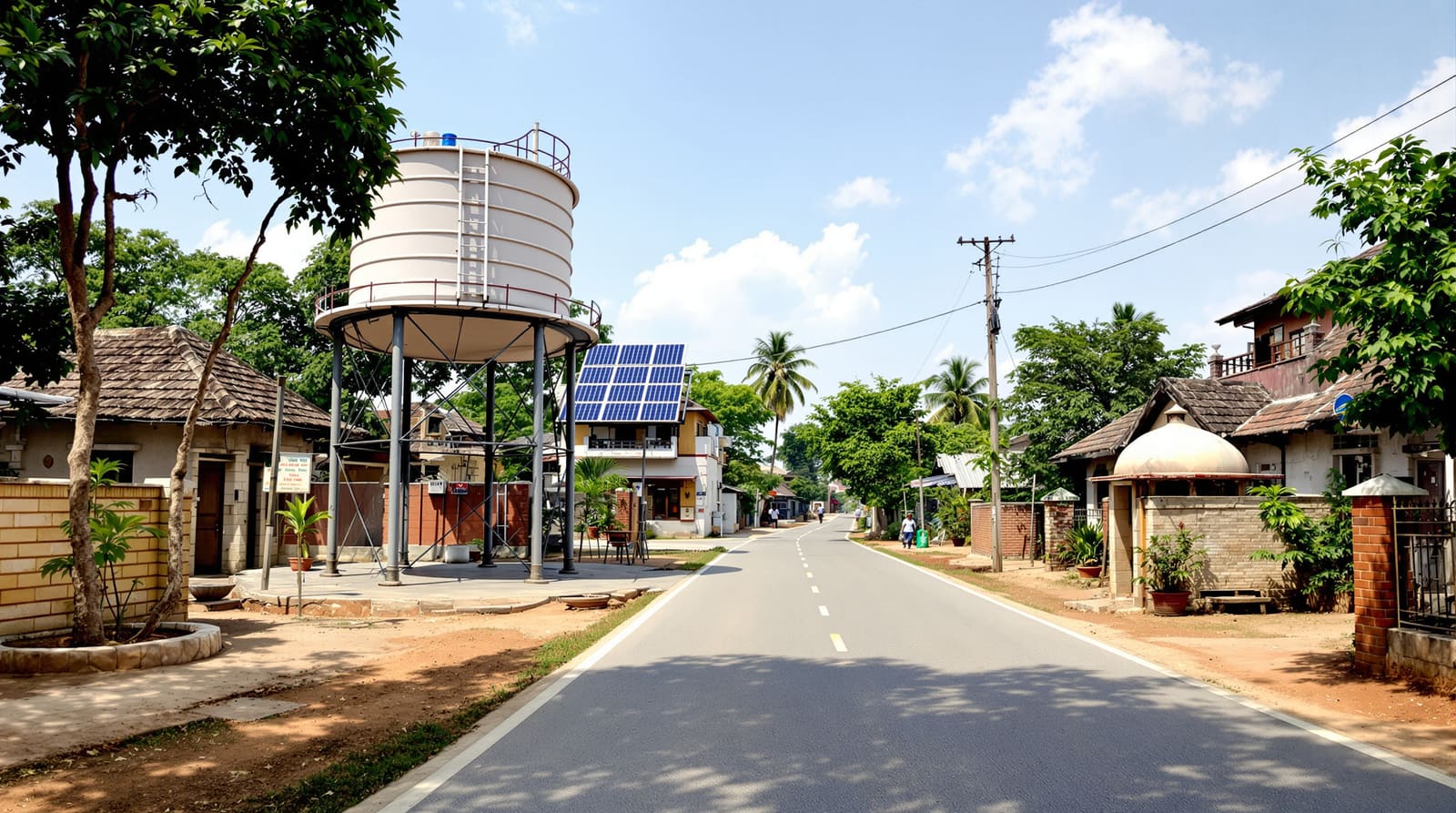
The tap in the courtyard of a house in a Marathwada village runs for forty minutes at dawn, and the whole rhythm of the morning bends around it. A woman fills two steel pots and a plastic drum; a child brushes teeth at the spout; the buffalo is watered last. Up the lane, a blue overhead tank on four concrete legs catches the first light, fed overnight from a borewell that the pump operator — a neighbour, paid a small honorarium by the gram panchayat — switches on when the power comes. Behind the cattle shed, a dome of plastered brick burps gently: the family's gobar-gas plant, eating last night's dung and giving back a clean blue flame for the morning tea. None of this looks like a city. There is no treatment plant humming at the edge of town, no manhole every thirty metres, no substation behind a fence.
And that is exactly the point. The village runs on a constellation of small, owner-near, low-maintenance systems rather than one big centralised machine. When the tank cracks or the pump burns out, the question that decides everything is not whether the engineering was clever — it is whether somebody in the village knows how to fix it, and whether there is money in the panchayat account to pay for the part. Rural infrastructure planning succeeds when the hard services are designed to be decentralised, frugal and — above all — locally maintainable, because in a village the asset that cannot be repaired by ordinary means is an asset that will be abandoned.
The opposite of the piped city
It helps to name what we are not doing. The urban approach — set out in our companion piece on utility planning in residential layouts — assumes a centralised spine: a trunk water main pressurised from a city reservoir, a gravity sewer network running to a single treatment plant, a grid substation, kerbside ducts for cables. It is an elegant model when you have density, capital, a continuous power supply and a municipal body with engineers on its payroll. A village has almost none of those. Households are spread thin, so a metre of pipe or sewer serves far fewer people; capital is scarce; and the "utility" is often a part-time water operator and a few MGNREGA workers, not a department.
So rural infrastructure inverts almost every urban assumption. Instead of one big sewer, you scatter twin-pit toilets and soak pits so that each household manages its own waste close to source. Instead of a single regional grid feeder you reach for solar microgrids and rooftop panels that keep working when the line trips. Instead of a centralised waste-to-energy plant you put a biogas dome behind each cattle shed. The logic is not poverty dressed up as virtue — it is appropriate engineering. A decentralised system has no single point of failure, needs no kilometres of pipe to break, and can be built incrementally as the gram sabha finds funds. The trade-off is that maintenance is distributed too, which is both the strength and the weakness of the whole model.
Water: the tap, the tank, and the harder question underneath
The most visible change in rural India over the last few years is the household tap. The Jal Jeevan Mission set out to bring a functional household tap connection to every rural home, and in much of the country the overhead tank and the courtyard tap are now ordinary. The planning pattern is simple and robust: a source (a borewell, an open well, or a village tank), a pump, an overhead storage tank sized for a day or so of demand, and a gravity distribution network of small-bore pipes to each house. Gravity does the work, which means fewer moving parts to fail.
But a tap is only as good as the water behind it, and this is where rural planning has to be honest. A borewell that is over-pumped chases a falling water table downward year after year; a tank that silts up or a catchment that has been built over stops recharging. The piping is the easy part — source sustainability is the hard part, and it is a watershed question, not a plumbing one. We deliberately keep that depth in our companion guide on water-sensitive rural planning, which covers check dams, percolation ponds, the johad and the kere, and the recharge thinking that keeps the source alive. For the infrastructure planner the discipline is this: never commission a distribution system without first asking who is protecting the source, because a dry tap is worse than no tap — it teaches people the system has failed.
Sanitation and solid waste: keep it close, keep it small
Sanitation is the clearest illustration of the decentralised rule. The Swachh Bharat Mission — Gramin built tens of millions of household toilets, and the technology of choice was deliberately humble: the twin-pit pour-flush latrine. Two leach pits are used in turn; while one fills the other rests, and after a year or two the rested pit yields a safe, dry, odourless manure that goes to the fields. There is no sewer, no pump, no treatment plant — just a pour of water and the soil doing the work. For washwater from kitchens and bathing, soak pits and small decentralised wastewater treatment systems (DEWATS) — settling tanks followed by planted gravel filters — clean greywater on site so it can recharge the ground or irrigate a garden rather than pooling in the lane.
Solid waste follows the same close-to-source logic. The non-negotiable first step is segregation at the household: wet from dry. The wet fraction — the bulk of village waste — is organic and belongs in a compost pit or, where there is enough cattle, a biogas digester. The dry recyclables are collected and sold; only a small inert residue needs disposal. A village that segregates well barely needs a landfill at all. The contrast with the city could not be sharper: where the urban layout exports its waste through a sewer and a truck to somewhere else, the village turns most of its waste back into manure and gas a few metres from where it was produced.
The dung-and-gas economy
Of all the village systems, the one that best captures frugal-but-durable engineering is the gobar-gas plant. Cattle and dairy are central to most agrarian villages, and where there are cattle there is dung — a problem and a resource at once. A masonry biogas digester takes the daily dung slurry, lets bacteria break it down without oxygen, and produces methane for cooking and a nutrient-rich slurry that goes straight back to the fields as manure. One plant can replace a household's firewood or cylinder for cooking and cut the smoke that damages women's lungs. Nothing is wasted: the dung that would have dried into cakes becomes a clean flame and then, as slurry, becomes next season's fertiliser.
This is a closed loop, and it is the kind of system that pays a planner to design for. Siting the gauthan — the common cattle ground — and the dairy collection point near the cluster of biogas plants, with a short, paved, washable approach so dung can be moved without churning the lane to mud, turns three separate problems (cattle management, cooking energy, soil fertility) into one tidy circuit. It is the village answer to the urban utility trench: not a buried pipe, but a metabolic loop.

Energy, roads and the digital layer
For energy the planning principle is reliability over sophistication. The grid reaches almost every village now, but rural feeders trip, sag and brown out, so the resilient design treats the grid as one source among several: rooftop solar on homes and the panchayat building, a solar microgrid with battery storage for the cluster, and biogas for cooking. A street-lighting circuit on standalone solar poles keeps the lanes lit even when the line is down. The aim is not the highest technology but the fewest dark nights.
Connectivity is what lifts a serviced village into a livable one. The all-weather road — the kind built under the Pradhan Mantri Gram Sadak Yojana (PMGSY) — is arguably the single highest-return piece of rural infrastructure, because a road that does not dissolve in the monsoon is what lets a sick child reach a hospital, a crop reach the market, and a teacher actually turn up. Inside the village, the lane hierarchy matters too; we treat the cart, tractor, foot and livestock widths in detail in village street planning, so here it is enough to say that the internal network must connect every cluster to that all-weather spine and to the bus stop at the village edge. The digital layer — the BharatNet fibre backbone and the Common Service Centre where a villager applies for a certificate, pays a bill or books a service — is the newest service, and the governance-and-"smart" side of it lives in our companion on smart villages.
Who builds it, who runs it — and the asset that gets abandoned
| Service | The rural (decentralised) solution | Who builds & runs it |
|---|---|---|
| Water supply | Borewell / well / tank source, pump, overhead tank, gravity pipes (Jal Jeevan Mission) | Panchayat & village water committee; state rural water dept builds |
| Toilets & faecal waste | Household twin-pit pour-flush latrine (Swachh Bharat — Gramin) | Each household; SBM-G funds construction |
| Greywater | Soak pits & small DEWATS planted filters | Household / cluster; panchayat for shared units |
| Solid waste | Source segregation, composting, biogas from dung | Self-help groups & panchayat staff; MGNREGA labour |
| Energy | Grid + rooftop solar + solar microgrid + biogas | Discom for grid; panchayat / agency for solar & biogas |
| Roads | All-weather approach road (PMGSY) + paved internal lanes | PMGSY agency builds; panchayat & MGNREGA maintain |
| Digital | BharatNet fibre + Common Service Centre kiosk | BharatNet agency; a local VLE runs the kiosk |
Read that last column carefully, because it is where rural infrastructure quietly fails. The 73rd Constitutional Amendment made the gram panchayat the local government, and the scheme alphabet soup — Jal Jeevan, SBM-G, PMGSY, the Rurban cluster under SPMRM — is generous with capital to build. The chronic weakness is on the right-hand side: operation and maintenance. A tank is built, a road is laid, a microgrid is commissioned, and then there is no line item, no trained hand, and no spare-parts budget to keep it running. India's villages are dotted with the evidence — defunct overhead tanks, solar lights that died when the battery did, toilets used as store rooms. The asset built then abandoned is the central failure mode of rural infrastructure.
So the planner's real job runs past the drawing. Sequence the build so that water and the all-weather road come first (everything else depends on them), then sanitation and energy, then the digital and dairy infrastructure. Size each system to what the panchayat can actually run: a microgrid a local technician can service beats a sophisticated plant that needs a city engineer. And budget the recurring cost up front, per household, as honestly as the capital cost — a tariff the village agrees to, a fund the gram sabha controls, a trained operator paid from it. Affordability in a village is not the one-time cost; it is the annual cost of keeping the thing alive. This service-systems discipline sits inside the wider settlement process set out in the rural housing layout design pillar, which is where the lanes, plots, commons and these services are knitted into one plan.

Making it real in the village
Bring it down to the gram sabha meeting, because that is where infrastructure either gets owned or gets orphaned. The choices are concrete: where the overhead tank stands, who holds the pump-house key, what the monthly water charge is, who empties the rested twin-pit, who is paid to sweep and segregate, who is the Village Level Entrepreneur at the Common Service Centre. MGNREGA can supply the labour to dig the soak pits, lay the internal lanes and desilt the source tank, turning an employment scheme into durable assets when the works are chosen well. The commons — the gauthan, the tank, the chaupal — become the anchor points where shared infrastructure naturally clusters.
The frugal-but-durable ethos has a long lineage here; it is village swaraj in pipework — the conviction that a village should, as far as it can, run its own services rather than depend on a distant machine. The art is to honour that self-reliance without romanticising it: decentralised does not mean primitive, and low-cost does not mean short-lived. A twin-pit that lasts twenty years, a tank a neighbour can repair, a microgrid a local technician keeps humming — these are sophisticated choices, just sophisticated about the right thing, which is endurance. Get that right and the dawn tap keeps running, the morning flame keeps burning, and the village keeps its own lights on.
References
- Ministry of Jal Shakti, Department of Drinking Water & Sanitation — Jal Jeevan Mission operational guidelines and Swachh Bharat Mission (Gramin) twin-pit guidance.
- Ministry of Rural Development, Government of India — PMGSY (Pradhan Mantri Gram Sadak Yojana) and MGNREGA asset-creation guidelines.
- Ministry of Rural Development — SPMRM (Shyama Prasad Mukherji Rurban Mission) cluster framework.
- The Constitution (Seventy-third Amendment) Act, 1992 — devolution to Panchayati Raj institutions.
- CPHEEO, Ministry of Housing & Urban Affairs — Manuals on Rural Water Supply and on Sanitation / decentralised wastewater (DEWATS) practice.
- URDPFI Guidelines, 2014 (Ministry of Urban Development) — norms for settlement-level infrastructure and services.
- M. K. Gandhi, "Hind Swaraj" / village swaraj writings — self-reliant village services.
For the source-sustainability and watershed depth behind the village tap, read water-sensitive rural planning; for the digital and governance "smart" layer, see smart villages; and plan the hard services as part of a whole settlement with DesignAI.
Export this guide
Related Guides — Deep-dive reading
Smart Villages of India
What a genuinely smart village means — appropriate technology, connectivity and good governance on a foundation of road, water, power and sanitation, honestly separated from smart-city hype
Rural Residential PlanningWater Supply Systems in India: How Water Reaches Every Tap in Your Home
The complete map of how water gets into an Indian home and out to every fixture — the sources it comes from, the sump-pump-overhead-tank storage model that buffers intermittent supply, how gravity and pressurised distribution differ, and the demand figures that size the whole thing.
PlumbingModern Village Planning Principles
Marrying the organic Indian village's wisdom with what modernity must add — commons first, cluster for community, mixed livelihood, decentralised self-reliance and participatory gram-sabha planning
Rural Residential PlanningRelated Tools — Try Free
Rainwater Tank Sizer
How big should your rainwater tank be? Computes annual harvest, recommended tank capacity in litres, water-bill savings, and payback — for 10 Indian cities.
RWH CalculatorApartment vs Villa Interior Planning Guide
Compare ceiling height, structural flexibility, lighting, storage, and services between apartments and villas.
Planning GuideApartment Video Door System Planner
Enter flats, entrances, floors and guard desk for a first-pass building intercom plan — door stations, indoor monitors, guard station, the right architecture and an indicative cost band.
Building Planner