
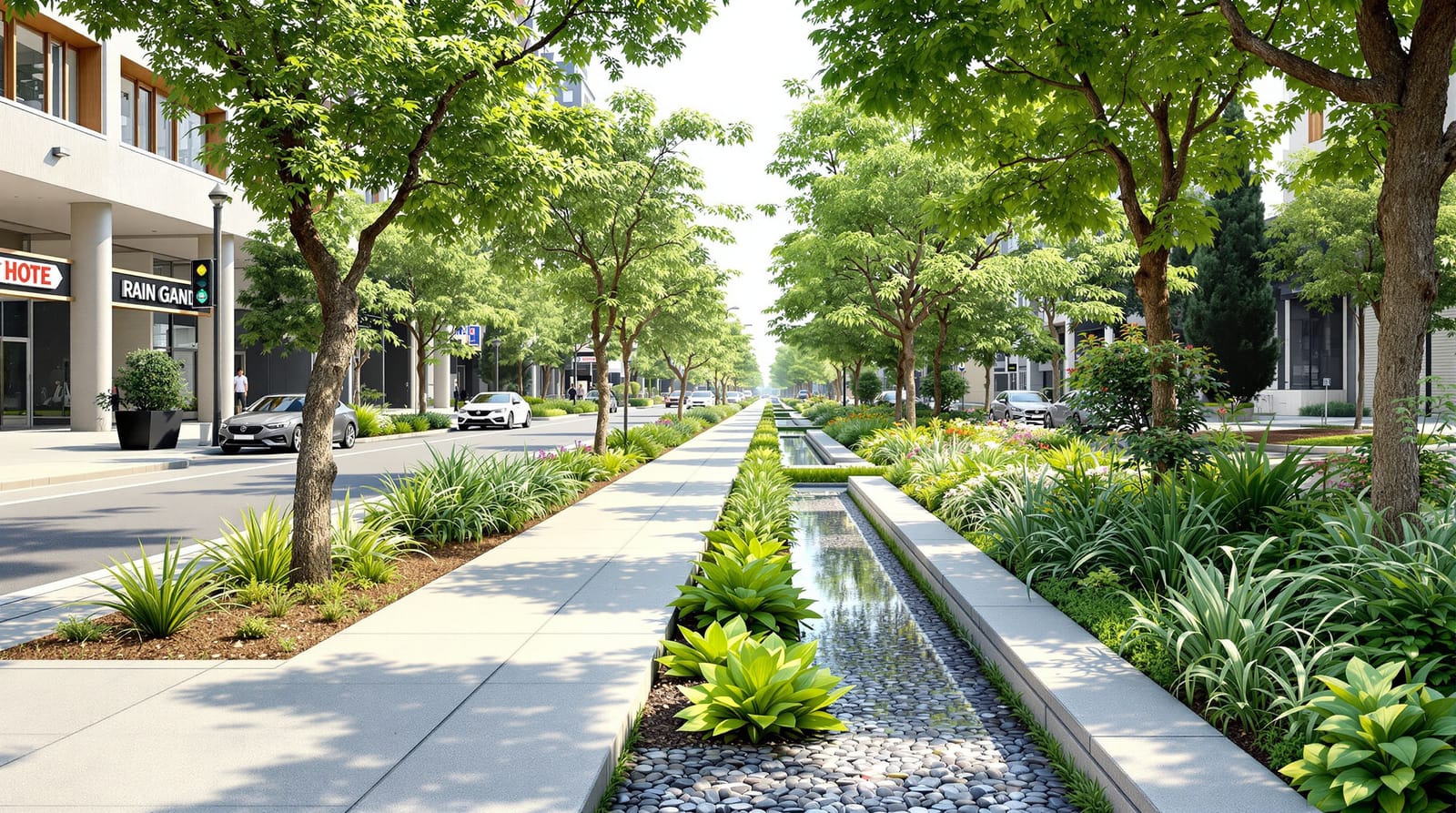
Water Sensitive Urban Design (WSUD) — Designing with the Urban Water Cycle
The WSUD framework for India — the urban water-cycle problem, the principles, the treatment train, the toolkit, and how to apply it from masterplan stage
Water Sensitive Urban Design (WSUD) is a way of designing places — layouts, campuses, streets and whole cities — so that the urban water cycle behaves more like the natural one it replaced: rain is slowed, soaked in, cleaned and used close to where it falls, instead of being rushed off concrete into a drain and out of reach. It is not a single device you bolt onto a finished masterplan; it is a design philosophy and a process that shapes where roads, roofs, levels and open spaces go in the first place.
For an Indian designer, WSUD is the framework that lets a gated layout in Pune, a tech campus in Hyderabad or an AMRUT street in Indore stop treating monsoon water as a nuisance to be evacuated, and start treating it as the resource that fills its borewells, cools its courtyards and protects it from the flood that arrives every few Augusts.
WSUD versus Blue-Green Infrastructure: same family, different job
These two terms are constant companions and are often used loosely, so it is worth being precise — because they answer different questions.
WSUD is the design approach and process. It is the set of principles, the decision-making sequence and the integrated thinking that asks: where will water go on this site, how do we manage it at source, and how do we treat stormwater, supply and wastewater as one system? It belongs at the masterplanning table.
Blue-green infrastructure is the physical asset typology — the actual network of swales, ponds, wetlands, green roofs and tree-lined corridors that gets built. It is the "what" on the ground.
In practice WSUD is the philosophy that decides whether, where and why to deploy blue-green infrastructure; blue-green infrastructure is the toolkit WSUD reaches for. Our sibling article Blue-Green Infrastructure Explained covers the asset network in detail; this guide stays in the design-process lane. The two are best read together.
Where WSUD came from
The term was coined in Australia in the 1990s, where chronically dry cities, periodic flooding and the pollution of urban waterways made conventional "pipe-it-away" drainage visibly inadequate. Melbourne Water became the global reference point, publishing WSUD engineering and planning guidelines that codified the treatment-train idea and the toolkit, and embedding water-sensitive thinking into statutory planning. Parallel movements grew elsewhere under different names — Sustainable Drainage Systems (SuDS) in the UK, Low Impact Development (LID) in the USA, and the "sponge city" programme in China. They are dialects of one language: design the built environment to work with the water cycle rather than against it.
The problem WSUD solves: the broken urban water cycle
To understand WSUD you have to picture what urbanisation does to water. On natural ground — soil, grass, trees — most rainfall infiltrates, some is taken up by plants and evaporated, and only a little runs off slowly. Replace that ground with roofs, roads and paving and the proportions invert.
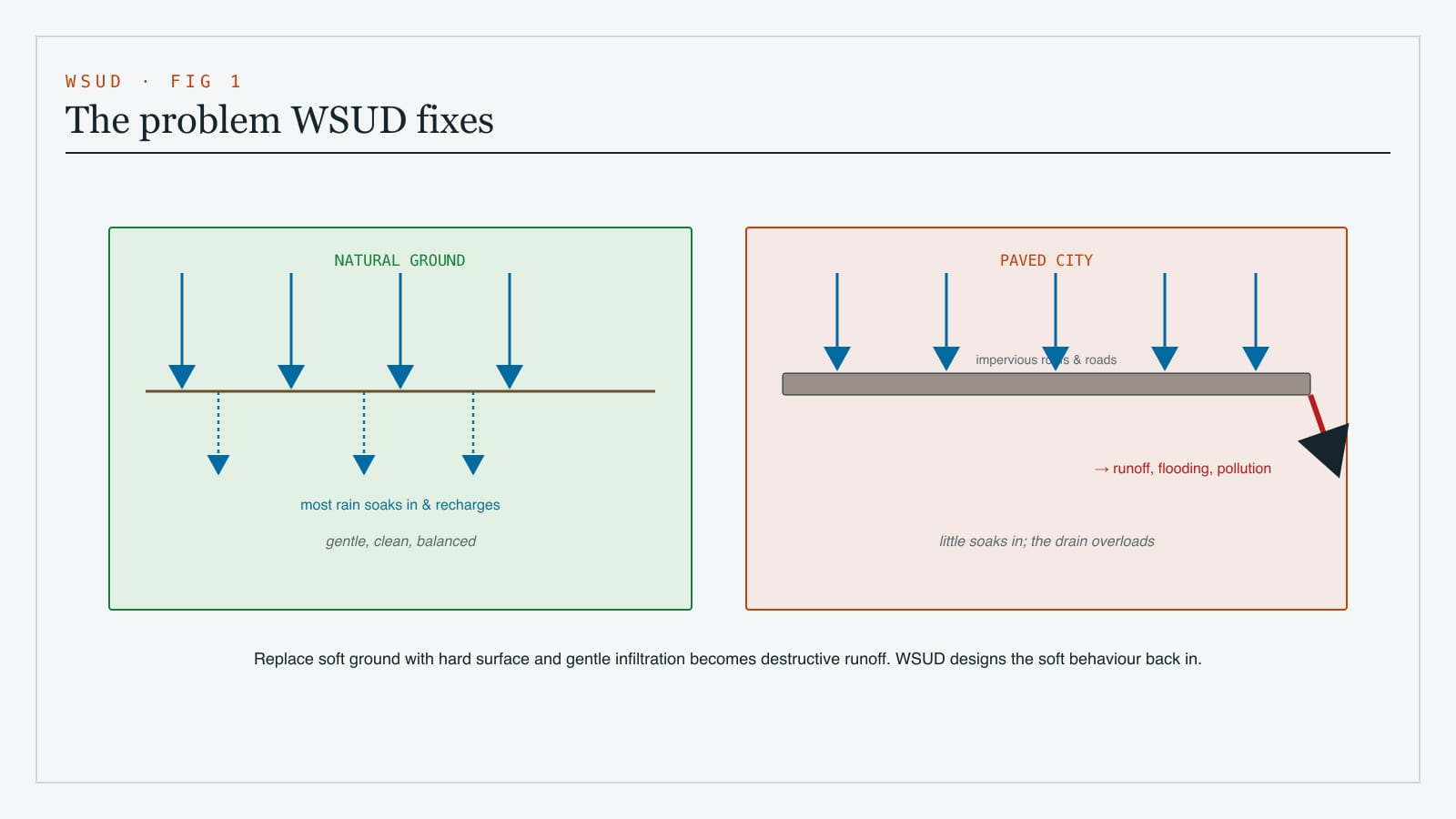
In a dense Indian neighbourhood, impervious cover can exceed 70–80 per cent. The consequences cascade:
- Flooding. Runoff that once trickled away over hours now arrives in minutes. Storm drains sized for a gentler era are overwhelmed — the recurring urban deluges of Chennai, Bengaluru, Mumbai and Hyderabad are, in large part, an impervious-cover and lost-floodplain story.
- Lost recharge. Water that should refill aquifers is shunted to the sea instead. The same cities that flood in August queue at tankers in April. The Central Ground Water Board (CGWB) records steady water-table decline under most major Indian cities.
- Pollution. First-flush runoff carries oil, rubber, silt, sewage cross-connections and nutrients straight into lakes and rivers, untreated.
- Heat. Dry, hard surfaces and the absence of vegetation and evaporative cooling intensify the urban heat island, pushing summer street temperatures several degrees higher.
WSUD addresses all four at once, which is precisely why it must be a design framework and not a bolt-on: a single rain garden cannot fix a layout that sheds water off-site by default.
The principles of WSUD
The framework rests on a handful of durable principles. Every WSUD decision can be traced back to one of these.
| Principle | What it means in practice |
|---|---|
| Manage water at source | Deal with rain where it lands — on the plot, the roof, the kerbside — rather than collecting and exporting it. Decentralised, many small interventions. |
| Mimic natural hydrology | Aim to keep post-development runoff volume, rate and quality close to the pre-development (greenfield) condition. Slow it, spread it, sink it. |
| Treat the water cycle as one system | Stormwater, potable supply and wastewater are not three separate problems. Treated greywater can irrigate; harvested rain can flush; recharged groundwater can supply. |
| Multi-functional landscape | The same open space stores floodwater, cleans runoff, cools the air, supports biodiversity and serves as amenity. Land does several jobs at once. |
| Integrate early and visibly | Water shapes the masterplan — levels, road alignment, open-space hierarchy — not the other way round. Make water a visible, valued part of the public realm. |
| Fit-for-purpose water | Match water quality to use. You do not need drinking-grade water to flush a toilet or water a lawn. |
The most important shift here is mental: water stops being a service-engineering afterthought and becomes a primary organising idea of the layout, alongside roads and built form. This is the same integrated logic our Sustainable Water Management in the Landscape guide applies at the plot scale.
The treatment train
The single most useful concept WSUD gives a designer is the treatment train — the idea that you manage runoff through a sequence of elements, each of which removes some pollutant load and reduces some volume, so no single device has to do everything. Like a real train, water passes from one carriage to the next, getting cleaner and slower as it goes.
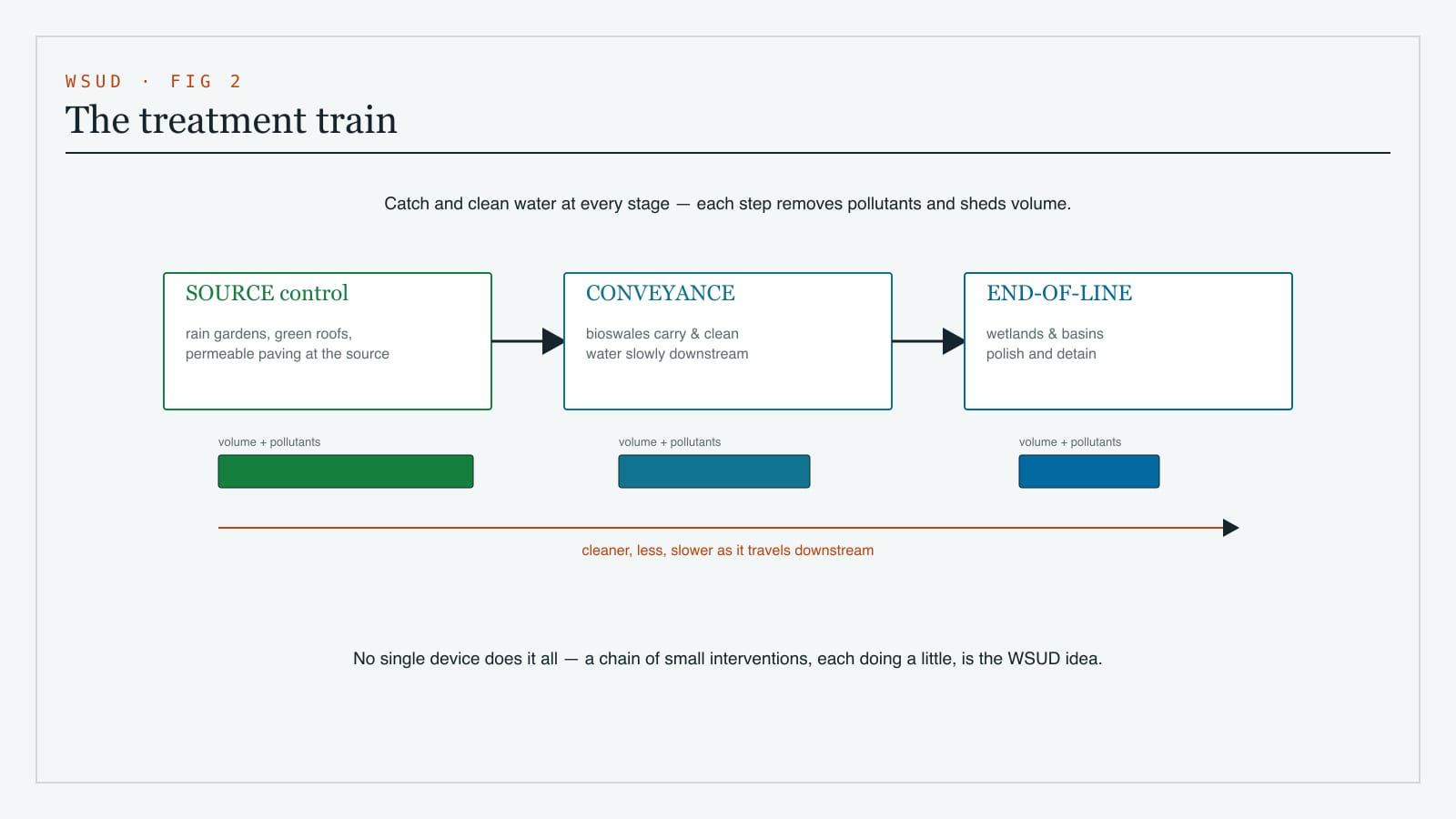
| Stage | Role | Typical elements | What it removes |
|---|---|---|---|
| Source control | Catch and reduce runoff at the point it is generated | Rainwater harvesting, green roofs, permeable paving, rain gardens at the plot | Coarse sediment, gross pollutants; cuts runoff volume early |
| Conveyance | Move water slowly, infiltrating and filtering en route, replacing pipes where possible | Vegetated swales, bioswales, tree-pit chains, planted channels | Fine sediment, some nutrients; slows peak flow |
| End-of-line | Final polishing and storage before discharge, reuse or recharge | Constructed wetlands, detention/retention basins, recharge structures | Dissolved nutrients, pathogens; provides flood storage and reuse |
Designing this way is liberating. A bioswale alone might only handle the "first flush"; followed by a detention basin and a wetland, the chain can manage both pollution and a large storm. The treatment train also builds in resilience — if one element silts up, the others still function while it is cleaned.
The WSUD toolkit
These are the physical elements — the blue-green assets — that WSUD assembles into treatment trains. Think of them as a palette, selected to suit the site, soil, space and budget.
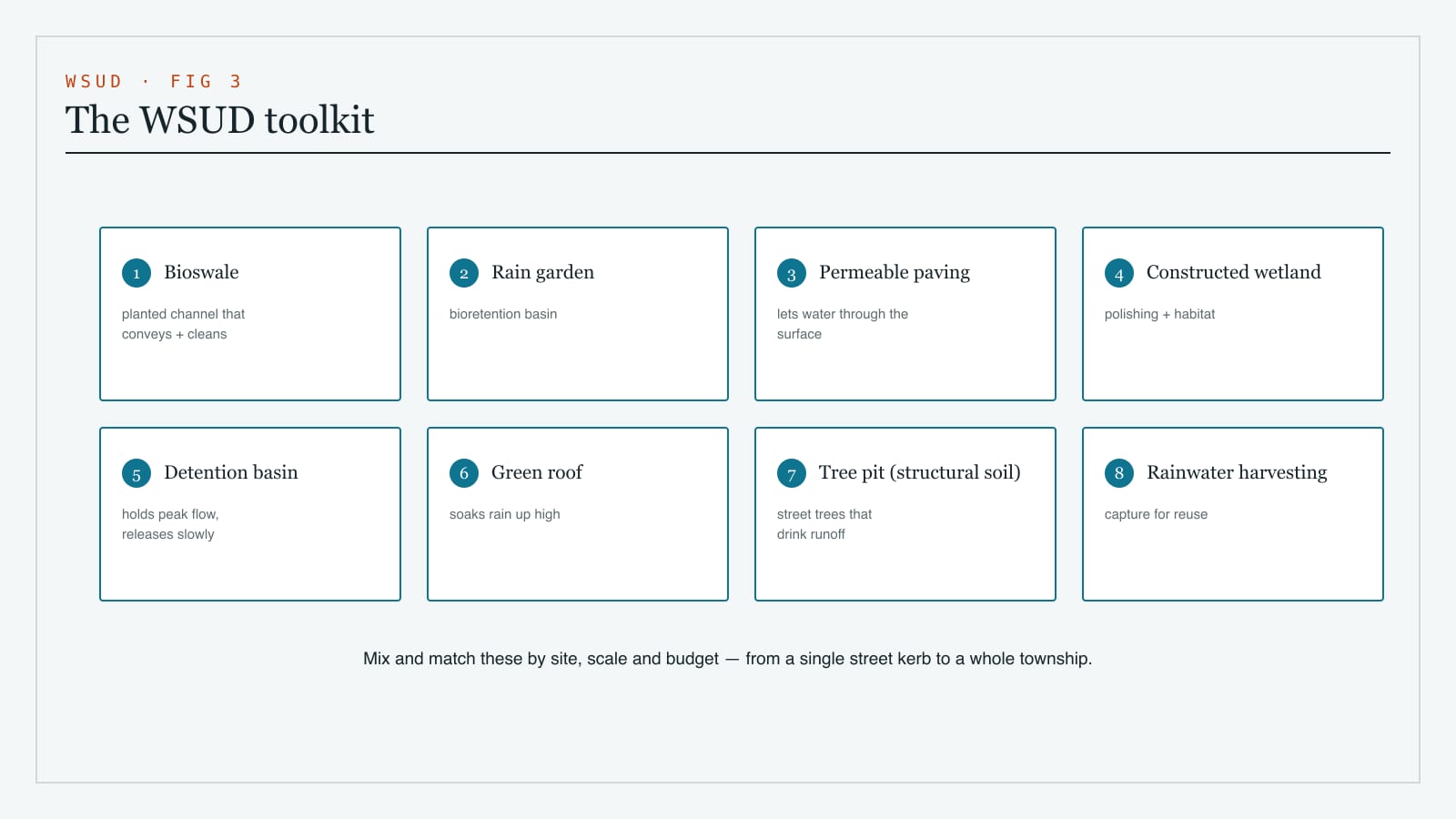
| Element | What it does | India notes |
|---|---|---|
| Bioswale / vegetated swale | Linear planted channel that conveys, slows and filters runoff | Ideal along internal roads and campus boundaries; plant with Vetiver, Cyperus, Canna |
| Rain garden / bioretention | Shallow planted depression where runoff ponds briefly and infiltrates through a soil-media bed | The workhorse for kerbside and courtyard runoff — see Rain Gardens Explained |
| Permeable paving | Lets water pass through the surface into a stone reservoir below | Suits low-traffic parking, plazas, walkways; needs periodic vacuum-cleaning to avoid clogging |
| Constructed wetland | Engineered marsh that polishes water biologically | End-of-line on larger campuses; plant Typha, Phragmites, Canna, lotus; manage for mosquitoes |
| Detention / retention basin | Stores stormwater to cut peak flow (detention) or holds a permanent pool (retention) | Doubles as amenity lake or playing field; central to society-scale flood control |
| Green roof | Vegetated roof that absorbs rain and cools the building | Works on RCC roofs with waterproofing and drainage layer; cuts roof runoff meaningfully |
| Tree pit / structural soil | Street trees in engineered soil cells that also store and filter road runoff | High value on hot Indian streets — shade plus stormwater in one footprint |
| Rainwater harvesting | Captures roof runoff for storage or recharge | Statutory in most Indian cities; the source-control backbone — see Rainwater Harvesting Through Landscape Design |
A genuinely water-sensitive scheme rarely uses one of these in isolation; it threads several into a chain across the site.
WSUD in the Indian context
WSUD was born in a temperate, evenly-watered Australian climate. India's water reality is more violent and more bipolar, which both raises the stakes and changes the design.
Monsoon-then-drought. India receives most of its annual rain in roughly a hundred hours of intense monsoon, then goes dry for months. A WSUD scheme here must do two things at once: provide enough storage and detention to ride out cloudburst-scale storms, and prioritise recharge and reuse so that captured monsoon water carries the site through the dry season. This is a sharper design problem than the slow, frequent rain WSUD was first written for.
Policy and institutional context. WSUD principles are filtering into Indian practice through several channels:
- AMRUT and the sponge-city idea are pushing cities toward decentralised stormwater management, urban lakes rehabilitation and green stormwater corridors.
- Smart Cities Mission projects have piloted permeable paving, bioswales and lake revival in several cities.
- CPHEEO (the central manual on stormwater and sewerage) increasingly references sustainable urban drainage alongside conventional pipe design.
- CGWB mandates and model bye-laws make rainwater harvesting and artificial recharge compulsory for larger plots in most states.
- IGBC and GRIHA green-rating systems award credits for managing site runoff, reducing imperviousness and reusing water — a practical lever for getting WSUD into private projects.
Where it lands. In India, WSUD has the freest hand on greenfield projects with a single decision-maker: gated layouts and townships, IT and corporate campuses, institutional and hospital estates, and new smart-city precincts. Retrofitting it into a dense, fragmented old city is far harder — which is exactly why getting it right in new development matters so much. A campus that recharges its own water and detains its own storms takes load off the municipal system for everyone downstream.
Barriers — told honestly
WSUD's logic is unarguable; its adoption in India is still patchy, for real reasons a designer must plan around.
- Maintenance. Swales silt up, permeable paving clogs, wetlands need de-weeding. Many fine installations fail within a few monsoons because no one budgeted for upkeep. WSUD only works with a maintenance plan and a named owner — the RWA, the facility manager, the municipality.
- Mosquitoes and safety. Standing water and dengue are a genuine, justified fear. Well-designed WSUD avoids it: bioretention and swales are designed to drain within 24–48 hours, basins are kept moving or stocked with larvivorous fish (Gambusia), and edges are graded gently for child safety.
- Codes and approvals. Indian development control rules still assume conventional kerb-and-pipe drainage; swales and bioretention can fall foul of road-section standards or approval checklists, and few municipalities have adoption frameworks for green assets.
- Awareness and skills. Contractors who can build a wetland or lay permeable paving correctly are still scarce, and clients underestimate the long-run savings (lower tanker bills, higher borewell yields, flood insurance).
- Land and cost perception. WSUD assets occupy open space that developers want to monetise. The counter-argument is multi-functionality — that open space is also amenity, recharge and flood insurance.
Integrating WSUD from the masterplan stage
Because WSUD is a process, here is how it threads through a project rather than appearing at the end:
1. Read the water first. Before fixing roads or plots, map the natural drainage — the lines water already wants to follow, low points, existing tanks and nalas, soil infiltration rates, and the water table from CGWB data. Work with these flow lines, not over them.
2. Set hydrology targets. Decide the design storm, the runoff-volume reduction goal (often "no net increase over greenfield"), and the recharge and reuse targets. These numbers discipline every later choice.
3. Shape the masterplan around water. Place open spaces at low points so they become detention basins and wetlands; align swales along the road hierarchy; set finished levels so runoff sheets toward green assets, not gates.
4. Design the treatment trains. For each catchment, chain source control → conveyance → end-of-line, sized to the targets.
5. Plant and detail for India. Choose robust, locally appropriate species; detail drain-down times, overflows, sediment forebays and safe edges.
6. Write the maintenance into the handover. Schedules, responsibilities and a small recurring budget. This single step decides whether the scheme survives.
Done this way, WSUD does not cost the project its open space or its amenity — it makes both work harder. The lake is also flood storage; the swale is also a cool, green street; the wetland is also a habitat and a recharge engine. That multi-functional, water-led logic — designing with the cycle rather than against it — is the heart of climate-responsive practice, and connects naturally to Climate-Responsive Landscape Design at every scale below the city.
References & further reading
- Melbourne Water — Water Sensitive Urban Design Guidelines and the WSUD Engineering Procedures: Stormwater (the foundational reference for the treatment-train method and toolkit).
- CPHEEO, Ministry of Housing & Urban Affairs, Government of India — Manual on Storm Water Drainage Systems (Indian standards and emerging sustainable-drainage guidance).
- Central Ground Water Board (CGWB) — Manual on Artificial Recharge of Ground Water and master plans for urban recharge.
- Indian Green Building Council (IGBC) and GRIHA — green-rating criteria for sustainable site, stormwater and water-efficiency credits.
- Central Pollution Control Board (CPCB) — guidance on urban stormwater quality and waterbody pollution.
- Rainwater Club / S. Vishwanath — practical writing on urban rainwater harvesting, recharge and decentralised water management in the Indian city.
Export this guide
Related Guides — Deep-dive reading
Circular Water Management for Buildings & Cities: The Closed-Loop Guide
How to stop treating water as a one-way flow and design a closed loop — treat, reuse, recharge, repeat — with a sewage treatment plant at its core, for Indian buildings, campuses and cities.
Sewage Treatment PlantsSmart City Wastewater Guidelines: Urban Reuse Rules Developers Must Know
How the Smart Cities Mission, AMRUT 2.0 and India's reuse framework are turning treated sewage into a mandated resource — and what the shift to decentralised treatment and reuse targets means for developers, RWAs and facility managers.
Sewage Treatment PlantsTreated Water for Landscape Irrigation: Distribution, Storage, Quality & Salinity
How to irrigate large lawns, planted podiums and campus landscapes with STP-treated water — the distribution network, storage sizing, the quality numbers that keep plants alive, and how to manage salt build-up in the soil over the years.
Sewage Treatment PlantsRelated Tools — Try Free
Rainwater Tank Sizer
How big should your rainwater tank be? Computes annual harvest, recommended tank capacity in litres, water-bill savings, and payback — for 10 Indian cities.
RWH CalculatorStructural Modification Approval Checklist
41 items across structural assessment, society approval, municipal compliance, and safety.
Approval ChecklistGarden Planning Toolkit
Get a tailored garden plan — planting layers, Indian species, features and a checklist — from your climate, space, sun and goals.
Planner