
Future Rural Housing Models
Beyond the PMAY-G concrete box — incremental, vernacular-modern, self-reliant and climate-resilient rural housing models that grow with the family and keep the agrarian homestead alive
In a village two hours from Nagpur, three houses stand in a row, each built under the same scheme in the same year. They are identical: a single flat-roofed concrete room, a sanctioned twin-pit toilet at the back, a doorway facing the lane. By April the slabs have turned the rooms into ovens, so the families sleep on the cooler verandahs they have improvised in front, under tarpaulins. The buffalo is tied where the kitchen garden used to be, because there was no plan for the animal. The grain that once sat in a cool mud kothi now spoils in a steel trunk. The house was delivered; the home is being negotiated, brick by salvaged brick, against the design.
A short walk away sits an older house the scheme would call "kachcha". It has thick mud-and-stone walls, a sloping country-tile roof, a courtyard the women cook and dry chillies in, a cattle byre to one side and a neem tree the whole lane sits under in the heat. It is cooler, it holds the family's livelihood, and it has grown three rooms over two generations. The problem is not that rural India lacks housing ambition; it is that we have been exporting a small urban flat into the fields and calling it progress. The future of rural housing is not a better concrete box delivered faster — it is a small set of climate-rooted, livelihood-friendly, expandable models, matched to who the family is and where they live.
Why the concrete-box default fails
Pradhan Mantri Awaas Yojana – Gramin (PMAY-G) has done something genuinely important: it has moved millions of families out of leaking, unsafe kachcha shelter, with a defined minimum area (roughly 25 sq m), a sanctioned toilet under Swachh Bharat Mission – Gramin, and a wage top-up through MGNREGA. That achievement is real and should not be sneered at. The failure is narrower and more fixable: the model that often gets built — a flat-roofed RCC unit, the same in the Thar as in the Brahmaputra floodplain — treats a house as a sanctioned object rather than a living system.
A flat reinforced-concrete roof is the wrong default across most of rural India. It absorbs heat in dry zones, leaks in high-rainfall ones, and costs more in cement and steel than local materials would. It also quietly erases the things a rural home does: it has nowhere for the cattle, no cool store for grain, no courtyard for processing and drying, no shaded threshold for the day's heat. The standard unit assumes a nuclear, non-agrarian family living an urban indoor life — which is precisely not the household it is being given to.
This is the line that separates this guide from its urban cousins. An apartment block or a future-ready residential layout optimises serviced, repeatable units on costly land. A rural home is a small enterprise: it shelters people and animals, stores a harvest, hosts the haat-day visitors, and changes shape as sons marry and incomes rise. The future models below are organised around that difference. (For the building-tradition lens behind them, see Indian vernacular architecture; for where these homes sit within the village plan, the full process is in the rural housing layout design pillar.)
The incremental home: build the core, grow the rest
The single most useful shift is to stop delivering a "finished" house and start delivering a good core. A rural family rarely has the cash to build everything at once, and its needs change — a marriage, a new buffalo, a returning migrant son, a small shop at the front. The incremental model gives the household a well-built, well-sited core (a strong plinth, one or two rooms, the toilet, the roof structure designed to extend) plus a clear, drawn plan for how it can grow room by room as money arrives.
This is honest about how rural homes are actually built. Most are self-built or built with a local mason, over years, with remittance money sent in instalments. Designing for that — rather than against it — means a sound foundation sized for a future second storey or wing, a roof that can be extended without demolition, and a plot layout that leaves room for the courtyard, the byre and the garden to come. It is the rural equivalent of "site and services", and it lets MGNREGA labour and local materials do the slow, cheap parts while the scheme grant secures the hard core.
The vernacular-modern hybrid: old walls, new services
The romantic mistake is to want the old mud house back exactly as it was; the modern mistake is to throw all of it away. The hybrid keeps the parts of the vernacular that genuinely outperform — the sloping local-material roof, the thick thermal-mass walls (stabilised mud blocks, laterite, rammed earth or local stone), the deep verandah, the courtyard — and adds the things the old house lacked: a sealed damp-proof plinth, a proper twin-pit toilet, tap water under Jal Jeevan Mission, decent ventilation and light, and reliable wiring.
Done well, this is cheaper and cooler than the concrete box, because it leans on materials available within a few kilometres and on masons who already know how to build with them. It is also why vernacular design is returning: not nostalgia, but performance and cost. The hybrid is not a single house style — it is a method that produces a Kutch home that looks nothing like a Konkan one, which is exactly the point the flat-slab default missed.
The agrarian homestead: the home as a small farm
For a farming or dairy household, the house is one corner of a working compound. A future model should plan the whole homestead: the dwelling, a clean and separate cattle byre with drainage that feeds a gobar-gas (biogas) unit, a covered grain and fodder store, a hardstanding for drying and threshing, and a kitchen garden watered with household greywater. Getting the cattle out of the living room is a public-health gain; capturing the dung as biogas turns a waste into the family's cooking fuel and a slurry fertiliser.
This is also the model most at odds with a "tidy" sanctioned unit, and the reason so many delivered houses sprout informal byres and stores within a year. Planning the homestead as a system — animal, energy, water and garden in one loop — is how the home stops fighting the livelihood.
Clustered and shared models: the courtyard reborn
Not every gain is at the scale of a single plot. Where families are related or share a caste-occupation cluster, a shared-courtyard model groups four to eight homes around a common open space, sharing a hand pump or recharge well, a covered work area, a children's space and sometimes a single larger biogas digester. It uses land and infrastructure more efficiently and rebuilds the social fabric the isolated row-house quietly dissolves — without becoming an urban apartment block. This is housing's contribution to the broader cluster-village development idea and to the design of community open spaces in villages. The trade-off is real: shared space needs a clear understanding of who maintains and governs it, or it degrades.
Climate-resilient models: design for the disaster that will come
A future rural home should be designed for the specific hazard of its place, not a generic average. The honest typologies are:
- Flood zones (the Gangetic and Brahmaputra plains, coastal deltas): raised plinths or stilts, a safe upper refuge level, light strong roofs, and salvageable materials. A flat ground-floor slab is actively dangerous here.
- Drought and heat zones (the arid west, the Deccan): high thermal mass, courtyards, small shaded openings, light-coloured roofs, and every drop of water harvested. This is where the concrete oven hurts most.
- High-rainfall and cyclone zones (the Konkan, the Northeast, the eastern coast): steep tied-down roofs with generous overhangs, raised floors, and wind-rated detailing.
These are not exotic; they are what the local vernacular already half-knew before the slab arrived. Matching the model to the hazard is the housing-scale half of designing climate-responsive rural settlements.
The self-reliant home: solar, biogas, rainwater
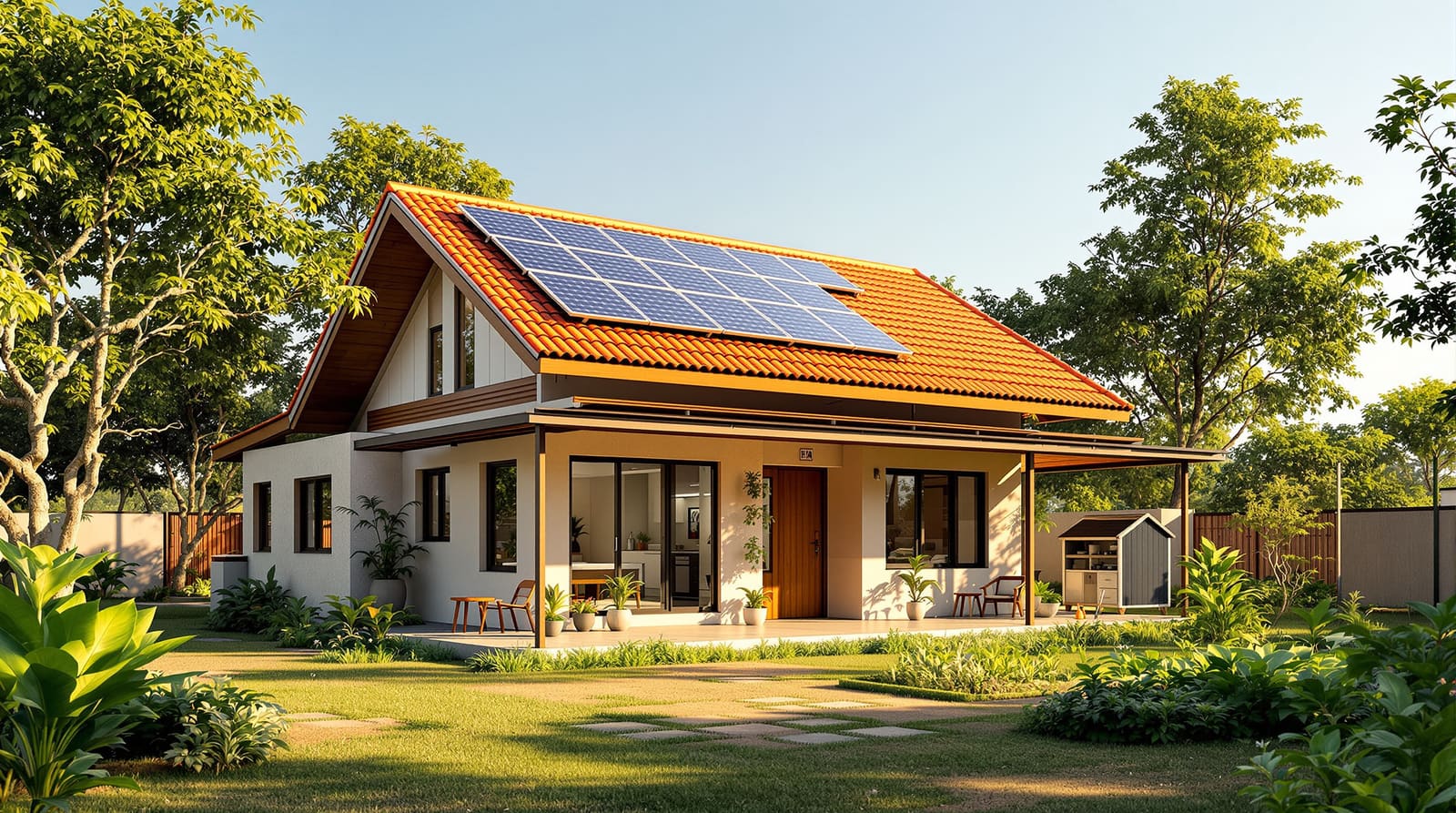
The most genuinely "future" model is the one that needs the least from a fragile grid. Rooftop solar (increasingly within reach of a single household or a small cluster), a biogas plant fed by cattle dung and kitchen waste, rooftop and recharge-pit rainwater harvesting, and decentralised greywater treatment together make a home largely self-supplying in energy, fuel and water. In a village where the grid flickers and the water table is falling, that is not a luxury — it is resilience. It also dovetails with the water-sensitive rural planning the village needs at the settlement scale.
The honesty caveat: self-reliance is bought with maintenance and upfront cost. A solar panel without a repair technician within reach is a roof ornament; a biogas plant nobody feeds correctly stops producing. The model works only when the village has the skills and supply chain to keep it running — which is exactly the gap smart villages work is meant to close.
Models for migration: lock-up, remit and return
Rural housing must also be honest about who is actually living there. Many homes are built with city remittances, used part-time, and increasingly occupied by the old while the young migrate. This produces three real needs: the lock-up-and-leave home that is secure and low-maintenance when the family is away; the remittance home built in slow phases as money is wired back (the incremental model again); and the returning-migrant home that anticipates a small shop, a workshop or a homestay at the front for a family coming back to a non-farm livelihood. Designing for ageing occupants — single level, no steps, a toilet that an old body can use — is part of the same realism.
Matching the model to the family and the place
No single model is "the future". The future is a small kit of them, chosen by who the household is and where it stands.
| Housing model | Who it suits | The trade-off |
|---|---|---|
| Incremental core-&-grow | Most families; remittance & phased self-builders | Looks "unfinished" early; needs a disciplined plan so growth stays sound |
| Vernacular-modern hybrid | Anyone in a strong local-material region | Depends on skilled local masons & a material supply chain that is thinning |
| Agrarian homestead | Farming & dairy households | Needs more land; byre, biogas & store must be managed, not just built |
| Clustered / shared-courtyard | Related or occupation-linked families | Shared space & assets need clear governance or they degrade |
| Climate-resilient (flood/drought/cyclone) | Hazard-prone locations | Hazard-specific detailing costs more upfront than the generic slab |
| Self-reliant (solar / biogas / rainwater) | Villages with skills & supply chains | High capital cost & real maintenance burden; fails without local repair |
| Lock-up / remittance / returning-migrant | Migration-affected & ageing households | Risks under-use; must avoid building for a family that never returns |
Making it real: the panchayat, the schemes and self-build
None of this needs a new law — it needs the existing machinery pointed differently. The gram panchayat and gram sabha already approve house sites on abadi (lal-dora) land, and the SVAMITVA survey is finally giving families clean titles to build and borrow against. PMAY-G can fund a good core and a climate-appropriate roof instead of a generic slab if its house-design menus offer regional, sloped, expandable typologies. MGNREGA labour and assets can build the plinth, the recharge pit, the byre platform and the approach path. Swachh Bharat's twin-pit and Jal Jeevan's tap are already the sanitation and water layer. SPMRM's Rurban clusters are the place to pilot shared-courtyard and self-reliant models at a few hundred households at a time.
The deepest point is the oldest one: rural housing works when families build it themselves, with local labour and local materials, helped rather than overruled. Gandhi's "village swaraj" was exactly this — self-reliance designed from the village outward. The planner's job is not to hand down a finished box but to give each family a sound core, an honest model that fits its land and livelihood, and the freedom to grow the rest. Used this way, a design tool like DesignAI can help a young architect or a panchayat sketch these regional, expandable typologies quickly — so the next three houses in that row near Nagpur are cooler, kinder to the family's livelihood, and built to grow.
References
1. Ministry of Rural Development, Government of India — Pradhan Mantri Awaas Yojana – Gramin (PMAY-G): Framework for Implementation & House Design Typologies.
2. Ministry of Rural Development — Shyama Prasad Mukherji Rurban Mission (SPMRM): Mission Guidelines.
3. Ministry of Panchayati Raj, Government of India — SVAMITVA Scheme guidelines and the 73rd Constitutional Amendment Act, 1992 (Panchayati Raj).
4. CPHEEO, Ministry of Housing & Urban Affairs — Manuals on Rural Water Supply and on Decentralised Sanitation (twin-pit / DEWATS).
5. Bureau of Indian Standards — National Building Code of India (NBC) 2016, provisions on low-rise and hazard-resistant rural construction.
6. M. K. Gandhi — Hind Swaraj and the "village swaraj" writings on self-reliant rural settlement.
7. Development Alternatives / Hunnarshala and allied work on cost-effective, climate-responsive rural building technologies.
Read this alongside the rural housing layout design pillar and climate-responsive rural settlements, and plan your own regional typologies with DesignAI.
Export this guide
Related Guides — Deep-dive reading
Belapur Incremental Housing: How Charles Correa Gave the Poor a House That Could Grow
In Navi Mumbai, Charles Correa refused the housing block. Instead he gave roughly 550 families a small plot, an open-to-sky courtyard, and — crucially — no shared walls, so each house could be extended by its own occupants over decades. It is India's most quietly radical answer to where affordable housing should go next.
The Future of ArchitectureQuinta Monroy: How ELEMENTAL Built Half a Good House and Let the Residents Finish It
In Iquique, Chile, Alejandro Aravena and ELEMENTAL answered an impossible social-housing budget by building only the half of each dwelling that families could never build themselves — the structure, kitchen, bathroom and stair — and leaving a deliberate void for the other half. This is the case study in incremental housing, participatory design, and why the future of shelter may lie in the unfinished.
The Future of ArchitectureSmart Villages of India
What a genuinely smart village means — appropriate technology, connectivity and good governance on a foundation of road, water, power and sanitation, honestly separated from smart-city hype
Rural Residential PlanningRelated Tools — Try Free
Rainwater Tank Sizer
How big should your rainwater tank be? Computes annual harvest, recommended tank capacity in litres, water-bill savings, and payback — for 10 Indian cities.
RWH CalculatorCross-Ventilation Analyzer
Estimate airflow and air changes per hour (ACH) from room size, window areas, layout, and local wind — with NBC 2016 Part 8 compliance check.
Ventilation CalculatorApartment Video Door System Planner
Enter flats, entrances, floors and guard desk for a first-pass building intercom plan — door stations, indoor monitors, guard station, the right architecture and an indicative cost band.
Building Planner