
Modern Village Planning Principles
Marrying the organic Indian village's wisdom with what modernity must add — commons first, cluster for community, mixed livelihood, decentralised self-reliance and participatory gram-sabha planning
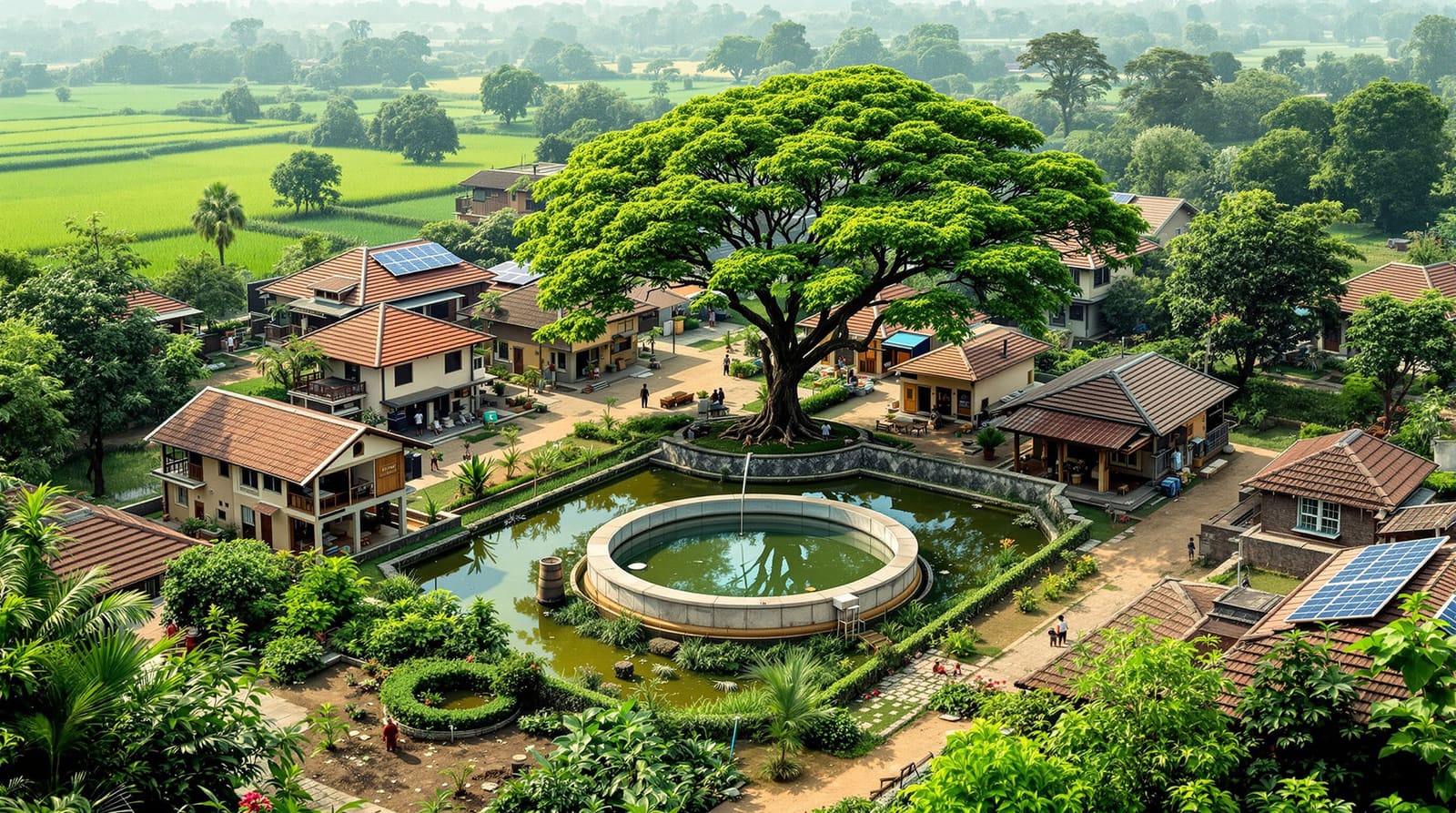
Stand at the edge of Hiware Bazar in Maharashtra, or any village that has aged with grace, and you can read its whole logic in a single slow turn. The houses lean inward toward a tank that has held the monsoon for two centuries. A peepal tree throws shade over a raised platform where four old men are arguing about nothing. A cart lane curls between the homes, too narrow for a car and exactly wide enough for a bullock and a tractor. Beyond the last wall, the fields begin and do not stop. Nobody drew this. It grew, the way a banyan grows, from the inside out — around water, around the temple, around the route that the first families walked.
Now drive twenty kilometres to a government "model village" rebuilt after a flood: straight rows of identical concrete boxes on a gridded plot, each with its mandated twin-pit toilet, each facing a road that goes nowhere in particular. It has every facility on the checklist and not one square metre that anyone wants to sit in. The tank was filled to make room for plots. The chaupal became a "community hall" locked behind a chowkidar. The fields were sliced. People took the houses, because a pucca roof is not nothing — and then they migrated to the city anyway. A modern village succeeds not by importing the city's grid and calling it progress, but by learning the wisdom already written into the old settlement — water, commons, cluster, the walking route — and adding only what modernity genuinely owes it: a tap, a panel, a clinic, a paved lane.
Principles, not a layout
This is the vision guide for the cluster — the set of enduring ideas that should govern any modern Indian village, whether you are rebuilding after a disaster, planning a new SPMRM Rurban cluster, or simply helping a gram panchayat extend its abadi land. If you want the end-to-end method — surveying the site, sizing plots, phasing the build — that lives in the rural housing layout design pillar, and you should read it alongside this one. Here we stay with the why.
These principles are deliberately not the principles of urban layout planning. That discipline optimises a subdivision for density, saleable area, road frontage and a road hierarchy that moves cars efficiently. A village is a different organism. Its economy is agrarian, its movement is feet and carts and livestock, its land is held partly in common, and its governance is a face-to-face assembly rather than a municipal corporation. Borrow the urban toolkit wholesale and you get the sterile model village. The principles below are what fill that gap.
Read the settlement before you draw
Every old village is a record of decisions that worked. The lanes bend to follow the contour and shed monsoon runoff. The houses cluster on the higher, well-drained ground and leave the fertile low land to farming. The tank sits where the catchment naturally feeds it. The temple or mosque marks the social centre, and the bazaar route runs where people already walked to the next village. This is settlement logic, and it is almost always smarter than a grid laid over a contour map in a district office.
The first principle of modern village planning is therefore humility: survey what is already there and let it lead. The SVAMITVA drone survey, which is finally mapping abadi (lal-dora) land and giving households property cards, is most valuable not as a record of plots but as a record of pattern — where settlement clusters, where the commons sit, where water collects. Build on that pattern. Densify the existing fabric before you sprawl onto farmland. A new extension should read as the next ring of the same tree, not a foreign object bolted on.
The commons are the structure, not the leftover
In an urban subdivision, open space is a percentage — a number the regulation extracts after the saleable plots are laid out, often a sad rectangle in a corner. Invert that completely for a village. The tank, the gauthan or cattle ground, the threshing floor (khalihan), the sacred grove and the chaupal are not what remains after planning; they are the frame the whole village hangs on. Place them first, and let the homes cluster around them.
This is the deepest difference between a living village and a model one. The tank is hydrology, livestock water, washing, fishing and a microclimate all at once — fill it for plots and you break four systems to gain one. The grazing ground is fodder and a buffer. The grove is the village's lungs and its conscience. The chaupal, chabutara or village square is where the gram sabha meets, where weddings happen, where children play and old people watch — it is the civic heart. Treat these as the primary geometry and the homes almost arrange themselves. We treat the design of these spaces in depth in community open spaces in villages; here the point is simply their primacy.
Cluster for community, keep the farmland whole
A dispersed or thinly linear settlement looks generous on a drawing and is a quiet disaster in practice: every metre of pipe, wire, road and walking distance multiplies, and the social glue thins out. Clustering homes tightly around the commons does the opposite. It shortens every service run, it makes a tap, a microgrid and a school catchment affordable, and — just as important — it keeps the surrounding farmland in large, workable, uninterrupted parcels rather than fragmenting it into useless slivers. The cluster is both an efficiency move and an act of agrarian respect. The full mechanics of this model — pooling, shared services, the SPMRM Rurban cluster idea — sit in cluster village development.
Movement on feet, carts and hooves first
Design the village around the bullock, the tractor, the bicycle and the walking grandmother, and the car will fit fine. Design it around the car, as the model village does, and everything else suffers. Lanes want to be narrow, shaded and continuous, with the wider all-weather road (PMGSY) and the bus stop kept to the edge so that through-traffic and dust do not cut the settlement in half. Livestock need their own passage from home to grazing to tank without crossing the social spaces. This inversion of the urban street hierarchy, which is engineered to move vehicles, is the subject of village street planning.
Mixed livelihood woven in, not zoned apart
The single most damaging urban habit to import is zoning — homes here, work over there, the market somewhere else. A village economy is integrated by nature. The home is also a workshop, a cattle shed, a grain store and a drying yard. The dairy, the haat (periodic market), the craft cluster and the farm plots belong woven into the fabric within an easy walk, not banished to a separate "commercial zone". A woman should be able to mind the stove, the buffalo and a weaving frame in one continuous day. Plan for that overlap deliberately — generous courtyards, a back lane for the cart, storage at the home, a market square that is also the chaupal on non-market days.

Decentralised, self-reliant services — village swaraj, updated
Gandhi's idea of village swaraj — the self-reliant village republic of Hind Swaraj — reads today less as nostalgia and more as sound infrastructure engineering. A village far from the grid and the trunk sewer is best served by systems it can own and maintain: rooftop and microgrid solar, a biogas (gobar-gas) plant on the dairy waste, twin-pit toilets and a decentralised DEWATS greywater system under Swachh Bharat Gramin, a community rainwater tank and percolation ponds restoring the water table, composting for solid waste. These are not poor substitutes for "real" infrastructure; for dispersed rural India they are frequently the more resilient and far cheaper answer. We detail the technical menu in rural infrastructure planning, and the water-first version of the same logic in water-sensitive rural planning.
Vernacular, climate-rooted building
A village built in load-bearing brick boxes with flat RCC roofs because that is what the contractor knows is a village that bakes in summer and floods in the monsoon. The old builders solved the climate for free — thick walls, deep verandahs, courtyards for stack ventilation, sloping tiled or thatched roofs, the house raised on a plinth above flood level, local stone, mud, lime and timber. Modern materials should be added with judgement, not as a replacement for this intelligence. This is why vernacular architecture is returning, and the regional grammar of it is laid out in Indian vernacular architecture. A modern village can have a damp-proof course, a solar panel and a smokeless chulha without losing its courtyard and its verandah.
The principles at a glance
| Principle | What it means in a village | The common failure |
|---|---|---|
| Read the settlement | Survey water, route & temple; densify the existing fabric first | Imposing a grid on a contour map from a district office |
| Commons first | Tank, gauthan, khalihan, grove & chaupal are the frame, placed first | Open space as a leftover corner; the tank filled for plots |
| Cluster & spare farmland | Homes tight around the commons; fields kept whole & workable | Dispersed rows that fragment farms & multiply every service run |
| Walk-and-cart movement | Narrow shaded lanes, livestock passage, the bus & PMGSY road at the edge | A car-scaled grid & through-road slicing the settlement |
| Mixed livelihood | Home, dairy, craft, store & haat woven within a walk | Urban-style zoning that exiles work & market away from homes |
| Decentralised services | Solar microgrid, biogas, twin-pit/DEWATS, rainwater & ponds | Waiting on a trunk grid & sewer that may never arrive |
| Vernacular form | Courtyards, verandahs, plinths, local materials, climate-tuned | RCC-box housing that bakes in summer & floods in monsoon |
| Participatory planning | The gram sabha shapes the plan; ownership through the panchayat | A top-down "model" handed over & never adopted |
Making it real through the gram sabha
A principle nobody owns is a drawing nobody follows. The deepest reason model villages feel sterile is that they are designed for the village rather than by it — a layout arrives finished from above and the community is asked only to occupy it. The 73rd Constitutional Amendment gave the gram panchayat and the gram sabha — the assembly of every adult voter — real planning authority precisely so this would not happen. Use it. Walk the site with the sabha. Ask where the cattle have always crossed, which tree must not be cut, which low ground floods, where the bride's procession goes. That knowledge is the survey no drone can capture, and a plan that incorporates it is a plan the village will defend and maintain.
Then thread the schemes through the principles rather than letting the schemes write the plan. PMAY-G can build the houses — but cluster them around a commons instead of in rows. MGNREGA labour can desilt the tank, dig the percolation ponds and build the check dams. Jal Jeevan Mission brings the tap; Swachh Bharat Gramin the sanitation; SPMRM the cluster economy and the shared facilities. A "smart village" then layers connectivity and digital governance on top of a settlement that is already humane — the right order, explored in smart villages.
Finally, plan for the people who are not in the room. Villages are ageing as the young migrate; design level paths, ground-floor living and shaded sitting for the old who stay, and design for the young who may yet return if there is a livelihood and a life worth returning to. A village with a strong identity — its tank, its grove, its festival square intact — is a village people come home to. That belonging is not decoration; it is the most durable infrastructure of all, and the through-line of the future rural housing models we should be building.
References
1. Ministry of Rural Development, Government of India — Pradhan Mantri Awaas Yojana – Gramin (PMAY-G) Operational Guidelines.
2. Ministry of Rural Development — Shyama Prasad Mukherji Rurban Mission (SPMRM) Framework for Implementation.
3. The Constitution (Seventy-third Amendment) Act, 1992 — provisions on panchayats, the gram sabha and village planning.
4. M. K. Gandhi — Hind Swaraj and the writings on Village Swaraj (Navajivan Publishing House).
5. Town and Country Planning Organisation — URDPFI Guidelines, 2014 (rural and regional planning norms).
6. CPHEEO, Ministry of Housing & Urban Affairs — Manual on Water Supply and Sanitation (rural decentralised systems).
7. Ministry of Panchayati Raj — SVAMITVA Scheme: Survey of Villages and Mapping with Improvised Technology in Village Areas.
Read this beside the rural housing layout design pillar for the full process, and community open spaces in villages for the commons that anchor it — then sketch your own village plan with DesignAI.
Export this guide
Related Guides — Deep-dive reading
Belapur Incremental Housing: How Charles Correa Gave the Poor a House That Could Grow
In Navi Mumbai, Charles Correa refused the housing block. Instead he gave roughly 550 families a small plot, an open-to-sky courtyard, and — crucially — no shared walls, so each house could be extended by its own occupants over decades. It is India's most quietly radical answer to where affordable housing should go next.
The Future of ArchitectureRural Housing Layout Design
Planning a village housing layout from the land up — the gram-sabha process, clustered agrarian homesteads, the commons, cart lanes and decentralised services, funded through PMAY-G and SPMRM
Rural Residential PlanningSmart Villages of India
What a genuinely smart village means — appropriate technology, connectivity and good governance on a foundation of road, water, power and sanitation, honestly separated from smart-city hype
Rural Residential PlanningRelated Tools — Try Free
Rainwater Tank Sizer
How big should your rainwater tank be? Computes annual harvest, recommended tank capacity in litres, water-bill savings, and payback — for 10 Indian cities.
RWH CalculatorCross-Ventilation Analyzer
Estimate airflow and air changes per hour (ACH) from room size, window areas, layout, and local wind — with NBC 2016 Part 8 compliance check.
Ventilation CalculatorInterior Layout Planner — Printable Graph Grid
Printable graph grid to sketch room layouts to scale before committing to furniture placement.
Layout Tool