
Penthouse Design — Top-Floor Luxury in Indian Towers (2026)
DLF Camellias / Lodha Altamount / Oberoi Sky Suites · Private terraces · ₹15-150 crore market
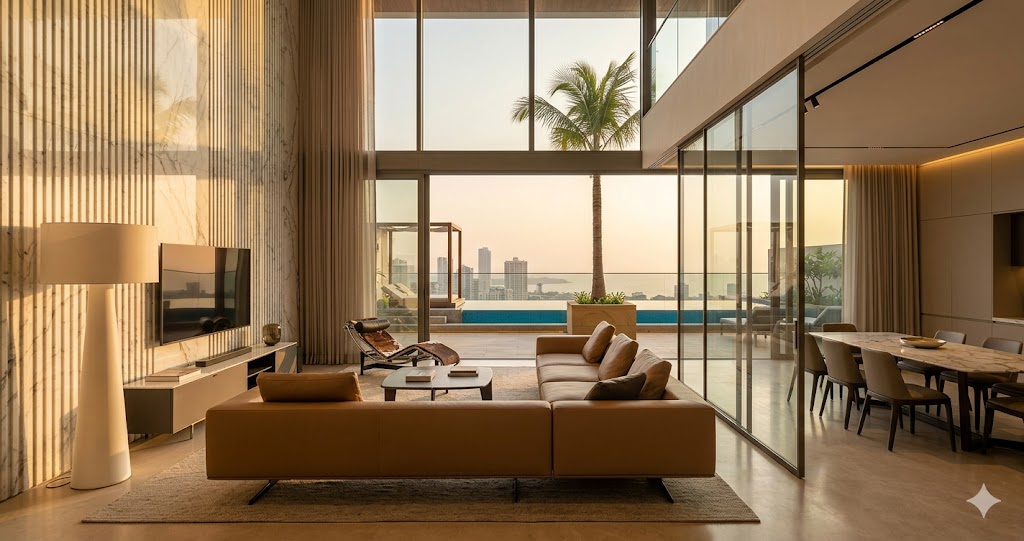
A penthouse in India in 2026 is no longer a marketing flourish for the top apartment in a building — it is a distinct asset class with its own structural, regulatory and lifestyle grammar. From DLF Camellias in Gurgaon at ₹50–150 crore to Lodha Altamount in Mumbai at ₹35–90 crore, Lodha Park at Worli, Oberoi Sky Suites at Goregaon, Prestige Falcon City Tower in Bengaluru, Sobha Indraprastha, Embassy One, Worli Sea Face and My Home Avatar in Hyderabad — the country now has a deep, transactable inventory of top-floor luxury units that share a recognisable design vocabulary: 800–3,500 sqft of private terrace, double-height living, panoramic glazing, private lift access, optional private pool, and an indoor–outdoor flow that the floor below cannot offer.
Penthouse design is the discipline of translating a developer's shell-and-core handover at the top of a high-rise into a finished home that earns its premium over the units one or two floors below. It is closer to villa-on-the-sky design than to apartment interior work — but the constraints are entirely high-rise: wind load, lift logistics, society rules, NBC 2016 high-rise fire compliance, and the relentless physics of a terrace that sits over occupied apartments.
"A penthouse is the only home in India where your roof is your garden, your floor is someone's ceiling, and your front door is a private lift lobby. Every design decision sits at the intersection of those three facts."
This guide reads alongside luxury-apartment-design, defining-luxury-residential-architecture-india, luxury-villa-architecture-india and high-rise-apartment-interiors — together they cover the full top-of-market residential design stack.
This guide refreshes every 12 months. Last verified: May 2026 · Next verify: May 2027.
What Penthouse Design Actually Means in 2026 India
A penthouse, in the 2026 Indian high-rise market, is the residential unit occupying the topmost habitable floor (or floors) of an apartment building, sold at a substantial premium over the standard units below and distinguished by a combination of: a private terrace of typically 800–3,500 sqft, ceiling heights of 3.6 m or more (often a double-height living volume of 5.5–7 m), full-height structural glazing on at least two exposures, direct private lift access opening into the unit itself rather than a shared corridor, and a developer-permitted set of additions that the lower floors are not allowed — private pool, cabana, outdoor kitchen, terrace landscaping.
The price differential is the cleanest definition. In every project that markets a penthouse, the per-square-foot rate is 1.6× to 3.0× the building's base rate. DLF Camellias in Gurgaon transacts penthouses at ₹50–150 crore (duplex), Lodha Altamount at ₹35–90 crore, Lodha Park Worli ₹30–70 crore, Oberoi Sky Suites Goregaon East ₹25–50 crore, Prestige Falcon City Tower ₹15–35 crore, Sobha Indraprastha Rajajinagar ₹12–25 crore, Embassy One ₹20–40 crore, Worli Sea Face stock ₹40–100 crore, and My Home Avatar in Hyderabad's Hi-Tech City ₹8–20 crore. The penthouse is no longer a Mumbai-only category; Bengaluru, Hyderabad and Gurgaon supply has matured enough that buyers can comparison-shop.
Five things penthouse design is NOT. First, it is not the same as a villa or independent house — the unit still sits inside a society, governed by NBC 2016 high-rise rules, by-laws on terrace use, glazing alteration restrictions, lift maintenance schedules and a common waste/water system you cannot opt out of. Second, it is not a "top-floor flat with a balcony" — a balcony is a cantilevered slab of 80–250 sqft; a penthouse terrace is 800 sqft or more and is the building's actual roof plane converted to private use. Third, it is not the same as a duplex — duplex penthouses exist (DLF Camellias, some Lodha towers), but a single-level penthouse with double-height living is equally a penthouse if the price and terrace differentials hold. Fourth, it is not interchangeable with "super-luxury apartment" — a unit on the 12th floor of a 30-storey tower with a ₹40 crore tag is a super-luxury apartment, not a penthouse, because it has neither the terrace, the private lift opening, nor the development-rights privileges. Fifth, it is not a builder-finish ready home — developers in the ₹25 crore-plus band almost universally hand over penthouses shell-and-core, leaving the buyer to commission an interior architect and run a ₹6–25 crore fit-out programme on top of the sale price.
Why Penthouse Design Matters Now
Three structural shifts have pushed penthouses from a niche Mumbai phenomenon into a national category. First, India's UHNW population — households with declared net worth above USD 30 million — crossed 13,600 by end-2025 per the Knight Frank Wealth Report, up roughly 32% from 2020, with projections suggesting a further 50–60% rise by 2030. This cohort is the natural penthouse buyer: they have already absorbed a primary villa, and the second/third residence is increasingly a top-floor city unit chosen for views, lift-to-door privacy and zero-maintenance landscape handled by the society.
Second, returning NRIs — the demographic that drove the 2022–2024 luxury sales surge in Bengaluru and Hyderabad — overwhelmingly prefer high-rise penthouses over plotted villas. They want lock-and-leave security, hotel-grade lobbies, gym/pool/concierge below, and a finished landscape they don't have to staff. Anarock's 2025 luxury report attributes 38% of ₹10-crore-plus apartment sales in Bengaluru in calendar 2024 to NRI or returning-NRI buyers, with a marked preference for top-floor units.
Third, supply has caught up. From 2018 onwards every premium developer began including 1–4 penthouse units in towers above 25 floors — the top floor delivers 1.8–2.5× revenue on near-identical construction cost. Lodha, DLF, Oberoi, Embassy, Prestige, Sobha, Brigade, Tata Housing and K Raheja each launched penthouse-anchored projects in the 2020–2025 cycle. The convergence means a search for "penthouse design" in 2026 is no longer aspirational browsing — it is an active mid-funnel query from buyers 60 days from an allotment letter, with a ₹5–25 crore fit-out decision waiting on the other side.
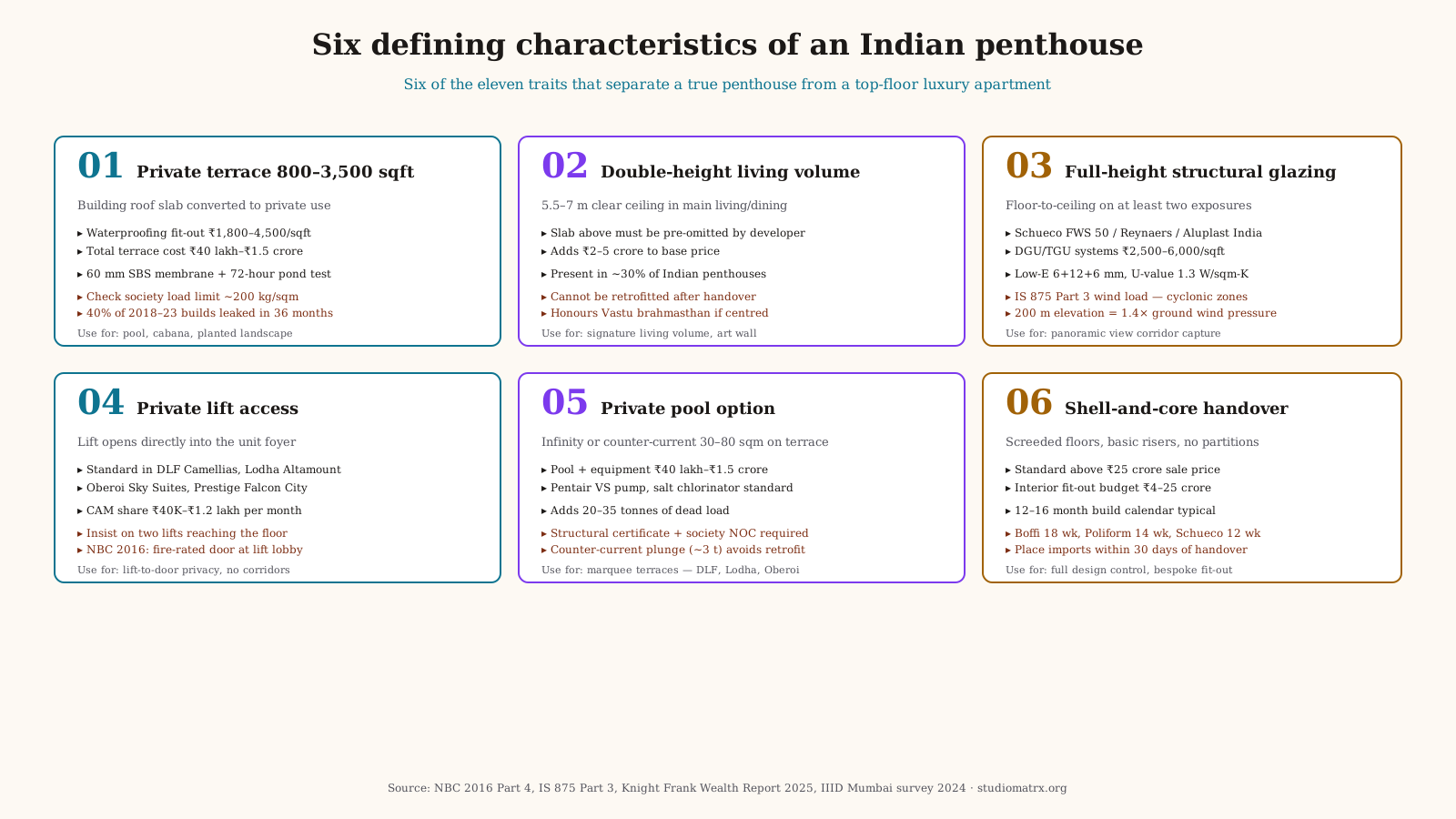
The Eleven Defining Characteristics
| Characteristic | What it means | India-specific note | Typical cost or constraint |
|---|---|---|---|
| Private terrace 800–3,500 sqft | The building roof slab converted to private use, with developer permission baked into the sale deed | Society by-laws sometimes restrict heavy planters above 200 kg/sqm; check structural memo | Waterproofing fit-out ₹1,800–4,500/sqft; total terrace cost ₹40 lakh–₹1.5 crore |
| Double-height living volume | A 5.5–7 m clear ceiling in the main living/dining, achieved by omitting the slab above | Possible only if the developer pre-planned the void; cannot be retrofitted | Available in roughly 30% of Indian penthouses; adds ₹2–5 crore to base price |
| Full-height structural glazing | Floor-to-ceiling glazing on at least two exposures, often three | Must comply with IS 875 Part 3 wind loads — cyclonic zones (Mumbai, Chennai, Vizag) require thicker glass | DGU/TGU systems ₹2,500–6,000/sqft installed; Schueco, Reynaers, Aluplast India suppliers |
| Private lift access | The lift opens directly into the penthouse foyer or a private lobby with one door | Requires a dedicated lift bank in the building design; common in DLF Camellias, Lodha Altamount, Oberoi Sky Suites | Doubles lift maintenance share for the unit; ₹40K–₹1.2 lakh/month CAM |
| Private pool option | An infinity or counter-current pool of 30–80 sqm on the terrace | Permitted only with explicit structural certificate and society NOC; rare in 95% of buildings, common in marquee projects | Pool plus equipment ₹40 lakh–₹1.5 crore; adds 20–35 tonnes dead load |
| Indoor–outdoor flow | Sliding/folding door systems collapsing the wall between living and terrace | Cyclonic and monsoon zones need bottom-tracked telescopic systems, not top-hung | Schueco ASS 70/77 systems ₹4,500–8,500/sqft of opening |
| Panoramic view corridor | The terrace and primary living orient toward an unobstructed 180–270° view | Mumbai Sea Face, Worli, Goregaon East, Bengaluru hill views drive the largest premiums | View premium adds 15–40% to base penthouse price |
| Wellness floor or zone | Sauna, steam, cold plunge, gym and meditation room as a dedicated wing | Requires extra MEP capacity beyond standard apartment provisioning | Wellness fit-out ₹60 lakh–₹2.5 crore depending on equipment |
| Smart-home backbone | Lutron Quantum, Crestron Pyng or Loxone Premium controlling lights, climate, shading, audio, security | Indian power grid quality needs surge protection and UPS on the main hub | ₹35 lakh–₹2 crore for full integration |
| Cabana / outdoor kitchen | Roofed terrace structure with kitchenette, bar, dining | Heritage/coastal zones restrict added roof area; check FSI compliance | Cabana + outdoor kitchen ₹35 lakh–₹1.2 crore |
| Shell-and-core handover | Developer delivers the unit with screeded floors, basic plumbing/electrical risers, no internal partitions | Standard for ₹25 crore-plus units; basic-finish for ₹8–15 crore range | Interior fit-out budget ₹4–25 crore depending on tier |
These eleven features are not all-or-nothing. A ₹15 crore Bengaluru penthouse may have nine of them; a ₹100 crore Mumbai penthouse will have all eleven plus one or two beyond — a wine cellar with humidity control, a chauffeur lounge separate from staff quarters, a panic room. The taxonomy matters because pricing conversations get sloppy without it: a unit with five of the eleven is a "top-floor luxury apartment", a unit with eight is a penthouse, a unit with all eleven is a "duplex super-penthouse" and the per-square-foot maths is different at each tier.
A Worked Example
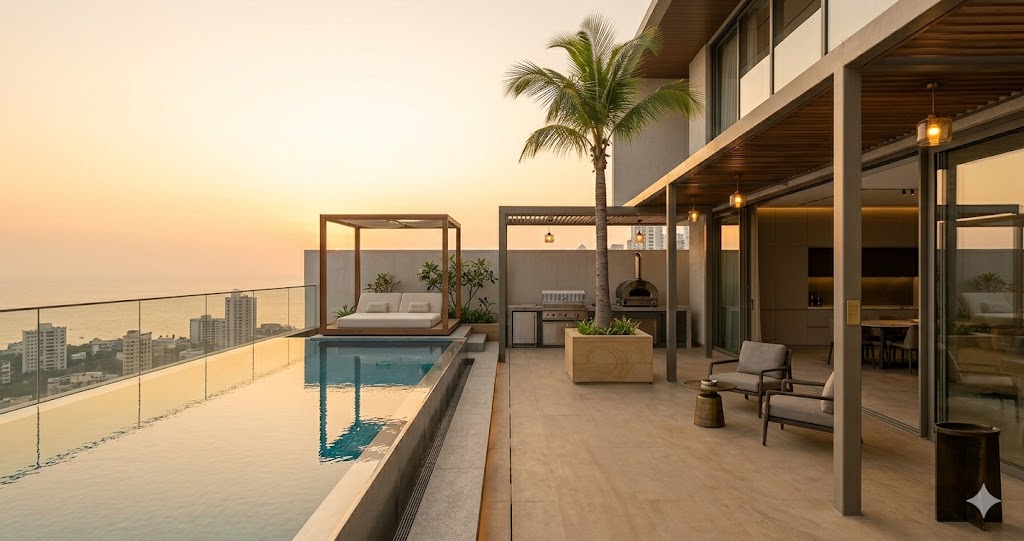
Consider a real-shape brief: a 6,500 sqft 4 BHK penthouse on the 70th floor of a Lodha Park-style Worli tower, with 1,800 sqft of private terrace, full Worli Sea Face view to the west, double-height living, private lift opening into the unit, shell-and-core handover. The buyer is a 48-year-old promoter of a Mumbai-listed company, married, two college-age children, parents visiting often. Interior design budget: ₹15 crore.
Layout. The 6,500 sqft indoor splits as: living/dining 1,400 sqft with a 6.4 m double-height volume, kitchen 280 sqft semi-open to dining, master suite 1,200 sqft (bedroom, walk-in, bath, private terrace), two children's suites at 750 sqft each, guest suite 480, family room/study 380, wellness floor 520, staff and utility 180, foyer and circulation 560. The 1,800 sqft terrace splits as: 320 cabana with outdoor kitchen, 480 infinity pool with sun deck, 600 planted landscape with a 6 m olive tree as feature, 400 outdoor lounge with fire pit.
Structural and waterproofing reality. The terrace is stripped to slab before any finish. A 60 mm SBS membrane (Sika SikaShield P 60 or BASF MasterSeal HLM 5000) is laid over a primed slab with cant strips at every parapet junction and 100 mm upturn into the parapet rebate, followed by 40 mm XPS insulation, 25 mm protection screed, then the finish. Total waterproofing buildup including warranty and 72-hour leak-pond test: ₹52 lakh. Skipping this is the #1 reason Indian penthouses end up in litigation within 36 months.
Glazing. West and south get Schueco FWS 50 SI mullion-transom facades with 50 mm sightlines, 6+12+6 mm Low-E double glazing, U-value 1.3 W/sqm-K. The 14 × 6 m west wall facing the Sea Face combines fixed glazing above and three Schueco ASS 77 PD lift-and-slide doors of 4.5 m each below. Engineered to IS 875 Part 3 wind loads at 60 m cyclonic-zone elevation. Glazing total: ₹2.8 crore.
Living/dining palette. Floors: Antolini Calacatta Borghini book-matched 1.2 × 2.4 m slabs at ₹3,200/sqft installed (₹78 lakh). Ceiling: CNC-milled American black walnut coffer at the double-height volume with concealed Lutron Ketra circadian downlights. Wall feature: 6 m vertical fluted travertine panel (see fluted-panel-design). Furniture: B&B Italia Charles, Minotti Russell, Cassina LC4 chaise, Edra Boa for the conversation pit, Poliform Mondrian dining for 12, Cassina 412 Cab chairs. Furniture: ₹2.6 crore.
Kitchen. Boffi Code island with Corian top, Wolf 90 cm induction with Wolf downdraft, Sub-Zero 762 mm wine column and 914 mm side-by-side fridge, Miele M7 oven/steam combi, Quooker boiling tap. Boffi cabinetry in Eucalyptus Smoke veneer with brushed-bronze handleless detail. Total ₹1.4 crore.
Master suite. Poliform Onda bed, Minotti Sherman armchair, Molteni 505 walk-in (12 lineal metres, brushed aluminium, backlit jewellery drawers). Bath: Boffi Wing tub, Boffi Liquid basin doubles, Dornbracht CYO fittings, Antoniolupi Strappo shower. Total ₹2.1 crore.
Wellness floor. Klafs Sanarium 4-seat combi sauna, Mr Steam iSteam 3 with chromotherapy, Tylo Sense Combi-U dry-wet combination, Sundance Sweetwater cold plunge, Hyperice Normatec recovery. Yoga room with Junckers oak, Bose surround, blackout drapery. Total ₹1.8 crore.
Smart home and HVAC. Lutron HomeWorks QSX with Ketra circadian lighting (740 fixtures), Crestron Pyng OS3 for AV and climate, Loxone Tree for shading. Five-zone Daikin VRV5 (52 indoor, 4 outdoor on screened terrace deck) with ERV. Sonos Architectural by Sonance audio in 14 zones. Total ₹1.2 crore.
Terrace and pool. 9 × 4 m infinity-edge pool in Bisazza glass mosaic, Pentair VS pump, salt chlorinator, automatic cover. Cabana: teak-batten roof on steel frame, outdoor kitchen with Lynx 42" grill, Sub-Zero outdoor fridge drawers, Galanter & Jones heated cast-aluminium seating for monsoon. Landscape: 6 m mature olive tree (₹14 lakh delivered), 24 cu m planting medium in vibration-isolated planter boxes, Hunter MP Rotator drip. Total ₹1.9 crore.
Vastu adjustments. The brahmasthan falls in the dining, kept double-height and uncluttered. Northeast holds a pooja niche with marble jaali (see pooja-room-design-india). Master is southwest as desired. Kitchen is southeast satisfying the agni placement (see vastu-for-kitchen). The brahmasthan's "open-to-sky" requirement is honoured by the double-height living sitting directly under the terrace, with the terrace itself unbuilt above the void.
Budget summary.
| Line item | Amount |
|---|---|
| Waterproofing, screed, terrace structure | ₹52 lakh |
| Glazing and facade engineering | ₹2.80 crore |
| Stone, woodwork, ceiling, walls | ₹2.40 crore |
| Furniture (living, dining, family, study) | ₹2.60 crore |
| Kitchen with appliances | ₹1.40 crore |
| Master + 3 other bedroom suites | ₹3.60 crore |
| Wellness floor | ₹1.80 crore |
| Smart home + AV + HVAC | ₹1.20 crore |
| Terrace + pool + cabana + landscape | ₹1.90 crore |
| Design fees (8% of build) | ₹1.45 crore |
| Project management + contingency | ₹0.85 crore |
| Total | ₹20.52 crore |
The buyer's ₹15 crore budget falls ₹5 crore short of this brief. The honest design conversation is what to cut: typically the wellness floor scales back to sauna-and-steam only (saving ₹1 crore), pool downsizes to a counter-current plunge (saving ₹70 lakh), Boffi kitchen swaps to a Poliform Phoenix (saving ₹40 lakh), and the Antolini slabs are replaced with Italian Statuario from a single block (saving ₹35 lakh). With these trade-offs the project lands at ₹15.2 crore and a 14-month build calendar from shell-and-core handover to move-in.
Penthouse Design vs Adjacent Categories
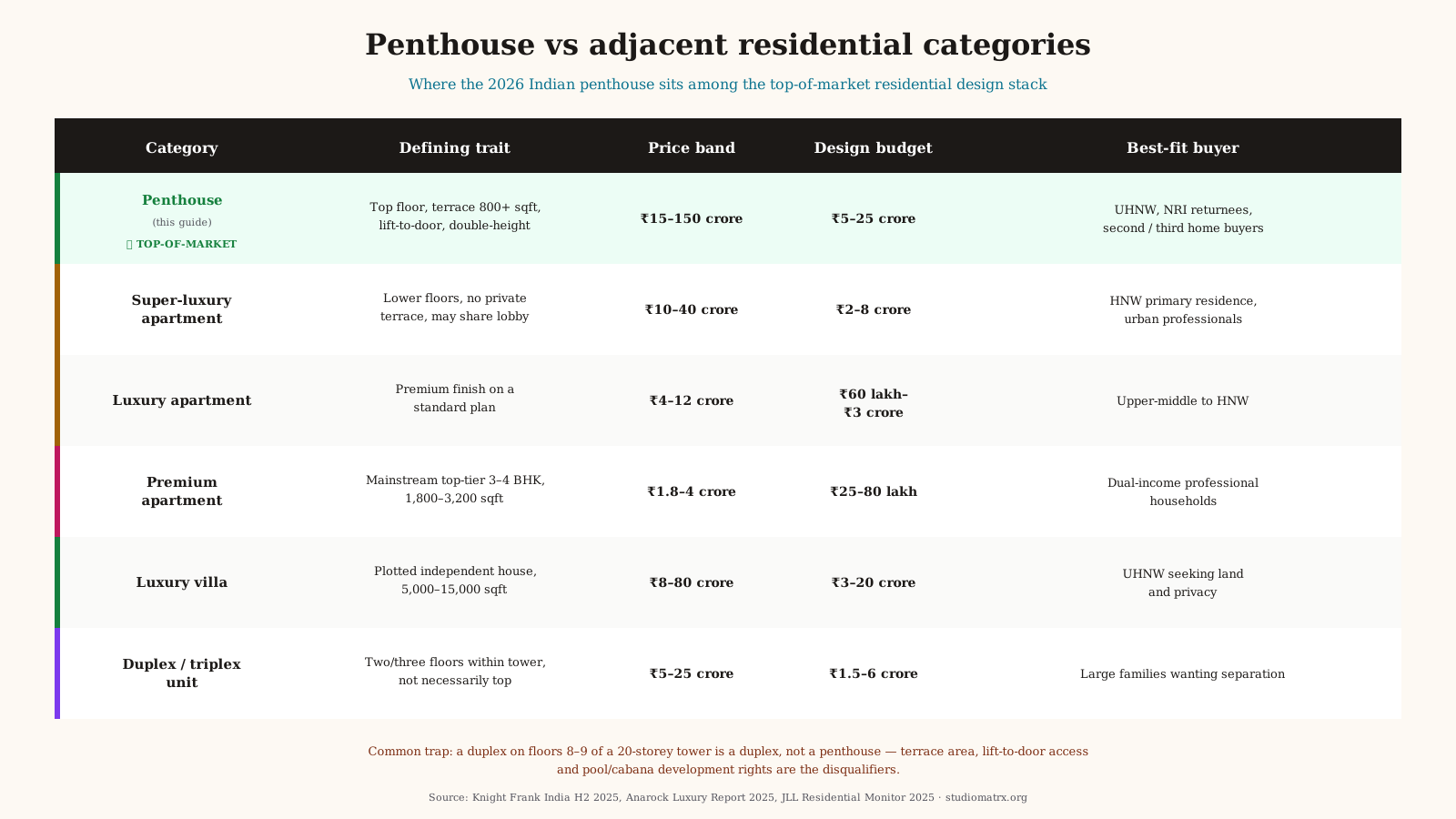
| Category | Defining trait | Typical India price | Design budget | Best fit |
|---|---|---|---|---|
| Penthouse (this guide) | Top-floor, private terrace 800+ sqft, lift-to-door | ₹15–150 crore | ₹5–25 crore | UHNW, NRI returnees, second/third home buyers |
| Super-luxury apartment | Lower floors, no private terrace, may share lobby | ₹10–40 crore | ₹2–8 crore | HNW primary residence, urban professionals |
| Luxury apartment | Premium finish on a standard plan | ₹4–12 crore | ₹60 lakh–₹3 crore | Upper-middle to HNW, see luxury-apartment-design |
| Premium apartment | Mainstream developer top-tier (3–4 BHK), 1,800–3,200 sqft | ₹1.8–4 crore | ₹25–80 lakh | Dual-income professional households |
| Luxury villa | Plotted independent house, 5,000–15,000 sqft | ₹8–80 crore | ₹3–20 crore | UHNW seeking land + privacy; see luxury-villa-architecture-india |
| Duplex / triplex unit | Two/three floors within the building, not necessarily top | ₹5–25 crore | ₹1.5–6 crore | Large families wanting separation |
The trap buyers fall into is conflating a duplex with a penthouse. A duplex on floors 8–9 of a 20-storey tower is a duplex, not a penthouse — even if the developer's brochure uses the word. The distinguishing features are the terrace area, the lift-to-door access, and the development rights for pool/cabana, none of which a mid-tower duplex carries.
Materials, Finishes and Brand Landscape
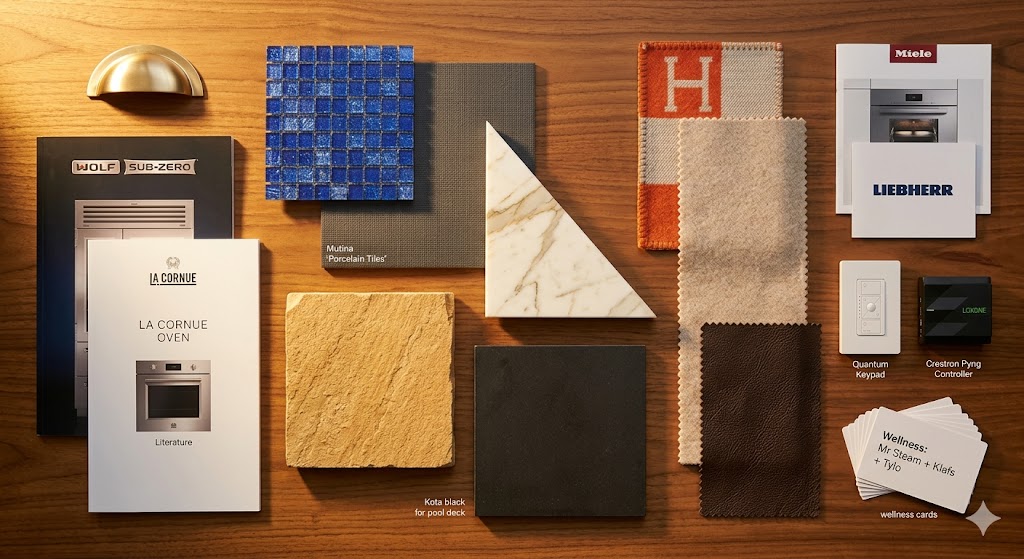
The brand vocabulary in the Indian penthouse market is narrower than buyers expect. A handful of European brands dominate, supported by a deepening Indian premium tier and a small set of marble wholesalers that supply most of the ₹15 crore-plus segment.
| Category | International benchmark | India distributor / equivalent | Typical penthouse spec | Cost order |
|---|---|---|---|---|
| Kitchen system | Boffi, Poliform Varenna, Bulthaup, Molteni Dada | Boffi Bombay/Bengaluru showrooms, Poliform Mumbai, Sleek by Asian Paints (mid-luxury) | Boffi Code or Poliform Phoenix island | ₹40 lakh–₹2.5 crore |
| Wardrobes | Molteni 505, Poliform Senzafine, Rimadesio Cover | Molteni&C Mumbai, Poliform, Rimadesio India dealers, Hettich India for premium hardware | Molteni 505 walk-in with backlit interiors | ₹12–80 lakh per walk-in |
| Sofa | B&B Italia, Minotti, Cassina, Edra, Flexform | Mumbai (Living Etc, BB Italia store at BKC), Bengaluru | B&B Italia Charles, Minotti Russell or Edra Boa | ₹8–45 lakh per sofa |
| Dining | Poliform, Molteni&C, Cassina, Knoll | Poliform Mumbai, Knoll India dealer | Poliform Mondrian or Cassina La Rotonda | ₹6–28 lakh |
| Bed | Poliform, Minotti, Flou, Cassina | Mumbai Living Etc, Beyond Designs Delhi | Poliform Onda or Flou Letto Notturno | ₹4–18 lakh |
| Bath fittings | Dornbracht, Gessi, Vola, Boffi RAW | Dornbracht India dealers (Mumbai, Delhi), Jaquar Artize tier for value | Dornbracht CYO or Tara series | ₹3–18 lakh per bathroom |
| Sanitaryware | Antoniolupi, Boffi, Agape, Duravit Cape Cod | Direct import or Mumbai/Delhi showrooms; Kohler Veil for tier below | Boffi Wing tub, Antoniolupi Strappo shower | ₹4–22 lakh per bathroom |
| Stone | Antolini, Margraf, Citco | Antolini India (Mumbai), Stonemart, A-Class Marble in Kishangarh | Antolini Calacatta Borghini book-matched | ₹2,200–6,500/sqft installed |
| Wood floor | Junckers, Listone Giordano, Bolefloor | Direct import; Pergo Premium and Quick-Step for tier below | Listone Giordano oak plank | ₹650–2,800/sqft installed |
| Glazing | Schueco, Reynaers, Aluprof | Schueco India (Mumbai), Reynaers India (Bengaluru) | Schueco FWS 50 facade + ASS 77 PD doors | ₹2,500–8,500/sqft |
| Lighting | Flos, Artemide, Vibia, Davide Groppi, Lutron Ketra | Light & Beyond, Mumbai/Bengaluru import boutiques | Flos Skygarden, Davide Groppi Moon | ₹40,000–6 lakh per fixture |
| Smart home | Lutron HomeWorks/Ketra, Crestron Pyng, Loxone | Lutron India (Mumbai HQ), Crestron India, Loxone India dealers | Lutron HomeWorks QSX + Ketra | ₹35 lakh–₹2 crore |
| HVAC | Daikin VRV5, Mitsubishi City Multi, Toshiba SMMS | Daikin India, Mitsubishi Electric India | Daikin VRV5 with ERV | ₹35–95 lakh |
| Sauna/steam | Klafs, Tylo, Helo, Mr Steam | Klafs India (Mumbai), Tylo dealers | Klafs Sanarium combi | ₹18–55 lakh |
| Pool | Pentair, Hayward, Endless Pools | Lotus Pools India, Aquanomic, regional pool engineers | Infinity edge with Pentair VS pump | ₹40 lakh–₹1.5 crore |
The Indian mid-luxury tier — Sleek by Asian Paints, Hettich, Hafele India, Jaquar Artize, Kohler, Wakefit (for non-statement furniture), Urban Ladder — does not enter the ₹15 crore-plus penthouse vocabulary except in staff areas or utility zones. For ₹8–15 crore penthouses, a hybrid is common: Boffi or Poliform kitchen but Hettich India for non-visible drawer mechanisms, Antolini stone but Indian travertine accents, Dornbracht in master baths but Kohler Components in guest baths.
Eight Pitfalls Common in 2026 India
1. Terrace waterproofing failure (the single biggest penthouse pitfall). Roughly 40% of Indian penthouses fitted out between 2018 and 2023 reported terrace water ingress to the floor below within 36 months, per a 2024 IIID Mumbai chapter survey. The cause is almost always a developer's standard APP membrane (waterproof for a roof, not for a planted/walked/pooled terrace) kept in place under new finishes. Mitigation: strip to slab, lay a 60 mm SBS or PMMA liquid membrane warranted to 25 years, conduct a 72-hour leak-pond test before any finish, and have the structural engineer sign off on slab deflection.
2. Glazing wind-load under-specification. IS 875 Part 3 wind-load math at 60–200 m elevation in cyclonic zones (Mumbai, Chennai, Vizag, parts of Kolkata) often demands 12 mm or thicker outer panes and reinforced mullions. Many contractors quote standard 6 mm DGU systems compliant only at lower elevations. Mitigation: insist on a stamped wind-load calculation before approving the glazing package.
3. Lift access stoppage on lower-only floors. Some buildings have a single dedicated penthouse lift; if it goes down, the unit is accessible only via the fire stair or by riding a general lift to floor N-1 and walking up. Mitigation: pre-purchase, confirm two lifts reach the penthouse floor (even if one is the service lift), with a service-lift entry into a service corridor of the unit.
4. NBC 2016 Part 4 fire compliance gaps. Penthouses above 70 m need refuge area access, sprinklered terrace if combustible roofed structures exist (cabana, pergola, outdoor kitchen with flame), and a fire-rated door at the private lift lobby. Many fit-outs install cabanas without sprinklers, breaking compliance and voiding insurance. Mitigation: bring an NBC-2016-fluent fire consultant on from concept stage.
5. Vastu compromise — the brahmasthan problem. Vastu asks for the brahmasthan (central one-ninth) to be kept open with sky access. A penthouse's centre often has a structural column grid and the terrace above — honouring brahmasthan requires a double-height void or skylight at the centre. Where the slab cannot be opened, keep the brahmasthan as the family/dining circulation core, uncluttered. See vastu-modern-homes.
6. HVAC outdoor unit placement disputes with the RWA. A 6,500 sqft penthouse with 5-tonne VRV needs 4 outdoor units. Most buildings assign a small AC ledge fitting 2 units; the rest have to go on the terrace, violating society rules. Mitigation: get explicit written RWA permission before specifying HVAC, and use Daikin VRV5 (lower outdoor count per tonnage) where possible.
7. Acoustic transfer to the floor below — pool, gym, audio. The penthouse owner's 2 a.m. pool swim and 6 a.m. Peloton ride become the downstairs owner's lawsuit. Mitigation: float the gym floor on Mason isolation pads, build a Cinemascape acoustic ceiling for home theatre, and install pool pumps on neoprene vibration isolators in a sound-dampening enclosure. See acoustic-privacy-visualizer.
8. Underestimating fit-out timeline. A ₹15 crore shell-and-core penthouse takes 12–16 months from handover to move-in. Imported lead times (Boffi 18 weeks, Poliform 14, Schueco 12, plus shipping and customs) drive the critical path. Mitigation: place all imported orders within 30 days of handover, deposits paid and shipping pre-booked.
India-Specific Considerations
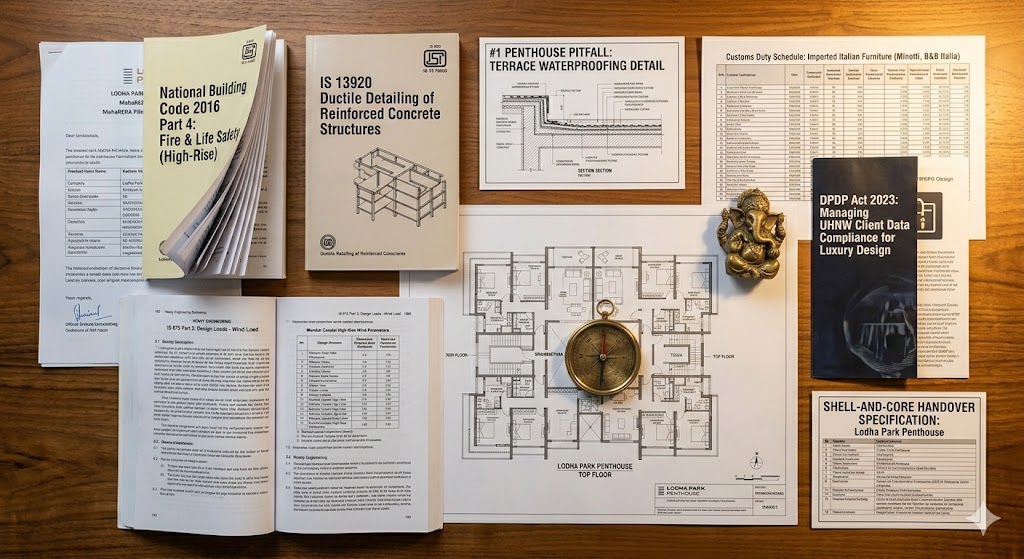
The Indian penthouse sits at the intersection of national codes, state municipal by-laws, society rules, and Vastu — a denser regulatory and cultural stack than its London, Dubai or Singapore counterparts.
NBC 2016 Part 4. High-rise residential buildings above 15 m fall under the Code's high-rise fire and life safety provisions. Penthouses on towers above 70 m additionally require refuge area access on the floor itself or within one floor below, sprinklered ceilings throughout including any covered terrace structures, fire-rated doors at the private lift lobby, and a dedicated wet riser. Any terrace cabana or outdoor kitchen with cooking flame triggers a sprinklered-roof requirement. The deeded "private" terrace does not override fire-code obligations.
IS 875 Part 3. Wind-load design for glazing, parapets and terrace pergolas. India's wind zones range from 33 m/s inland to 55 m/s in the East Coast cyclonic belt. A penthouse at 200 m elevation in Mumbai sees roughly 1.4× the wind pressure of a ground-floor unit in the same building. Glazing, balcony railings, pergolas and outdoor kitchen roofs all need IS 875 calculations stamped by a structural engineer.
IS 4651 / IS 13920. Seismic. Mumbai and Delhi NCR sit in Zone IV; Bengaluru and Hyderabad in Zone II. Heavy stone slabs on upper floors increase seismic mass at the top of the building, which is dynamically worst-case — Antolini 30 mm book-matched slabs are heavier than ceramic alternatives, so the structural consultant should sign off on added dead load.
Vastu Shastra compatibility. Beyond the brahmasthan issue, three penthouse-specific themes arise. First, the entrance door — Vastu prefers north, east or northeast entry, but the penthouse's entry is whatever the lift core dictates, often southwest. Mitigation: use a foyer to "redirect" the entry visually toward the favourable direction. Second, the pooja room — northeast is preferred but often coincides with the best view. Most owners resolve by placing a small pooja niche in the northeast and the primary view terrace separately. Third, kitchen placement in the southeast (agni) is often constrained by MEP risers, requiring expensive plumbing re-routing.
Society and RWA by-laws. Common restrictions: no external glazing alteration (which can break the panoramic glazing brief — pre-approval needed), no terrace structures above ~3.5 m (ruling out double-height cabanas), no pool without written society approval (rarely granted in older buildings), no exterior elevation alteration. Newer marquee projects (DLF Camellias, Lodha Altamount, Oberoi Sky Suites) bake penthouse alteration rights into the sale deed, sidestepping the RWA. Older buildings do not, and the RWA can block a fit-out months in.
DPDP Act 2023. Smart-home installations capturing voice (Alexa, Nest), video (CCTV) and biometric data (smart locks, facial recognition) trigger DPDP compliance. Cameras pointing at common areas need RWA permission. Footage retention beyond 30 days needs a documented purpose. Voice-assistant data leaving India may need cross-border transfer disclosures if the owner uses the residence as a registered business address.
Climate zones and orientation. A Mumbai penthouse (warm-humid) faces 75% RH for 4 months — every material needs mould resistance and HVAC sizing must include latent load. A Delhi penthouse (composite) sees 47°C summers and 4°C winters — glazing must handle the full thermal range and underfloor heating is worth considering. A Bengaluru penthouse (moderate) has the gentlest climate and can run operable glazing for most of the year. See tropical-architecture-india for the climate-response framework.
Regional vendor differences. Mumbai has the deepest penthouse ecosystem — Boffi, Poliform, B&B Italia, Minotti, Schueco, Klafs and Dornbracht all hold showrooms or experience centres. Delhi NCR is next, with strong Boffi/Poliform presence in Gurgaon. Bengaluru has Living Etc and a handful of premium dealers but most imports route through Mumbai. Hyderabad, Pune and Chennai run via Mumbai/Bengaluru firms with logistics expertise.
The Budget Bands for 2026 India
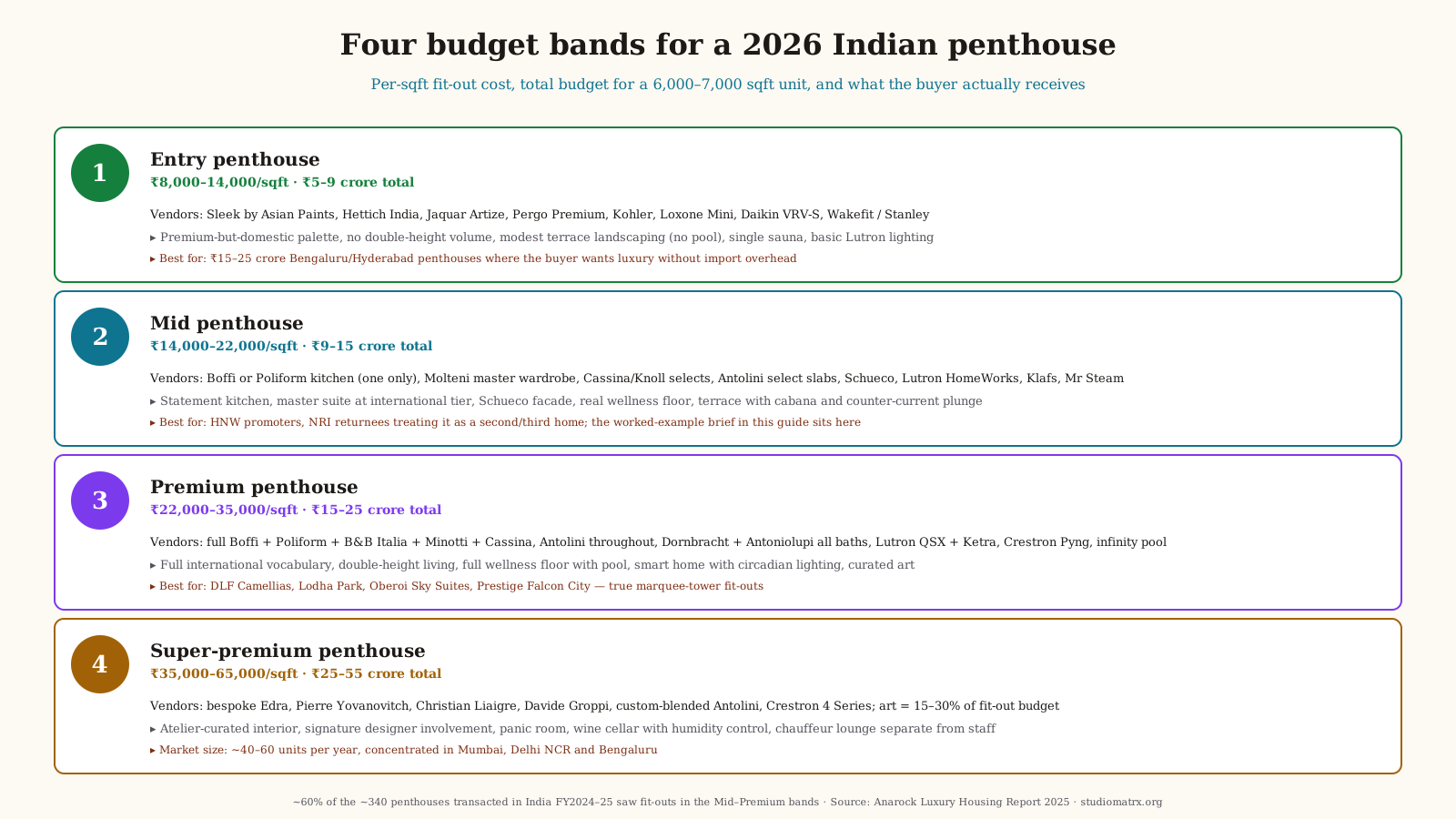
| Tier | Per-sqft fit-out | Total fit-out (6,000–7,000 sqft) | Vendors | What you get |
|---|---|---|---|---|
| Entry penthouse | ₹8,000–14,000/sqft | ₹5–9 crore | Sleek, Hettich, Jaquar Artize, Pergo Premium, Saint-Gobain, indigenous stone, Kohler, Loxone Mini, Daikin VRV-S, Wakefit/Stanley | Premium-but-domestic palette, no double height, modest terrace landscaping (no pool), single sauna, basic Lutron lighting |
| Mid penthouse | ₹14,000–22,000/sqft | ₹9–15 crore | Boffi/Poliform kitchen (one only), Molteni wardrobes (master only), Cassina/Knoll select pieces, Antolini select slabs, Dornbracht in master, Schueco glazing, Lutron HomeWorks, Daikin VRV5, Klafs sauna, Mr Steam | Statement kitchen, master suite at international tier, Schueco facade, real wellness floor, terrace with cabana and counter-current plunge |
| Premium penthouse | ₹22,000–35,000/sqft | ₹15–25 crore | Full Boffi + Poliform + B&B Italia + Minotti + Cassina, Antolini throughout, Dornbracht and Antoniolupi in all baths, Schueco full facade, Lutron HomeWorks QSX + Ketra, Crestron Pyng, Klafs + Tylo + Mr Steam wellness, infinity pool with Pentair | Full international vocabulary, double-height living, full wellness floor with pool, smart home with circadian lighting, premium curated art |
| Super-premium penthouse | ₹35,000–65,000/sqft | ₹25–55 crore | All of the above plus bespoke commissioned pieces from Edra, custom Pierre Yovanovitch furniture, Davide Groppi lighting, Christian Liaigre signature pieces, custom-blended Antolini slabs, Crestron 4 Series with custom programming, art collection 15–30% of fit-out budget | Atelier-curated interior, signature designer involvement, museum-grade art lighting, full bespoke fabrication, panic room, wine cellar with humidity control, chauffeur lounge separate from staff quarters |
The dominant pattern in 2026 is the mid and premium tiers. Anarock's data suggests that of the ~340 penthouse units transacted nationally in 2024–25, roughly 60% saw fit-out budgets in the ₹9–25 crore range. The super-premium tier (₹25 crore-plus) is a 40–60 unit/year market concentrated in Mumbai, Delhi NCR and Bengaluru.
When Penthouse Design Is NOT the Right Fit
A penthouse is the wrong purchase for at least four buyer profiles.
First, families with very young children or with elderly parents needing routine medical access. The lift dependency is a real risk: every lift fails sometimes, and a 90-second response from a service technician for a standard apartment turns into a 20-minute escalation for a penthouse on the 70th floor with a single dedicated lift. For families with infants or with parents on dialysis or oncology schedules, the predictability of a lower-floor apartment or a villa is structurally safer.
Second, buyers who want "lock-and-leave" but undervalue staff and maintenance. A penthouse with 1,800 sqft of terrace, an infinity pool, a Klafs sauna and a Lutron smart-home backbone needs at least one full-time live-in staff member, a weekly pool service, a monthly sauna service, and a smart-home maintenance contract. The all-in monthly running cost — staff, CAM, smart-home contracts, pool chemicals, sauna service, plant care — for a ₹15 crore penthouse settles in the ₹3.5–6 lakh per month range. If the buyer is travelling 200+ days a year and uninterested in managing this, a serviced apartment in a hotel-branded residence (Four Seasons Private Residences, Oberoi Three Sixty) is often a cleaner answer.
Third, buyers who want garden, ground contact, or vegetable cultivation. A penthouse terrace can host planters and small trees, but the load limits, planter depth (rarely above 600 mm) and salt-laden coastal wind mean that the experience is fundamentally a roof garden, not a ground garden. Buyers who want the feel of a Sahyadri hill bungalow, a south Bengaluru plotted villa with mango trees, or a Goa beach house garden — should buy those, not a penthouse. See luxury-villa-architecture-india and villa-landscape-design for the alternative.
Fourth, buyers in heritage-sensitive zones where high-rise penthouses don't exist. Old South Mumbai (Fort, Colaba, Marine Drive), Old Delhi, Lutyens' Bungalow Zone, Bengaluru Cantonment, parts of Kolkata's heritage zone — these locations either prohibit high-rises or have no marquee penthouse inventory. Buyers wedded to these neighbourhoods should look at heritage bungalow restoration or whole-floor apartments in 1930s–1960s buildings, which is a different design discipline.
The 5-Year Trajectory: 2030 Outlook
Three trends are reshaping Indian penthouse design between 2026 and 2030.
Branded residences move from anomaly to default. As of 2026, hotel-branded penthouses (Four Seasons Private Residences Bengaluru, Oberoi 360 West Mumbai, Trump-branded Lodha towers, Ritz-Carlton Residences Pune) represent roughly 12% of the ₹15 crore-plus supply. Knight Frank and JLL project this rising to 30–35% by 2030, driven by hotel-grade service expectations and the resale premium branded residences carry. Fit-out vocabularies will need to align with brand standards, reducing the blank-canvas freedom of today's shell-and-core handover.
Wellness floors expand from sauna to medical-grade. The 2024–2026 wellness floor was sauna, steam, cold plunge, gym. The 2028–2030 wellness floor is being commissioned with hyperbaric oxygen chambers (Vitaeris 320), red-light therapy (Joovv Elite), continuous-glucose-monitor-friendly kitchens, Eight Sleep Pod 4 sleep optimisation suites, and quarterly biological-age testing as a home service. The wellness budget on a ₹25 crore fit-out rises from ₹1.5–2.5 crore in 2026 to a projected ₹3–5 crore by 2030.
AI-orchestrated home operating systems. Today's Lutron + Crestron + Loxone backbone is rule-based. By 2030, leading fit-outs are commissioning AI agents (Crestron Project Horizon, Lutron Ketra+ AI, Apple HomeKit Matter integrators) that learn occupant preferences, adapt circadian profiles to Oura/Whoop sleep data, run preventive HVAC maintenance, and orchestrate cross-system scenarios without explicit rules. Smart-home spend rises from ₹35 lakh–₹2 crore today to ₹1–4 crore by 2030. See smart-home-design-india.
A fourth, quieter trend: sustainability moves from optional to required. By 2030, IGBC and GRIHA Platinum will be buyer expectation rather than developer claim — meaning fit-outs must account for embodied carbon of imported stone, water reuse on terrace landscape, and grid-tied solar where the developer's PV plant doesn't already cover the load. See sustainable-interiors-india.
Frequently Asked Questions
Q1. Is a penthouse always the top floor?
By definition in 2026 Indian usage, yes — the topmost habitable floor (or two floors for a duplex penthouse). A "second-from-top" unit marketed as a penthouse is using the word loosely; the absence of the building roof as private terrace means none of the penthouse premium features apply. The exception is towers with two equally configured top units where both are sold as twin penthouses sharing the roof terrace zone.
Q2. Can I add a swimming pool to my terrace if it wasn't designed in?
Probably not. A pool adds 20–35 tonnes of dead load to a slab likely engineered for foot traffic plus 200 kg/sqm live load. Retrofitting needs structural reinforcement (typically steel beams in the floor below, requiring downstairs consent), society NOC, and a municipal permit. The realistic alternative is a counter-current plunge (1,500–2,500 litres, ~3 tonnes loaded) which most slabs accept without reinforcement.
Q3. How long does a ₹15 crore penthouse fit-out take?
12–16 months from shell-and-core handover to move-in, assuming imported furniture orders are placed within 30 days of handover. The critical path is Schueco glazing (12 weeks lead plus 6 weeks install) and Boffi/Poliform kitchen (16–18 weeks ex-Italy plus 4 weeks install). Wellness equipment from Klafs adds 10 weeks. Most delays come from indecision on art and stone book-matching — both should be locked by month 3.
Q4. What is the difference between a duplex penthouse and a single-level penthouse with a double-height living?
A duplex penthouse has two floors of habitable interior connected by an internal staircase, plus the terrace above. A single-level penthouse has all habitable rooms on one floor but may have a double-height void in the living/dining. Both are penthouses; the duplex carries 20–40% more interior area at similar terrace size, so a higher absolute price but often lower per-sqft rate.
Q5. Do penthouse Vastu rules differ from regular apartment Vastu?
The principles are the same, but practical compromises arise: harder to keep brahmasthan open, entrance dictated by the lift core rather than direction, kitchen constrained by MEP risers. The penthouse advantage is that the northeast can be the prime view zone with terrace access, which Vastu accepts. See vastu-modern-homes, entrance-vastu and pooja-room-design-india.
Q6. Is the developer's handover always shell-and-core?
Above ₹25 crore, almost always yes — buyers in this tier want full design control. Between ₹8–15 crore, developers often offer "basic finish" (vitrified flooring, builder-grade modular kitchen, standard sanitaryware) which buyers typically replace 70%+ in the first fit-out. Below ₹8 crore, a more comprehensive developer finish is common but the unit at that price is typically a top-floor luxury apartment rather than a true penthouse.
Q7. What ongoing monthly cost should I budget for a ₹15 crore penthouse?
Roughly ₹3.5–6 lakh per month all-in: CAM ₹60K–₹1.5 lakh, one live-in staff ₹40K–₹60K, weekly pool service ₹15K–₹30K, sauna/steam service ₹8K–₹15K, smart-home AMC ₹15K–₹35K, terrace plant care ₹15K–₹35K, HVAC AMC ₹10K–₹25K, glazing cleaning ₹25K–₹60K, electricity ₹40K–₹90K, water ₹8K–₹15K. Costs scale with terrace size and wellness complexity.
Q8. Who should I commission to design my penthouse?
For ₹15 crore-plus budgets, work with an interior architect (not just an interior designer) who has at least three completed penthouse projects in their portfolio and who is fluent with international vendor specifications and import logistics. India-based firms with credible penthouse practices include Hirsch Bedner Associates India, JTCPL Designs, Beyond Designs, Lipika Sud Interiors, DesignAtelier, Cadence, Iqrup + Ritz and Khosla Associates. International firms with India project capacity include Yabu Pushelberg, Pierre Yovanovitch and Studio KO, typically partnering with a local execution architect. See choosing-an-interior-designer-india for the broader vetting framework.
Q9. Can AI tools meaningfully help with penthouse design?
For early-stage moodboarding, palette exploration, furniture clearance checks and lifestyle-driven space programming, yes — AI tools shorten the discovery phase from weeks to days. For ₹15 crore-plus actual specification, no — every line item needs human-architect judgment, vendor relationships and project-management depth that AI cannot substitute. A reasonable workflow is to use Studio Matrx's moodboard builder to develop the initial visual language with the family, then hand a clarified brief to the human design team for execution.
Q10. How does penthouse design differ between Mumbai and Bengaluru?
Three structural differences. First, Mumbai penthouses face harsher wind, salt and monsoon — glazing systems, facade sealants and metalwork specifications run heavier and more expensive. Second, Mumbai penthouses are predominantly view-driven (Sea Face, Worli, Bandra harbour); Bengaluru penthouses are more often green-view-driven (Cubbon Park, golf courses, the eastern Whitefield lake zones), which changes the orientation strategy. Third, Mumbai's vendor and import ecosystem is significantly deeper, which means a Bengaluru penthouse fit-out often routes furniture and imported finishes via Mumbai logistics — adding 3–6 weeks and modest cost. See high-rise-apartment-interiors for shared high-rise principles.
References
1. National Building Code of India 2016, Part 4 — Fire and Life Safety, Bureau of Indian Standards, New Delhi. https://www.bis.gov.in
2. National Building Code of India 2016, Part 8 — Building Services, Bureau of Indian Standards. https://www.bis.gov.in
3. IS 875 (Part 3) : 2015, Design Loads (Other than Earthquake) for Buildings and Structures — Code of Practice, Part 3 Wind Loads, Bureau of Indian Standards.
4. IS 4651 (Part 5) : 2014 and IS 13920 : 2016, Seismic Design Provisions, Bureau of Indian Standards.
5. Knight Frank Wealth Report 2025, UHNW segment analysis and luxury residential demand. https://www.knightfrank.com/wealthreport
6. Knight Frank India, India Real Estate Outlook H2 2025 — Residential, Knight Frank India Research. https://www.knightfrank.co.in/research
7. Anarock Group, India Residential Market Update Q4 2025 and Luxury Housing Report 2025. https://www.anarock.com/research
8. JLL India, Residential Market Monitor 2025 — Luxury and Ultra-Luxury Segment. https://www.jll.co.in
9. CBRE India, India Living Report 2025 — Premium Residential Trends. https://www.cbre.co.in
10. Magicbricks Research, Luxury Housing Index 2025, Mumbai/Delhi NCR/Bengaluru/Hyderabad segments. https://www.magicbricks.com
11. 99acres Insite Report, Top-Floor Premium Analysis FY2025. https://www.99acres.com
12. Energy Conservation Building Code (ECBC) 2017, Bureau of Energy Efficiency, climate zones and envelope provisions. https://beeindia.gov.in/ecbc
13. Digital Personal Data Protection Act 2023, Ministry of Electronics and Information Technology, India. https://www.meity.gov.in/data-protection-framework
14. Indian Institute of Interior Designers (IIID) Mumbai Chapter, Penthouse Fit-out Survey 2024 — defect frequency analysis.
15. India Brand Equity Foundation (IBEF), Luxury Real Estate in India: Drivers and Outlook 2025. https://www.ibef.org
16. Houzz India, 2025 India Luxury Residential Trends Report. https://www.houzz.in
17. Architectural Digest India, "The New Indian Penthouse" — feature edition, 2025.
18. Schueco India technical documentation, FWS 50 SI facade and ASS 77 PD lift-and-slide door wind-load test reports.
19. Lutron Electronics, HomeWorks QSX and Ketra system integration guides — India edition 2025.
Related Guides
Export this guide
Related Guides — Deep-dive reading
Luxury Apartment Design — The ₹2 to ₹15 Crore Tier in Indian Towers (2026)
Super-luxury apartment fit-out · Boffi / Poliform / Minotti · Italian Statuario · Lutron / Crestron
Design StylesHigh-Rise Apartment Interiors — 15+ Floor Tower Specifics for Indian Cities (2026)
Wind-load glazing · Lift-time tax · Refuge floors · Post-tension slab limits · World One Worli ₹35 lakh example
Design StylesStudio Apartment Design — The 1RK 250-450 sqft Indian Cornerstone (2026)
1RK studio · 5 zones in 350 sqft · Bed-as-sofa · Co-living adjacent · Mumbai BKC ₹35K rent
Design StylesRelated Tools — Try Free
Brise-Soleil Visualizer
Interactive horizontal-louvre cut-off angle calculator — sun altitude, louvre depth, and spacing inputs with a live shadow preview. Computes θ = arctan(spacing/depth) for façade shading, ECBC envelope compliance, hospital daylight design, and tropical sun-control detailing.
Sun Shading ToolCircadian Light Meter
Patient-centric circadian lighting visualizer for Indian healthcare design — time-of-day × intensity → CCT, melanopic lux (EML / mEDI), melatonin suppression, and an alertness curve. Calibrated against WELL v2 L03 Circadian Lighting Design, CIE S 026:2018, Brainard 2001, and Lucas et al. 2014.
Circadian ToolCross-Ventilation Analyzer
Estimate airflow and air changes per hour (ACH) from room size, window areas, layout, and local wind — with NBC 2016 Part 8 compliance check.
Ventilation Calculator