
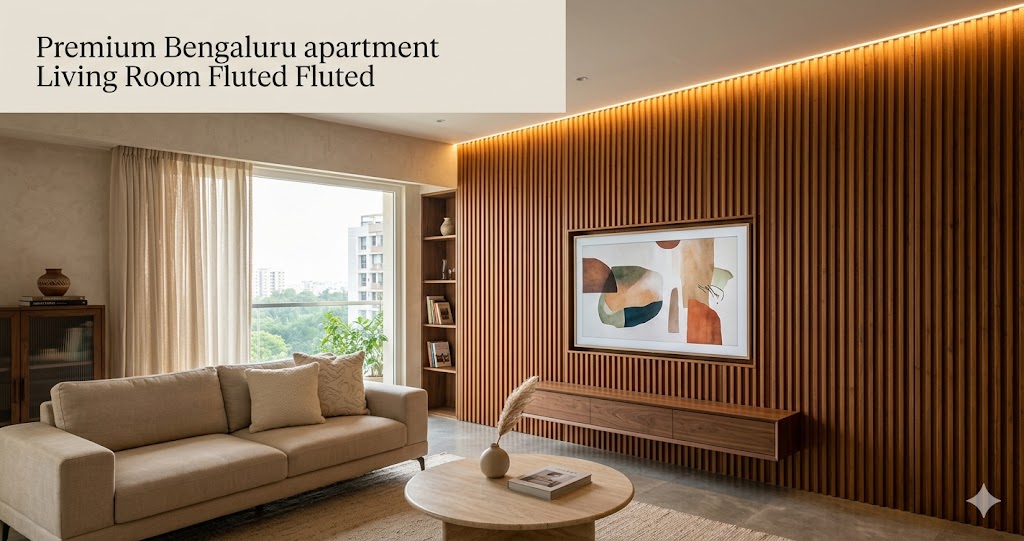
Fluted Panel Design — A Working Reference for Indian Interiors 2026
Anatomy · Materials · Pitch · Lighting · Pitfalls
Fluted panels are the single most over-specified and under-detailed element in 2024-26 Indian interiors. Walk into ten new premium apartment fit-outs in Mumbai, Bengaluru, Hyderabad, or Delhi NCR this year and eight will have a fluted feature wall — the TV wall, the headboard, the foyer screen, occasionally all three. The reason is structural: fluted panels solve four design problems in one move. They add visible texture without colour, they read warm without being heavy, they hide cabling and joinery without looking utilitarian, and they photograph well enough to anchor a real-estate listing. The problem is that most of them are detailed badly — wrong pitch, wrong substrate, wrong lighting, wrong termination — and the panel ages from "premium" to "dated" inside three years.
This is a 22-minute working reference for homeowners and interior designers specifying fluted panels in Indian apartments. It covers the anatomy of a fluted system (groove pitch, depth, substrate, finish, mounting), nine material options with installed cost and durability, room-by-room application across a 2-3 BHK, the lighting moves that separate a flat fluted wall from a sculptural one, three budget tiers, ten execution pitfalls the site team will not warn you about, and the diagnostic test for whether your room actually needs a fluted panel at all.
Fluted panels became dominant in 2024-26 Indian interiors for one reason — they are the cheapest premium-looking solution to the warm-minimal brief. They give texture without colour, depth without ornament, and a recognisable visual signature without a designer's signature. The risk is that the same ubiquity will date them by 2030. The defence is detailing — pitch, substrate, light, termination. Done well, a fluted wall outlives the trend cycle; done badly, it advertises the year it was installed.
For complementary depth see Warm Minimal Interiors, Wardrobe Finish Ideas, False Ceiling Design Guide, Japandi Apartment Interior Guide, and Modular Kitchen Design Guide.
This guide refreshes every 12 months — material spec, hardware, and PU finish references shift annually. Last verified: May 2026 · Next verify: May 2027.
What Fluted Panels Are
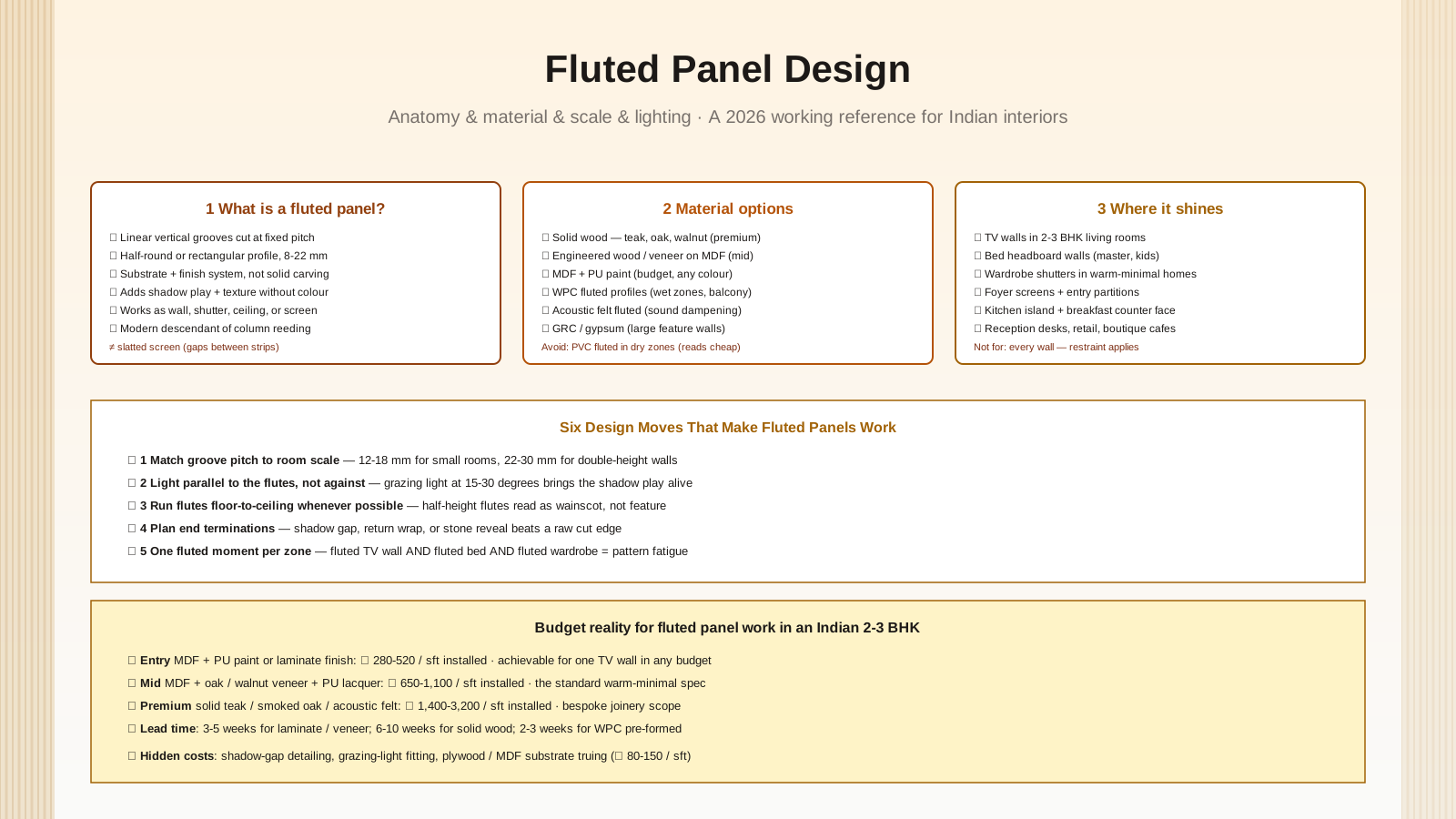
A fluted panel is a flat sheet finished with parallel vertical grooves of fixed pitch and depth — usually half-round, sometimes rectangular, occasionally V-cut. It is a substrate system (MDF, plywood, solid wood, WPC, GRC, or felt-backed slat) plus a finish system (PU lacquer, veneer, paint, or oil). The grooves are either CNC-routed at the factory, planed at site, or pre-extruded into the profile.
The modern interior fluted panel descends from three older sources. Classical column reeding (Greek and Roman fluted pilasters) is the architectural ancestor. Wegner and Sori Yanagi's mid-century reeded wood furniture is the Scandinavian ancestor. And Studio KO, Vincent Van Duysen, and Joseph Dirand's 2010s residential walls are the contemporary popularisers. What looks like a 2023 design trend is actually a 2,500-year-old surface treatment having its third revival.
Five things a fluted panel is NOT
1. Not a slatted screen. A slatted screen has air gaps between solid strips — you see through it. A fluted panel is one continuous surface with carved grooves — you can't see through it. The two read very differently.
2. Not beadboard. Beadboard is a colonial-era American wainscot system with thin tongue-and-groove vertical planks and a small bead at each joint. Beadboard reads cottage; fluted reads contemporary.
3. Not V-groove panelling. V-groove uses sharp 90-degree cuts between flats. Fluted uses curved or rectangular profiles. V-groove reads as joinery seam emphasis; fluted reads as continuous texture.
4. Not corrugated metal or plastic. Industrial corrugated cladding shares the visual rhythm but reads utilitarian. Fluted panels in interiors are always wood-finish, paint-finish, or felt-finish — never raw metal.
5. Not "feature wall" by default. A fluted panel can be a feature wall, but it can also be a shutter face, a ceiling island, a partition, or a screen. Treating fluted as "feature wall only" misses 70 percent of its real applications.
Anatomy of a Fluted Panel
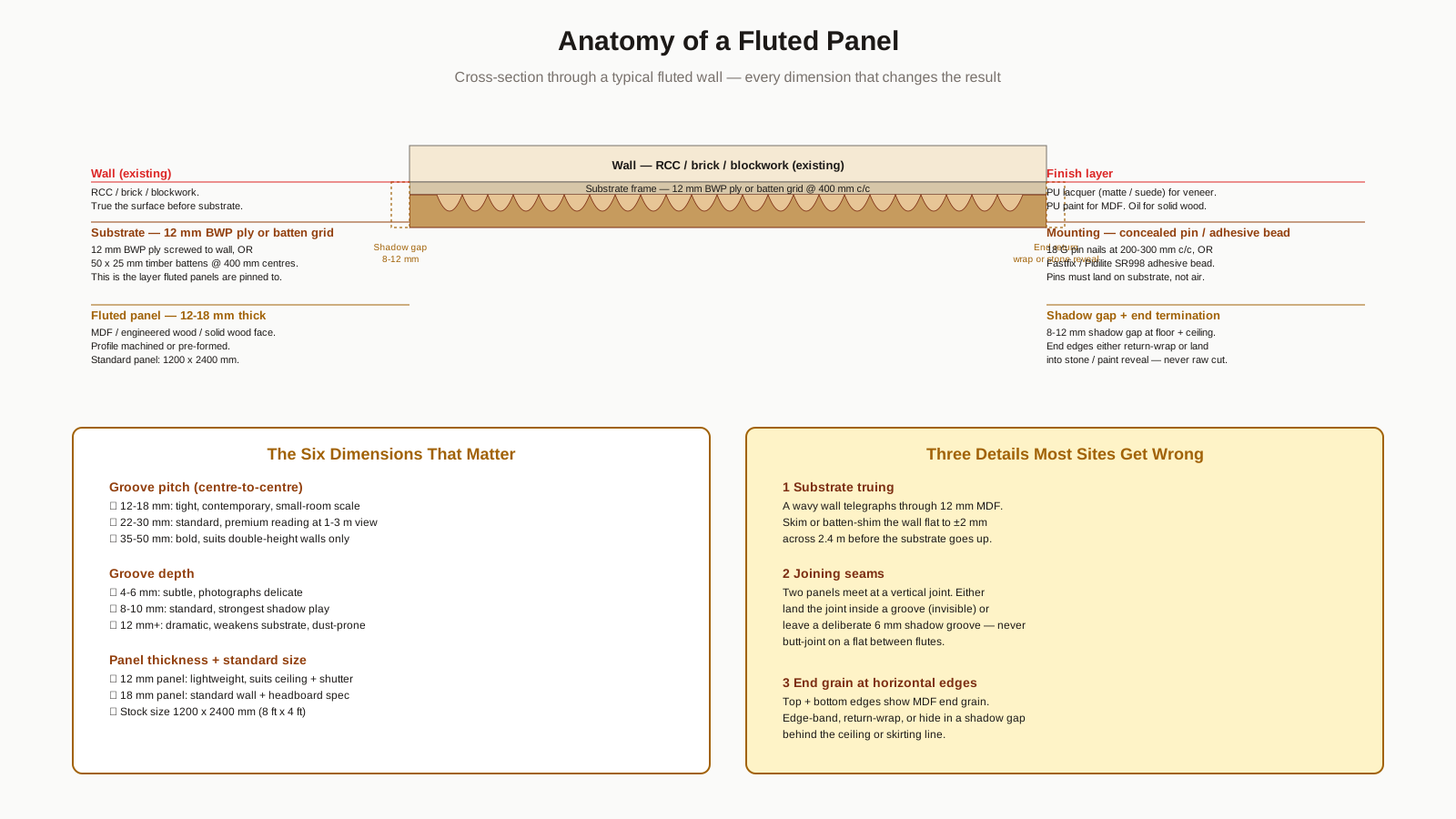
A fluted panel installation has six dimensions that change the visual result and three details most sites get wrong. Specifying the panel without specifying these six dimensions is how a Pinterest reference turns into a disappointing site mock-up.
Groove pitch (centre-to-centre spacing)
Pitch is the distance from the centre of one flute to the centre of the next. It is the single most important dimension for visual scale.
- 12-18 mm pitch — tight, contemporary, reads fabric-like at 2-3 m view. Right for small rooms (under 12 sqm), shutter scales, and intimate vertical surfaces like a bedside niche or a foyer half-wall under 2.4 m height.
- 22-30 mm pitch — the standard premium specification. Reads clearly as fluted from 1-5 m, photographs well, doesn't fight other materials. This is the right answer for 80 percent of residential fluted panel briefs in 2026.
- 35-50 mm pitch — bold, architectural scale. Only correct for double-height walls (over 4 m tall), staircase voids, atrium reception desks, and hospitality lobbies. In a 2.7 m apartment ceiling this pitch dominates the room and dates within four years.
Groove depth
Depth is how far each flute is recessed from the panel face. Shallow looks delicate, deep looks dramatic, too deep risks structural weakness.
- 4-6 mm depth — subtle, photographs as a soft rhythm. Works on shutters and small surfaces.
- 8-10 mm depth — standard for wall-scale fluted panels. Strongest shadow play under grazing light without compromising substrate strength.
- 12 mm+ depth — dramatic but risky. On 18 mm MDF substrate, 12 mm depth leaves only 6 mm of structural face — splits at pin lines, dust accumulates aggressively.
Panel thickness
- 12 mm panel — light enough for ceiling islands and shutter faces. Insufficient for headboard walls or any surface that gets touched.
- 18 mm panel — the workhorse spec for walls, headboards, kitchen island faces. Right for 90 percent of vertical applications.
- 25-40 mm cast panels — GRC and gypsum only, anchor-fixed to structure for large-format feature walls.
Stock panel size is 1200 x 2400 mm (8 ft x 4 ft). A wall longer than 1.2 m always needs a vertical seam — which means you have to plan the seam location at design stage.
Substrate (the layer behind the panel)
The substrate is the framework the fluted panel pins or glues onto. Two options:
- 12 mm BWP ply screwed directly to the wall — quickest, flattest, requires a truly plumb wall.
- 50 x 25 mm timber battens at 400 mm centres — bridges over wavy walls, allows electrical conduit behind, mandatory for any wall thicker than ±5 mm out of plumb.
Indian site reality: nine out of ten apartment walls are out of plumb beyond ±3 mm over 2.4 m. Always batten unless you have plastered and skim-trued the wall first.
Finish layer
- Solid wood: hard-wax oil (Osmo, Rubio Monocoat) for matte natural reading, or hand-rubbed PU matte for premium.
- Veneer: 0.6 mm veneer + 3-coat PU matte. Never spec 0.4 mm veneer for any touched surface — wears through at fingertip zones in 18 months.
- MDF + paint: primer + 3-coat spray PU. Asian Paints PU Apcolite, AkzoNobel Sikkens, or Berger Luxol PU are the bankable systems.
- WPC: factory-applied UV coating, no site finish needed.
Mounting + shadow gap + end termination
Pins go inside the groove valley, never on the convex face. Adhesive bead (Pidilite SR998, Sika SikaFlex 11FC) supplements pins, never replaces them. Shadow gap of 8-12 mm at floor and ceiling reads as deliberate; flush-to-skirting reads as cheap. End edges either wrap-return into the side wall, terminate into a stone reveal, or land into a deliberate shadow gap — never a raw cut edge showing MDF end grain.
Material Options — Nine Substrate-and-Finish Systems
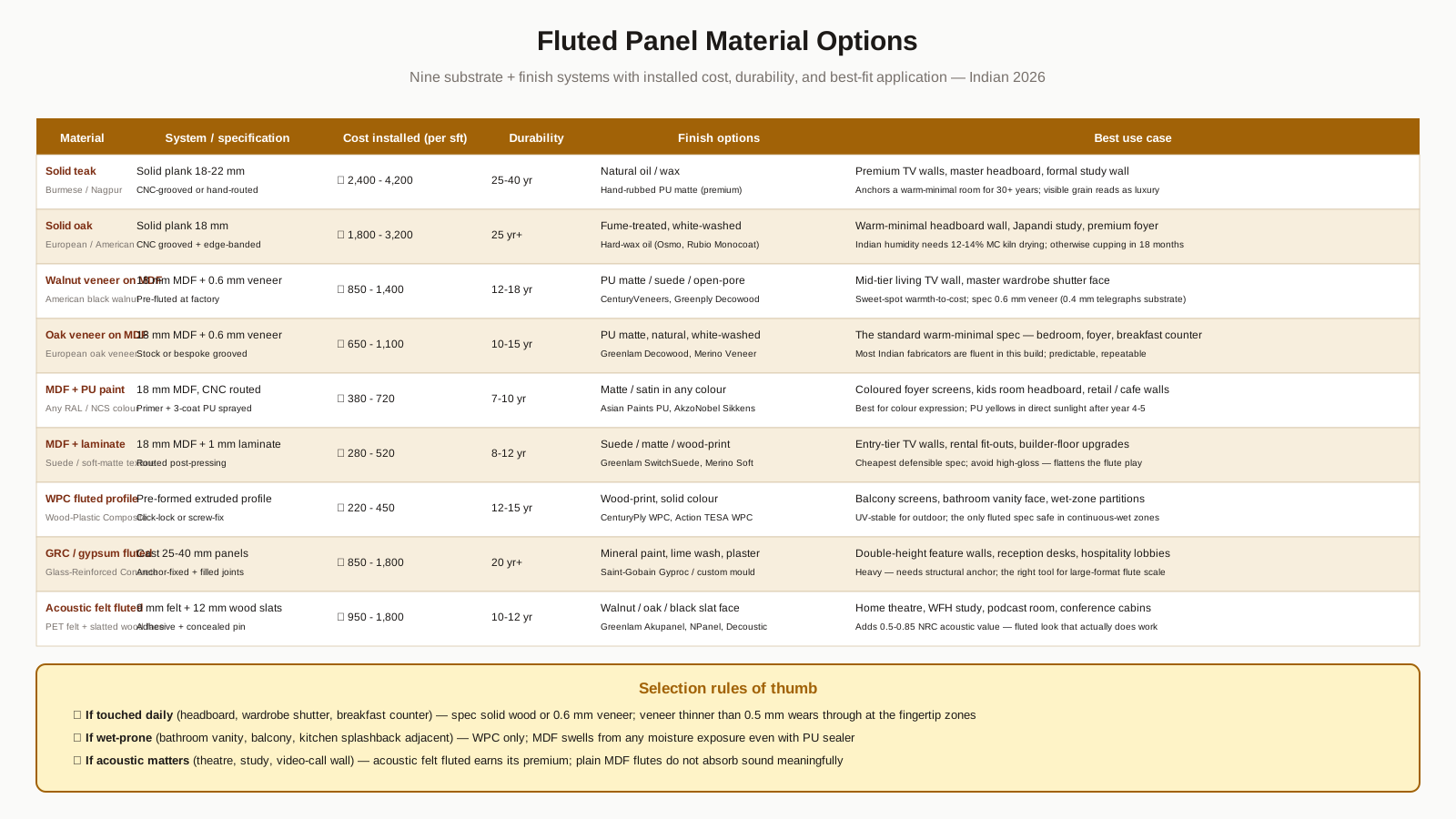
There are nine bankable fluted panel systems for Indian interiors in 2026. Cost is installed (material + skilled labour + finish + mounting), based on Mumbai-Bengaluru rates for May 2026; metro-tier 2 cities run 12-20 percent lower.
| Material | System | Installed cost (per sft) | Durability | Best use |
|---|---|---|---|---|
| Solid teak (Burmese, Nagpur) | Solid plank 18-22 mm, CNC-grooved + hand-rubbed oil | ₹ 2,400-4,200 | 25-40 yr | Premium TV wall, master headboard, formal study |
| Solid oak (European, American) | Solid 18 mm, CNC-grooved, hard-wax oil | ₹ 1,800-3,200 | 25 yr+ | Warm-minimal headboard, Japandi study, foyer |
| Walnut veneer on MDF | 18 mm MDF + 0.6 mm veneer + PU matte | ₹ 850-1,400 | 12-18 yr | Mid-tier TV wall, wardrobe shutter |
| Oak veneer on MDF | 18 mm MDF + 0.6 mm veneer + PU matte | ₹ 650-1,100 | 10-15 yr | The standard warm-minimal spec — bedroom, breakfast counter |
| MDF + PU paint | 18 mm MDF, CNC routed, spray PU | ₹ 380-720 | 7-10 yr | Coloured foyer screens, kids headboard, retail |
| MDF + laminate | 18 mm MDF + 1 mm suede laminate, post-routed | ₹ 280-520 | 8-12 yr | Entry-tier TV wall, rental fit-out, builder floor |
| WPC fluted profile | Pre-extruded, click-lock or screw-fix | ₹ 220-450 | 12-15 yr | Balcony screen, bathroom vanity, wet zone |
| GRC / gypsum fluted | Cast 25-40 mm panels, anchor-fixed | ₹ 850-1,800 | 20 yr+ | Double-height feature wall, reception, lobby |
| Acoustic felt fluted | 9 mm PET felt + 12 mm wood slats | ₹ 950-1,800 | 10-12 yr | Home theatre, WFH study, podcast room |
Sourcing notes for Indian fabrication
- Plywood substrate — Greenply Ecotec BWP, CenturyPly Sainik 710, Kitply Royal Marine. Always spec ISI marked, IS 710:2010 compliant.
- MDF face panel — Greenpanel HMR (high moisture resistance), Action TESA HDHMR, Centuryply MDF EXT. HMR grade is mandatory for any panel within 1.5 m of a wet wall.
- Veneer — CenturyPly CenturyVeneers, Greenlam Decowood, Merino Veneer. Specify 0.6 mm thickness on the purchase order; 0.4 mm is the default and is too thin for touched surfaces.
- Pre-fluted veneer panels (stock) — Greenlam Sleek-Flute, Stylam VistaFlute, Merino Linea. Save 20-30 percent of fabrication time but limit pitch choices to manufacturer's stock.
- WPC fluted profile — CenturyPly NCL Bluekraft, Action TESA WPC, Wood&Frame Bharat WPC. The only acceptable spec for balcony and bathroom.
- Acoustic felt fluted — Greenlam Akupanel, NPanel Acoustic, Decoustic Lines, Hush Acoustics. Verify NRC certification — anything claiming acoustic value below NRC 0.45 is not doing meaningful sound work.
- PU finish system — Asian Paints PU Apcolite, AkzoNobel Sikkens Cetol, Berger Luxol PU. Three-coat sprayed application; one-coat brush finish wears through in two years.
- Hardware — Hettich Push-to-Open (Sensys), Häfele Tip-On, Blum Tip-On Blumotion. Knob and pull hardware drilled through fluted faces splits at the fillet under load.
- Adhesive + pins — Pidilite SR998 or Sika SikaFlex 11FC bead adhesive, plus 18-gauge brass pins fired into groove valleys at 200-300 mm c/c.
Room-by-Room Application
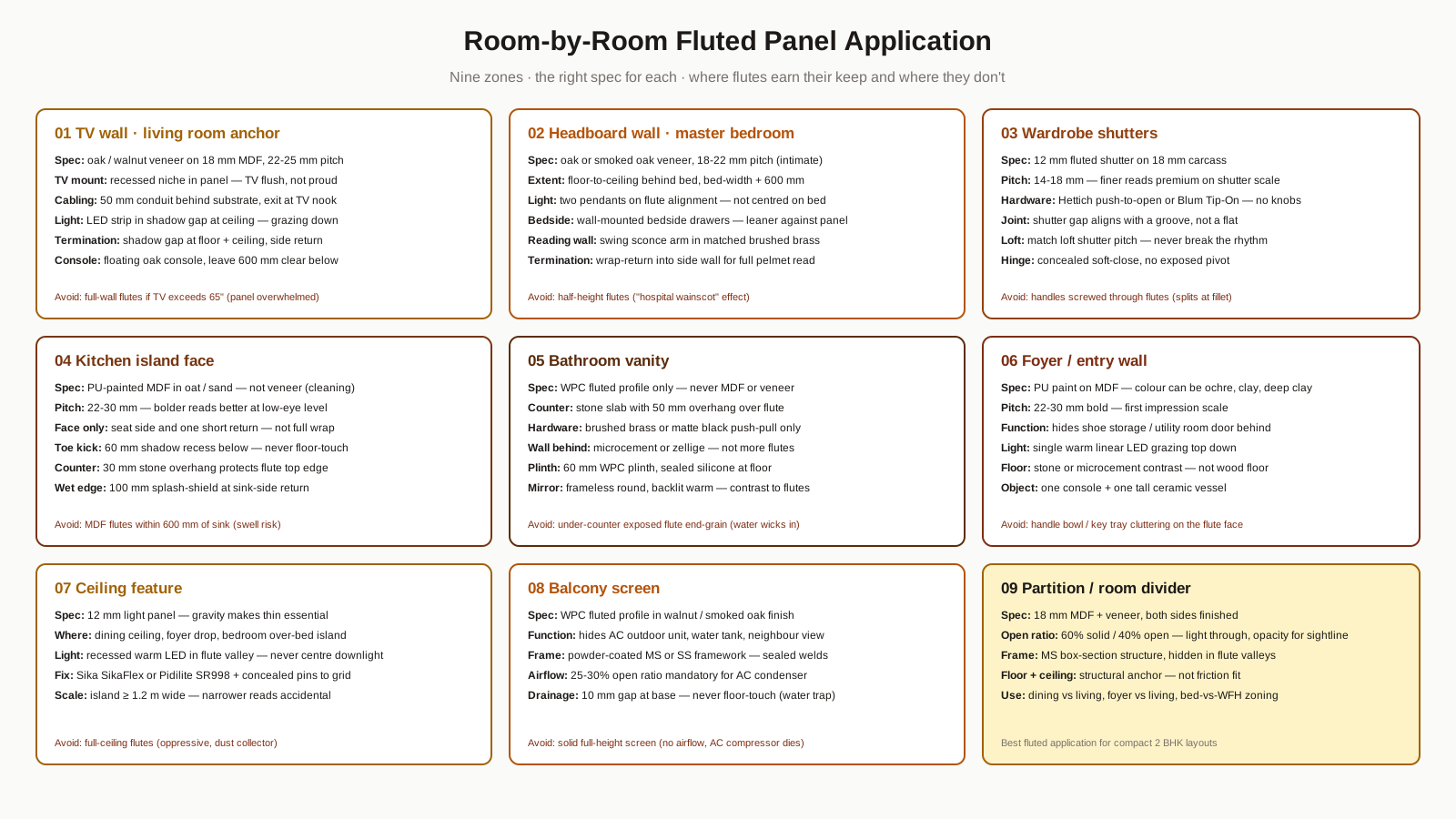
Fluted panels work in nine zones in a typical Indian 2-3 BHK. The right material and detail varies sharply by zone — the same spec that succeeds on a TV wall fails on a bathroom vanity.
TV wall — the living-room anchor
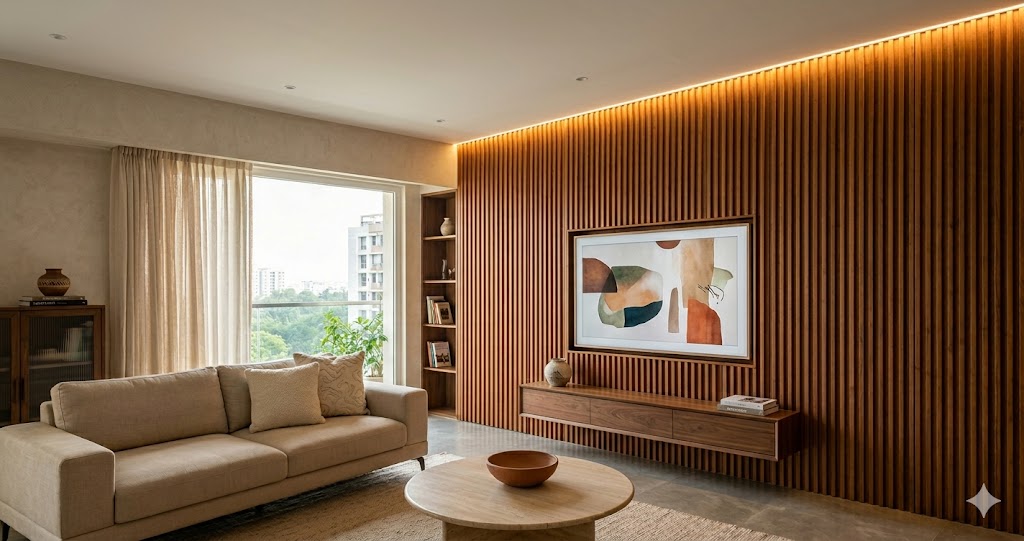
The most over-specified fluted application and the one most likely to read badly if mishandled. Spec is oak or walnut veneer on 18 mm MDF, 22-25 mm groove pitch, floor-to-ceiling, with a recessed TV niche (the TV sits flush with the panel face, not proud of it). Run a 50 mm conduit behind the substrate for cabling and HDMI runs, exiting at the TV nook. A floating oak console below leaves 600 mm clear floor — never a chunky cabinet that fights the vertical rhythm.
Critical detail: grazing LED strip in the shadow gap at the top of the panel, throwing light down parallel to the flutes. This is what separates a sculptural fluted wall from a flat decorative one. A centre-of-ceiling downlight hits the panel perpendicular and kills all shadow play — the panel reads as flat painted veneer.
Headboard wall — the master bedroom
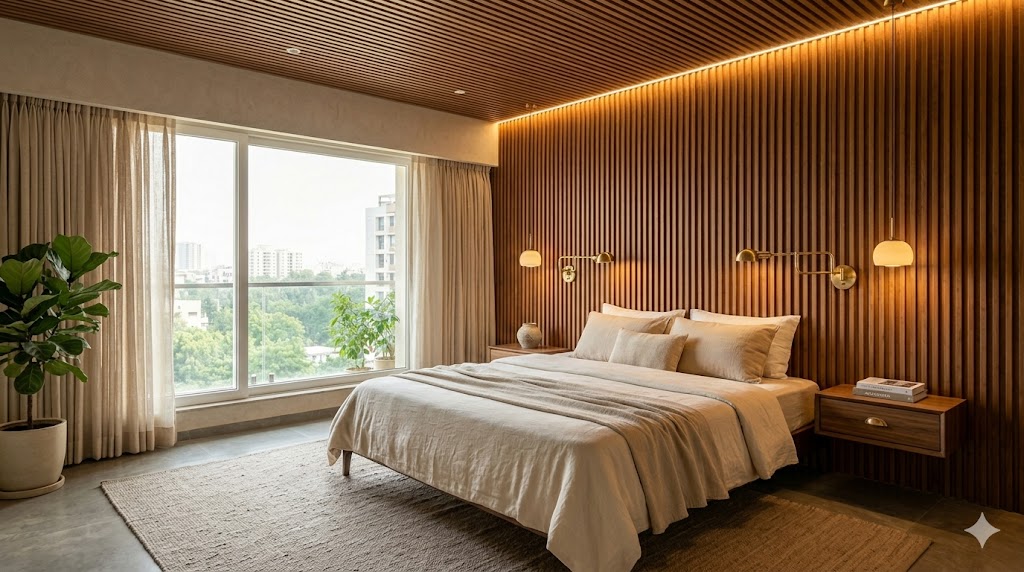
Spec is oak or smoked oak veneer, 18-22 mm pitch (intimate scale for the most-private room), floor-to-ceiling behind the bed and extending bed-width + 600 mm so the headboard reads as a deliberate pelmet, not a clipped backdrop. Wall-mounted bedside drawers (Hettich rail systems) instead of free-standing tables — they lean against the fluted face cleanly. Two reading sconces with swing arms in matched brushed brass, mounted on the panel itself.
A half-height fluted headboard (1.2 m tall, sized to the bed only) reads as 1990s hospital wainscot. Always go floor-to-ceiling, or — if there is a structural reason not to — terminate honestly at the 2.1 m door-head datum, with flat painted wall above.
Wardrobe shutters
Fluted wardrobe shutters are one of the best uses of the language in a 2-3 BHK because they turn a 4-6 metre run of joinery into a single textural pelmet. Spec is 12 mm fluted shutter on 18 mm carcass, 14-18 mm pitch (fine enough to read at shutter scale without overpowering). Hardware is Hettich Push-to-Open or Blum Tip-On — never knob or pull through the flute face, which splits at the fillet.
The shutter gap (typically 3 mm between shutters) must land inside a groove valley, never on a flat between flutes. The loft shutter (above wardrobe) must match the main shutter pitch — breaking the rhythm with a different scale above 2.4 m kills the pelmet read.
Kitchen island face
A fluted kitchen island face works only with PU-painted MDF in oat, sand, or warm white — never veneer. Cooking releases steam, splatter, and turmeric / oil stains; veneer in this environment fails inside three years. Pitch is 22-30 mm (bolder reads better at seated-eye level). Face the seat side and at most one short return — never wrap the full island. Counter overhang of 30 mm protects the top edge of the flute from spills.
Critical limit: no MDF flutes within 600 mm of the kitchen sink. The localised humidity is enough to swell HMR MDF over 18-24 months. If flutes are essential at that distance, switch the local panel to WPC.
Bathroom vanity
WPC fluted profile only. Never MDF, never plywood, never veneer — bathroom humidity destroys all three regardless of PU sealer. Counter is stone slab with 50 mm overhang. Hardware is brushed brass or matte black push-pull. The wall behind the vanity should be microcement, zellige tile, or honed limestone — not more fluted panel. A fluted vanity against a fluted wall reads as visual noise.
Foyer / entry wall
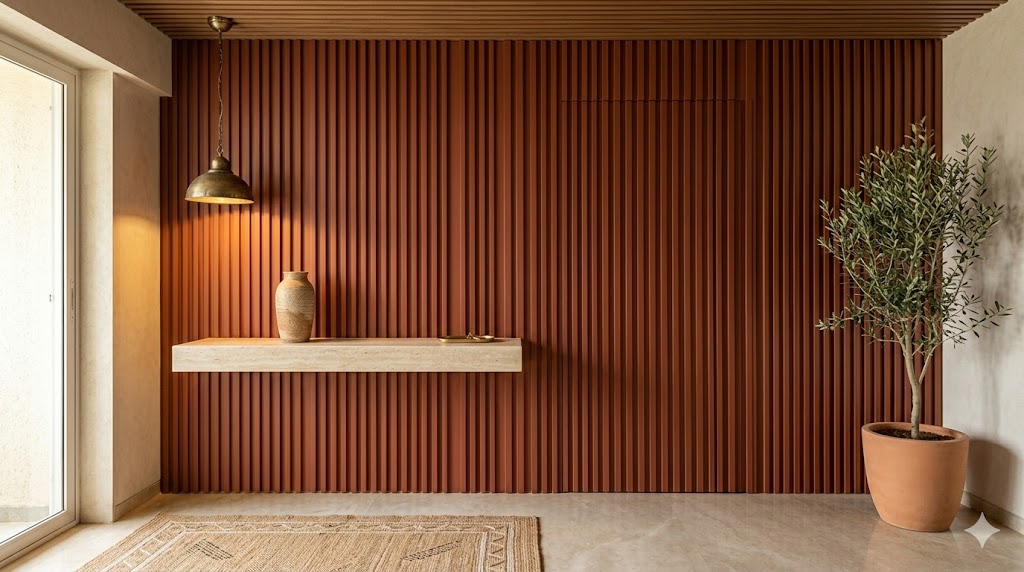
The foyer is the one zone where fluted panels can carry a saturated colour. Spec is PU paint on MDF — and the colour can be ochre, clay, deep clay, terracotta, or smoky charcoal. Pitch is 22-30 mm bold (first impression scale). Function-double the panel: it can hide a shoe storage cabinet, a utility room door, or a tall electrical panel behind. Single warm linear LED grazing top-down. Floor should contrast — stone, microcement, or terrazzo — never wood floor against a wood-toned fluted entry.
Ceiling feature, balcony screen, partition
The remaining three applications — ceiling islands over dining or foyer, WPC balcony screens hiding AC outdoor units, and free-standing or anchored partitions for zoning compact 2 BHKs — extend the same vocabulary without dominating. See the diagram above for spec details; the universal rule is one fluted moment per zone, never three.
Groove Pitch and Scale — The Reading Distance Rule
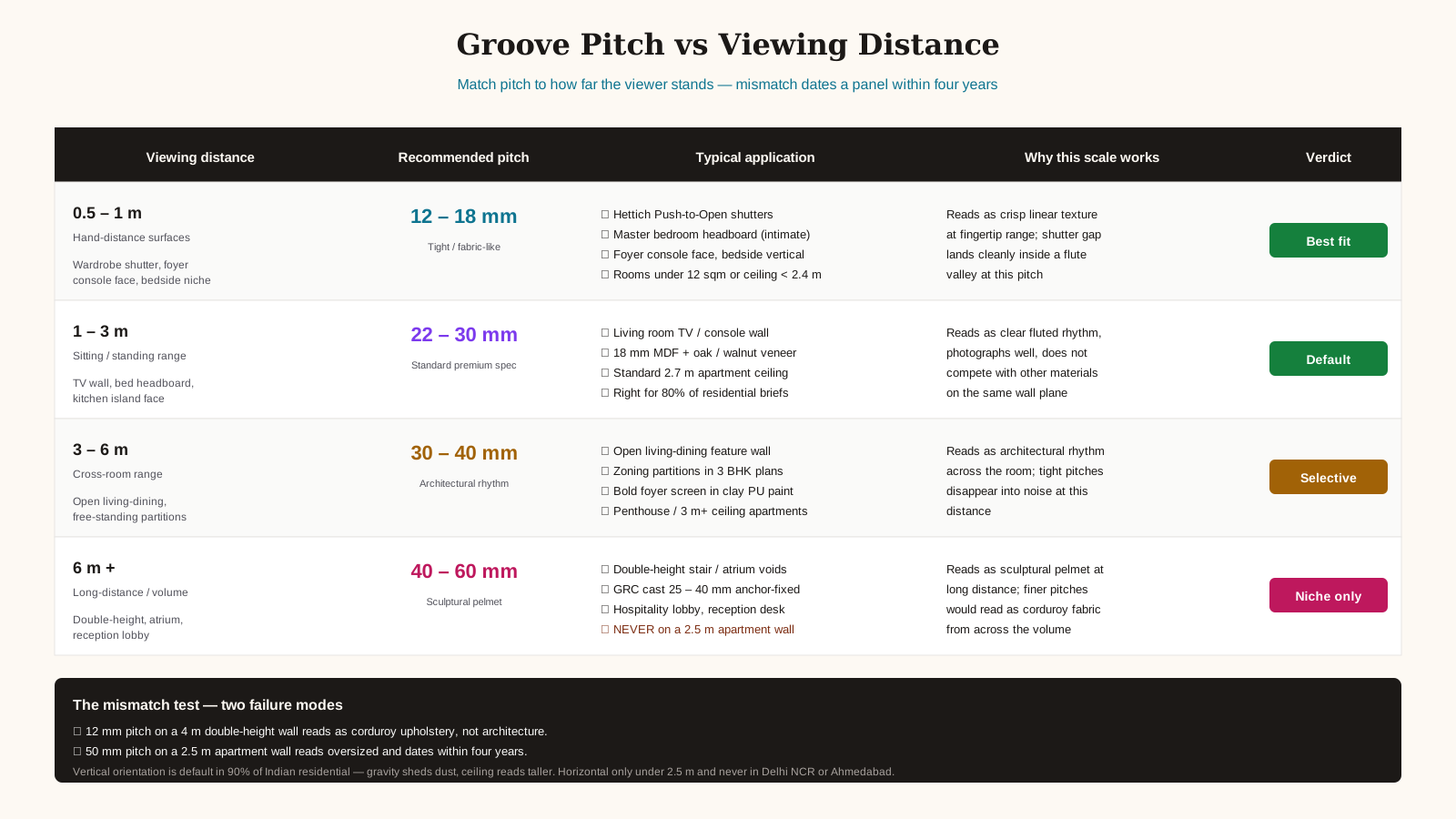
Pitch must be specified against viewing distance. A useful working rule:
| Viewing distance | Recommended pitch | Why |
|---|---|---|
| 0.5-1 m (wardrobe shutter, foyer console face) | 12-18 mm | Reads as crisp linear texture at hand distance |
| 1-3 m (TV wall, bed headboard, kitchen island) | 22-30 mm | Reads as clear fluted rhythm at sitting / standing distance |
| 3-6 m (open living-dining feature wall, partition) | 30-40 mm | Reads as architectural rhythm across the room |
| 6 m+ (double-height, atrium, reception lobby) | 40-60 mm | Reads as sculptural pelmet at long distance |
The mismatch test: a 12 mm pitch on a 4 m double-height wall reads as corduroy upholstery, not architecture. A 50 mm pitch on a 2.5 m apartment wall reads as oversized and dated within four years. If the spec doesn't match the distance, fix the spec.
Vertical or horizontal?
Vertical fluting is the default for 90 percent of Indian residential applications. It draws the eye up, makes ceilings read taller, and accumulates less dust because gravity does the cleaning work. Horizontal fluting is correct only for low-ceiling rooms (under 2.5 m) where you want to widen the visual perception, breakfast counter faces under stone, and as a rare contrast detail. Never horizontal in dust-heavy cities (Delhi NCR, Jaipur, Ahmedabad) — the valleys load up visibly in 6-8 weeks.
Lighting With Fluted Panels — The Move That Makes or Breaks Everything
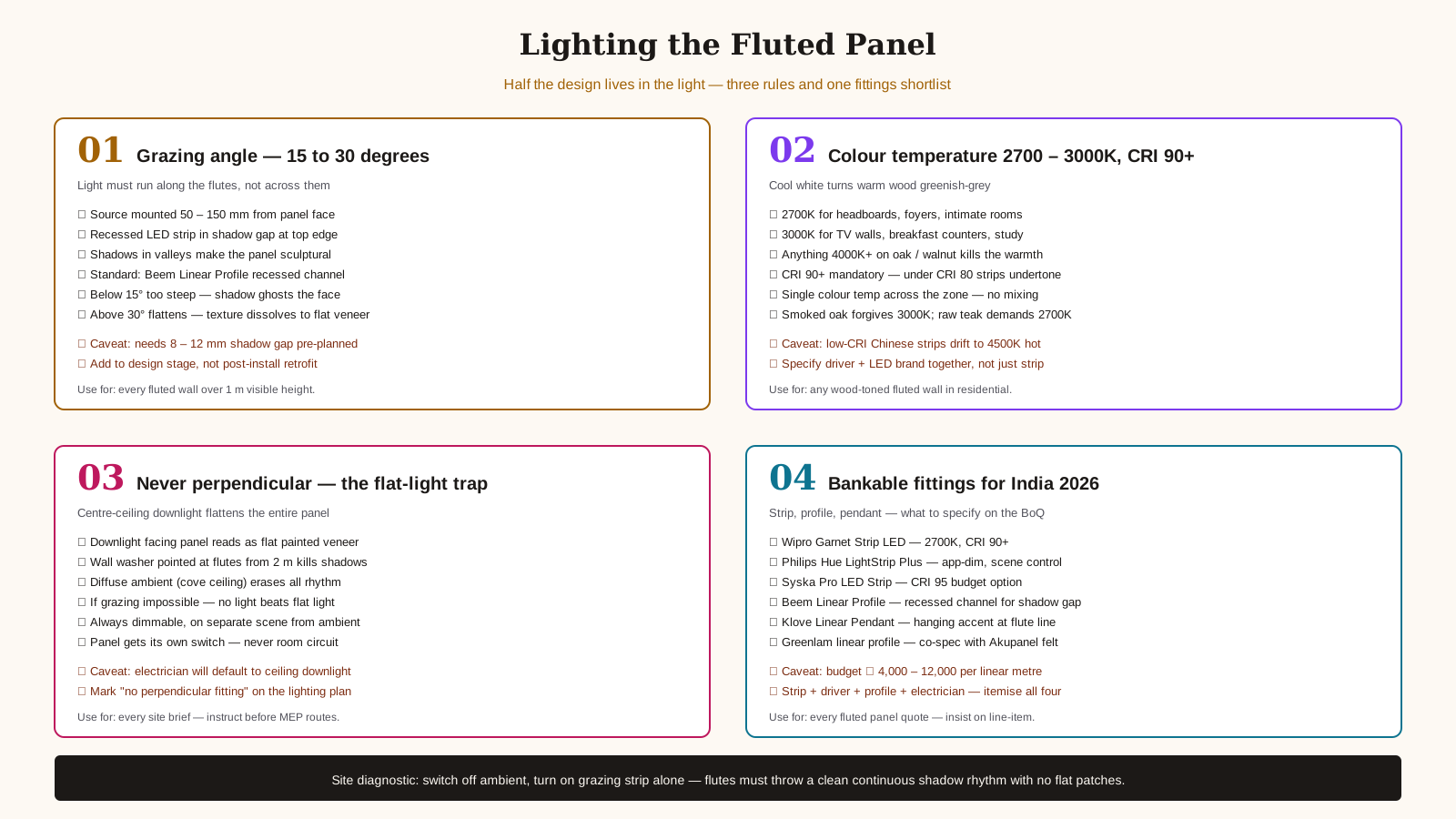
Fluted panel design is half about the panel and half about how light hits it. The same oak veneer fluted wall reads as a hero element under grazing light and as a flat decorative panel under flat overhead light. Three lighting rules:
Rule 1 — Grazing angle. Light must hit the panel at 15-30 degrees from parallel. This means the light source is mounted very close to the panel face (within 50-150 mm), throwing light along the flutes, not across them. A recessed LED strip in a shadow gap at the top edge of the panel is the standard solution. The shadows in the groove valleys are what make the panel sculptural.
Rule 2 — Colour temperature 2700-3000K. Warm wood flutes under 4000K cool-white light read greenish-grey. Always 2700K (intimate) for headboards and foyers; 3000K (transitional) for TV walls and breakfast counters. CRI 90+ mandatory — anything below CRI 80 strips the wood undertone.
Rule 3 — Never perpendicular. A centre-ceiling downlight or a single light fitting facing the panel from across the room flattens the flutes completely. If grazing light is impossible because of site constraint, no light is better than perpendicular light — the panel will read flat either way, but flat-with-no-light at least reads as deliberate restraint instead of accidentally flat.
Recommended fittings: Wipro Garnet Strip LED (warm 2700K, CRI 90+), Philips Hue LightStrip Plus, Syska Pro LED Strip CRI 95, Klove Linear Pendant for hanging accent, Beem Linear Profile for shadow-gap recess. Always dimmable, always on a separate switch from the room ambient — the fluted panel needs its own light scene.
Three Budget Tiers
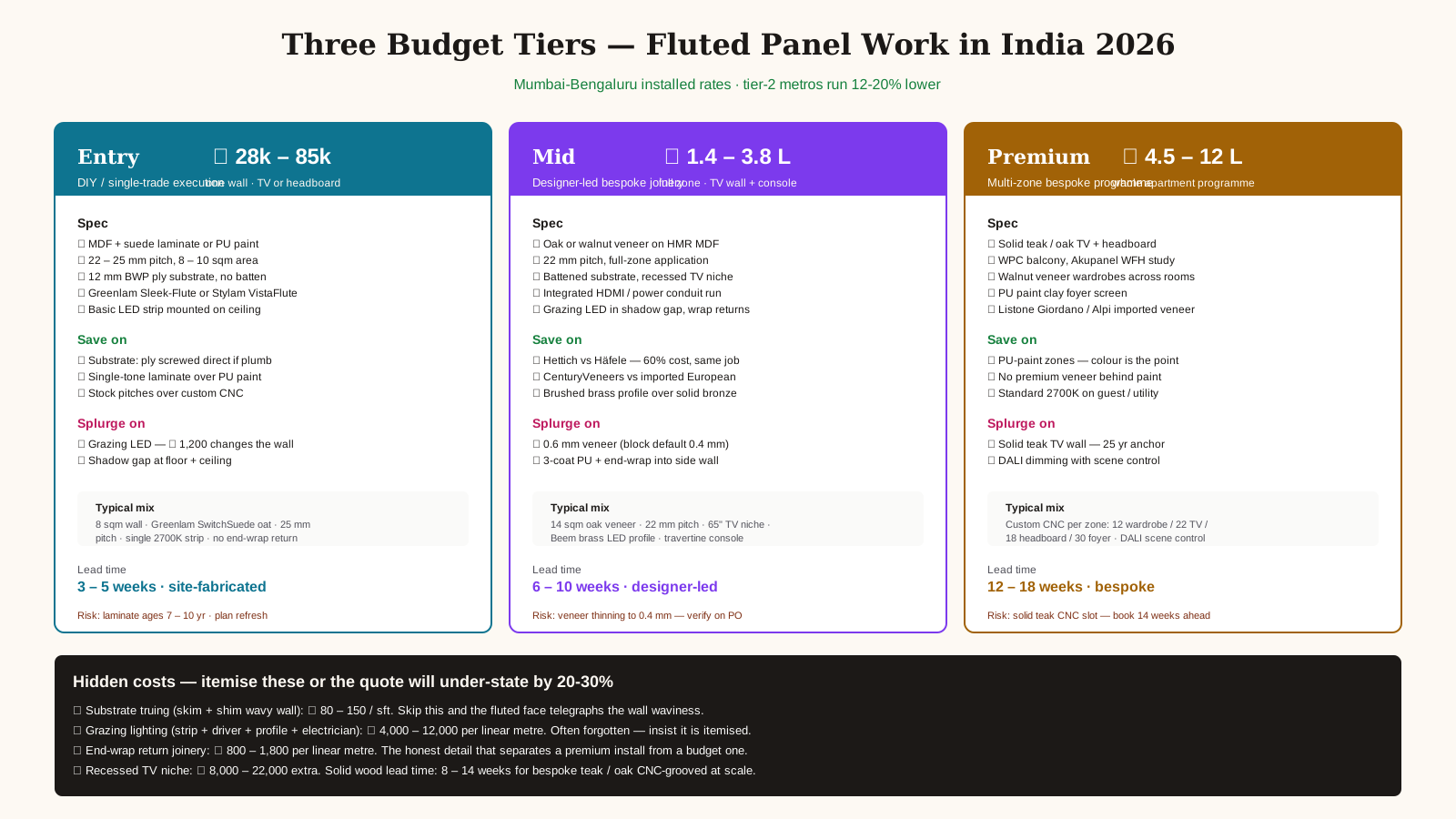
Entry tier — ₹ 28,000-85,000 for one wall (TV or headboard)
DIY-led or single-trade execution. Spec is MDF + suede laminate or MDF + PU paint, 22-25 mm pitch, 8-10 sqm wall area, basic LED strip mounted on the ceiling. Stock pre-fluted panels from Greenlam Sleek-Flute or Stylam VistaFlute keep fabrication time short. Save on: substrate (12 mm BWP ply screwed directly works if wall is plumb), finish (single-tone laminate cheaper than PU paint). Splurge on: the grazing LED (a ₹ 1,200 strip changes how the whole wall reads). Lead time 3-5 weeks site-fabricated.
Typical mix: 8 sqm fluted wall, MDF + Greenlam SwitchSuede laminate in oat, 25 mm pitch, 12 mm BWP ply substrate, shadow gap at floor and ceiling, single grazing LED strip 2700K, no end-wrap return. Installed cost ₹ 35,000-65,000 for the panel + ₹ 6,000-12,000 for lighting fittings.
Mid tier — ₹ 1.4-3.8 L for one full zone (TV wall + console wall)
Designer-led, bespoke joinery. Spec is oak or walnut veneer on HMR MDF, 22 mm pitch, full-zone application (TV wall + adjacent console + side return), grazing LED in shadow gap, recessed TV niche, integrated cabling. Save on: hardware brand (Hettich works as well as Häfele at 60 percent of the cost), veneer source (CenturyVeneers as good as imported European veneer at half the price for most species). Splurge on: 0.6 mm veneer thickness specification (don't let the fabricator default to 0.4 mm), three-coat PU finish, custom CNC pitch (not stock 22 mm), end-wrap returns into side wall. Lead time 6-10 weeks designer-led.
Typical mix: 14 sqm fluted wall and return, oak veneer on HMR MDF, 22 mm pitch, 18 mm BWP ply battened substrate, recessed 65-inch TV niche, integrated HDMI / power conduit, brushed brass shadow-gap LED profile (Beem or Greenlam linear), wrap-return into side wall, floating travertine console below. Installed cost ₹ 1.4-2.8 L.
Premium tier — ₹ 4.5-12 L for whole apartment fluted programme
Bespoke joinery across multiple zones. Spec is solid teak or solid oak in TV wall and headboard, WPC fluted balcony screen, acoustic felt fluted in WFH study, walnut veneer fluted wardrobe shutters across master and guest, PU-painted MDF fluted foyer screen in clay. Imported pre-fluted veneer panels from Italian or German mills for premium TV wall (Listone Giordano, Alpi Veneers). Custom CNC pitches matched per zone (12 mm wardrobe, 22 mm TV, 18 mm headboard, 30 mm foyer). Lead time 12-18 weeks bespoke, often coordinated with overall apartment fit-out.
Save on: PU-paint zones where colour expression is the point (no need for premium veneer behind paint). Splurge on: solid teak TV wall (the warmth anchor for the next 30 years), the lighting plan (DALI dimming with scene control), and the foyer fluted screen in saturated colour — it's the first impression of the apartment.
Hidden costs to budget
- Substrate truing: ₹ 80-150 / sft to skim and shim a wavy wall before substrate goes up. Skip this and the fluted face telegraphs the wall waviness.
- Grazing lighting: ₹ 4,000-12,000 per linear metre installed (strip + driver + profile + electrician). Often forgotten in the quote; insist it's itemised.
- End-wrap return joinery: ₹ 800-1,800 per linear metre. The honest detail that separates a premium install from a budget one.
- Recessed TV niche: ₹ 8,000-22,000 for the additional MDF cutting, framing, and finishing around the TV opening.
- Solid wood lead time: 8-14 weeks for bespoke teak or oak fluted panel CNC-grooved at scale. Budget the lead time.
Ten Execution Pitfalls
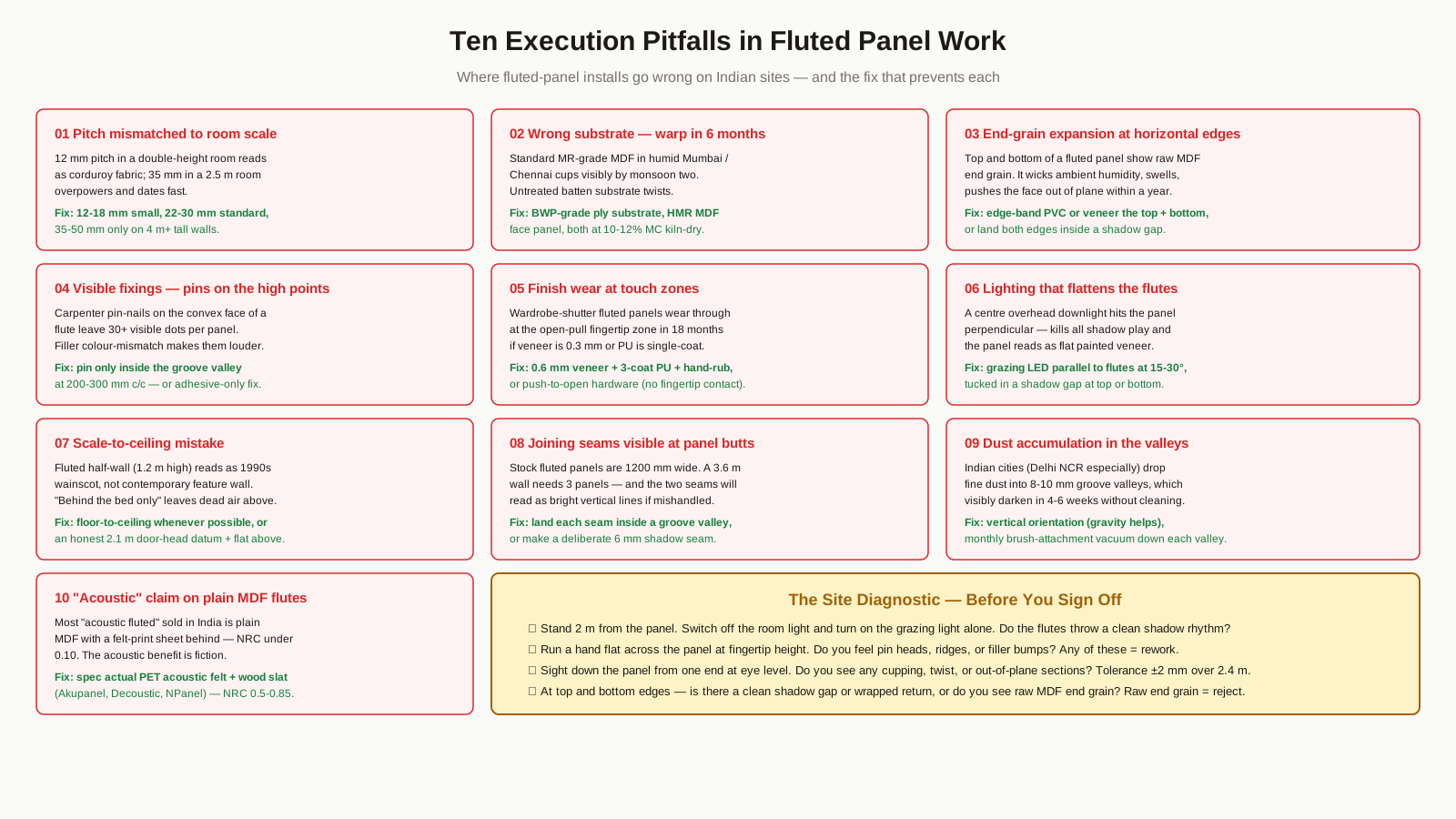
1. Pitch mismatched to room scale. 12 mm pitch in a double-height room reads as corduroy fabric; 35 mm pitch in a 2.5 m apartment room overpowers and dates fast. Fix: 12-18 mm for small rooms, 22-30 mm for standard apartments, 35-50 mm only for 4 m+ tall walls.
2. Wrong substrate causes warp in 6 months. Standard MR-grade MDF in humid Mumbai or Chennai cups visibly by the second monsoon; untreated batten substrate twists. Fix: BWP-grade plywood substrate plus HMR MDF face panel, both at 10-12 percent moisture content kiln-dried.
3. End-grain expansion at horizontal edges. Top and bottom of a fluted panel show raw MDF end grain; it wicks ambient humidity, swells, and pushes the face out of plane within a year. Fix: edge-band PVC or veneer the top and bottom, or land both edges inside a shadow gap.
4. Visible fixings on the high points. Carpenter pin-nails on the convex face leave 30+ visible dots per panel that filler colour-mismatch makes louder. Fix: pin only inside the groove valley at 200-300 mm c/c, or adhesive-bead fix only.
5. Finish wear at touched zones. Wardrobe shutter fluted panels wear through at the fingertip pull zone in 18 months if veneer is 0.3 mm or PU is single-coat. Fix: 0.6 mm veneer + 3-coat PU + hand-rub, or push-to-open hardware that eliminates fingertip contact entirely.
6. Lighting that flattens the flutes. A centre-ceiling downlight hits the panel perpendicular and kills all shadow play — the panel reads as flat painted veneer. Fix: grazing LED parallel to flutes at 15-30 degrees, tucked into a shadow gap at the top or bottom edge.
7. Scale-to-ceiling mistake. A fluted half-wall at 1.2 m height reads as 1990s wainscot, not contemporary feature. "Behind the bed only" leaves dead air above. Fix: floor-to-ceiling whenever possible, or an honest 2.1 m door-head datum with flat painted wall above.
8. Joining seams visible at panel butts. A 3.6 m wall needs three 1200 mm panels; the two seams read as bright vertical lines if mishandled. Fix: land each seam inside a groove valley so it's invisible, or make a deliberate 6 mm shadow seam that reads as intentional design.
9. Dust accumulation in valleys. Indian cities, especially Delhi NCR and Ahmedabad, drop fine dust into 8-10 mm groove valleys which visibly darken in 4-6 weeks. Fix: vertical orientation (gravity helps), brush-attachment vacuum down each valley monthly, avoid horizontal fluting in high-dust zones.
10. "Acoustic" claim on plain MDF flutes. Most "acoustic fluted" sold in India is plain MDF with a felt-print sheet behind — NRC under 0.10, no meaningful acoustic benefit. Fix: spec actual PET felt + wood slat (Greenlam Akupanel, NPanel, Decoustic) with NRC certification of 0.45 or higher.
The site diagnostic — before you sign off
Walk up to the installed panel and run these four checks before final payment. Stand 2 m back. Switch off the room ambient and turn on the grazing light alone. Do the flutes throw a clean continuous shadow rhythm, or are there flat patches where the light isn't reaching parallel? Run a hand flat across the face at fingertip height — do you feel pin heads, filler bumps, or substrate ridges? Sight down the panel from one end at eye level — any visible cupping, twist, or out-of-plane sections? Tolerance is ±2 mm over 2.4 m. At top and bottom edges — clean shadow gap or wrap-return, or raw MDF end grain? Raw end grain is reject-and-rework.
How Fluted Panels Differ from Slatted, Beadboard, and V-Groove
| Surface system | Profile | Reading | Best context |
|---|---|---|---|
| Fluted | Continuous panel, curved or rectangular grooves at fixed pitch | Modern, sculptural, textural | Contemporary residential, warm-minimal, Japandi, premium retail |
| Slatted screen | Discrete strips with air gaps between | Light-filtering, transparent | Partitions, screens where light pass-through is wanted |
| Beadboard | Tongue-and-groove vertical planks with small bead at each joint | Cottage, colonial, traditional | Heritage homes, farmhouses, country-style interiors |
| V-groove panelling | Sharp 90-degree cuts between flat panels | Joinery seam emphasis, mid-century | Mid-century furniture references, traditional wainscot |
| Reeded (classical) | Convex half-rounds standing proud of the face (opposite of fluting) | Classical, ornamental | Heritage restoration, classical revival, Wegner furniture |
| Corrugated cladding | Industrial profile in metal or polymer | Utilitarian, factory aesthetic | Industrial conversions, lofts, warehouse spaces |
Fluting and reeding are the two complementary classical surface treatments — fluting is concave (grooves cut into the face), reeding is convex (half-rounds standing proud). Most "fluted" panels sold in India in 2026 are technically reeded — half-round profiles standing above the substrate plane. The terminology has collapsed; what matters is the visual result, which is the same vertical rhythm of light and shadow regardless of which side of the surface the profile lives on.
When Fluted Is the Wrong Answer
Fluted panels are the right answer for many premium Indian residential briefs. They are the wrong answer for:
- Heritage Bombay flats with original lime plaster walls — adding fluted MDF over century-old lime plaster destroys both the heritage character and the wall's natural humidity buffering
- Homes that already have three competing textures on the same wall plane — fluted on lime plaster on stone is visual cacophony, not layering
- Compact apartments under 600 sft total — the visual weight of a full-wall fluted panel overwhelms small rooms; switch to a half-height pelmet or skip entirely
- Direct-sunlight-exposed walls (south or west-facing windows hitting the panel) — PU finish yellows in 4-5 years; UV-grade WPC is the only safe spec but reads less premium than veneer
- Families with toddlers in the panel-touch zone — groove valleys are crayon traps; the cleanup is impossible without solvent and PU rework
- Budgets under ₹ 28,000 for the wall — anything cheaper produces a builder-grade laminate panel that ages worse than a plain matte-paint feature wall
If any of the above describes you, consider Warm Minimal Interiors (a fluted wall isn't mandatory for warm minimal), Wardrobe Finish Ideas (where fluted earns its keep on shutters specifically), or microcement / lime plaster as a textural alternative that doesn't carry the trend-date risk.
Where to Go Next
- For the parent warm-minimal style — Warm Minimal Interiors
- For wardrobe-specific fluted shutter detailing — Wardrobe Finish Ideas
- For ceiling fluted island work — False Ceiling Design Guide
- For Japandi-style smoked-oak fluting — Japandi Apartment Interior Guide
- For kitchen island fluted face detail — Modular Kitchen Design Guide
- For palette + finish family that complements fluted — Earthy Interior Palette
- For sustainable substrate sourcing — Sustainable Interiors India Guide
- For compact apartment fluted partition use — Compact Luxury Apartment Guide
- For storage solutions that fluted shutters can disguise — Smart Storage Interiors
- For budget-luxury reading of fluted spec — Budget Luxury Interiors
See it before you build it. Browse 25 wall-panelling designs — fluted and reeded walls, classic wainscoting, wood-slat and veneer, upholstered headboard walls and statement stone-clad features — and recolour each one instantly across five finishes to find the feature wall that suits your room.
References
1. Indian Standard IS 2046:1995. High-Pressure Decorative Laminates — Specification. Bureau of Indian Standards. (For laminate-finished fluted panel spec.)
2. Indian Standard IS 1003 (Part 1):2003. Timber Panelled and Glazed Shutters — Specification. Bureau of Indian Standards. (For panel substrate timber spec.)
3. Indian Standard IS 710:2010. Marine Plywood — Specification. (BWP-grade substrate compliance reference.)
4. Indian Standard IS 12406:2003. Medium Density Fibreboard for General Purposes — Specification. (MDF substrate compliance.)
5. Hettich Catalogue 2025. Push-to-Open Hardware Systems — Sensys and InnoTech Atira ranges. (Hardware reference for fluted shutter applications.)
6. Häfele India Fitting & Function Catalogue 2025. Tip-On and Soft-Close Hinge Systems. (Hardware reference.)
7. Greenlam Industries (2025). Decowood Veneer Technical Specification. (Veneer substrate and finish reference.)
8. CenturyPly (2025). CenturyVeneers Application Guide. (Indian-manufactured veneer spec.)
9. Vincent Van Duysen (2016). Vincent Van Duysen — Complete Works 1989-2016. Thames & Hudson. (Belgian warm-minimalist master; foundational fluted-panel design references.)
10. Studio KO (2018). Studio KO. Rizzoli. (Moroccan-Mediterranean fluted column and reeded wall references.)
11. Hans J. Wegner (Various). Carl Hansen & Søn Wegner Collection Reference. (Mid-century reeded furniture references; adjacent design language.)
12. Pallasmaa, J. (2012). The Eyes of the Skin — Architecture and the Senses. Wiley. (Theoretical foundation for texture-led surface design.)
13. Saint-Gobain Gyproc India (2025). GRC Cladding Technical Manual. (For cast fluted GRC and gypsum panel specification.)
14. Bauwerk Colour Application Guide (2024). (Wall preparation and substrate truing standards relevant to fluted panel substrate work.)
Author's note: Fluted panels are the design element I would specify with the most caution in 2026. They solve real problems — texture without colour, depth without ornament, joinery cover without utility-reading — but they are also the most over-used surface treatment in Indian premium residential right now. By 2028 a fluted TV wall will read as confidently of-its-time as a 2014 ombre wall does today. The defence is restraint (one fluted moment per zone, never three), detailing (pitch, substrate, grazing light, end termination), and material truth (solid wood and good veneer age into the next decade; laminate and cheap PU don't). Specified with discipline, a fluted oak headboard or solid teak TV wall is a 25-year element. Specified without discipline, it dates faster than wallpaper.
Disclaimer: Installed costs, brand references, finish system specifications, and material durability ranges are 2026 indicative for Mumbai-Bengaluru metro rates and shift with currency, import duties, raw material supply, and regional labour. Verify all costs with current vendor quotes before committing. Hardware brand and finish-system mentions are illustrative; Studio Matrx has no commercial relationship with any brand named. NRC acoustic values quoted are manufacturer-published — independent verification recommended for critical acoustic applications such as home theatre and recording studios. Studio Matrx, its authors and contributors are not responsible for procurement, installation, or finish-life outcomes based on this guide.
Export this guide
Related Guides — Deep-dive reading
Compact Luxury Apartment — A 2026 Working Reference for Premium 1-2 BHK Indian Homes
Four-pillar discipline · Ten signature moves · Three budget tiers ₹22-90L
Room PlanningWarm Minimal Interiors — A 2026 Style Guide for Indian Homes
Restraint with warmth · Oat & oak & linen · Curated negative space
Design StylesMinimalist Door Designs in India (2026): Flush, Frameless & Concealed-Frame Doors
The clean-line, no-architrave, hidden-hardware door language behind modern Indian apartments and designer interiors — flush-to-wall doors, concealed hinges, recessed pulls, tall leaves and what the look really costs.
Home Doors & EntrancesRelated Tools — Try Free
False Ceiling Cost Estimator
Live ₹/sqft across 8 ceiling types — POP, gypsum, designer, metal, PVC, wooden — with cove and spot lighting for 20 Indian cities.
Cost CalculatorCross-Ventilation Analyzer
Estimate airflow and air changes per hour (ACH) from room size, window areas, layout, and local wind — with NBC 2016 Part 8 compliance check.
Ventilation CalculatorAcoustic Privacy (STC) Visualizer
Indian healthcare acoustic visualizer — compare wall assemblies and noise sources, see received SPL after STC attenuation, and check FGI 2018 / IS 1950 / NABH speech-privacy compliance with live dual-canvas waveform.
Acoustic Tool