
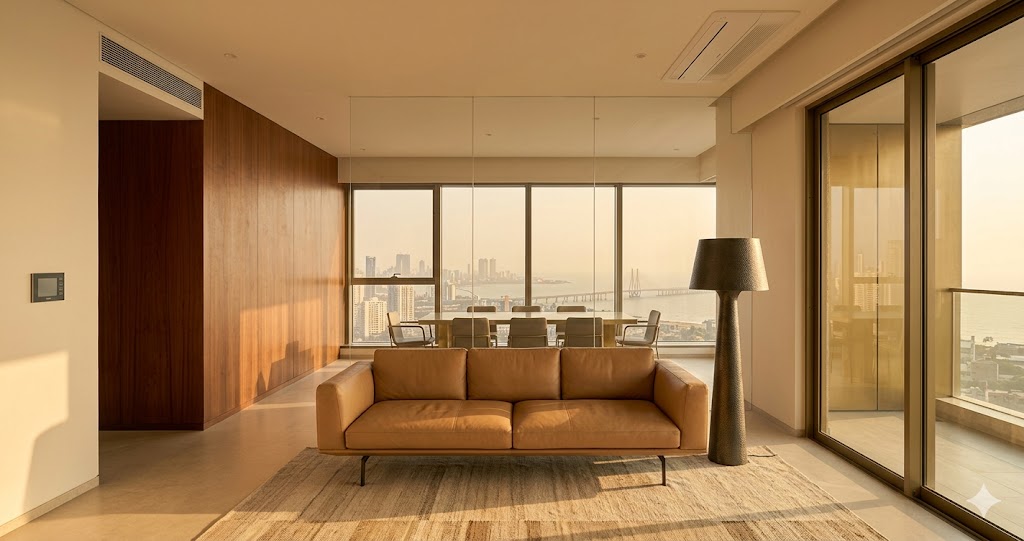
High-Rise Apartment Interiors — 15+ Floor Tower Specifics for Indian Cities (2026)
Wind-load glazing · Lift-time tax · Refuge floors · Post-tension slab limits · World One Worli ₹35 lakh example
A high-rise apartment in India in 2026 is not just a tall apartment — it is a different building typology with different physics, different bylaws, and a different lifestyle clock. Wind pressure on the glazing of an 80th-floor flat at Lodha World One Worli is two to three times what a mid-rise flat in Andheri faces. The lift becomes infrastructure, not amenity. A demolished wall is no longer a renovation question — it is a structural-engineer-and-society question. And the interior brief, if it is not written with the building in mind, will quietly fight the building for the next ten years.
This guide is the high-rise-specific reference: 15+ floor towers in Mumbai, Bengaluru, Delhi NCR, and Hyderabad, where the standard "apartment interior" rulebook breaks down and a different one takes over. It covers the wind-load reality, the lift-time tax, the society/structural NOC chain, the facade and balcony bylaws that change what you can even propose, and the worked example of a real 26th-floor 3 BHK at Worli with a ₹35 lakh interior brief that respects all of it.
"In a high-rise, the building is the first client. The owner is the second. Designers who flip that order will spend half the project re-issuing drawings to the structural consultant and the society NOC committee."
For the upstream apartment fundamentals see /guides/apartment-interior-planning-india; for the premium and luxury tiers of high-rise flats see /guides/premium-apartment-interiors and /guides/luxury-apartment-design; for top-of-tower duplex flats see /guides/penthouse-design; for the smart-home overlay that high-rise residents disproportionately ask for see /guides/smart-home-design-india.
This guide refreshes every 12 months. Last verified: May 2026 · Next verify: May 2027.
What High-Rise Apartment Interiors Actually Mean in 2026 India
In Indian building-code language, a high-rise is any building taller than 15 metres (roughly five floors) for fire-safety classification under NBC 2016 Part 4. But in real-estate and lifestyle terms, the market draws a sharper line: low-rise is one to three floors (the builder-floor and stilt-plus-three typology), mid-rise is four to fourteen floors (the typical Indian gated-society tower of the 2000s and 2010s), and high-rise in everyday usage now means fifteen floors and above — with super-tall and ultra-luxury towers crossing 40, 60, and 80 floors in Mumbai's island-city pockets.
A high-rise apartment interior is therefore the interior brief for a flat sitting somewhere on floor 15 to floor 80 of an RCC-core-with-outrigger tower, where the structural system, the facade system, the lift bank, the fire-evacuation strategy, the water and DG-backup infrastructure, and the society bylaws have all been engineered together — and the interior fitout must fit inside those engineered constraints without breaking any of them.
The 2026 Indian high-rise market is concentrated in five clusters. Mumbai dominates the super-tall segment with Lodha World One in Worli (76 floors), Palais Royale (still the symbolic skyline marker), Imperial Heights at Tardeo, Oberoi Three Sixty West at Worli, Lodha Trump at Worli, Indiabulls Sky at Lower Parel, Beaumonde Tower at Prabhadevi, and the Bombay Dyeing Spring Mills redevelopment. Bengaluru's high-rise stock sits at Brigade Exotica on Old Madras Road, Prestige Skyline towers, and Embassy One on Bellary Road. Delhi NCR contributes DLF Camellias and Magnolias on Golf Course Road Gurugram, M3M Skywalk, and ATS One Hamlet at Sector 104 Noida. Hyderabad's high-rise pocket is Hitec City and Gachibowli, with Lodha Bellissimo and My Home Avatar as flag towers.
Five things a high-rise apartment interior is NOT:
1. It is not just a taller version of a mid-rise apartment. The wind, water, fire, lift, and structural envelope is genuinely different — not gradually different, categorically different. Briefs that copy a mid-rise approach skip too many constraints.
2. It is not a free renovation canvas. No load-bearing demolition, no plumbing relocation across slabs (post-tension slabs cannot be cored), no facade modification without society plus civic NOC, no balcony enclosure without structural sign-off. The "open kitchen" or "extra study" that was trivial in a builder floor is a structural-engineer letter in a high-rise.
3. It is not a place where you can run multiple high-load appliances on DG backup. Most high-rise DG allocations are 1.5–3 kVA per flat — enough for fans, lights, fridge, one AC, not enough for the full ducted-VRF and induction-hob lifestyle some briefs assume.
4. It is not a building where window-AC or even some split-AC options exist. Many 2026-vintage high-rises ship with building-supplied VRF or chilled-water HVAC — the resident chooses fan-coil units inside, not the outdoor compressor. The interior brief has to design around the supplied system, not retrofit a parallel one.
5. It is not a low-maintenance house. Maintenance per square foot in a high-rise (₹4–₹12/sqft/month in 2026 Mumbai for mid-tier towers, ₹15–₹35/sqft/month for super-luxury towers like Lodha World One or Three Sixty West) is two to four times what a mid-rise charges. That recurring cost is part of the total interior-plus-living budget conversation.
Why High-Rise Apartment Interiors Matter Now
Three forces have made high-rise interiors a distinct 2026 search and design category, not a sub-bullet under "apartment design."
First, supply has finally caught up with the planning permissions of 2018–2022. Mumbai's TDR-and-FSI reform, Gurugram's tower-cluster developments, and Bengaluru's high-density redevelopment of Whitefield and Bellary Road parcels have all delivered high-rise inventory in the last 18–30 months. Anarock and Knight Frank India's 2025 reports both show that 15+ floor stock as a share of new-launch apartment supply in Mumbai crossed 55% in 2025, up from under 30% in 2018. In Gurugram and Hyderabad, the share is 40–45%. This is now the modal new-build apartment for premium and luxury buyers in tier-1 cities.
Second, the resale premium of high-rise over mid-rise has crystallised. In the same locality and same brand, a 15+ floor unit sells at a 10–15% premium per square foot over a comparable 4–14 floor unit, according to 2025 Magicbricks and 99acres market-tracker data across Worli, Lower Parel, Powai, Gurugram Sector 65, and Bengaluru's Bellary Road. The view, the amenities, the elevator-mediated security feeling, and the brand of having a 50th-floor address all show up in transaction prices. Owners therefore invest more in interior fitouts — a high-rise flat is the asset the family is most likely to actually live in long-term, not flip.
Third, the interior brief itself has become more complex. Smart-home overlays, full ducted-AC briefs, full home-automation backbones, security and intercom integration with the building system, and the heavy structural-glass balcony enclosure debate have all moved from optional to expected at the premium and luxury end. The brief that a designer is handed for a 35th-floor 3 BHK at Lower Parel in 2026 has roughly twice the line items of the same brief in 2018.
The result is that "high-rise apartment interiors" is now a distinct mid-funnel query. The buyer is not researching whether to buy — they have bought, or are about to. They are researching how to design the inside without fighting the building, without breaking society rules, and without over-spending on the wrong line items.
The Twelve Defining Characteristics
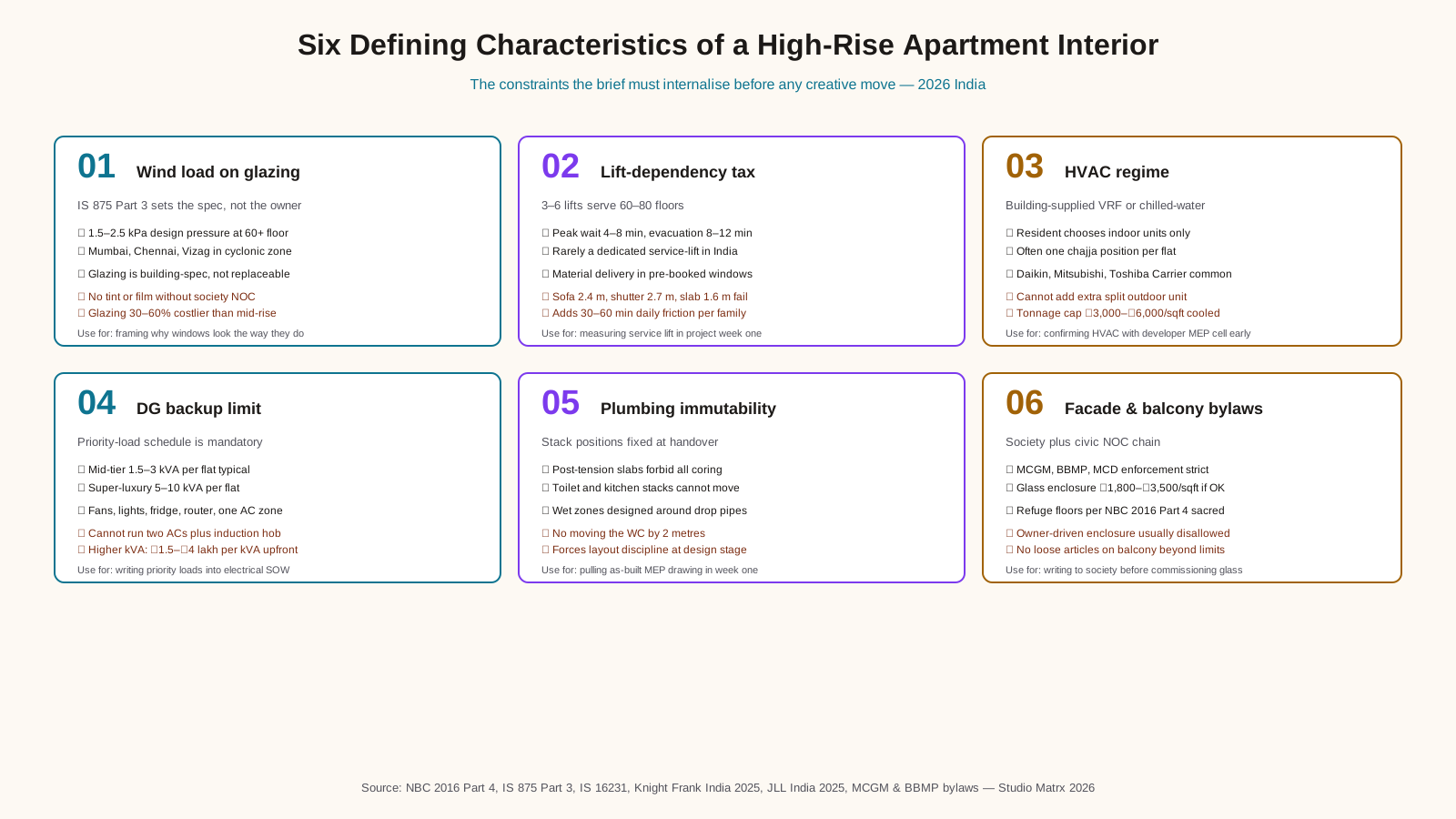
| # | Characteristic | What It Means in Practice | India-Specific Note | Typical Cost or Constraint |
|---|---|---|---|---|
| 1 | Wind load on glazing | Glass and frame must resist 1.5–2.5 kPa design wind pressure at 60+ floor on India's west and east coasts per IS 875 Part 3 | Mumbai coastal towers face cyclonic-zone loads; Chennai and Visakhapatnam similar | Glazing system 30–60% costlier than mid-rise spec |
| 2 | Lift-dependency tax | 3–6 lifts serve 60–80 floors; peak-time wait 4–8 minutes, evacuation 8–12 minutes for an 80-floor tower | Indian residential lifts rarely have dedicated service-lift; grocery and movers compete with residents | Adds 30–60 minutes of daily friction per family |
| 3 | Water pressure variation | Upper floors get lower municipal pressure; building uses pressure-booster pumps and zoned distribution | Without boosters, top-10-floor bathrooms get 1.5–3 bar instead of design 5 bar | Booster system is building-supplied; resident cannot modify |
| 4 | Fire-safety regime | NBC 2016 Part 4: refuge floors every 24 m / 8 floors, full sprinkler coverage, smoke detection, dedicated fire pump, drills | Refuge floors are common-area — cannot be enclosed by adjacent flat owners | Adds 4–8% to building cost; resident fitout must not block refuge access |
| 5 | Structural rigidity | RCC core plus outrigger trusses plus post-tension slabs — no load-bearing wall change, no slab coring | Even a "non-structural" wall may carry MEP runs and need society NOC | Demolition NOC + structural engineer letter for any wall ₹15K–₹50K |
| 6 | Facade and balcony bylaws | Balcony glass enclosure needs society + MCGM/BMC NOC; no AC outdoor unit on facade; no loose articles on balcony | Society fines for facade-changing balconies are common in Mumbai high-rises | Approved enclosure ₹1,800–₹3,500/sqft of glass |
| 7 | HVAC system | Many 2026 towers ship building-supplied VRF or chilled-water; resident picks indoor units only | Cannot add window-AC or extra split outdoor; some towers do allow split with chajja location | Building-supplied tonnage cap ₹3,000–₹6,000/sqft of cooled area |
| 8 | DG backup limit | Per-flat allocation 1.5–3 kVA typical; super-luxury towers 5–10 kVA | Cannot run multiple ACs simultaneously on DG; brief must designate priority loads | Higher DG allocation costs ₹1.5–₹4 lakh per kVA upfront |
| 9 | Plumbing immutability | Toilet and kitchen stack locations are fixed; cannot relocate without slab coring (post-tension slabs forbid this) | Bathroom layout must work around existing waste-pipe drop; no "moving the WC by 2 metres" | Forces layout discipline at design stage |
| 10 | Sound and wind on balcony | Wind speeds at 40+ floor make balconies usable only certain hours; conversation at table is hard above 60 floor | Bangalore and Hyderabad towers experience less than Mumbai/Chennai coastal towers | Balcony seating must be wind-anchored; light umbrella will not survive |
| 11 | Maintenance cost overhead | ₹4–₹12/sqft/month mid-tier high-rise; ₹15–₹35/sqft/month super-luxury (lifts, facade-cleaning, security, club, pool) | A 1,500 sqft flat at ₹25/sqft = ₹37,500/month — non-trivial part of total cost of living | Resale prices already discount maintenance load |
| 12 | Resale premium retention | Same-locality high-rise sells at 10–15% premium per sqft over mid-rise | Brand of developer (Lodha, Oberoi, DLF, Embassy, Prestige, Brigade) compounds the premium | Justifies higher interior spend; fitout actually preserves and adds resale value |
The single underlying theme of the table is that the high-rise apartment interior is a constrained-optimisation problem, not a blank-canvas design problem. The brief has to internalise the constraints before it can express any creative intent. Designers who treat the constraints as discoverable-during-execution rather than known-at-brief-stage burn 15–25% of the budget on rework.
A Worked Example: 1,450 sqft 26th-Floor 3 BHK at Lodha World One Worli, ₹35 lakh Interior Brief
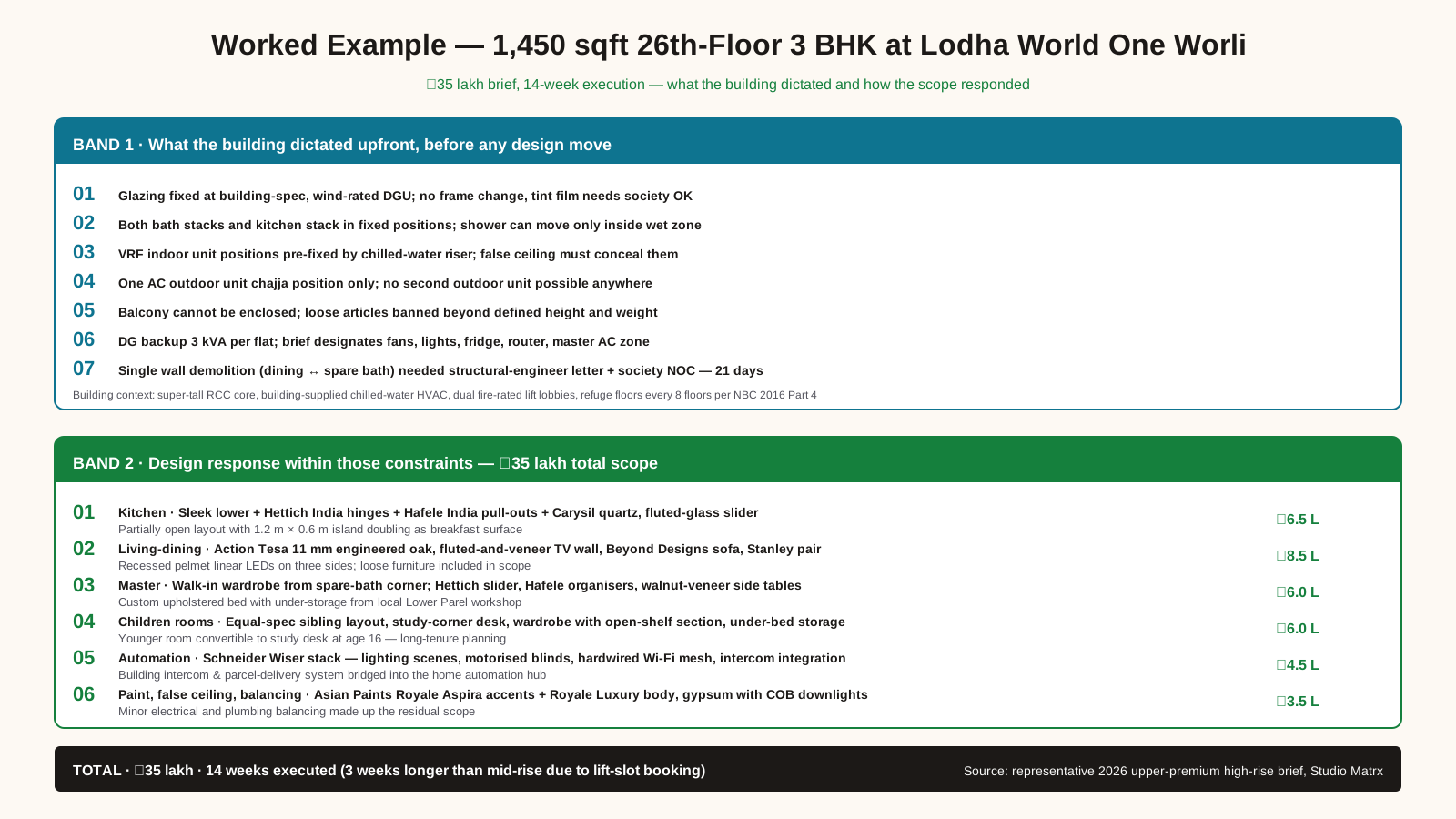
This is a representative — not literal — worked example based on the standard 3 BHK floor plate at one of Mumbai's recognisable super-tall towers, with a realistic 2026 interior brief at the upper-premium tier.
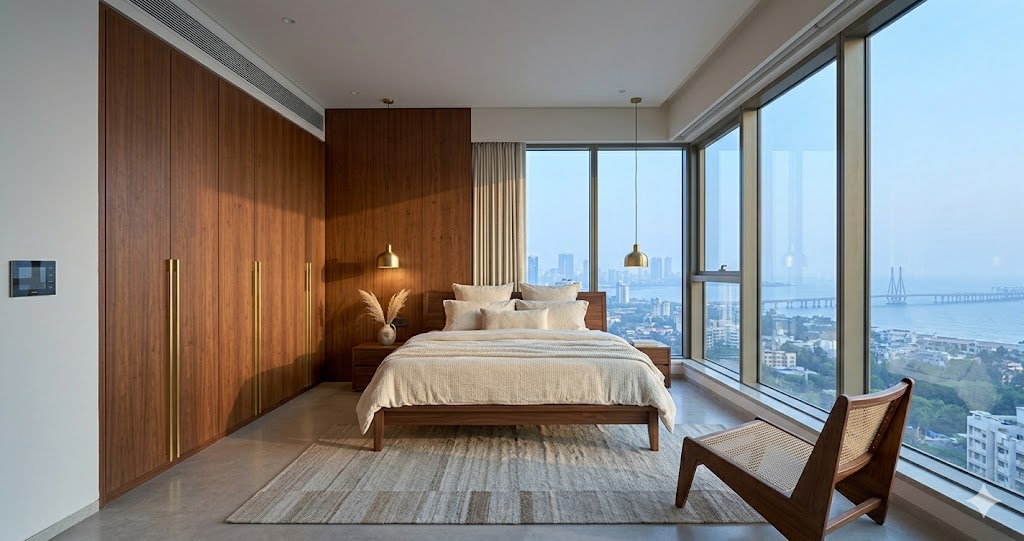
Building and unit context: Lodha World One stands at the Upper Worli redevelopment cluster, with floor plates engineered for high cyclonic wind load, building-supplied chilled-water HVAC, dual fire-rated lift lobbies, refuge floors at every 8 floors per NBC 2016 Part 4, and balcony spec that does not permit owner-driven glass enclosure. The 1,450 sqft 3 BHK on the 26th floor has three bedrooms, three baths, a kitchen with utility, a 250 sqft living-dining, and a 110 sqft sea-facing balcony.
The brief from the owner: A family of four (two parents, two children aged 9 and 13), the parents both working professionals, the family intending to live here for 10+ years. They want the kitchen open to living for everyday use but closeable for festival cooking; a study corner for the older child; a bedroom for the younger child that converts at age 16; the master with walk-in wardrobe; full home automation; warm-modern aesthetic. Budget ₹35 lakh hard ceiling for interior fitout, excluding loose furniture beyond a core set.
What the building dictated upfront, before any design move was made:
- All glazing is building-spec, double-glazed, wind-rated, and cannot be replaced. No frame modification, no tint film without society approval.
- Both bath stacks and the kitchen plumbing stack are in fixed positions; the walk-in shower in the master can move only inside the existing wet zone.
- The VRF indoor unit position in each room is pre-fixed by the building's chilled-water riser layout; the false ceiling design must conceal these without blocking airflow.
- One AC outdoor unit position is allocated on the kitchen-side chajja; no second outdoor unit possible.
- Balcony cannot be enclosed; loose articles (planters, dryers, storage) prohibited beyond a defined height and weight.
- DG backup is 3 kVA per flat — sufficient for fans, lights, refrigerator, one AC zone, and the Wi-Fi/router. Brief must designate which AC zone gets DG priority.
- All wall demolition (only one was proposed — between formal dining and the spare bath) required structural engineer letter and society NOC; took 21 days.
The design response within those constraints:
The kitchen became a partially open layout with a 1.2 m × 0.6 m island and a fluted-glass-and-aluminium sliding partition along the living edge — open by default, closed for tadka-heavy festival meals. The island doubled as the casual breakfast surface. Cabinetry was Sleek lower with Hettich India hinges and slides, Hafele India pull-outs, and a Carysil quartz worktop. Total kitchen scope: ₹6.5 lakh.
The living-dining ran a continuous 11 mm engineered oak floor (Action Tesa premium range), wall-to-wall, with a recessed pelmet for linear LEDs along three sides. The TV wall used fluted-and-veneer panelling with concealed cable runs; the side console was a custom Pepperfry studio piece. Loose furniture was a Beyond Designs 3-seater with a Stanley occasional armchair pair. Total living-dining scope including loose furniture: ₹8.5 lakh.
The master bedroom was given the walk-in wardrobe via converting the spare-bath corner (the demolition above) — Hettich-track sliding doors, internal Hafele organisers, soft-close drawers, integrated full-length mirror. Custom upholstered bed with under-storage from a local Lower-Parel workshop, side tables in walnut veneer, blackout-and-sheer dual track. Total master scope: ₹6 lakh.
The older child's room had a study-corner with a 1.6 m desk on a fluted-back wall, full-height wardrobe with one open-shelf section for books, and a single bed with under-bed storage. The younger child's room mirrored this layout (a deliberate choice — equal-spec sibling rooms reduce future conflict) with the option to swap the toy storage for a study desk at age 16. Combined children-room scope: ₹6 lakh.
Home automation was a hub-based (Lutron-equivalent India spec or a Schneider Wiser stack — chosen for India service network), covering lighting scenes in living and bedrooms, motorised blinds in master and living, Wi-Fi-mesh hardwired access points at three locations, and integration with the building intercom and parcel-delivery system. Total automation scope: ₹4.5 lakh.
Painting (Asian Paints Royale Aspira in three accent walls, Royale Luxury Emulsion across the rest), false ceiling (gypsum with recessed COB downlights and pelmet lighting), and minor electrical-and-plumbing balancing made up the residual ₹3.5 lakh.
Total: ₹35 lakh, executed in 14 weeks (3 weeks longer than a comparable mid-rise fitout because of lift-slot booking constraints — material delivery to 26th floor needed pre-booked 2-hour lift windows, and society allowed only specific weekday hours).
The takeaway from the worked example is that the constraints did not reduce design quality — they shaped it. The open-but-closeable kitchen was a constraint-driven choice (no relocation possible, so flexibility was the move). The equal-spec sibling rooms were a long-tenure family-life choice. The home-automation scope was a high-rise-appropriate spend (the building's smart-intercom and access integration meant a dumb-switches brief would have left value on the table).
For the moodboard and material palette starting point on a high-rise brief like this, the Studio Matrx moodboard builder and material palette tools accept the building-constraint inputs and generate aesthetic options that respect them; for the clearance check on the open-kitchen island and the walk-in wardrobe corridor, the furniture planner is the verification step. These two touches are where a tool meaningfully cuts the design-iteration time.
High-Rise Apartment Interiors vs Adjacent Categories
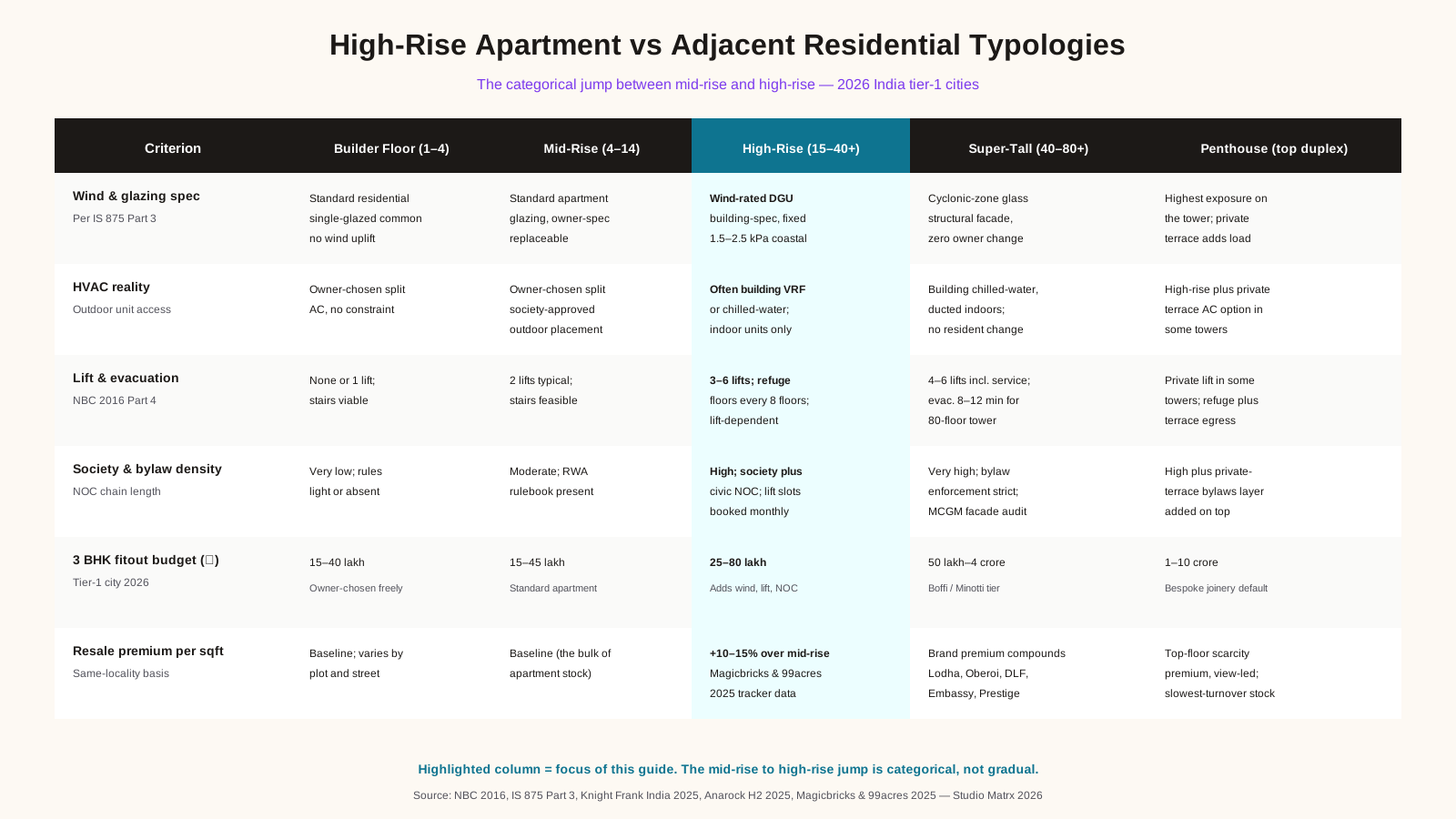
| Category | Floor Count | Wind & Glazing Spec | HVAC Reality | Lift & Evacuation | Society/Bylaw Density | Typical 3 BHK Fitout Budget Range (₹) |
|---|---|---|---|---|---|---|
| Builder Floor / Independent Floor | 1–4 | Standard residential glazing, single-glazed common | Owner-chosen split AC, no constraint | None or 1 lift, evacuation by stairs | Very low — society rules light or absent | 15–40 lakh |
| Low-Rise Apartment | 1–3 floors stilt+ | Standard, no wind spec uplift | Owner-chosen split AC | 1 lift, evacuation by stairs | Low to moderate | 12–35 lakh |
| Mid-Rise Apartment | 4–14 floors | Standard apartment glazing | Owner-chosen split AC, outdoor placement society-approved | 2 lifts typical, evacuation by stairs feasible | Moderate — RWA rules clear | 15–45 lakh |
| High-Rise Apartment (this guide) | 15–40+ floors | Wind-rated double-glazed, often building-spec | Often building-supplied VRF or chilled-water | 3–6 lifts, lift-dependent evacuation, refuge floors per NBC | High — society + civic NOC chain | 25–80 lakh |
| Super-Tall / Ultra-Luxury Tower | 40–80+ floors | Cyclonic wind spec, structural glass system, no resident modification | Building-supplied chilled-water, ducted indoors | 4–6 lifts including service, refuge floors every 8 floors mandatory | Very high — bylaw enforcement strict | 50 lakh–4 crore |
| Penthouse (top-floor duplex) | Atop high-rise or mid-rise | Highest wind exposure on the tower | Same as high-rise + private terrace AC if any | Private lift in some towers | High; private-terrace bylaws additional | 1–10 crore |
The table makes the categorical jump from mid-rise to high-rise visible: it is not a smooth gradient of "a bit more wind, a bit more lift." It is a different building system, a different bylaw regime, and a different fitout discipline.
For the mid-rise and general apartment brief, the upstream reference is /guides/apartment-interior-planning-india. For the premium and luxury tiers regardless of building height, /guides/premium-apartment-interiors and /guides/luxury-apartment-design cover the aesthetic and finish ladder. For the top-of-tower duplex specifically, /guides/penthouse-design takes over.
"The mid-rise to high-rise jump is the single biggest typology jump in Indian residential design. The bylaws change, the physics change, the lifestyle clock changes. Designers who treat it as a continuous spectrum miss four out of the five things that go wrong in execution."
Materials, Finishes and Brand Landscape
The materials and brands list for a high-rise fitout looks similar to a premium apartment list at first glance but diverges in three specific places: glazing (building-spec, not owner-spec), HVAC (building-spec at many towers), and any item that must survive vertical-transport-by-lift logistics.
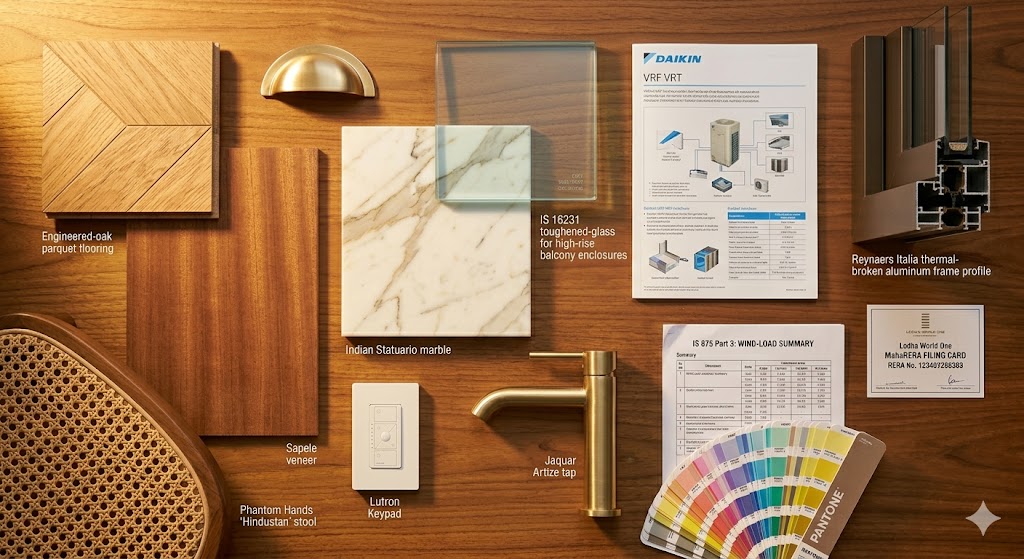
| Element | Indian Brand Options (Mid to Premium) | International Brand Options (Premium to Luxury) | High-Rise-Specific Note |
|---|---|---|---|
| Glazing system | Saint-Gobain India, Asahi India Glass (AIS) | Schueco India, Reynaers Aluminium | Usually building-supplied and not owner-replaceable; resident can add solar/privacy film with society NOC |
| Engineered wood flooring | Action Tesa, Greenlam, Square Foot | Quick-Step, Kahrs (via India distributors) | 11 mm or 14 mm engineered preferred; lift-friendly plank length (1.2 m max) for transport |
| Modular kitchen carcass and shutters | Sleek by Asian Paints, Spacewood, Hacker India, Wurfel | Poggenpohl (via India), SieMatic, Bulthaup | Knockdown kit format required — assembled inside, no full-built cabinet through lift |
| Kitchen hardware | Hettich India, Hafele India, Ebco | Blum (via India), Grass | Soft-close everywhere is the 2026 default at premium |
| Worktop / kitchen counter | Carysil quartz, Kalingastone, Classic Marble | Caesarstone, Silestone, Dekton | Slab transport via lift — 3.2 m × 1.6 m fits most service lifts; larger needs crane permission |
| Sanitaryware and faucets | Jaquar, Cera, Hindware, Parryware | Kohler, Grohe (India), Hansgrohe, Duravit, Toto | Wall-hung WC requires pre-engineered carrier-frame in concealed cistern — only possible during fitout window |
| Wardrobe systems | Sleek, Spacewood, Godrej Interio, Wurfel | Lema, Misuraemme | Tall-unit shutters max 2.4 m due to lift door height clearance |
| Wall paint (interior emulsion) | Asian Paints Royale Luxury and Royale Aspira, Berger Silk Glamour, Nerolac Excel Premium | Farrow & Ball (limited India availability), Little Greene | Low-VOC critical in airtight high-rise; window-opening for fume-out is limited |
| Tiles and stone | Kajaria, Somany, Asian Granito, RAK India | Porcelanosa, Florim, Mirage | Large-format slabs (1.6 m+) require service-lift access — confirm before order |
| Lighting | Wipro, Havells, Philips India, Syska | Erco, Flos, Artemide, Vibia, Tom Dixon | Pendants over 1.5 m drop need ceiling-load check; some high-rise gyp ceilings limited to 5 kg/point |
| Furniture, sofas and beds | Beyond Designs, Pepperfry studio, Stanley Lifestyles, Urban Ladder, Wakefit (for budget rooms) | Minotti, Poliform, B&B Italia, Cassina, Molteni, Boffi (kitchen) | Sofa width 2.4 m and chest depth 0.9 m are common lift-aperture failure points; confirm before order |
| HVAC indoor units | Daikin India, Mitsubishi Electric India, Toshiba Carrier, Voltas | Daikin VRV-X, Mitsubishi City Multi | If building-supplied VRF, the resident chooses concealed-grille indoor units only; confirm with building MEP cell |
| Home automation | Schneider Wiser, Legrand MyHome, Crestron India, Polycab | Lutron, Crestron, Control4, KNX | Building-intercom and access-control integration adds 10–15% cost but is the differentiator |
| Window treatments | Hunter Douglas India, D'Decor, Pioneer Industries | Silent Gliss, Mottura | Motorised blackout-plus-sheer dual track is the high-rise premium default |
The hidden constraint that runs through the table is lift aperture and weight limit. A 2.4 m sofa, a 3.6 m kitchen island worktop, a 2.7 m tall wardrobe shutter, a 1.8 m × 2.4 m stone slab — any of these can fail at the lift door, the lift cabin diagonal, or the building's allowed crane-and-lift schedule. Designers who measure the service lift in week one of the project before finalising any oversized item avoid 80% of vertical-transport rework.
Eight Pitfalls Common in 2026 India
1. Treating wall demolition as a renovation question. In a high-rise, removing or modifying any wall — even a clearly non-load-bearing one — needs a structural-engineer letter (the wall may carry MEP runs that affect upper-floor flats) and a society NOC. Skipping this is the most common source of stop-work notices. Mitigation: at brief stage, list every wall the design touches and pre-book the structural review.
2. Assuming plumbing can be relocated. Post-tension slabs cannot be cored without compromising the slab's tension cables; even RCC slabs in high-rises typically forbid coring after handover. The bathroom and kitchen layouts must work around fixed stack positions. Mitigation: get the as-built MEP drawing from the developer or society in week one; design the wet zones around those stacks, not against them.
3. Specifying split-AC outdoor units the facade cannot accept. Many 2026 high-rises either supply VRF/chilled-water systems or allocate exactly one outdoor-unit position on a chajja per flat. Briefs that specify three split outdoor units when only one position exists hit a wall during execution. Mitigation: confirm HVAC regime with the developer's MEP cell at the brief stage; design indoor units only if building-supplied.
4. Over-specifying DG-backed loads. A 1.5–3 kVA DG allocation cannot run two ACs plus an induction hob plus a microwave simultaneously. The brief must designate priority loads — usually fans, lights, fridge, router, master-bedroom AC. Mitigation: ask for the exact DG allocation in kVA and draft the priority load schedule into the electrical scope of work.
5. Designing a balcony enclosure without society approval. The structural-glass balcony enclosure has become a high-rise aspiration item in Mumbai and Bengaluru, but most societies and BMC bylaws explicitly disallow owner-driven facade modification. A few towers have a building-coordinated enclosure programme; outside that, the answer is no. Mitigation: write to the society in week one; do not commission glass without written approval.
6. Forgetting lift aperture and weight limits during furniture and stone selection. A 2.4 m sofa, a 1.8 m × 3.6 m island worktop, or a 2.7 m wardrobe shutter will fail at the lift door. Mitigation: measure the service lift in week one; pass the spec sheet (W × D × H, weight, lift-fits-or-not) for every oversized item.
7. Ignoring fire-safety access in the fitout. False ceilings cannot block sprinkler heads, smoke detectors, or fire-detection device access. Refuge floors and refuge access points cannot be obstructed by adjacent-flat additions. Mitigation: get the building's fire-safety drawing; mark sprinkler and detector positions on the false-ceiling drawing.
8. Underestimating the lift-time and material-delivery tax on schedule. A high-rise fitout commonly runs 2–4 weeks longer than a comparable mid-rise fitout because of lift booking windows (society allows specific hours), shared lift use with other ongoing fitouts in the tower, and restricted material-delivery slots. Mitigation: build a 15–20% schedule buffer at brief stage; pre-book lift slots monthly, not weekly.
India-Specific Considerations
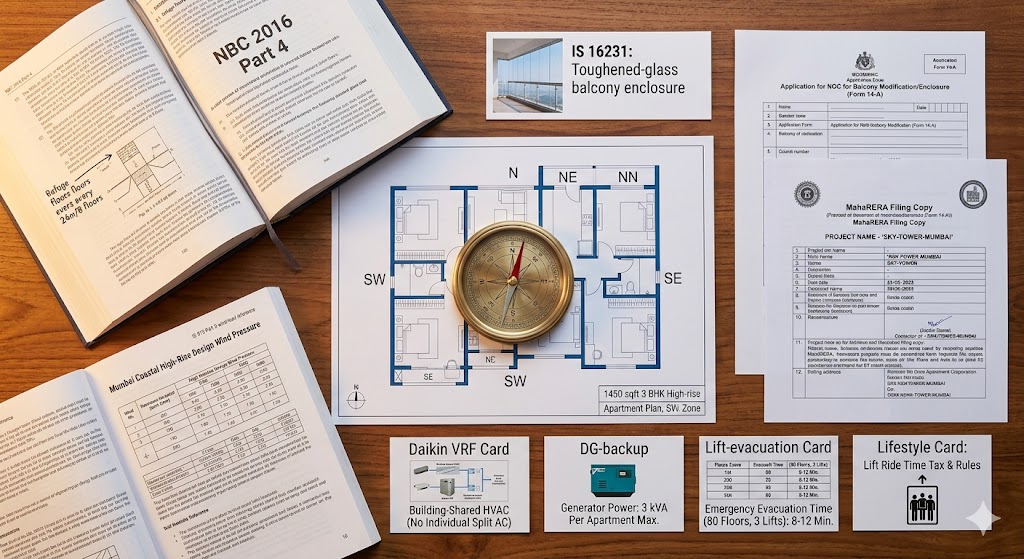
NBC 2016 Part 4 — Fire and Life Safety. This is the single most important code for high-rise residential. It mandates refuge floors every 24 m or 8 storeys (whichever is less) for buildings above 24 m, full sprinkler coverage above 15 m, smoke detection across common areas and within flats at certain points, fire-rated lift lobby separation, dedicated fire-pump rooms with terrace overhead tanks of 20,000 litres minimum, and emergency stair pressurisation. The interior fitout must not block sprinkler heads, smoke detectors, or access to refuge floors. False ceiling sprinkler-head positions are a fixed checklist item.
IS 875 Part 3 — Wind Loads. This is the structural code that determines glazing and facade-system spec for high-rise. Coastal cities (Mumbai, Chennai, Visakhapatnam, Kolkata) sit in higher wind-zone categories with design wind pressures of 1.5–2.5 kPa at 60+ floors. Inland high-rises (Bengaluru, Hyderabad, Delhi NCR, Pune) face lower wind loads but still require wind-rated glazing at 30+ floors. The resident does not choose the glazing — the building does — but it is worth knowing why the windows look the way they do, why they may not be openable beyond a restricted aperture, and why film-and-tint modifications need approval.
IS 16231 — Glass in Buildings. This standard covers the toughened, laminated, and insulated glass used in high-rise facade and any balcony enclosure. Any owner-driven glass enclosure that does get society approval must specify per IS 16231; designers and society architects expect this reference in the proposal.
DPDP Act 2023. Smart-home installations in high-rises (which are common at the premium end) collect data — door-access logs, motion patterns, indoor cameras, voice-assistant logs. The DPDP Act 2023 requires explicit consent, purpose limitation, and data-fiduciary disclosure. Premium home-automation brands operating in India (Schneider, Legrand, Crestron, Control4 via local SI partners) typically have DPDP-compliance documentation; ad-hoc Wi-Fi-camera setups often do not. The brief should specify DPDP-compliant equipment for any data-collecting smart-home device.
Society and RWA Rules. Every high-rise society has its own fitout-rulebook covering working hours (commonly 9 am–6 pm Mon–Sat, no Sundays, no public holidays), lift booking, material-delivery windows, deposit (refundable, usually ₹25K–₹2 lakh per fitout), debris-removal protocol, painting and noise restrictions, and the NOC chain for any wall, plumbing, or facade modification. The single biggest source of fitout-schedule slippage is mis-estimating how restrictive the society rules will be. Read the rulebook before signing the contractor agreement.
Civic NOCs — MCGM/BMC, BBMP, MCD, GHMC. Any facade modification (balcony enclosure, AC outdoor unit relocation, signage) requires the municipal NOC in addition to society NOC. MCGM in Mumbai is particularly strict; BBMP in Bengaluru has become stricter after the 2024 facade-safety review.
Vastu Compatibility. Indian high-rise buyers commonly check Vastu compatibility of their flats — main door direction, kitchen position, master-bedroom direction, pooja room placement. The reality is that the floor plate is fixed and not modifiable, so Vastu in a high-rise is about working within the fixed plate rather than designing the plate. Common compromises that work: the kitchen on the southeast quadrant (often pre-engineered that way in India-aware developer plans), the master bedroom in the southwest, the pooja room in the northeast even if it is a niche rather than a dedicated room. For deeper Vastu treatment see /guides/vastu-modern-homes.
Climate Zone Considerations. Mumbai and Chennai high-rises face humidity and salt corrosion; the brief should specify marine-grade hardware in balcony and exposed locations. Delhi NCR high-rises face winter low temperatures and summer dust loads; the HVAC and air-purification overlay matters more. Bengaluru is the most benign climate but high-rise wind on balconies still applies. Hyderabad mid-rise-to-high-rise pockets see moderate dust loads.
Regional Vendor Differences. Mumbai's premium and luxury high-rise fitout market is dominated by a handful of specialist contractors (Beyond Designs, ELE Design, Beyond the Door) who know the Worli/Lower Parel/Tardeo tower-specific rule sets. Bengaluru has Studio Lotus, Studio Carbon, Spaces & Design at the premium tier. Delhi NCR's high-rise fitout pool is concentrated around Gurugram with Lipika Sud Interiors, Renesa, and several Gurugram-specific firms. Choosing a contractor who has done a fitout in the same tower or the same developer's adjacent project compresses the learning curve by 30–50%.
The Budget Bands for 2026 India
| Tier | Budget Range (₹/sqft) | Total for 1,500 sqft 3 BHK | What You Get | Typical Vendors and Brands |
|---|---|---|---|---|
| Entry High-Rise | ₹1,200–₹2,000/sqft | ₹18–30 lakh | Functional fitout, Asian Paints Royale, Sleek modular kitchen, Hettich hardware, basic false ceiling, standard split-AC or building-supplied indoor units, no automation | Sleek, Spacewood, Hettich India, Hafele India, Asian Paints, Kajaria, Jaquar |
| Mid-Premium High-Rise | ₹2,000–₹3,500/sqft | ₹30–52 lakh | Open-plan kitchen with island, engineered oak flooring, fluted-panel features, designer lighting, basic home automation, motorised blinds in master, premium-brand sanitaryware | Spacewood/Wurfel kitchen, Action Tesa or Greenlam flooring, Schneider Wiser automation, Jaquar premium / Kohler entry, Pepperfry/Beyond Designs furniture |
| Premium High-Rise | ₹3,500–₹6,000/sqft | ₹52–90 lakh | Custom kitchen with international brand options, large-format stone, full home automation, integrated AV, premium engineered or solid wood, designer pendant lighting, custom wardrobes with internal organisation, marble or large-format porcelain bathrooms | Wurfel / Hacker India kitchen, Kohler/Grohe full sanitary, Crestron or Lutron automation, B&B Italia or Minotti loose furniture, Erco/Flos lighting |
| Super-Luxury High-Rise | ₹6,000–₹15,000+/sqft | ₹90 lakh–₹2.5 crore | Imported Italian kitchen (Poliform, Boffi, SieMatic), bookmatched stone walls, Crestron/Control4 full automation, Lutron lighting, smart-glass partitions, art and bespoke joinery, full B&B Italia/Minotti/Cassina loose furniture, integrated wine and humidor rooms | Boffi/Poliform kitchen, Minotti/B&B Italia furniture, bespoke joinery by Beyond Designs or ELE, Crestron with custom-programmed scenes, Erco architectural lighting |
The bands are 2026-anchored and assume Mumbai/Delhi NCR/Bengaluru tier-1 pricing. Tier-2 city high-rises (Ahmedabad, Kochi, Indore, Coimbatore) typically run 15–25% lower in the entry and mid-premium bands; the premium and super-luxury bands are similar because they import similar international brands.
A useful cross-check: the Studio Matrx cost-benchmark and budget allocation tools let you stress-test a budget against city, tier, and room mix; the material rate library gives current Indian rates for the specified brands. For the upstream apartment-budget framework see /guides/apartment-interior-planning-india; for the pure-luxury tier see /guides/luxury-apartment-design.
When High-Rise Apartment Interior Approach Is NOT the Right Fit
The high-rise apartment approach in this guide is calibrated for tier-1-city 15+ floor towers with structured societies, civic NOC chains, and engineered HVAC/MEP systems. It is the wrong reference in five specific situations.
Builder floor or independent floor. None of the wind, lift, society, or HVAC constraints apply. The fitout is closer to a small house than an apartment; the /guides/apartment-interior-planning-india and /guides/compact-urban-home-planning-india references are more useful.
Low-rise or mid-rise apartment. The 4–14 floor apartment has its own pattern — open AC choice, simpler society rules, no wind-load uplift. Using the high-rise rulebook over-engineers the brief.
Plotted villa or row house. Different typology entirely; no shared-building constraints. The /guides/luxury-villa-architecture-india reference is the right anchor.
Rental apartment fitout. Even in a high-rise, a 2–3 year rental brief should not commission custom joinery, structural-glass partitions, or built-in automation that the landlord will not refund. The rental brief is a separate discipline — modular, demountable, lease-friendly.
Pre-occupancy resale flip. A flat being fitted out to sell within 12 months should target ₹1,200–₹1,800/sqft maximum, focus on photogenic aesthetics and standard finishes, and not over-spend on smart-home or custom joinery that does not show up in resale price. The premium and luxury high-rise approach assumes long-tenure occupancy.
The 5-Year Trajectory: 2030 Outlook
By 2030, six shifts will have changed the high-rise apartment interior brief in measurable ways.
Building-supplied VRF and chilled-water HVAC will be the default at 25+ floors. Already common in 2026 super-luxury towers, this will extend down-market to premium and mid-premium high-rises. Resident-choice split AC will be a budget-tier marker.
Refuge-floor amenitisation will become an interior-adjacent design topic. Several 2025–2026 developments have started turning refuge floors (which by code must remain empty and accessible) into landscaped semi-public spaces between adjacent towers. The NBC compliance work-around — refuge plus garden — is becoming a design feature.
Structural-glass balcony enclosure may become a building-coordinated programme rather than an owner-driven retrofit. Developers like Lodha and Oberoi have signalled in 2025 that future towers may include pre-approved enclosure-system options at handover, removing the society-NOC pain point.
Home-automation default will rise from basic-scene control to full intent-based automation. The 2026 premium-tier brief that specifies four lighting scenes will, by 2030, specify intent-driven automation (the system learns and pre-empts) — driven by Crestron and Lutron AI-overlay rollouts already piloted.
DPDP enforcement will tighten what data-collecting smart-home devices are legal to install. The 2023 Act's enforcement regime is still maturing; by 2028–2030 the data-fiduciary obligations will have shifted what Wi-Fi camera, indoor sensor, and voice-assistant briefs look like.
Wind and structural-glass spec will tighten further on coastal high-rises. Post-2024 facade incidents in Mumbai and Chennai have triggered the IS 875 Part 3 review committee; the 2027 revision (expected) is likely to raise design wind pressure for coastal 60+ floor towers by 10–20%. New buildings will be heavier-spec; older buildings (including some 2018–2022 vintage) may need facade-system upgrades.
Frequently Asked Questions
Q: Can I remove a wall in my high-rise apartment?
Only with a structural-engineer letter confirming the wall is non-load-bearing and not carrying MEP runs that affect upper floors, plus a society NOC. Even then, post-tension slab buildings often forbid all coring and most demolition. Expect 2–4 weeks for the approval chain.
Q: Can I enclose my balcony with glass?
In most Mumbai, Bengaluru, and Delhi NCR high-rises in 2026, no — society and civic (MCGM/BMC/BBMP) bylaws explicitly prohibit owner-driven facade modification. A few towers have building-coordinated enclosure programmes. Confirm with the society in writing before commissioning any glass.
Q: My flat has building-supplied VRF — can I add a split AC for one room?
Usually no. The building HVAC is engineered as a closed system, and adding a split AC requires an outdoor-unit chajja position that the building may not allocate. Check with the developer's MEP cell first.
Q: What is the DG backup load my brief can assume?
Typically 1.5–3 kVA per flat in mid-tier high-rises, 5–10 kVA in super-luxury towers. Get the exact allocation from the society and write a priority-load schedule (fans, lights, fridge, router, one AC zone usually).
Q: How much does it cost to do a quality 3 BHK fitout in a high-rise?
₹30–52 lakh for mid-premium (₹2,000–₹3,500/sqft on 1,500 sqft), ₹52–90 lakh for premium, ₹90 lakh–₹2.5 crore for super-luxury. Entry tier starts ₹18–30 lakh but compromises on finish and automation.
Q: Will my high-rise fitout take longer than a regular apartment fitout?
Typically 2–4 weeks longer for an equivalent scope because of lift booking constraints, shared-lift use with other ongoing fitouts in the tower, and society-restricted working hours and material-delivery windows. Build a 15–20% schedule buffer at brief stage.
Q: Is a high-rise flat resale-friendly compared to a mid-rise?
Yes — same-locality high-rise typically sells at a 10–15% per-sqft premium over comparable mid-rise. Premium developer brand (Lodha, Oberoi, DLF, Embassy, Prestige, Brigade) compounds the premium. The fitout investment is more recoverable than in a mid-rise.
Q: Can I install full home automation in a building-supplied smart-intercom tower?
Yes, and ideally yes — the building's intercom and access-control system is the integration point that makes the home automation more valuable. Choose a system (Schneider Wiser, Legrand MyHome, Crestron, Control4) whose India SI partner has done integration in your specific tower or developer.
Q: What about Vastu compliance in a high-rise where I can't move walls?
Vastu in a high-rise is about working within the fixed floor plate. Common compromises that work: kitchen in southeast (often pre-engineered that way), master in southwest, pooja niche in northeast. Most India-aware developers (Lodha, Brigade, Prestige) ship plans that are 70–80% Vastu-aligned. For deeper guidance see /guides/vastu-modern-homes.
Q: Is the maintenance cost of a high-rise apartment a major factor in the total cost of living?
Yes — ₹4–₹12/sqft/month in mid-tier high-rise, ₹15–₹35/sqft/month in super-luxury. A 1,500 sqft flat at ₹25/sqft is ₹37,500/month. Factor this into the total decision before locking the interior budget; the resale market discounts this load but the operating cost is real.
References
1. Bureau of Indian Standards. National Building Code of India 2016, Volume 1 and Volume 2, particularly Part 4 (Fire and Life Safety) and Part 8 (Building Services). New Delhi: BIS, 2016.
2. Bureau of Indian Standards. IS 875 (Part 3): 2015 — Code of Practice for Design Loads (Other than Earthquake) for Buildings and Structures — Wind Loads.
3. Bureau of Indian Standards. IS 16231 (Parts 1–4) — Glass in Buildings.
4. Government of India. Digital Personal Data Protection Act, 2023. Ministry of Electronics and Information Technology.
5. Knight Frank India. India Real Estate Report H1 and H2 2025: Residential Market Insights for Mumbai, Bengaluru, Delhi NCR, Hyderabad and Pune. Knight Frank Research, 2025.
6. JLL India. Residential Market Update 2025 — High-Rise and Premium Segment Analysis.
7. CBRE India. India Real Estate Market Outlook 2026 — Residential Segment.
8. Anarock Property Consultants. India Residential Market Report H2 2025 and Q1 2026 Update.
9. Magicbricks Research. PropIndex Reports Q1 2026 — City-Level High-Rise vs Mid-Rise Premium Analysis for Mumbai, Bengaluru, Gurugram, Hyderabad.
10. 99acres Market Tracker. City-Level Apartment Price Trends 2025 — Vertical Segment Breakdown.
11. Houzz India. 2025 Renovation and Interior Trends Survey — Apartment Segment.
12. India Brand Equity Foundation (IBEF). Real Estate Industry Report February 2026.
13. Municipal Corporation of Greater Mumbai (MCGM). Building Bylaws and Facade Modification Guidelines, accessed 2026.
14. Bruhat Bengaluru Mahanagara Palike (BBMP). High-Rise Building Safety Review Guidelines 2024 Update.
15. Maharashtra Real Estate Regulatory Authority (MahaRERA). Project Disclosures and Compliance Filings for High-Rise Residential Towers, accessed 2026.
Related Guides
- /guides/apartment-interior-planning-india — the upstream reference covering general apartment interior planning, layout, materials, and budget framework across all building heights
- /guides/premium-apartment-interiors — the premium tier of apartment fitouts including high-rise premium spec
- /guides/luxury-apartment-design — the luxury and super-luxury tier including the Boffi/Poliform/Minotti kitchen and furniture briefs typical at the top of Mumbai's super-tall towers
- /guides/penthouse-design — the top-of-tower duplex penthouse design reference, the natural next step from a high-rise apartment brief
- /guides/smart-home-design-india — the smart-home overlay that high-rise residents disproportionately ask for, with DPDP and Indian SI partner specifics
- Choosing an interior designer — how to select a designer who has done fitouts in the same tower or developer's adjacent project, a 30–50% learning-curve compression
Export this guide
Related Guides — Deep-dive reading
Penthouse Design — Top-Floor Luxury in Indian Towers (2026)
DLF Camellias / Lodha Altamount / Oberoi Sky Suites · Private terraces · ₹15-150 crore market
Design StylesPremium Apartment Interiors — The ₹15-40 Lakh Tier for Indian 3 BHKs (2026)
Above budget-luxury · Below super-luxury · Materials, brands, contractor-tier reality
Design StylesSpace-Saving Furniture — The 12-Category Piece-by-Piece Indian Reference (2026)
Sofa-cum-beds · Murphy beds · Transformer dining · Modular wardrobes · IS 8888 · Indian brand+price tables
Design StylesRelated Tools — Try Free
Cross-Ventilation Analyzer
Estimate airflow and air changes per hour (ACH) from room size, window areas, layout, and local wind — with NBC 2016 Part 8 compliance check.
Ventilation CalculatorProperty Tax Calculator — 10 Indian Cities
Estimate annual municipal property tax across BBMP / MCD / MCGM / GHMC / GCC / KMC / PMC / AMC / TMC / PCMC — with self-occupied, tenanted, and age-rebate adjustments.
Property TaxAcoustic Privacy (STC) Visualizer
Indian healthcare acoustic visualizer — compare wall assemblies and noise sources, see received SPL after STC attenuation, and check FGI 2018 / IS 1950 / NABH speech-privacy compliance with live dual-canvas waveform.
Acoustic Tool