
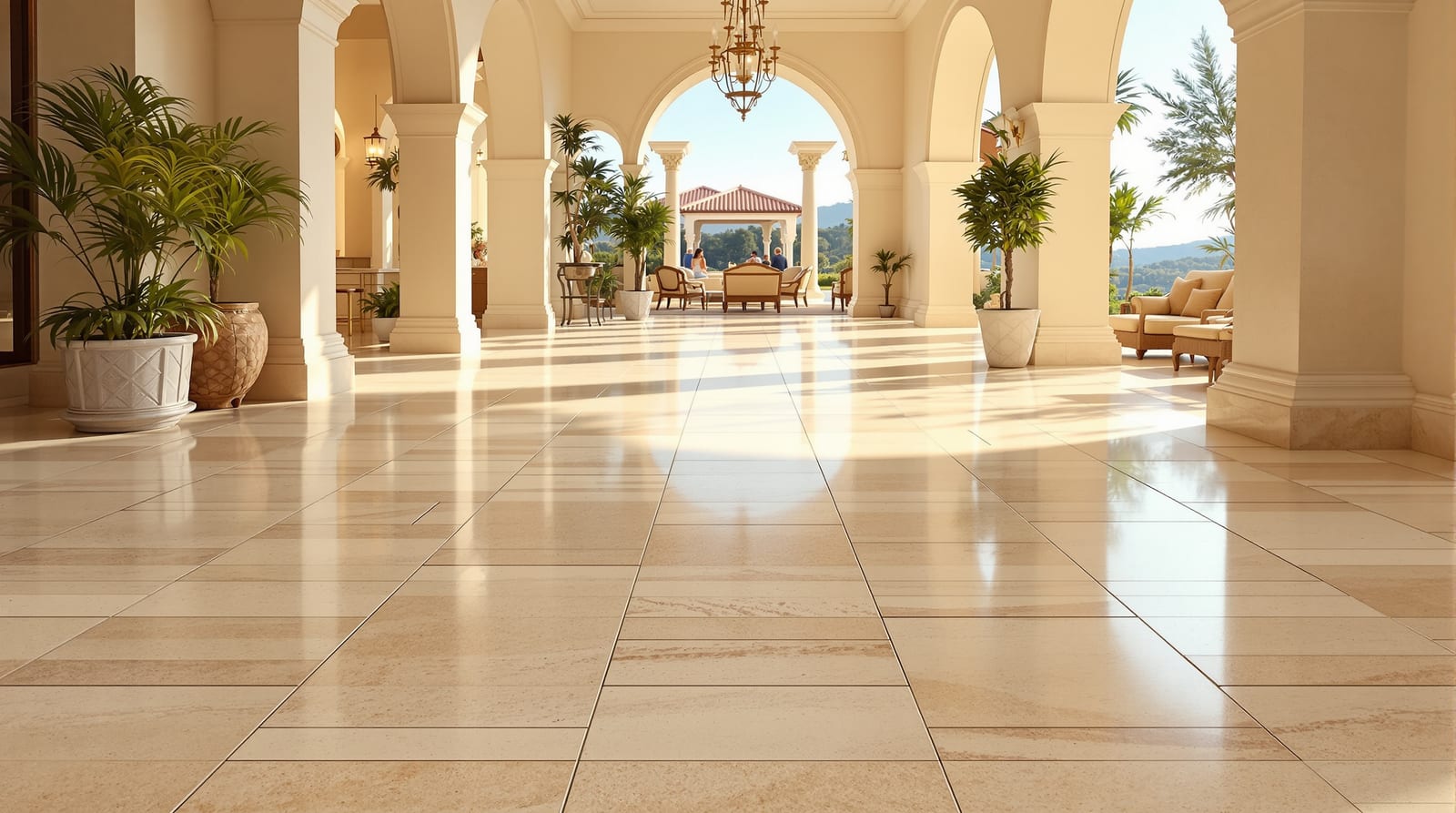
Travertine Flooring in India: Cost, Finishes, Filling & Care (2026)
The banded cream-and-walnut limestone with natural pits — filled vs unfilled, honed vs polished, where it suits, and how to seal it for Indian homes.
Travertine is the stone that gives a room that warm, sun-bleached Mediterranean calm — the same banded cream-and-walnut limestone you see across Roman piazzas, Turkish hotels and Indian villa lobbies. It is a form of limestone deposited around mineral springs, and that origin gives it two signatures no factory tile can fake: soft horizontal banding, and natural pits and holes left by escaping gas bubbles. Those pits are exactly what makes travertine beautiful, and exactly what you must understand before you lay it. This guide covers what travertine is, the filled-vs-unfilled and honed-vs-polished decisions, real Indian costs, where it genuinely suits, and how to seal and live with a porous luxury stone in Indian conditions.
What travertine actually is
Travertine forms when calcium-carbonate-rich water from hot or mineral springs deposits layer upon layer of limestone over thousands of years. Trapped gases and decaying organic matter leave behind the characteristic voids — the "pits" — running roughly with the bedding. Because it is calcium carbonate, travertine sits in the same family as marble and limestone: soft, porous, and chemically vulnerable to acids. It is softer than granite and most basalt, comparable to or slightly softer than marble, and considerably more porous than polished marble because of those open voids.
Most travertine in the Indian market is imported — Turkey and Iran are the dominant sources, with some Italian, Mexican and Peruvian stone at the top end. Turkey supplies the familiar light ivory and "classic" beige fields; Iran offers silver, walnut and red-brown varieties. A small amount of Indian travertine and travertine-like sedimentary stone exists, but the recognised premium varieties you will be quoted in a slab yard are almost always Turkish or Iranian. This import dependence is the single biggest reason travertine costs more than Indian limestones like Kota or Shahabad despite being chemically similar.
Colour ranges from the palest ivory and beige through honey, gold, silver-grey and deep walnut to reddish "noce" tones. The banding can be subtle or dramatic, and slabs are commonly cut two ways: "vein cut" (across the bedding, giving long linear streaks) and "cross cut" or "fleuri" (with the bedding, giving cloudy, flower-like figuring). Vein cut reads more contemporary and directional; cross cut reads softer and more random.
The two decisions that define your floor: fill and finish
Two independent choices control how travertine looks and performs: whether the natural pits are filled, and how the surface is finished. Understanding them separately is the key to specifying correctly.
Filling deals with the holes. In filled travertine the pits are packed at the factory with a matching resin or cementitious filler and ground flush, giving a smooth, continuous surface that is easy to clean and walk on barefoot. In unfilled (sometimes called "open" or "natural") travertine the pits are left open, giving a more rustic, textured, authentic look — beautiful, but the open holes collect dust, grit and water, and need more careful sealing and cleaning. Most indoor Indian floors use filled travertine; unfilled is reserved for rustic outdoor paving, pool surrounds and feature walls where the texture is the point.
Finish deals with the surface texture of the stone itself:
- Polished — ground to a glossy reflective sheen. Looks luxurious and marble-like, shows the colour at its richest, but is slippery when wet and shows etch marks and scratches readily. Best for low-traffic premium dry interiors.
- Honed — ground to a smooth matte or satin surface with no shine. The most popular travertine finish: elegant, contemporary, more slip-friendly than polished, hides etching better. The default for Indian living rooms and lobbies.
- Brushed / antiqued — surface mechanically brushed for a soft, slightly textured, time-worn feel. Good slip resistance, warm character.
- Tumbled — edges and surface tumbled to a rounded, rustic, aged look; almost always unfilled. Classic for Mediterranean patios, courtyards and pool decks; excellent grip.
The two choices combine: a typical premium living room is filled and honed; a villa patio or pool deck is often unfilled and tumbled or brushed for grip and an old-world look.
Fill, finish, look, cost and best use
| Type (fill + finish) | Look | Slip / barefoot | Indicative ₹/sq ft (material) | Best use |
|---|---|---|---|---|
| Filled + polished | Glossy, marble-like, rich colour | Slippery wet, smooth dry | ₹250-500 | Premium dry living/dining, lobbies |
| Filled + honed | Matte, elegant, contemporary | Good dry, fair wet | ₹200-450 | Living rooms, bedrooms, lobbies, spas |
| Brushed / antiqued | Soft textured, warm, time-worn | Good | ₹180-400 | Living areas, kitchens, semi-covered patios |
| Unfilled + tumbled | Rustic, pitted, old-world | Very good | ₹150-350 | Patios, courtyards, pool decks, garden paths |
| Unfilled + honed | Textured matte, authentic | Good | ₹150-380 | Outdoor paving, feature walls |
| Premium Italian / select Iranian | Best figuring & consistency | Varies by finish | ₹400-500+ | Statement floors, hospitality |
Ranges are indicative and vary by city, vendor, slab vs tile format, thickness and selection grade; add roughly 18% GST. Laying is extra (see below). Prices are material only.
What it costs to actually lay in India
Material at ₹150-500 per sq ft is only part of the bill. Travertine is a natural stone, laid on a cement mortar bed by skilled masons, and the finishing work is real:
- Laying labour and mortar bed: roughly ₹40-90 per sq ft depending on city, format and pattern (tiles are quicker than large slabs; intricate borders cost more).
- Sealing: a good penetrating sealer plus application is roughly ₹15-40 per sq ft over the life of the floor, and it must be repeated periodically (more on this below).
- Edge polishing, skirting and wastage: budget another 8-12% on material for cutting waste and skirting.
- Re-filling and re-honing over time: with filled travertine, some pit fillers can pop out over years; periodic re-fill and a light re-hone restore the surface.
A realistic installed cost for a quality honed-and-filled Turkish travertine living-room floor in a metro lands around ₹300-600 per sq ft all-in (material + laying + sealing), before borders or imported select grades push it higher. For accurate slab counts and a buy quantity that accounts for wastage, our natural-stone slab calculator at /utilities/natural-stone-slab-calculator is the fastest way to convert your floor area into slabs and a budget, and the flooring cost calculator helps compare it against alternatives.
The pit question: filling, refilling and porosity
The pits are the heart of both travertine's charm and its maintenance story. Even "filled" travertine is more porous than polished marble, because the fill sits in voids and the stone matrix itself absorbs liquid. This has three practical consequences for Indian homes.
First, fillers can fail over time. Factory epoxy or cementitious fills are durable but not permanent — under heavy traffic, thermal movement and cleaning, some plugs can crack, discolour or pop out, leaving small open pits that catch dirt. This is normal and fixable: a stone professional drills out the failed fill, repacks with a colour-matched resin or specialised travertine filler, and lightly re-hones the patch. Budget for a touch-up every several years on a busy filled floor.
Second, unfilled floors need their pits respected. Open pits are a feature outdoors, but they trap grit that acts as sandpaper and hold water that can stain or grow algae in damp Indian monsoon conditions. Keep unfilled travertine swept, sealed, and out of constantly-wet indoor zones.
Third, everything depends on sealing — which deserves its own section.
The diagram below shows a travertine section: the banded layers, the natural voids, and the difference between an unfilled pit and a filled-and-honed surface.
Sealing: the non-negotiable for a calcium stone
Because travertine is calcium carbonate, it is acid-sensitive. Anything acidic — lemon, vinegar, tomato, wine, many household and bathroom cleaners, even hard-water scale removers — will react with the surface and leave a dull, slightly rough "etch" mark that is a chemical burn, not a stain, and cannot be wiped away. It can only be re-honed or polished out by a professional. This is the same vulnerability marble and limestone share, and it is the number-one cause of regret with travertine floors.
The defence is twofold. First, seal it with a quality penetrating (impregnating) sealer at installation and re-seal periodically — typically every 1-3 years for interiors and more often for outdoor or wet zones, depending on traffic and the product. A penetrating sealer slows absorption so spills can be wiped before they soak in; it does not make the stone acid-proof, but it buys you crucial minutes. Our floor resealing guide walks through products, frequency and the simple water-drop test that tells you when a re-seal is due, and the floor sealer calculator estimates how much sealer your area needs.
Second, change your cleaning habits: only pH-neutral stone-safe cleaners, never acidic or generic tile cleaners, never abrasive scouring pads, and wipe acidic spills immediately. Use felt pads under furniture and a doormat at entries to keep grit off the surface.
Where travertine genuinely suits in an Indian home
Travertine rewards the right placement and punishes the wrong one. It is at its best where its warmth and luxury show and its softness is not abused:
- Premium living and dining rooms — filled, honed travertine gives a calm, expensive, neutral backdrop that pairs beautifully with both contemporary and classic interiors. This is its strongest indoor use.
- Villa lobbies, foyers and stair landings — large honed slabs read as serious luxury; a hospitality favourite.
- Patios, verandahs and courtyards — unfilled, tumbled or brushed travertine is a Mediterranean classic outdoors; it stays cooler underfoot than dark stone and grips well. Pair it with our outdoor flooring guide.
- Pool decks and surrounds — travertine's signature use worldwide: it stays relatively cool in the sun, is naturally non-slip when tumbled, and wicks away splash water. Seal well and use unfilled or brushed grades.
- Spas, wellness rooms and bathrooms (with care) — its soft, spa-like neutrality suits wellness spaces, but in wet bathrooms it needs diligent sealing, good slope and acid-free cleaning, and many designers prefer it on walls there rather than wet floors.
Where to be cautious: busy kitchens (acid and oil), hard-use entries with heavy grit, and constantly-wet utility areas all stress a soft porous stone. In those zones, vitrified tiles or denser stones like granite or basalt are easier.
Travertine vs marble vs limestone
These three are close cousins, and choosing between them is a common decision in premium Indian projects.
| Property | Travertine | Marble | Limestone (Kota/Indian) |
|---|---|---|---|
| Geology | Spring-deposited limestone | Metamorphosed limestone | Sedimentary limestone |
| Signature look | Banded, naturally pitted | Veined, often dramatic | Even, matte, understated |
| Surface | Pits (filled/unfilled) | Solid, no voids | Solid, slightly porous |
| Hardness / durability | Soft, porous | Soft, less porous when polished | Soft to medium |
| Acid sensitivity | High (seal) | High (seal) | High (seal) |
| Typical finish | Honed / tumbled | Polished / honed | Honed / polished |
| Indicative ₹/sq ft | ₹150-500 | ₹150-3,000+ | ₹40-150 |
| Sourcing | Mostly imported | Indian + Italian | Indian (very economical) |
| Best vibe | Warm Mediterranean / villa | Opulent / statement | Cool, practical, value |
For a deeper look at each cousin, see our marble flooring guide and limestone flooring guide. If your shortlist has narrowed to high-end surfaces, the comparison in Italian marble vs quartz is also useful for understanding the natural-versus-engineered trade-off. In short: choose travertine for warm, banded, Mediterranean character at a more accessible price than premium marble; choose marble for veined opulence; choose Indian limestone for the same cool calm at a fraction of the cost where you do not need the banded travertine look.
Living with and caring for travertine
Day-to-day care is simple if you internalise the two rules — neutral cleaners and prompt spill wiping. Dry-dust or vacuum (soft head) regularly to remove grit, mop with warm water and a pH-neutral stone cleaner, and keep felt pads under furniture legs. Re-seal on schedule using the water-drop test. For etch marks, light scratches or failed pit fills, call a stone-polishing professional rather than trying to grind it yourself — honing and re-filling are specialist jobs. Our floor cleaning guide has the full neutral-cleaning routine for porous stone.
Travertine is part of the wider world of premium and specialty floors beyond mainstream tiles. If you are still mapping options, the specialty flooring guide is the pillar overview that places travertine alongside other stone, seamless and resilient floors and helps you decide whether it is the right fit at all.
Frequently asked questions
Is travertine flooring good for Indian homes?
Yes, in the right places. Filled, honed travertine is excellent for premium living rooms, lobbies and spas, and unfilled tumbled travertine is one of the best stones for patios and pool decks because it stays cool and grips well. The caveats are that it is porous and acid-sensitive, so it must be sealed and cleaned only with pH-neutral products, and it is best kept out of acid-heavy kitchens and constantly-wet utility floors.
Should I choose filled or unfilled travertine?
Choose filled for almost all indoor floors — the pits are packed and ground flush, giving a smooth, easy-to-clean surface. Choose unfilled (usually with a tumbled or brushed finish) for outdoor patios, courtyards and pool decks, where the open texture adds grip and old-world character and the pits draining water is an advantage.
How much does travertine flooring cost in India?
Material runs roughly ₹150-500 per sq ft depending on type, finish, format and grade, with premium Italian or select Iranian stone at the top. Add about 18% GST, plus ₹40-90 per sq ft for laying and a mortar bed, plus sealing — so a quality honed-and-filled floor installed in a metro typically lands around ₹300-600 per sq ft all-in. Use the natural-stone slab calculator to size your buy.
Will travertine etch or stain?
It can. Being a calcium-carbonate stone, travertine etches (a dull rough mark) on contact with acids — lemon, vinegar, wine, tomato and many cleaners — and can stain from oil or coloured liquids if unsealed. Sealing with a penetrating sealer plus prompt wiping and pH-neutral cleaning prevents most problems; etch marks that do occur are re-honed out by a professional.
How is travertine different from marble?
Both are limestone-based, soft and acid-sensitive, but travertine has natural pits and soft horizontal banding, while marble is solid with flowing veins and no voids. Travertine reads warmer and more Mediterranean and is usually imported from Turkey or Iran at ₹150-500 per sq ft; marble ranges far wider in price and reads more veined and opulent.
Export this guide
Related Guides — Deep-dive reading
Limestone Flooring India: Honed Matte Stone, Colours, Cost and Care
The soft sedimentary stone family — beige, grey, blue and cream limestone with an elegant honed matte look, cool underfoot — plus its porosity, sealing needs, ₹/sq ft cost and where it suits Indian homes.
Flooring & SurfacesHow to Clean Bathroom Tiles (India): Shine, Hard-Water Film & Soap Scum
A practical, India-first routine for cleaning bathroom tiles and keeping them glossy — the daily squeegee habit, weekly wash, monthly deep clean, and the safe cleaner for each tile type, including the golden rule that natural stone must never meet acid.
BathroomsNatural Stone vs Tiles for Bathrooms: Which Is Better? (India)
A fair, India-first head-to-head between natural stone (granite, marble, kota) and ceramic/vitrified tiles for bathroom floors and walls — porosity, hard-water and stain resistance, slip, luxury, ₹ cost and real maintenance effort — with a verdict by budget.
BathroomsRelated Tools — Try Free
Flooring Cost Calculator
Estimate the all-in cost of a floor — material, laying, wastage, skirting and GST — by area and material.
Flooring CalculatorAcoustic Privacy (STC) Visualizer
Indian healthcare acoustic visualizer — compare wall assemblies and noise sources, see received SPL after STC attenuation, and check FGI 2018 / IS 1950 / NABH speech-privacy compliance with live dual-canvas waveform.
Acoustic ToolFloor Sealer Calculator
Estimate stone and grout sealer in litres, bottles and cost by area, surface porosity and coats.
Flooring Calculator