
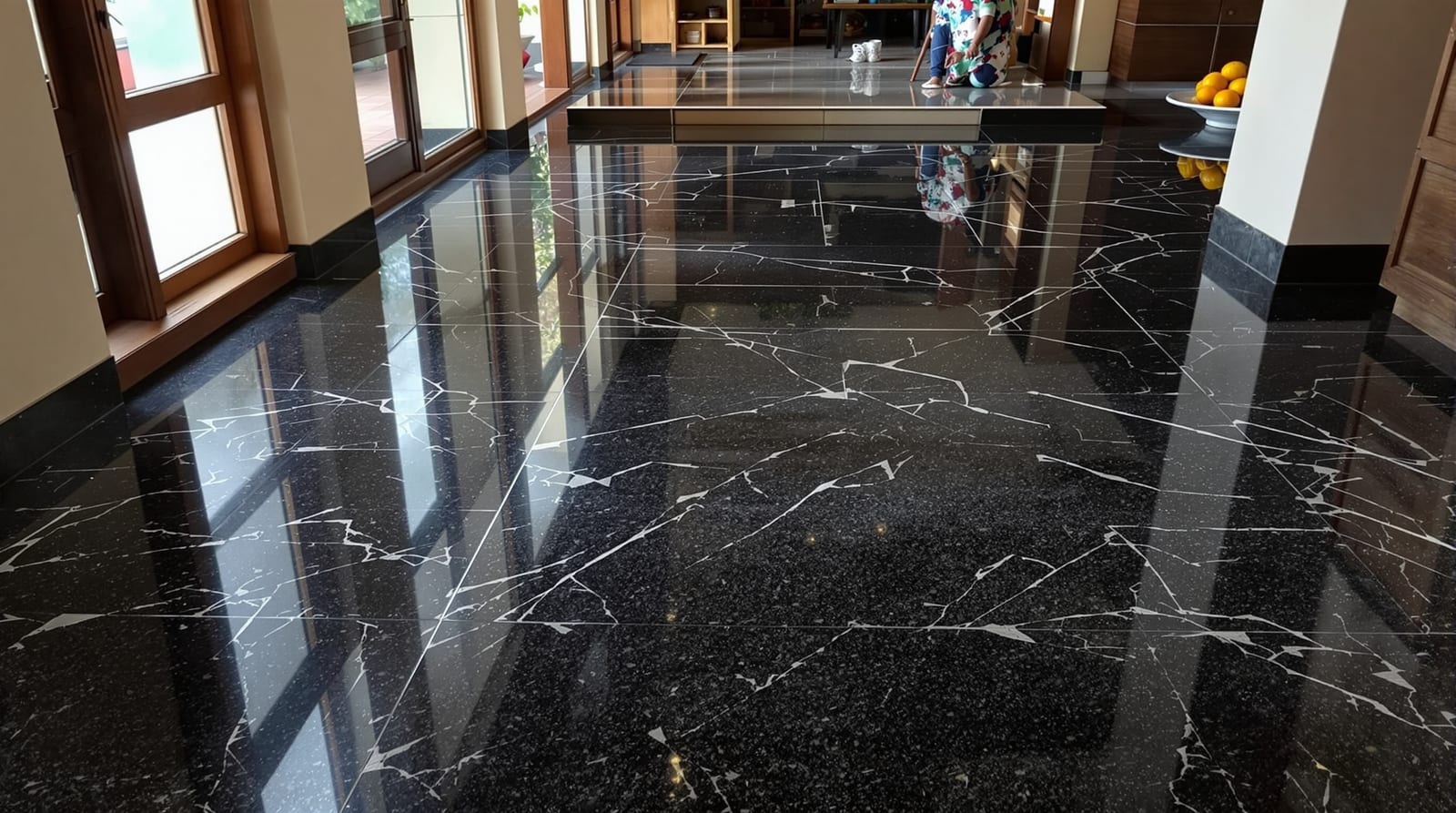
Kadappa Stone Guide: Andhra's Cheap Black Limestone for Floors, Stairs & Platforms (India)
What Kadappa (Cuddapah) black limestone costs, how it looks natural versus polished, why it is so dense, hard and budget-friendly, and where this South Indian stone works best in homes and commercial floors.
Walk through almost any older South Indian home, staircase or government building and the dark, faintly shiny treads underfoot are very likely Kadappa stone. Quarried around Cuddapah (now Kadapa) in Andhra Pradesh, this dense, near-black limestone has been the region's workhorse floor and stair material for generations precisely because it is hard, durable and astonishingly cheap. This guide explains how Kadappa looks natural versus polished, why it behaves the way it does, what it costs per square foot in 2026, where it shines and where it does not, and how to buy and care for it.
What Kadappa stone is
Kadappa stone — also spelt Cuddapah or Kadapa — is a fine-grained, compact limestone (sometimes described in the trade as a "lime-shale" or slatey limestone) from the Kadapa basin of Andhra Pradesh. Its defining trait is colour: a deep grey-black to almost jet-black body, occasionally with greenish or brown undertones, that reads as black from across a room. It splits and saws into flat slabs and tiles with naturally smooth faces, which is part of why it has always been cheap to produce.
Despite the name "limestone," Kadappa is far denser and harder than the soft, chalky limestone people picture. It is in the same family as the grey and yellow Tandur stone from Telangana and the blue-grey Kota stone of Rajasthan — all are dense calcareous flooring stones — but Kadappa is the darkest of the three and is prized specifically for its black colour. It sits within the wider story of regional flooring traditions in India, where each state has its signature local stone. Where it differs from those siblings is in how it is used: as much for stairs, shelving and platforms cut to size as for full floors.
How Kadappa looks: natural versus polished
The single biggest decision with Kadappa is finish, because it transforms the look completely. The stone is sold in two broad states and the price barely changes between them — what changes is the appearance and the upkeep.
Natural (matt) Kadappa is the raw sawn or honed face: a flat, dull, charcoal-to-black surface with a soft, almost slate-like character. It hides dust and minor scratches, gives reasonable grip underfoot, and is the traditional choice for stair treads, parking, pathways and utility floors. Polished Kadappa is machine-buffed to a deep, near-mirror shine that makes the stone look richly black, almost like a budget substitute for black granite or black marble. Polished surfaces look premium and are easy to wipe clean, but they show every smudge, scuff and water mark, and they become slippery when wet.
The diagram below contrasts the two finishes and what each implies.
A common middle path is a honed or "lapato" semi-matt finish that keeps some depth of colour without the full glare and slip risk of high polish — worth asking for in bathrooms and wet utility areas.
Properties: why Kadappa behaves the way it does
Kadappa's reputation rests on a simple combination: it is very hard, very dense and very cheap. The trade-off is a mild sensitivity to acids, which is normal for any limestone.
| Property | How Kadappa performs | What it means for you |
|---|---|---|
| Density / compactness | Very dense, fine-grained, low porosity | Low water absorption; resists dampness better than soft stone; heavy and solid underfoot |
| Hardness / durability | Hard, abrasion-resistant; takes heavy footfall | Excellent for stairs, parking and commercial floors; long service life |
| Colour | Deep grey-black to near-black, sometimes greenish tint | Dramatic dark floors and treads; hides dust well in matt finish |
| Acid sensitivity | Slightly acid-sensitive (it is a limestone) | Lemon, vinegar, tea, harsh acidic cleaners and toilet acids can etch or dull it — wipe spills fast |
| Slip (polished, wet) | Slippery when polished and wet | Use natural/honed finish on stairs, bathrooms and outdoor areas |
| Workability | Saws and cuts cleanly to size | Easy to fabricate into treads, risers, shelves, sills and platforms |
| Cost | Among the cheapest hard stones in India | Budget flooring and stairs without sacrificing durability |
Because Kadappa is a calcareous stone, it shares the same acid caution as marble and Kota stone: the surface can etch (lose its shine in a dull patch) if acidic liquids sit on it. This is cosmetic rather than structural, and a matt finish hides it far better than a polish. For everyday spills and care logic the granite floor care and marble polishing and care routines apply closely, since Kadappa sits between the two in behaviour.
Where Kadappa stone works best — and where it does not
Kadappa is unusually versatile for such a cheap stone, which is why it appears in so many roles across South Indian construction. The table maps finish to look to indicative installed cost to use.
| Use | Best finish | Look | Installed cost (indicative) | Notes |
|---|---|---|---|---|
| Staircase treads & risers | Natural / honed | Solid dark steps, grippy | ₹60–110 / sq ft | Classic South Indian use; hard-wearing, anti-slip |
| Indoor flooring (halls, passages) | Polished | Rich near-black floor | ₹70–130 / sq ft | Budget alternative to black granite; needs regular wiping |
| Kitchen platform / counter | Polished / honed | Dark worktop | ₹120–220 / running ft (slab) | Cheap but slightly acid-sensitive; granite is harder-wearing |
| Shelving / lofts / wardrobe slabs | Natural / honed | Thin strong shelves | ₹50–100 / sq ft | Cuts into long, load-bearing shelves cheaply |
| Parking / driveway | Natural (rough) | Matt grey-black | ₹50–90 / sq ft | Tough, anti-skid; popular for car porches |
| Window sills, thresholds, skirting | Honed / polished | Neat dark trim | priced by running ft | Easy to cut to size; durable edges |
| Bathrooms / wet floors | Honed / natural | Matt dark | ₹60–110 / sq ft | Use matt, not polish; seal; mind slip |
| Outdoor pathways, courtyards | Natural | Rugged dark paving | ₹50–90 / sq ft | Sealing recommended; weathers well |
Costs are material plus laying, indicative for 2026 and varying by city, finish, slab size and quantity; add 18% GST and transport, and confirm a written all-in rate before ordering.
Where Kadappa is the wrong choice: as a premium feature floor where a uniform, flawless black is expected (natural variation and the odd vein show), or as a kitchen platform in a heavy, acid-spilling kitchen where granite's superior hardness and stain resistance earn their extra cost — compare in granite flooring in India and the South India granite guide. For courtyards and pathways, more porous sandstone flooring in India is the warmer-toned alternative to dark Kadappa. For a light, airy room a dark floor can also feel heavy, so balance it with lighter walls and good lighting.
What Kadappa stone costs in 2026
Kadappa's headline appeal is price. As one of India's cheapest hard stones, material rates commonly run roughly ₹30–70 per square foot at the dealer for standard slabs and tiles, with thicker, larger or premium-select lots higher. Installed — material plus laying labour — most home floors and stairs land around ₹50–130 per square foot depending on city, finish and complexity.
Three things move the number. First, proximity to source: Kadappa is cheapest across Andhra Pradesh, Telangana, Karnataka and Tamil Nadu, where it is quarried and traded locally; ship it to Mumbai, Delhi-NCR or Kolkata and transport plus loading add meaningfully to the per-square-foot rate. Second, laying labour: metros such as Bangalore, Hyderabad and Chennai run higher mason rates than tier-2 towns, and stair work (treads, risers, nosing) costs more per square foot than flat floor laying because of cutting and fitting. Third, finish and thickness: mirror polishing and thicker structural slabs cost more than sawn matt tiles. Always compare an all-in figure — material plus laying plus polishing plus skirting plus transport plus GST — rather than the slab rate alone, exactly as set out in the broader flooring cost per square foot in India guide. You can sanity-check a quote with the flooring cost calculator.
Buying Kadappa stone well
Because natural stone in India carries no mandatory ISI mark — only voluntary IS specifications, as explained in natural stone standards in India — the inspection is on you. Kadappa is forgiving but a few checks prevent regret.
Inspect slabs in daylight for hairline cracks, soft seams, patches and uneven colour; sight along the face for warp or bowing. Tap-test for soundness — a dull thud instead of a clear ring can mean an internal crack. Confirm the finish you are paying for (natural, honed or polished) and the gauge: floor tiles around 15–20 mm, stair treads and platforms thicker. Ask whether the rate is per square foot for floors or per running foot for treads and counters, and get cutting-to-size, nosing and edge-polishing priced in writing.
Buy 5–10% extra from the same lot for cuts, breakage and future repairs, since shade can vary between lots. Insist on a GST invoice — natural stone slabs and tiles attract 18% GST — and an e-way bill for transported loads; this protects warranty, input credit and genuineness. For larger jobs, the slab-by-slab discipline in how to buy granite in India transfers directly to dark limestone. In the south, Kadappa is widely available through stone yards and granite dealers in and around Kadapa, Hyderabad, Bangalore and Chennai; buying near source is the surest way to keep the price low.
Caring for Kadappa stone
Kadappa is low-maintenance but not no-maintenance. Seal it after installation — a penetrating stone sealer — and reseal every couple of years, especially for polished, kitchen, bathroom and outdoor surfaces, to slow staining and etching. For daily cleaning, sweep or dust-mop, then damp-mop with plain water or a pH-neutral stone cleaner. Avoid acidic cleaners, vinegar, lemon, strong bathroom and toilet acids, and harsh scouring — acids etch limestone and abrasives scratch polish. Wipe spills, especially acidic or oily ones, promptly. Polished floors that have lost their shine in patches can be re-buffed by a stone polisher; matt floors hide wear and need far less fuss. The maintenance rhythm mirrors the wider floor cleaning guide for India and the resealing approach in floor resealing guide.
Frequently asked questions
Is Kadappa stone the same as Cuddapah stone?
Yes. Kadappa, Kadapa and Cuddapah all refer to the same dense black limestone quarried in the Kadapa (formerly Cuddapah) district of Andhra Pradesh. "Cuddapah stone" is the older colonial spelling and "Kadappa stone" the common trade name today. There is no quality difference implied by the spelling — it is one stone.
Is Kadappa stone good for kitchen platforms?
It can be — polished Kadappa is a cheap, dark, dense worktop and is widely used. The caveat is that, being a limestone, it is slightly acid-sensitive, so lemon, vinegar, tamarind and acidic cleaners can etch the shine over time, and it is softer than granite. Seal it, wipe spills fast, and if you cook heavily with acids, granite is the more robust choice.
How much does Kadappa stone cost per square foot in India?
In 2026, material rates commonly run roughly ₹30–70 per square foot at the dealer, and installed (material plus laying) most home floors and stairs land around ₹50–130 per square foot, depending on city, finish, thickness and quantity. It is among the cheapest hard stones in India. Add 18% GST and transport, and always confirm an all-in written rate.
Is Kadappa stone slippery?
Polished Kadappa becomes slippery when wet, so it is unsuitable as a high-gloss finish on stairs, bathrooms and outdoor areas. The natural matt or honed finish gives much better grip and is the traditional choice for treads, parking and wet zones. Match the finish to the location rather than polishing everything for looks.
How is Kadappa different from Kota and Tandur stone?
All three are dense calcareous flooring stones, but the colour and region differ. Kota stone (Rajasthan) is blue-grey to greenish-brown; Tandur stone (Telangana) is grey, yellow or blue; Kadappa (Andhra Pradesh) is the darkest, a near-black limestone prized for that black colour and heavily used for stairs, shelving and platforms as well as floors.
Export this guide
Related Guides — Deep-dive reading
Limestone Flooring India: Honed Matte Stone, Colours, Cost and Care
The soft sedimentary stone family — beige, grey, blue and cream limestone with an elegant honed matte look, cool underfoot — plus its porosity, sealing needs, ₹/sq ft cost and where it suits Indian homes.
Flooring & SurfacesFlooring Cost Comparison Across Indian Cities 2026: Installed ₹/Sq Ft by Material
A single cross-city reference comparing installed flooring rates across Mumbai, Delhi-NCR, Bangalore, Hyderabad, Chennai, Pune, Kolkata, Ahmedabad and Jaipur — vitrified, granite, marble, wood/laminate and vinyl, plus laying labour — and why each city differs.
Flooring & SurfacesTandur Stone Guide: Telangana's Affordable Grey & Yellow Limestone Flooring (India)
What Tandur stone costs, how its grey, yellow and blue shades look, and where this dense, cool, anti-skid limestone works best in Indian homes and commercial floors.
Flooring & SurfacesRelated Tools — Try Free
Flooring Cost Calculator
Estimate the all-in cost of a floor — material, laying, wastage, skirting and GST — by area and material.
Flooring CalculatorGranite Flooring Cost Calculator
Estimate installed granite-floor cost — material, cutting, laying, polishing, sealing, wastage and GST.
Flooring CalculatorStamp Duty Calculator — All Indian States
Stamp duty + registration charges for all 28 states and 8 UTs — gender concessions, urban/rural variants, metro cess built in.
Stamp Duty