
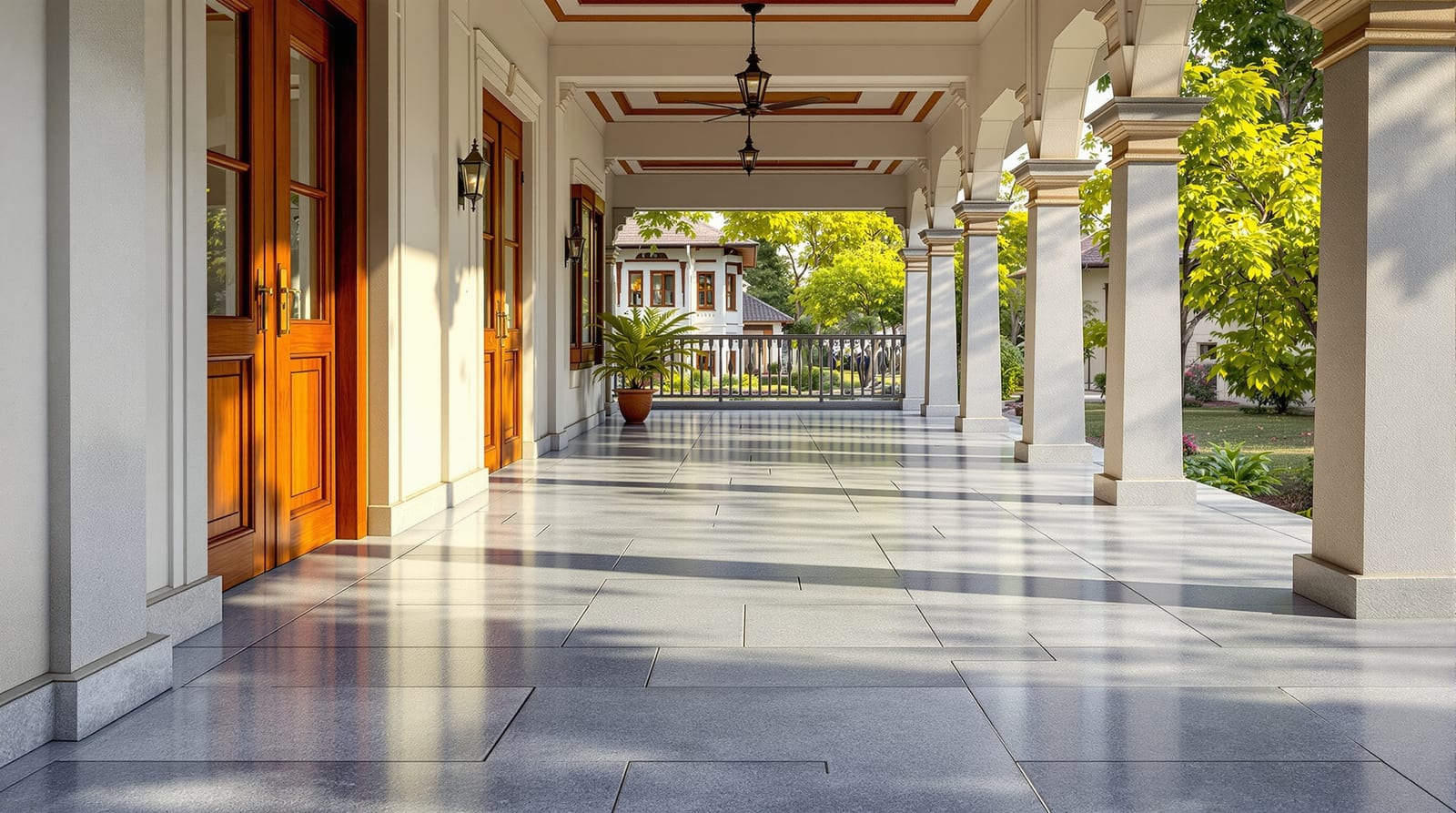
Shahabad Stone Flooring India: Grey-Blue Karnataka Limestone, Finishes, Cost and Care
The dense grey-blue limestone from Shahabad in Gulbarga, Karnataka — the budget workhorse floor of Maharashtra and Karnataka homes, verandahs, stairs and temples — its natural matte anti-skid look, polished black-ish finishes, ₹/sq ft cost, sizes, sealing and where it suits.
If you have walked across a verandah in Pune, climbed a flight of stairs in Belagavi, or stood in a village temple in north Karnataka, you have almost certainly walked on Shahabad stone without knowing its name. This dense grey-blue limestone, quarried around the town of Shahabad in the Kalaburagi (Gulbarga) district of Karnataka, is the quiet budget workhorse of west and south Indian floors — cheap, cool underfoot, hard-wearing, and naturally anti-skid in its rough state. It does not photograph as glamorous, yet it has outlasted countless trendier floors for generations.
This guide explains what Shahabad stone actually is, how its four common finishes change its look and price, where it works best, and how to buy and care for it so it serves you for decades.
What Shahabad stone is
Shahabad stone is a sedimentary limestone — calcium-carbonate rock laid down in flat beds, which is why it splits naturally into broad, thin slabs ideal for flooring. It is named after Shahabad town in Karnataka, the heart of its quarry belt, and is closely related to other Deccan limestones such as Tandur (Telangana) and Kadappa (Andhra Pradesh). In the trade it is sometimes simply called "Shabad" stone or grey limestone.
Its natural colour ranges from a soft dove grey through grey-blue to a darker slate-grey, occasionally with faint lighter veining or fossil specks. When polished hard it darkens to a near-black, glassy grey-blue that many mistake for a dark granite at a distance. It is dense and reasonably hard for a limestone, which is what gives it its durability — but it is still a limestone, meaning it is porous and sensitive to acids (lime juice, vinegar, toilet cleaners, cola), so it benefits from sealing.
Because it is sold in calibrated tiles and large slabs alike, and because the same quarry feeds both rough rural verandahs and polished urban living rooms, Shahabad is unusually versatile across budgets.
The look: finishes and what they do
The single biggest decision with Shahabad is the finish, because it transforms both the appearance and the price of the same stone. The rough quarry surface is matte and grippy; the more you grind and polish, the darker, smoother and more formal it becomes — and the more slippery when wet.
Natural / shahabad rough
The stone as it splits from the bed, with a slightly textured matte grey surface. This is the cheapest, most rustic and most anti-skid version — the classic choice for verandahs, parking, ramps and rural courtyards. Outdoors and in monsoon-prone west India, this grip is a genuine safety feature, not a compromise.
Honed / lapato (semi-matte)
Ground flat to an even, smooth-but-not-shiny grey surface. Modern and understated, it keeps reasonable grip while losing the rough texture. Increasingly popular in contemporary homes that want a calm, minimalist stone floor.
Polished
Machine-polished to a satin-to-glossy sheen that deepens the colour to a rich dark grey-blue. This is the "living room" finish — elegant and easy to mop — but it is slippery when wet, so keep it to dry interior areas.
Mirror / full polish
The highest gloss, taking the stone to an almost black, reflective surface resembling dark granite. Used for feature floors, temple sanctums and showpiece spaces. Most expensive of the four, and the slipperiest, so it is strictly for dry indoor use.
Finish, look, cost and best use
Prices below are indicative India ranges for 2026, material only (laying, polishing on site and 18% GST extra), and vary by city, quarry quality, slab size and finish:
| Finish | Look | Cost (₹/sq ft) | Best use |
|---|---|---|---|
| Natural / rough | Textured matte grey, grippy | 35 to 50 | Verandah, parking, ramps, rural courtyards, stairs |
| Honed / semi-matte | Smooth flat grey, understated | 45 to 65 | Modern interiors, passages, balconies, bathrooms (sealed) |
| Polished | Satin dark grey-blue, refined | 55 to 80 | Living rooms, bedrooms, dry interior floors |
| Mirror / full polish | Glossy near-black, reflective | 70 to 90 | Feature floors, temples, showpiece spaces |
On-site machine polishing and edge cutting typically add ₹15 to ₹40 per sq ft over the rough material, which is why a "polished Shahabad floor" laid and finished commonly lands at ₹90 to ₹140 per sq ft all-in. Even so, it remains one of the cheapest natural stone floors in India — well below granite or marble — which is its enduring appeal. Use the Studio Matrx flooring cost calculator and natural stone slab calculator to estimate your job, and our floor polishing cost calculator for the polishing line item.
Properties at a glance
What makes Shahabad a workhorse rather than just a cheap floor:
- Dense and durable. Harder and less porous than many limestones, it shrugs off foot traffic for decades — which is why old Maharashtra and Karnataka houses still have their original Shahabad floors.
- Cool underfoot. Like all stone it stays cool in summer, a real comfort in the hot, dry interiors of the Deccan plateau.
- Naturally anti-skid (rough finish). The riven matte surface grips well even when wet, making it a top pick for verandahs, stairs, ramps and bathrooms — see our guide on anti-slip flooring for wet areas.
- Budget-friendly. Among the lowest cost-per-sq-ft of any natural stone in India.
- Porous and acid-sensitive. Being limestone, it stains and etches if left unsealed and exposed to acids or oils; sealing solves most of this.
- Low colour variety. It is essentially a grey stone — you choose finish and sheen, not colour. For warmer or more decorative floors, look at Kota stone (greenish/blue) or sandstone.
How the finish changes the surface
The diagram below shows the same stone taken through three finishes — and why grip falls as gloss rises:
Sizes and how it is sold
Shahabad is sold in three broad formats:
- Random / crazy slabs: large irregular pieces straight from the bed, laid as random paving for verandahs, courtyards and parking. Cheapest, most rustic, minimal cutting waste.
- Cut-to-size tiles: calibrated rectangles and squares — common sizes 1x1 ft, 2x2 ft, 1x2 ft and bespoke cuts — for neat interior floors and skirtings.
- Large slabs / strips: long pieces used for stair treads, risers, window sills, kitchen platforms and bench tops, where a single unbroken length looks best.
Thickness usually runs 20 to 40 mm; thicker pieces are chosen for stairs, parking and high-load areas. For stairs in particular, Shahabad is a regional default — durable, cool, and available in long single treads.
Where Shahabad suits — and where it does not
It excels in:
- Verandahs and porches — the natural rough finish is grippy and weatherproof.
- Stairs and steps — long durable treads, cool and slip-resistant.
- Parking and driveways — random slabs take vehicle loads cheaply.
- Kitchens — both as floor and as a budget platform/countertop slab (seal well against oil and acid).
- Temples and prayer rooms — the polished near-black finish suits sanctums; widely used across Karnataka and Maharashtra.
- Bathrooms and balconies — honed or rough finish for grip (sealed).
- Commercial lobbies, schools, institutional floors — cheap, tough, low maintenance.
It is less ideal where you want a warm, light or colourful floor, a high-gloss showroom marble look, or a perfectly uniform tone — Shahabad is honest, grey and slightly variable. For glossy luxury, see marble flooring; for a similar-but-different Deccan look, compare Tandur stone and Kadappa stone, and for the whole regional craft picture read regional flooring traditions of India.
Shahabad vs its Deccan cousins
| Stone | Typical colour | Cost (₹/sq ft) | Note |
|---|---|---|---|
| Shahabad (Karnataka) | Grey to grey-blue | 35 to 90 | Densest, most anti-skid rough finish; verandah/stairs favourite |
| Tandur (Telangana) | Blue-grey, yellow | 35 to 100 | Similar limestone; lapato finish popular in modern homes |
| Kadappa (Andhra) | Black to dark grey | 30 to 80 | Darker, used for slabs/platforms and cladding |
| Kota (Rajasthan) | Greenish, blue, brown | 40 to 90 | Greener tone, the national budget stone benchmark |
These four cover most of India's budget natural-stone flooring. Shahabad's edge is its dense, grippy rough finish and its strong regional supply chain in Maharashtra and Karnataka, which keeps it cheap there. For a full map of alternative and specialty floors beyond the mainstream, start with our specialty flooring guide, and for the limestone family overview see limestone flooring in India.
Care and sealing
Shahabad is low-maintenance but not no-maintenance, because it is a limestone:
- Seal it. Apply a penetrating natural-stone sealer after laying, especially on rough and honed finishes and in kitchens, bathrooms and outdoors. Reseal every one to three years depending on traffic — see our floor resealing guide.
- Clean gently. Mop with plain water or a pH-neutral stone cleaner. Never use acidic cleaners, harsh toilet acid, or strong descalers — they etch and dull the surface.
- Wipe spills fast. Lime, vinegar, cola, wine and oil can stain or etch unsealed stone; blot quickly.
- Refresh the polish. Polished floors can be re-buffed by a stone polishing crew every few years to restore sheen.
- Mind the wet grip. On polished Shahabad in wet zones, use mats; reserve the rough or honed finish for areas that get wet. Our floor cleaning guide covers routine upkeep.
Buying tips
- Buy from the right belt. Karnataka and Maharashtra yards (and dealers sourcing from the Shahabad / Kalaburagi quarries) give the best price and selection; freight raises the cost the further you go.
- Inspect for cracks and bedding lines. Tap slabs to check they ring solid; reject pieces with hairline cracks or weak bedding planes that may split underfoot.
- Confirm thickness for use. Insist on thicker slabs (30 to 40 mm) for stairs, parking and platforms.
- Decide finish before you buy. Rough is cheapest and grippiest; budget for on-site polishing if you want the dark satin look, and factor that into your total.
- Order 8 to 10 percent extra for cuts, breakages and future repairs, since exact shade and quarry batch can be hard to re-match later. Our how to choose flooring guide helps weigh it against other options.
Frequently asked questions
Is Shahabad stone good for flooring?
Yes. It is a dense, durable, cool limestone that has been a trusted floor across Maharashtra and Karnataka for generations. It is cheap, hard-wearing, and naturally anti-skid in its rough finish, making it excellent for verandahs, stairs, parking and everyday interiors. Its main caveat is that it is porous and acid-sensitive, so it should be sealed.
What is the cost of Shahabad stone flooring in India?
Material costs roughly ₹35 to ₹90 per sq ft in 2026 depending on finish — around ₹35 to ₹50 for the natural rough finish and ₹70 to ₹90 for mirror polish. Laying, on-site polishing and 18% GST are extra, so a fully laid and polished floor commonly works out to ₹90 to ₹140 per sq ft. Ranges are indicative and vary by city and vendor.
What is the difference between Shahabad stone and Kota stone?
Both are budget Indian limestones. Shahabad is from Karnataka and is essentially grey to grey-blue, with a very grippy natural finish prized for verandahs and stairs. Kota is from Rajasthan and tends to be greenish, blue or brown. Kota is the more widely distributed national benchmark, while Shahabad dominates locally in Maharashtra and Karnataka where it is cheapest.
Is Shahabad stone slippery?
In its natural rough finish, no — it is one of the more anti-skid stone floors and is genuinely safe for wet verandahs and stairs. Once polished or mirror-finished it becomes slippery when wet, so reserve those high-gloss finishes for dry indoor areas and use the rough or honed finish wherever water is present.
Does Shahabad stone need sealing?
Yes. As a limestone it is porous and can stain or etch from oils and acids if left bare. A penetrating natural-stone sealer applied after laying, and re-applied every one to three years, keeps it stain-resistant and easy to clean while preserving its natural look.
Export this guide
Related Guides — Deep-dive reading
Kadappa Stone Guide: Andhra's Cheap Black Limestone for Floors, Stairs & Platforms (India)
What Kadappa (Cuddapah) black limestone costs, how it looks natural versus polished, why it is so dense, hard and budget-friendly, and where this South Indian stone works best in homes and commercial floors.
Flooring & SurfacesLimestone Flooring India: Honed Matte Stone, Colours, Cost and Care
The soft sedimentary stone family — beige, grey, blue and cream limestone with an elegant honed matte look, cool underfoot — plus its porosity, sealing needs, ₹/sq ft cost and where it suits Indian homes.
Flooring & SurfacesTandur Stone Guide: Telangana's Affordable Grey & Yellow Limestone Flooring (India)
What Tandur stone costs, how its grey, yellow and blue shades look, and where this dense, cool, anti-skid limestone works best in Indian homes and commercial floors.
Flooring & SurfacesRelated Tools — Try Free
Flooring Cost Calculator
Estimate the all-in cost of a floor — material, laying, wastage, skirting and GST — by area and material.
Flooring CalculatorWindow Cleaning Cost Calculator
Estimate professional window cleaning cost per visit and per year by access and frequency.
Window CalculatorFull-Room BOQ — Living, Bedroom, Kitchen, Bath
Room-wise BOQ across living, bedrooms, kitchen, utility, and bathrooms with line-item pricing.
Full-Room BOQ