
Traditional Indian Flooring: Regional Crafts, Looks, Prices & Revival (2026)
A cultural and practical tour of India's regional handmade floors — Athangudi tiles, red-oxide and IPS, Shahabad stone, mosaic terrazzo, araish lime and mud — with how they look, what they cost per square foot, why they are reviving and how to specify them today.
Long before Morbi pressed its first vitrified tile, Indian floors were made by hand, on site, from earth, lime, cement and pigment by craftspeople who treated the floor as a canvas. These regional traditions — Athangudi tiles from Chettinad, the seamless red-oxide and IPS floors of the south and west, Shahabad stone, the mosaic terrazzo legacy, Rajasthani araish lime and the humble mud-and-cow-dung floor — are not museum pieces. They are quietly reviving in 2026 because they are cooling underfoot, low in embodied carbon, full of character, and often cheaper than the imported alternatives people assume are superior. This guide is a tour of where each tradition comes from, how it looks, what it costs per square foot, and how to actually get one laid in your home today.
Why traditional Indian floors are coming back
Three forces are pulling these crafts off the heritage shelf. The first is climate: lime, oxide and stone floors stay genuinely cool in summer because they are dense and store little heat, which matters as cooling bills climb — the same physics covered in flooring thermal comfort in India. The second is ecology: a red-oxide or araish floor is mostly local mineral with almost no firing energy, the lowest-impact end of sustainable flooring materials in India and a natural fit for anyone counting flooring embodied carbon in India. The third is character: a handmade floor has tonal variation, slight unevenness and a depth of finish that a machine-pressed tile cannot fake, which is exactly why architects pair these surfaces with mid-century and vernacular interiors.
There is a catch that runs through every tradition below: they are skill-dependent and slow. The material is cheap; the craftsperson is the cost and the constraint. A vitrified floor is a product you buy off a shelf. A traditional floor is a service performed by a shrinking pool of artisans, and the difference between a glorious floor and a blotchy one is entirely in their hands.
The traditions at a glance — region, look, price, modern use
The table below is the heart of this guide. Prices are all-in installed, indicative for 2026 and vary by city, artisan availability and finish; add 18% GST on materials and works-contract labour where billed formally, though much of this work is still done by individual craftsmen on cash or simple contracts.
| Tradition | Heartland region | Look & feel | Installed cost (₹/sq ft) | Best modern use |
|---|---|---|---|---|
| Athangudi handmade cement tiles | Chettinad, Tamil Nadu | Vivid geometric & floral patterns, matte sheen, slightly soft underfoot | 90 to 200+ (pattern-dependent) | Living rooms, foyers, boutique hotels, accent borders |
| Red-oxide / IPS floor | Kerala, Karnataka, Maharashtra | Seamless warm terracotta-red or cool grey-green, hand-polished glow | 80 to 180 | Living, bedrooms, verandas, cafes, studios |
| Shahabad stone | Shahabad belt, Karnataka | Honest grey/blue-grey limestone, matte or honed, rustic | 60 to 140 | Kitchens, courtyards, utility, rustic interiors |
| Mosaic terrazzo (in-situ) | Pan-India (Maharashtra, Gujarat) | Chips of marble/granite in cement, polished | 90 to 220 | Living areas, stairs, heritage restorations |
| Araish / lime plaster floor | Rajasthan, Gujarat | Buttery, polished lime, soft pastel or natural off-white | 200 to 500+ (very skilled) | Premium living rooms, heritage homes, spas |
| Mud / cow-dung / lippan floor | Rural pan-India, Kutch | Earthen, warm, breathable, periodically re-applied | 20 to 80 | Farmhouses, eco-homes, rural and semi-rural builds |
Two reference points help you read these numbers. A plain vitrified-tile floor lands roughly in the same band as Athangudi or oxide once you add laying and adhesive, so traditional is not automatically the premium choice — see tile flooring cost in India. And in-situ mosaic terrazzo overlaps heavily with its modern descendants, which is why the dedicated terrazzo flooring in India guide is worth reading alongside this section.
Athangudi tiles — Chettinad's painted floors
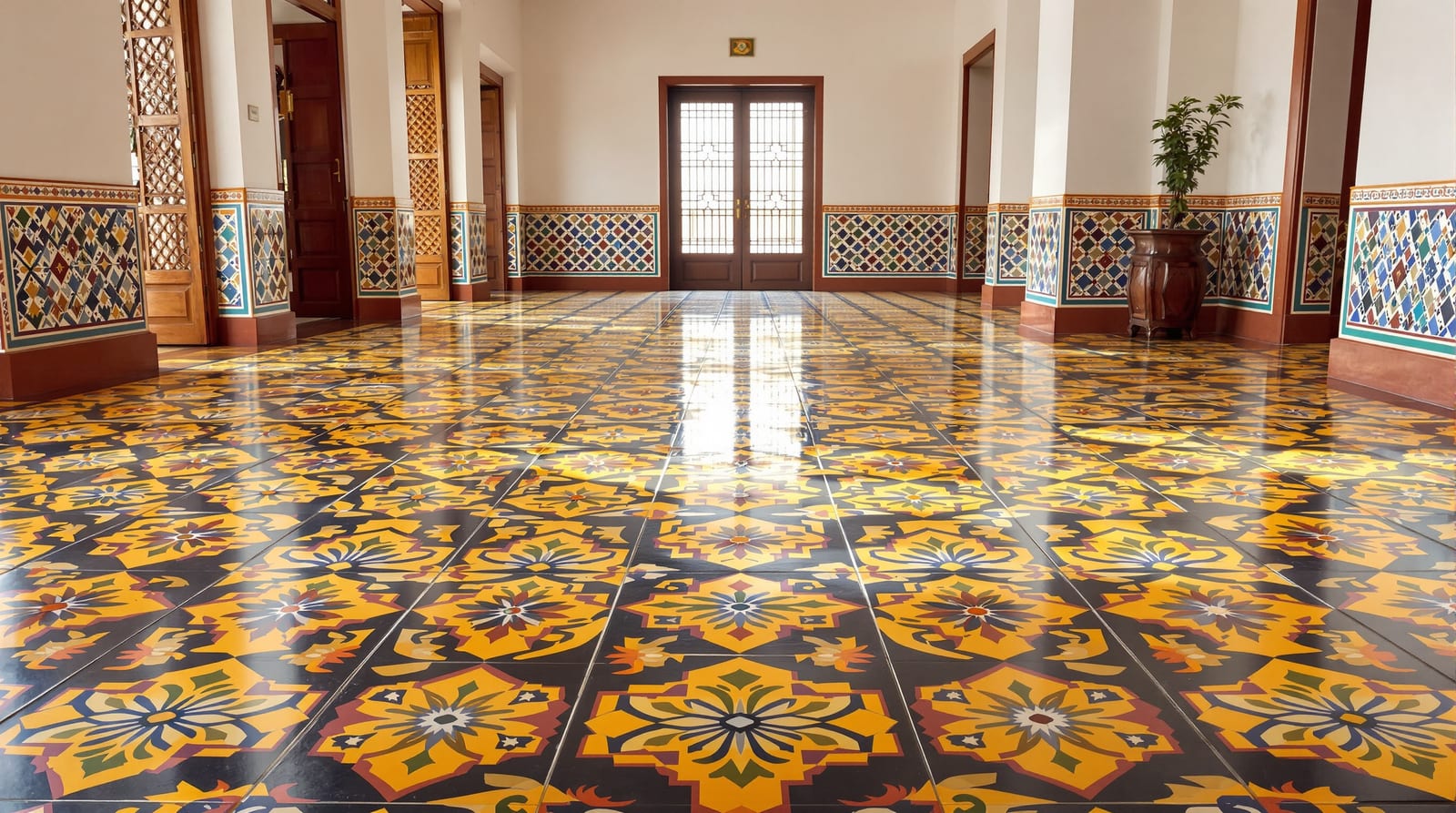
Athangudi tiles are named for a village near Karaikudi in the Chettinad region of Tamil Nadu, where the local soil, sand and a tradition of mansion-building by the Nattukottai Chettiar merchant community produced one of India's most distinctive handmade floors. Each tile is made on a glass plate: coloured cement slurry is poured into a thin metal stencil to form the pattern, backed with grey cement and sand, then cured in water. When the tile is lifted off the glass it carries a naturally smooth, glassy face — no firing, no machine pressing.
The signature is colour and geometry — ochre, oxide-red, indigo, mustard and emerald in repeating florals, diamonds and borders. Because the tiles are hand-cast they vary slightly in tone and size, which reads as warmth rather than defect. They are softer than vitrified tiles and can wear or chip at edges in very heavy traffic, so they suit living rooms, pooja rooms, foyers and hospitality interiors rather than a busy commercial entrance. Buy 10 to 15% extra from the same batch, because re-ordering a matching lot later is genuinely hard. Real Athangudi tiles still come mostly from the Karaikudi cluster; "Athangudi-style" tiles made elsewhere can be thinner and less true to the craft, so ask where they were cast.
Red-oxide and IPS floors — the seamless south and west
Red-oxide flooring (often called oxide floor) and IPS — Indian Patent Stone — are close cousins and India's great seamless tradition. IPS is a site-cast cement floor laid in panels divided by glass or aluminium strips; when iron-oxide pigment is mixed into the top layer and hand-polished, you get the warm terracotta-red oxide floor of Kerala homes, the cool grey-green oxide of Karnataka and the practical IPS of Maharashtra and beyond. There is no grout, no joints, no tiles — just one continuous, hand-trowelled, hand-rubbed surface that ages into a deep, soft glow.
The look is its whole appeal: monolithic, calm, slightly mottled, cool to the touch and almost impossible to replicate with a manufactured product. Done well it is also extremely durable and easy to clean. But it is unforgiving of poor workmanship — cracks at panel edges, blotchy pigment and a dull finish all come from a rushed or unskilled hand and curing. Insist on proper panelling, slow curing under wet cloth, and several rounds of hand-polishing. Modern microcement is the contemporary, more crack-resistant interpretation of this seamless aesthetic; if you love the oxide look but want a thinner overlay on an existing floor, compare it with microcement flooring in India. Oxide and IPS also belong firmly in the low-impact, locally sourced category of eco-friendly flooring in India.
Shahabad stone — the honest grey workhorse
Shahabad stone is a fine-grained grey to blue-grey limestone quarried around the Shahabad belt in Karnataka (and traded heavily into Maharashtra). It is one of India's most under-rated traditional floors: cheap, tough, naturally non-slip when left matte, and full of rustic character. For generations it has paved kitchens, courtyards, washing areas and verandas across the Deccan because it shrugs off water and heavy use.
It comes in rough (natural cleft), honed and polished finishes. Rough Shahabad is grippy and ideal for wet and outdoor areas; honed gives a smoother, more refined matte; polished can mimic a darker limestone but loses some of the slip-resistance. It is porous, so it benefits from sealing in stain-prone zones, and its colour deepens with use and oil. Because it shares the limestone family with Kota stone, the two are often compared — if you are weighing a budget natural stone, read Kota stone flooring in India alongside this, as Kota is the more widely distributed cousin with a similar honest-grey character.
Mosaic terrazzo — the in-situ chip floor
Before machine-made tiles, the polished chip floor was laid in situ: marble and granite chips broadcast into a cement bed, then ground and polished to a smooth speckled surface, divided into panels by metal or glass strips exactly like IPS. This is the true terrazzo of old Indian schools, banks, government buildings and bungalows, and it is enjoying a strong revival for its mid-century look and seamless durability. The craft of grinding and polishing on site is the constraint; the materials are humble. Because the modern, slab-form and large-format versions deserve their own treatment, the dedicated terrazzo flooring in India guide covers product options, while this entry is about the hand-laid in-situ heritage version.
Araish, lime and the buttery polished floor
Araish (also called aaraish or marble-dust lime plaster) is the aristocrat of traditional Indian surfaces — a Rajasthani and Gujarati lime-and-marble-powder technique, related to the wall finishes of palaces and havelis, that can be taken down onto floors as a buttery, polished, almost waxy surface in soft off-whites and pastels. It is built up in fine layers, burnished with stone or agate, and finished with soap or wax to a low sheen. It is breathable, naturally antibacterial and stunning — and the most demanding and expensive tradition here, entirely dependent on a master craftsman, which is why it sits at the top of the price table and is reserved for premium living rooms, heritage restorations and spas.
Lime floors, more broadly, are the original eco-floor: low embodied energy, breathable, and able to absorb and release moisture. They are softer and more maintenance-intensive than cement, so they reward owners who appreciate patina over perfection.
Mud, cow-dung and lippan — the rural foundation
The most widespread traditional floor in India is also the simplest: rammed earth or mud plaster, often finished with a thin cow-dung wash that the household re-applies. It is cool, breathable, repairable with a handful of mud, costs almost nothing, and in Kutch is elevated into the mirror-and-clay lippan craft. It is dismissed as primitive but is in fact a near-zero-carbon, fully circular floor. Its limits are honest — it needs periodic re-coating, is not suited to wet areas without protection, and demands acceptance of an earthen, living surface — but for farmhouses, eco-homes and semi-rural builds it is unmatched on sustainability. This is the deep root of India's vernacular architecture tradition of building with what the site provides; where mud meets contemporary low-impact construction, it sits beside the bamboo, cork and reclaimed options in the broader sustainable-flooring family.
A note on how an Athangudi tile is built
The diagram below shows why an Athangudi tile looks the way it does: the pattern lives in a thin coloured-cement face cast against glass, which is what gives it that smooth, slightly glassy sheen without any firing.
How to specify a traditional floor today
These floors fail on workmanship, not material, so your specification is mostly about finding and protecting the craft. A few rules carry across all of them. First, see real work before you commit — ask any artisan for completed floors you can walk on, ideally a few years old, because patina and crack behaviour only show with age. Second, agree the sample and the finish in writing: shade, sheen, panel layout and joint strips for oxide and terrazzo; pattern and batch for Athangudi; burnish level for araish. Third, respect curing time — seamless cement floors crack when rushed, and lime floors need days, so do not let a schedule compress the craft. Fourth, get spare material: extra Athangudi tiles from the same lot, and the same pigment batch for oxide patch-repairs.
On cost and billing, treat the artisan's labour as the real line item, not the cheap raw material. For formal projects you will pay 18% GST on works-contract labour and on cement and pigments; for small jobs much of this trade still runs on individual contractors, so put the scope and finish in a simple written agreement even if there is no tax invoice. When you compare a traditional floor against a conventional one, compare all-in installed rupees per square foot including polishing and curing, exactly as you would for any floor — the discipline in how to choose flooring in India applies here too. Done with the right hands, a traditional Indian floor is not a nostalgic indulgence; it is a cool, low-carbon, deeply characterful surface that often beats the imported alternative on both feeling and footprint.
Frequently asked questions
Are traditional Indian floors cheaper than vitrified tiles?
Often, but not always. Red-oxide, Shahabad stone and mud floors can undercut a good vitrified-tile floor, while araish lime and intricate Athangudi patterns can cost more. The material is usually cheap; the skilled labour and slow curing are what move the price. Always compare all-in installed rupees per square foot, including polishing, not just the headline material rate.
Do red-oxide and IPS floors crack?
They can, and almost always because of rushed work. Proper panelling with glass or aluminium dividing strips, a sound base, slow curing under wet cloth and patient hand-polishing prevent most cracks. Hairline crazing within a panel is part of the handmade character; structural cracks across panels signal poor base preparation or curing.
Where can I find artisans for these floors?
Athangudi tiles come from workshops around Karaikudi in Chettinad, Tamil Nadu, and are shipped nationwide. Oxide and IPS masons are common across Kerala, Karnataka and Maharashtra; Shahabad stone fitters work across the Deccan; araish craftsmen are concentrated in Rajasthan and Gujarat. Architects working in vernacular and sustainable styles usually keep contacts, and heritage-restoration firms are another reliable route.
Are these floors a good fit for modern apartments?
Yes, with judgement. Seamless oxide, IPS, in-situ terrazzo and Athangudi accents all work beautifully in apartments and suit contemporary and mid-century interiors. The constraints are weight and wet areas: confirm load and waterproofing for any thick site-cast floor, and keep mud and unsealed lime out of bathrooms. For wet zones, a sealed Shahabad or a modern overlay like microcement is the safer choice.
How do these floors compare on sustainability?
Very well. Mud, lime and oxide floors are among the lowest-embodied-carbon surfaces available because they are largely local minerals with little or no firing energy, and they are repairable rather than disposable. They sit at the green end of the spectrum alongside the options covered in our sustainable-flooring and eco-friendly-flooring guides, and are a natural choice for anyone designing for thermal comfort and a low footprint.
Export this guide
Related Guides — Deep-dive reading
Epoxy Grout vs Cement Grout for Tiles in India: Which to Specify (2026)
A plain-English guide to tile grouts for Indian homes: what grout does, how cementitious grout compares with epoxy grout on cost, stain and water resistance, hygiene and durability, and exactly where each one belongs - kitchens, bathrooms, pools, dry rooms and more.
Building MaterialsAthangudi Tiles in India: Handmade Chettinad Cement Tiles, Patterns, Cost & Care
Vivid, one-of-a-kind handmade cement tiles from Athangudi village in Chettinad, Tamil Nadu — poured by hand onto patterned glass plates, sun-and-water cured, cool underfoot — here is how they are made, the bold floral and geometric patterns, costs of ₹80–250 per sq ft, laying, sealing and the coconut-oil care.
Flooring & SurfacesRammed Earth Construction in India: A Guide to Compacted Earth Walls (2026)
What rammed earth is, its deep Indian and global tradition, and why architects are reviving it - superb thermal mass, low embodied carbon, a beautiful stratified natural finish, and honest limits around labour, formwork, wall thickness and erosion. A specify-and-select guide.
Building MaterialsRelated Tools — Try Free
Flooring Cost Calculator
Estimate the all-in cost of a floor — material, laying, wastage, skirting and GST — by area and material.
Flooring CalculatorHome Building & Interior Cost Calculator — 20 Cities
Construction + interior costs for 20 Indian cities across kitchen, wardrobes, flooring, painting, ceiling.
Cost CalculatorFull-Room BOQ — Living, Bedroom, Kitchen, Bath
Room-wise BOQ across living, bedrooms, kitchen, utility, and bathrooms with line-item pricing.
Full-Room BOQ