

Lake Rejuvenation Using Treated STP Water: Standards, Risks & Success Factors
How treated sewage is being used to revive India's dying urban lakes — the water quality it must meet, the eutrophication trap that sinks careless projects, and what separates a rejuvenation that lasts from one that turns green in a month.
India's cities are ringed by lakes that were once drinking-water sources and are now, in many places, little more than open sewers. Bengaluru alone has watched hundreds of its historic tanks shrink, foam and catch fire. The uncomfortable truth behind the decline is simple: the sewage that used to poison these lakes is also, once cleaned, the only reliable water available to refill them. Rainfall is seasonal; groundwater is falling; the one flow that runs 365 days a year is a city's own wastewater. Lake rejuvenation using treated water turns that liability into the feedstock for revival — but only if the treatment is good enough, and only if the project respects the one risk that sinks careless schemes: nutrients.
A lake does not care how clean your effluent looks. It cares about nitrogen and phosphorus. Feed it clear water that still carries nutrients and you have not rejuvenated a lake — you have built a very efficient algae farm.
Why treated water, and why now

A healthy urban lake needs a steady inflow to stay alive — to dilute pollutants, sustain dissolved oxygen and keep the water body from stagnating. Historically that came from rain and connected upstream tanks. Encroachment, silted feeder channels and hard urban catchments have cut those flows off. Meanwhile the same catchment now generates enormous volumes of sewage.
The circular logic is compelling. Instead of discharging treated effluent into a drain where it becomes someone else's problem, a city can route it — after adequate treatment — into a lake, where it:
- Restores the water level and revives the surface area lost to drying.
- Sustains a continuous inflow that keeps the lake oxygenated and flowing rather than stagnant.
- Recharges groundwater around the lake as water percolates through the bed.
- Rebuilds habitat for birds, fish and the wider ecosystem.
This is the same reuse logic that underpins treated water for landscape irrigation and groundwater recharge, scaled up to an entire water body. It is one of the highest-value uses in the urban water circular economy — and one of the most unforgiving of shortcuts.
The standard is different — and stricter
Here is what catches many developers and even municipal engineers off guard: the quality bar for putting water into a lake is not the same as the bar for flushing toilets. Most on-site reuse — flushing, gardening, cooling towers — cares mainly about BOD, TSS and disinfection. A lake cares about all of that plus nutrients, because a lake is a living system that will amplify whatever you feed it.
Discharge to surface water bodies in India is governed by CPCB and state pollution-control-board norms, and for a sensitive receiving water like a lake the tighter end of those norms applies. The parameters that actually decide success are these:
| Parameter | Typical target for lake inflow | Why it is decisive |
|---|---|---|
| BOD | ≤ 10 mg/L | Residual organic load consumes the lake's dissolved oxygen and causes fish kills |
| COD | ≤ 50 mg/L | Flags hard-to-degrade matter that biology alone missed |
| TSS | ≤ 10 mg/L | Suspended solids cloud the water and blanket the bed |
| Total Nitrogen | ≤ 10 mg/L | Primary fuel for algae and weed growth |
| Total Phosphorus | ≤ 1 mg/L (lower is better) | The single most critical nutrient — even traces trigger blooms |
| Faecal Coliform | ≤ 100–1000 MPN/100 mL | Public-health protection; people and animals contact the water |
| Dissolved Oxygen | Maintain > 4 mg/L in the lake | The measure of whether the lake is alive |
The headline numbers on BOD, COD and TSS are achievable by any well-run MBBR or MBR plant. The numbers that separate real rejuvenation from greenwash are nitrogen and phosphorus — and conventional secondary treatment does not remove them adequately.
The eutrophication trap
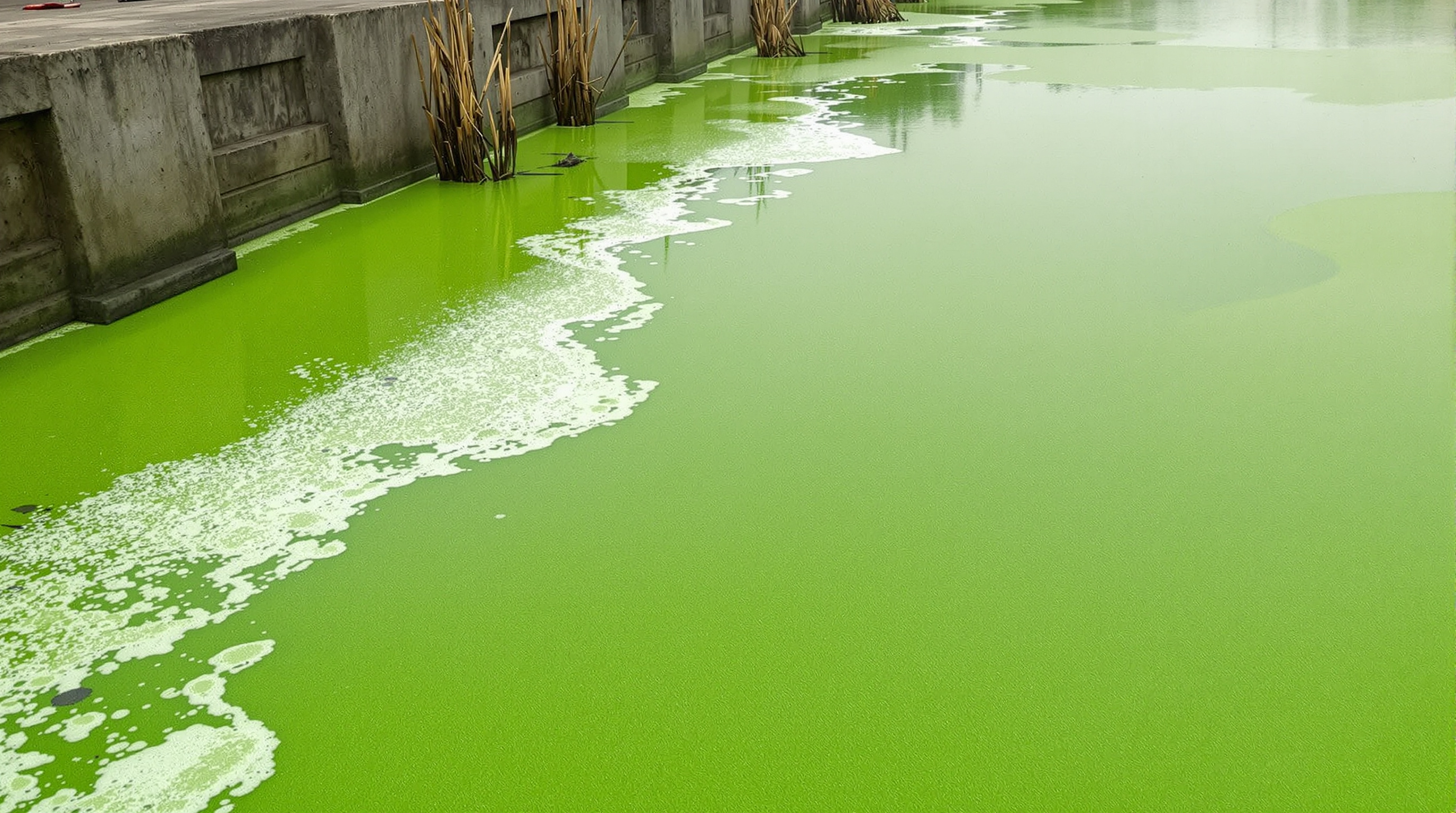
Eutrophication is the enemy, and it deserves to be understood plainly. When nutrient-rich water enters a lake, algae and aquatic weeds bloom explosively. The bloom looks like a green carpet; then it dies, sinks, and the bacteria decomposing it strip the oxygen out of the water. Dissolved oxygen crashes, fish suffocate, the water turns anaerobic, and it begins to stink and foam — the exact condition rejuvenation was meant to cure. The infamous froth on Bellandur and Varthur lakes is eutrophication and detergent phosphates working together.
The cruel part is that effluent can be crystal clear and low in BOD while still carrying enough nitrogen and phosphorus to devastate a lake. Clarity is not safety. A plant that proudly meets a 10 mg/L BOD but discharges 30 mg/L of nitrogen and 5 mg/L of phosphorus will accelerate a lake's death, not reverse it.
Avoiding the trap requires treatment specifically designed for nutrient removal:
- Biological nitrogen removal — alternating aerobic and anoxic zones (nitrification followed by denitrification) inside or after the aeration tank, so nitrogen leaves as harmless gas rather than dissolved nitrate.
- Phosphorus removal — either biological (enhanced biological phosphorus removal) or chemical dosing with alum or ferric salts to precipitate phosphate out.
- A polishing barrier — ultrafiltration or an activated carbon filter to catch residual solids and colour before the water reaches the lake.
- Reliable disinfection — UV or chlorination, sized for a water body the public will touch, with chlorine controlled so residual does not itself harm aquatic life.
Success factors: what actually makes it last
Plenty of lake projects launch with a ribbon-cutting and turn green within a season. The ones that endure share a set of engineering and governance disciplines.
1. Treat for nutrients, not just clarity
This is non-negotiable and bears repeating: the process train must include nitrogen and phosphorus removal, and the compliance monitoring must actually measure them. If the tender specifies only BOD, COD and TSS, the lake will fail regardless of how the plant performs on paper. Size and configure the plant for the receiving water, not the discharge drain — the sizing logic in how to size an STP still applies, but the effluent target is tighter.
2. A polishing wetland between plant and lake
The most resilient designs never pipe effluent straight into open water. They pass it through a constructed wetland or reed bed first — a shallow, planted channel where roots and microbes strip the last of the nutrients and act as a living safety net for any day the plant underperforms. It is cheap, it looks natural, and it buffers the lake against the inevitable bad batch.
3. Deal with the silt and the legacy load
Decades of raw sewage leave a lake bed thick with nutrient-saturated sludge. Pour clean water on top and the sediment simply releases its stored phosphorus back into the water column. Successful rejuvenation almost always includes desilting, wetland creation and often floating islands or aeration to rebuild dissolved oxygen — the water quality is only half the job.
4. Continuous monitoring and clear ownership
A lake is not a fit-and-forget asset. It needs regular sampling of the inflow and the lake itself — BOD, nutrients, DO, coliform — with an accountable operator empowered to divert flow away the moment quality slips. Many failures are governance failures: no one owned the outcome. Robust instrumentation and honest performance testing turn intentions into a controlled system.
5. Cut the phosphorus at source, too
The best projects also attack the incoming load — enforcing that only sewage, not industrial effluent, reaches the plant, and supporting low-phosphate detergent norms in the catchment. Less phosphorus in means less to chase out.
The economics are on the side of doing it right
Routing treated water to a lake is not charity — it is often the cheapest large-scale water asset a city can build. The revived lake recharges groundwater, moderates the local microclimate, lifts surrounding land value and removes a public-health hazard. Against that, the incremental cost of adding nutrient removal and a polishing wetland to an existing plant is modest. You can sanity-check the trade-off between effluent grade and reuse value with the water reuse savings calculator and frame the whole catchment flow with the water balance calculator.
The bottom line
Lake rejuvenation using treated water works — Bengaluru's better-run tank revivals prove it — but it succeeds or fails on one discipline that ordinary reuse lets you ignore: nutrient control. Clean the water to reuse-grade clarity, then go further and strip the nitrogen and phosphorus; pass it through a living wetland before it meets open water; deal with the legacy silt; and monitor relentlessly with someone genuinely accountable. Do that, and a city's own wastewater becomes the steady inflow that brings a dead lake back to life. Skip the nutrients, and you have simply engineered a faster route to the same green, foaming end.
To go deeper into the treatment train that makes this possible, start with the Sewage Treatment Plants guide library or read how an STP works end to end.
Export this guide
Related Guides — Deep-dive reading
Biological Culture Management in an STP: The Heart of Good O&M
The microbes in your aeration tank do the actual work of cleaning sewage. Keep them healthy — the right MLSS, food, oxygen and nutrients — and everything else falls into place. Here is how operators manage the living culture, diagnose bulking and foaming, and recover after a crash.
Sewage Treatment PlantsHow Does an STP Work? A Step-by-Step Explanation
Follow a single drop of sewage from the building drain to reusable water — through screening, settling, the living microbial heart of the plant, and final polishing — with every stage explained in plain language and no engineering background assumed.
Sewage Treatment PlantsChlorination System in an STP: Disinfection Explained
The final disinfection step that kills the pathogens biology and filtration leave behind — how chlorine dosing, contact time and residual work together to make treated sewage safe to reuse or discharge, explained for owners and operators alike.
Sewage Treatment PlantsRelated Tools — Try Free
Water Reuse Savings Calculator
Estimate the money you save by reusing STP-treated water instead of buying fresh supply, with daily, monthly and annual savings.
STP CalculatorWater Carbon Savings Calculator
Estimate the CO2 emissions you avoid each year by reusing treated water instead of fresh supply, with annual tonnes saved and a tree-equivalent.
SustainabilityPopulation Equivalent (PE) Calculator
Convert an organic pollution load into Population Equivalent from flow and BOD concentration — the BOD load in kg/day and equivalent number of people.
STP Calculator