

Writing & Reading an HVAC Specification
The specification is the contract for quality — what a good HVAC spec contains, the difference between prescriptive and performance specs, how it pairs with drawings and a BOQ, and how to read one so you get the system you actually designed.
Drawings show where things go; the specification says what quality they must be and how they must perform — and it's the document that decides whether you get the system you designed or a cheaper substitute. A vague spec invites corner-cutting; a good one locks in efficiency, safety and performance, and gives you recourse if the contractor delivers less. Whether you write specs or review them, understanding how they work is essential to getting HVAC that meets its brief. This guide explains what a good HVAC specification contains and how to read one.
It builds on the HVAC Design Process Guide, part of the HVAC Knowledge Hub.
Scope. An orientation to specifications. Writing project specifications is qualified MEP/HVAC engineering work, tailored to the project and the applicable standards.
What a specification does
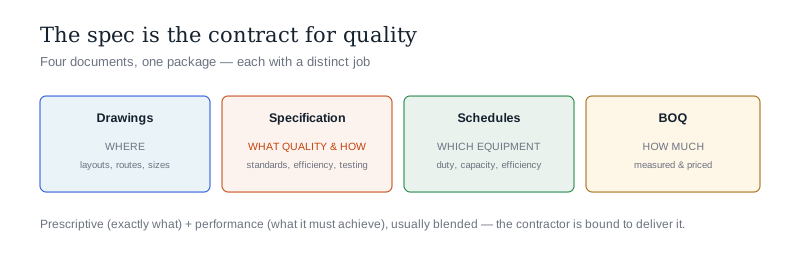
The specification sits alongside the other design documents, each with a distinct job:
- Drawings — the geometry: layouts, routes, positions, sizes.
- Specification — the quality and performance: materials, standards, efficiency minimums, installation requirements, testing, warranties.
- Schedules — the equipment list: each unit's duty, capacity, efficiency, electrical and physical data.
- Bill of Quantities (BOQ) — the pricing: measured quantities to be priced by tenderers.
Together these form the tender/contract package (see tender & procurement). The specification is what a contractor is contractually bound to deliver — which is why its precision matters.
Prescriptive vs performance specifications
Two ways to specify, often mixed:
- Prescriptive (descriptive) — states exactly what to provide: the make/model type, materials, gauges, methods (e.g. "GI ducts to IS 655, 24-gauge, externally insulated 25mm"). Precise and easy to check, but rigid — it fixes the means.
- Performance — states what it must achieve and leaves the how to the contractor (e.g. "maintain 24°C ±1 at 50% RH; system efficiency not less than X"). Flexible and innovation-friendly, but needs clear, measurable criteria and verification, or it's unenforceable.
- In practice — most HVAC specs blend both: performance for outcomes (comfort, efficiency), prescriptive for components and safety-critical items. Choosing the balance is a design decision.
What a good HVAC spec contains
A thorough specification typically covers:
- General/preliminaries — scope, standards (codes, IS/ISHRAE/ASHRAE references), submittals, warranties, coordination.
- Design conditions — indoor/outdoor design temperatures, humidity, ventilation and IAQ rates, noise limits.
- Equipment — minimum efficiency (ISEER/COP/IPLV), construction, refrigerant type, materials — for chillers, AHUs, pumps, fans, etc.
- Distribution — ductwork (material, gauge, sealing, insulation), piping, insulation, dampers, diffusers.
- Controls — the BAS/controls sequences, sensors, and points.
- Installation & workmanship — how it must be installed, supported, labelled and tested.
- Testing & commissioning — the TAB and commissioning requirements and acceptance criteria.
The more measurable each requirement, the more enforceable the spec.
Reading a spec well
- Check the efficiency minimums — are they at least code-compliant, and do they match the design intent?
- Look for "or equivalent" traps — loose equivalence clauses let substitutions in; ensure equivalence is defined and approved.
- Verify the standards cited — are they current and correct (see standards)? Don't accept invented or outdated code numbers.
- Confirm testing & acceptance — a spec without commissioning/acceptance criteria can't be enforced.
- Cross-check against drawings & BOQ — inconsistencies between documents are where disputes and shortfalls arise.
The one-line answer
The specification is the document that says what quality and what performance the HVAC must deliver — while drawings show where, schedules list the equipment, and the BOQ prices it, together forming the tender/contract package — so it's what the contractor is contractually bound to provide, and its precision decides whether you get the system you designed or a cheaper substitute. Specs come in two styles, usually blended: prescriptive (states exactly what to provide — precise, checkable, rigid) and performance (states what it must achieve — flexible, but needs measurable, verifiable criteria). A good HVAC spec covers general/standards, design conditions, equipment (minimum ISEER/COP efficiency, construction, refrigerant), distribution (ducts, pipes, insulation), controls, installation/workmanship, and testing & commissioning acceptance criteria — the more measurable each requirement, the more enforceable. Read one by checking the efficiency minimums (code-compliant and matching intent), watching "or equivalent" substitution traps, verifying the cited standards are current, confirming acceptance/commissioning criteria exist, and cross-checking drawings and BOQ for the inconsistencies where shortfalls hide.
Where to go next
- The workflow: HVAC Design Process Guide.
- Pricing & appointing: HVAC Tender & Procurement Guide.
- Proving compliance: HVAC Commissioning Guide.
- The standards it cites: HVAC Standards & Regulations Guide.
References
- ISHRAE — specification & documentation guidance; ASHRAE Handbook — Applications (design documentation).
- National Building Code of India, SP 7 : 2026; relevant IS standards (IS 655 ducts, IS 1391 room ACs, etc.), Bureau of Indian Standards.
- Bureau of Energy Efficiency (BEE) — ECBC minimum-efficiency requirements to specify: https://beeindia.gov.in/
An orientation to specifications. Writing project specifications is qualified MEP/HVAC engineering work, tailored to the project and applicable standards. Verify cited standards are current before relying on them.
Export this guide
Related Guides — Deep-dive reading
Bathroom Specification Template (India): Materials, Workmanship & Approved-Equivalent Clauses
A copy-and-use bathroom specification template for Indian projects — the materials schedule, the method-of-execution table and the sample-approval clauses that make a contractor price and build exactly what was designed, not a cheaper look-alike.
BathroomsHow to Write a Roofing Specification (India): Scope, Materials, Workmanship & Warranty
The anchor pro guide to writing a clear, tender-ready roofing specification — so the roof you designed is the roof you get, not the cheapest thing a bidder could read into a vague clause.
RoofingSTP Technical Specifications Guide: How to Read and Write One That Holds Up
Capacity, inlet and outlet parameters, equipment ratings, performance guarantees and the standards they must meet — a plain, practical guide to the document that decides whether your sewage treatment plant works or disappoints.
Sewage Treatment PlantsRelated Tools — Try Free
AI BOQ Generator
AI generates detailed Bill of Quantities with city-specific rates and labour breakdown.
ArchitectAIInterior Contract Clause Checklist
16 sections and 98 checkboxes covering scope, BOQ, milestones, penalties, warranty, and disputes.
Contract ChecklistContract-Ready BOQ — IS Code Pre-filled
BOQ with IS code specifications pre-filled and free-text brand entry for flexibility.
BOQ