
HVAC Refrigerants: What's Inside Your AC and Why It's Changing
The working fluid that makes cooling possible — what a refrigerant is, the properties that matter (GWP, ODP, efficiency, flammability), the generations from R22 to R32 and R290, the safety classes, and why the whole industry is transitioning to low-global-warming gases.
Every air conditioner, heat pump and refrigerator depends on a refrigerant — the working fluid that absorbs heat in one place and releases it in another, over and over. For decades, refrigerants were chosen purely for how well they cooled. Then we learned some destroyed the ozone layer, and others are potent greenhouse gases — and the entire industry began a decades-long transition to safer, cleaner alternatives. Understanding refrigerants explains why your next AC uses a different gas than your last one, and why "which refrigerant" is now a real buying decision. This guide explains it.
It's the anchor of the refrigerants thread in the HVAC Knowledge Hub, and builds on Air Conditioning Basics.
Scope & safety. This explains refrigerants to inform choice. Handling, charging and recovering refrigerant is qualified, licensed technician work — several modern refrigerants are mildly flammable (A2L) or flammable (A3), and all must be handled and recovered properly, never vented.
What a refrigerant is
A refrigerant is a fluid chosen because it boils and condenses at useful temperatures and pressures, letting it carry heat through the refrigeration cycle: it evaporates (absorbing heat indoors) and condenses (releasing heat outdoors), again and again. The ideal refrigerant would cool efficiently, be non-toxic, non-flammable, cheap, and harmless to the environment — but no single fluid is perfect on every count, which is why refrigerant choice is always a set of trade-offs.
The properties that matter
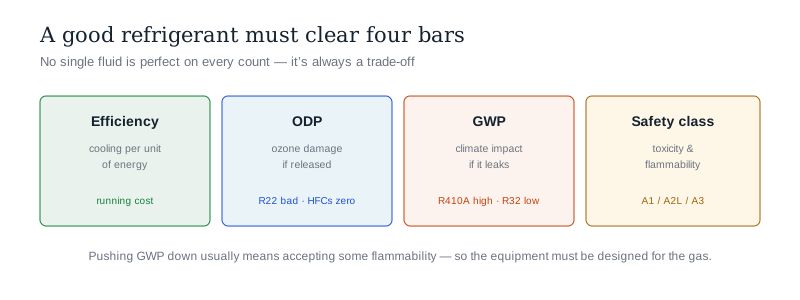
Four properties decide whether a refrigerant is acceptable today:
- Efficiency — how well it cools per unit of energy. Affects your running cost and the planet indirectly.
- ODP (Ozone Depletion Potential) — whether it damages the ozone layer if released. The old CFCs and HCFCs (like R22) do; modern HFCs and naturals don't. ODP-damaging refrigerants are being eliminated globally.
- GWP (Global Warming Potential) — how much it warms the climate if it leaks, relative to CO₂. This is the current battleground: R410A has a high GWP (~2,000), R32 is much lower (~675), and naturals like R290 are near zero (~3).
- Safety class — toxicity and flammability (see below). Lower-GWP refrigerants often trade off some flammability, which is why safety standards matter.
A refrigerant has to clear all four bars to be a sensible modern choice — and the industry's whole transition is the search for fluids that do.
The safety classes
Refrigerants are classified (in standards like ISO 817 / ASHRAE 34) by toxicity (A = low, B = higher) and flammability (1 = none → 3 = high):
- A1 — non-flammable, low toxicity. R410A, R22, R134a. Safest to handle, but the useful A1 options tend to have high GWP.
- A2L — mildly flammable, low toxicity. R32. Slightly flammable but hard to ignite; the mainstream low-GWP choice, handled safely under proper standards.
- A3 — flammable, low toxicity. R290 (propane). Very low GWP and efficient, but flammable, so limited to smaller charges and specific designs.
- The trade-off — pushing GWP down usually means accepting some flammability, which is managed by charge limits, leak detection and appliance-safety standards like IS 60335 (Part 2/Sec 40) for ACs and heat pumps.
This is why you can't just "swap in" a greener gas — the equipment must be designed for that refrigerant's class.
The generations — where we've been and are going
- CFCs (R12, etc.) — the original; banned for destroying ozone (Montreal Protocol).
- HCFCs (R22) — the ozone-friendlier stopgap, still with some ODP; being phased out — R22 equipment is legacy, and R22 is increasingly scarce and costly.
- HFCs (R410A, R134a, R407C) — zero ODP (they don't harm ozone) but high GWP (potent greenhouse gases if they leak); now being phased down under the Kigali Amendment.
- Low-GWP HFCs & naturals (R32, R290, CO₂, ammonia) — the present and future: R32 is today's mainstream for room ACs (a third of R410A's GWP, more efficient), and R290 where its flammability can be safely managed.
The direction is clear: buy R32 today; R410A is a phase-down path, R22 is legacy — see the detailed comparison in R32 vs R410A and the timeline in the phase-down guide.
What it means for you
- Buying an AC — prefer R32 (or R290 where offered and suitable); avoid new R410A, never buy R22 equipment. See choosing an AC.
- An AC shouldn't lose refrigerant — a sealed system doesn't "use up" gas; needing regular top-ups means a leak (see refrigerant leaks).
- Servicing — only a licensed technician should handle refrigerant; it must be recovered, not vented, both for safety and because venting high-GWP gas is environmentally serious.
The one-line answer
A refrigerant is the working fluid that carries heat through the cooling cycle by evaporating and condensing at useful temperatures — and choosing one is always a trade-off across four properties: efficiency, ODP (ozone damage — the old R22 and CFCs have it and are being eliminated; modern gases don't), GWP (climate impact if it leaks — R410A is high ~2,000, R32 much lower ~675, R290 near zero), and safety class (A1 non-flammable but usually high-GWP; A2L mildly flammable like R32, the low-GWP mainstream; A3 flammable like R290, very low GWP). Pushing GWP down usually means accepting some flammability, managed by charge limits and appliance-safety standards like IS 60335 (Part 2/Sec 40) — so you can't just swap a greener gas into old equipment. The generations run CFC (banned) → HCFC/R22 (phasing out, legacy) → HFC/R410A (zero-ODP but high-GWP, now phasing down) → R32 and naturals (the present and future). Practically: buy R32 today, never R22; a well-sealed AC shouldn't need regular gas top-ups (that's a leak); and only a licensed technician should handle refrigerant, recovering it rather than venting it.
Where to go next
- The head-to-head: R32 vs R410A vs R290.
- The timeline: Refrigerant Phase-Down in India.
- Weigh the climate impact: Refrigerant GWP Impact Calculator.
- When gas goes missing: Refrigerant Leak Guide.
References
- ISO 817 and ASHRAE Standard 34 — Refrigerant designation & safety classification (A1/A2L/A3).
- IS 60335 (Part 2/Sec 40) : 2018 — Safety of electrical heat pumps, air-conditioners & dehumidifiers (adoption of IEC 60335-2-40), Bureau of Indian Standards.
- Montreal Protocol & Kigali Amendment (HFC phase-down); MoEFCC Ozone Cell (India): https://ozonecell.nic.in/ · Bureau of Energy Efficiency (BEE).
This guide informs choice. Handling, charging and recovering refrigerant is qualified, licensed technician work. Verify any standard's current status via the BIS catalogue before relying on it.
Export this guide
Related Guides — Deep-dive reading
The Refrigerant Phase-Down: Montreal, Kigali and What to Buy Now
Why the gas in your AC keeps changing — the global agreements retiring ozone-damaging and high-warming refrigerants (the Montreal Protocol and Kigali Amendment), India's commitments and timeline, and how to future-proof an air-conditioner purchase.
HVAC & CoolingR32 vs R410A vs R290: Which AC Refrigerant Is Better?
The gas inside your AC matters more than you think — how R32, R410A and R290 compare on efficiency, global-warming impact and safety, why the industry is moving to lower-GWP refrigerants, and what it means when you buy an air conditioner today.
HVAC & CoolingSecurity Comparison Guide (2026): How to Weigh Any X vs Y Security Choice in India
The master decision framework for comparing security options in India — how to weigh any head-to-head choice across need, cost, performance, reliability, privacy, ease, scalability, maintenance and code, so your context decides the winner rather than a salesperson.
SecurityRelated Tools — Try Free
Renovation vs New Build Calculator
Compare renovating vs building new interiors city-wise across 13 work scopes with GST and per-sqft rates.
Cost ComparisonRefrigerant GWP Impact Calculator
The CO₂-equivalent released if an AC's refrigerant leaks — by gas (R32, R410A, R22, R290) and charge — compared and put in relatable terms to show why low-GWP refrigerants matter.
HVACGeyser Running Cost Calculator
Work out a water heater's electricity use and running cost per day, month and year — and compare electric, gas, heat-pump and solar.
Bathroom Calculator