
BEE Star Rating for ACs: How to Read the Label and Buy Smart
The 1–5 star label on every air conditioner, decoded — what BEE stars and ISEER actually mean, why the ratings get tougher over time, how much a higher star really saves, and how to weigh the price premium against the running-cost saving.
Every air conditioner sold in India carries a red-and-yellow BEE star label — 1 to 5 stars — and most buyers glance at it, assume "more stars = better," and move on. But understanding what the stars actually mean, the ISEER number behind them, and how much a higher rating really saves turns that label from a vague signal into a precise buying tool. Because an AC runs for a decade, the efficiency you choose today quietly decides your electricity bill for years. This guide decodes the BEE star label and how to buy smart.
It builds on the HVAC Standards & Regulations Guide, part of the HVAC Knowledge Hub. Reading the star label is squarely a homeowner skill — this guide is for you.
Scope. This explains the label to help you buy well. It's guidance, not a guarantee of any specific saving — actual savings depend on your usage, tariff and conditions.
What the stars and ISEER mean
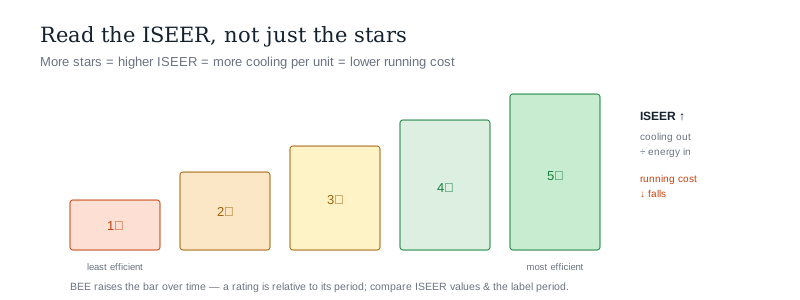
The label is simpler than it looks once you know the pieces:
- Stars (1–5) — a quick efficiency grade: more stars = more efficient = lower running cost for the same cooling. 5-star is the most efficient rung.
- ISEER (Indian Seasonal Energy Efficiency Ratio) — the actual number behind the stars: cooling output ÷ energy input, measured over a season (so it reflects real Indian conditions, not a single test point). Higher ISEER = more efficient. The star bands are defined by ISEER ranges.
- The label also shows the model, capacity, and an indicative annual energy consumption — useful for comparing.
- Mandatory — star labelling is compulsory for room ACs in India, administered by BEE, so every unit is rated and comparable.
In short: read the ISEER number, not just the star count, when comparing two ACs.
Why the ratings get tougher over time
A crucial subtlety many buyers miss:
- BEE periodically revises the star table, raising the ISEER needed for each star as technology improves. What earned 5 stars a few years ago might only earn 3 today.
- So a star rating is relative to its period — always check the ISEER value and the label's validity/period, not just the stars, especially when comparing older stock or across revisions.
- The direction is always "more efficient" — each revision pushes the whole market up, which is good, but means "5-star" isn't a fixed absolute.
The practical rule: compare ISEER numbers directly, and prefer current-period labels.
How much does a higher star really save?
The reason it matters:
- Higher star = fewer units for the same cooling. A 5-star AC can use meaningfully less electricity than a 3-star of the same tonnage over a cooling season.
- The saving compounds over the AC's ~10-year life — often enough to more than repay the higher purchase price, especially with heavy use and higher tariffs.
- The heavier your usage, the more a high star pays — for an AC that runs many hours a day, 5-star is usually worth the premium; for occasional use, the payback is slower.
- Do the sum — compare the two units' running costs and the price difference; our AC star-rating savings calculator works out the payback and lifetime saving for your usage. See also running cost.
Buying smart with the label
- Compare ISEER, not just stars — the number is the real efficiency.
- Match the star to your usage — heavy use → buy the highest star that pays back; light use → the premium matters less.
- Inverter ACs dominate the higher stars (inverter vs non-inverter) and suit long run-times.
- Don't stop at the star — also right-size the tonnage (capacity), pick a good refrigerant (R32), and set it well (24°C), since habits affect the bill as much as the rating.
- Weigh the premium — a higher star costs more upfront; use the payback calculator to check it's worth it for your usage.
The one-line answer
Every Indian AC carries a BEE star label (1–5) that grades efficiency — more stars mean a higher ISEER (Indian Seasonal Energy Efficiency Ratio, cooling output ÷ energy input over a season), which means more cooling per unit of electricity and a lower running cost. The key subtlety is that BEE periodically raises the bar, so a star rating is relative to its period — always compare the ISEER number (and label period), not just the star count. A higher star uses meaningfully less electricity for the same cooling, and over the AC's ~10-year life the saving often more than repays the higher purchase price — most so for heavy use and higher tariffs, less so for occasional use — so the smart move is to do the sum: weigh the price premium against the running-cost saving (our payback calculator does it for your usage). Buy on ISEER matched to your usage, prefer inverter units for long run-times, and remember the star is only part of it — right-sizing, refrigerant and how you set the AC matter for the bill too.
Where to go next
- Check the payback: AC Star-Rating Savings Calculator.
- See the running cost: AC Running Cost Calculator.
- The buying decision: Choosing an Air Conditioner · Inverter vs Non-Inverter AC.
- The framework: HVAC Standards & Regulations Guide.
References
- Bureau of Energy Efficiency (BEE) — Standards & Labelling programme; ISEER & star-rating tables for room air conditioners (periodically revised): https://beeindia.gov.in/
- IS 1391 (Parts 1 & 2 : 2023) — Room Air Conditioners (performance & ISEER test basis), Bureau of Indian Standards.
- Ministry of Power / BEE public advisories on AC efficiency and the 24°C default setting.
This guide helps you read the label and buy well; it is not a guarantee of a specific saving. Actual savings depend on your usage, tariff and conditions. Verify current ISEER tables before relying on them.
Export this guide
Related Guides — Deep-dive reading
Air Conditioning Basics: How an AC Works & What the Numbers Mean
The grounding every AC buyer needs — how an air conditioner actually cools, what a 'ton' really measures, how to read ISEER and the BEE star rating, why inverter beats fixed-speed, and what the refrigerant inside means, so you can choose and judge any AC with confidence.
HVAC & CoolingHVAC Energy Efficiency: Cutting the Biggest Energy Bill in the Building
HVAC often runs half a building's electricity, so trimming it saves the most — the practical measures that cut HVAC energy without cutting comfort: right-sizing, inverter and efficient plant, smart controls and zoning, recovery, good maintenance and sensible set-points.
HVAC & CoolingInverter vs Non-Inverter AC: Why the Compressor Type Matters Most
The single most important AC choice, explained — how an inverter's variable-speed compressor differs from a fixed-speed one, why it saves energy, runs quieter and copes with low voltage, whether the higher price pays back, and the rare case for a fixed-speed unit.
HVAC & CoolingRelated Tools — Try Free
STP Electricity Consumption Calculator
Estimate a sewage treatment plant's daily power use and its monthly and annual electricity running cost from capacity, specific energy and tariff.
STP CalculatorWindow Energy Savings Calculator
Compare standard glazing vs Low-E and DGU windows — annual cooling savings, 10-year savings and payback.
Window CalculatorAC Running Cost Calculator
What your AC costs to run each year — from tonnage, BEE star rating, hours and tariff — plus how much a higher star rating saves.
HVAC