

ECBC Compliance: The Energy Code for Commercial Buildings
India's Energy Conservation Building Code sets minimum efficiency for commercial buildings — what ECBC covers, who it applies to, its HVAC requirements, the prescriptive vs whole-building compliance routes, and how it's evolving into the sustainable-building code.
Commercial buildings — offices, malls, hospitals, hotels — are among India's biggest and fastest-growing energy consumers, and their HVAC is usually the single largest load. To rein that in, the Energy Conservation Building Code (ECBC) sets minimum efficiency requirements for new and large commercial buildings, covering HVAC, envelope, lighting, hot water and more. For anyone designing or approving a commercial building, ECBC is often a legal requirement — and understanding it shapes the whole HVAC design. This guide explains what ECBC is, who it applies to, its HVAC provisions, and how to comply.
It builds on the HVAC Standards & Regulations Guide, part of the HVAC Knowledge Hub.
Scope. This explains ECBC's structure to inform understanding. Actual compliance is a professional exercise against the version and amendments in force in the relevant state, confirmed by qualified consultants and the authority.
What ECBC is and who it applies to
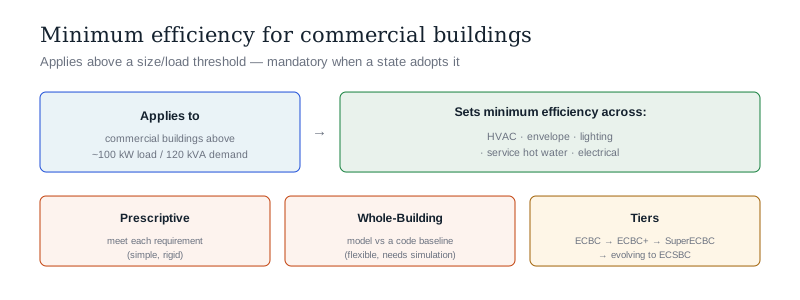
ECBC, developed by the Bureau of Energy Efficiency (BEE), is the national energy code for commercial buildings:
- Purpose — set minimum energy performance for commercial buildings so they're efficient by design, not by accident.
- Applicability — it targets commercial buildings above a threshold of connected load or contract demand (commonly cited as ≥100 kW connected load or ≥120 kVA contract demand), i.e. larger commercial buildings; the exact trigger and coverage depend on the version and state adoption.
- Mandatory when a state notifies it — ECBC becomes law when a state government adopts it into its building rules, so it's compulsory in some states and voluntary in others. Always confirm local status.
- Scope — it covers the building envelope, HVAC, lighting, service hot water, and electrical power systems together.
The idea: a code-compliant commercial building is guaranteed to be reasonably efficient across all its energy systems.
What ECBC requires of HVAC
HVAC is central to ECBC because it's usually the biggest load:
- Minimum equipment efficiency — chillers, packaged units, ACs and heat pumps must meet minimum efficiency levels (COP/kW-per-TR/IPLV).
- Envelope performance — U-values, roof/wall insulation and glazing limits reduce the cooling load the HVAC must meet (the same envelope-first logic).
- Controls — requirements for economizers/free-cooling, variable-speed drives, zoning and building automation so the plant runs efficiently.
- Ventilation & fans — limits on fan power and requirements for demand-controlled ventilation and energy recovery where applicable.
- Metering — sub-metering so energy use can be tracked.
The effect is that ECBC pushes right-sizing, efficient equipment, a good envelope and smart controls together.
The compliance routes
ECBC allows more than one path to demonstrate compliance:
- Prescriptive method — meet each individual requirement (each U-value, each efficiency minimum, each control). Simplest to check, least flexible.
- Whole-Building Performance (WBP) method — model the whole building's energy and show it performs at least as well as a code-compliant baseline. More flexible (lets you trade off between systems), needs energy simulation.
- Tiered ambition — beyond basic ECBC, higher voluntary tiers — historically ECBC+ and SuperECBC — reward buildings that go further, and the code is evolving toward the broader Energy Conservation & Sustainable Building Code (ECSBC) that adds sustainability beyond energy.
Choosing the route is part of the design strategy — prescriptive for simple projects, whole-building for complex ones seeking design freedom or higher tiers.
The one-line answer
The Energy Conservation Building Code (ECBC), from BEE, sets minimum energy-efficiency requirements for commercial buildings — since their HVAC is usually the biggest load, it's central to the code. It applies to larger commercial buildings above a connected-load/contract-demand threshold (commonly cited as ≥100 kW / ≥120 kVA) and becomes mandatory when a state adopts it, so local applicability varies. Across the envelope, HVAC, lighting, hot water and electrical systems, its HVAC provisions demand minimum equipment efficiency (chiller/AC COP, IPLV), a performant envelope to cut the load, efficient controls (economizers, VSDs, automation), fan-power and ventilation limits, and sub-metering. Compliance can be shown by the prescriptive method (meet each requirement — simple, rigid) or the Whole-Building Performance method (simulate the whole building against a code baseline — flexible, needs modelling), with higher voluntary tiers (ECBC+, SuperECBC) and an evolution toward the sustainability-inclusive ECSBC. Actual compliance is a professional exercise against the version in force in the relevant state.
Where to go next
- The framework: HVAC Standards & Regulations Guide.
- The home equivalent: Eco Niwas Samhita Guide.
- Going beyond code: Green Building HVAC Guide.
- The efficiency toolkit: HVAC Energy Efficiency Guide.
References
- Bureau of Energy Efficiency (BEE) — Energy Conservation Building Code (ECBC) and its updates toward the Energy Conservation & Sustainable Building Code (ECSBC): https://beeindia.gov.in/
- ASHRAE Standard 90.1 (Energy Standard for Buildings) — a reference basis for many ECBC provisions; ISHRAE guidance.
- National Building Code of India, SP 7 : 2026 (current edition), Bureau of Indian Standards; state ECBC notifications & rules.
This guide informs understanding. Actual ECBC compliance is a professional exercise against the version and amendments in force in the relevant state, confirmed by qualified consultants. Verify current applicability before relying on it.
Export this guide
Related Guides — Deep-dive reading
Designing a Naturally Energy-Efficient Indian Home
Comfort first, gadgets last — passive design, orientation, insulation, ventilation and the climate wisdom that cuts Indian energy bills
SustainabilitySolar Energy Mandates in Buildings: Where India Requires Solar
Solar water heating and rooftop PV requirements in building bye-laws and energy codes, and how they differ from subsidies
Building Regulations & ComplianceEnergy-Efficient Facades in India: How the Building Skin Cuts Your Cooling, Heating & Lighting Bills
How a building facade drives cooling, heating and lighting energy in India, the three levers of solar-heat-gain control, insulation and daylighting, U-value, SHGC, VLT and WWR in plain terms, ECBC and Eco-Niwas expectations, and real Indian green buildings.
Building FacadesRelated Tools — Try Free
Green Building Window Compliance Tool
Check your window design against Eco-Niwas Samhita — WWR, VLT, SHGC and U-value pass or fail.
ENS Pre-checkRainwater Tank Sizer
How big should your rainwater tank be? Computes annual harvest, recommended tank capacity in litres, water-bill savings, and payback — for 10 Indian cities.
RWH CalculatorContract Studio
AI generates professional architecture service agreements with milestones and scope.
ArchitectAI