

HVAC Tender & Procurement: Getting the Right Contractor at the Right Price
How an HVAC project goes from design to a signed contract — the tender package, the BOQ, inviting and evaluating bids, why the lowest price isn't the best value, and the contract models that decide who carries the risk.
A good HVAC design still has to be bought — and procurement is where quality is often quietly lost. Award to the lowest bidder without scrutiny and you can get an under-scoped, corner-cut installation that fails to hold conditions; procure well and you get a competent contractor delivering the system as designed, at a fair price. Tendering and procurement is a discipline of its own: packaging the design, inviting the right bidders, evaluating on value not just price, and choosing a contract model that puts risk where it belongs. This guide explains how HVAC procurement works.
It builds on the HVAC Design Process Guide, part of the HVAC Knowledge Hub.
Scope. An orientation to procurement. Actual tendering, contracts and evaluation for a project are handled by qualified professionals (consultant, PMC, procurement/legal), per the applicable procurement rules.
The tender package and the BOQ
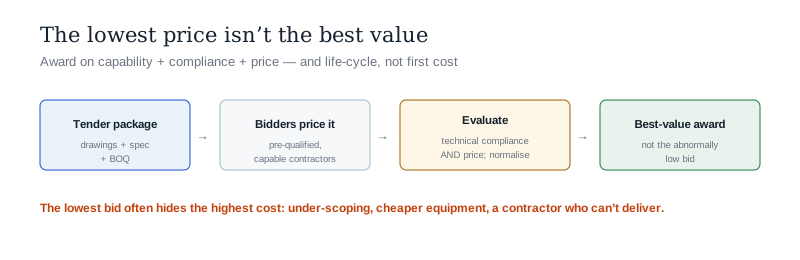
Procurement starts by packaging the design into a tender that bidders can price consistently:
- The tender package — the drawings, the specification, the schedules, and the Bill of Quantities (BOQ) — plus commercial terms (scope, timeline, conditions).
- The BOQ — an itemised, measured list of everything to be supplied and installed, which each bidder prices line by line. A well-made BOQ lets you compare bids like-for-like; a vague one guarantees apples-to-oranges quotes and later claims.
- Clear scope — what's included/excluded (e.g. electrical supply to plant, builder's work, commissioning) must be unambiguous, or the gaps become disputes.
A precise package is what makes competitive bidding fair and comparable.
Inviting and evaluating bids
- Pre-qualify bidders — invite contractors with the capability, experience and financial standing for the project's scale and type; a data-centre or hospital job needs specialists.
- Technical + commercial evaluation — assess each bid on technical compliance (does it meet the spec, the right equipment, efficiencies, methodology, program?) and price — not price alone.
- Normalise the bids — check that low bids aren't low because they've excluded scope or substituted inferior equipment; bring them to a common basis before comparing.
- Clarifications — resolve ambiguities and qualifications before award, so everyone is priced for the same thing.
Why the lowest price isn't the best value
The single most important procurement lesson:
- The lowest bid often hides the highest cost — through under-scoping (claims later), cheaper/less-efficient equipment (higher running cost for the building's life), or a contractor who can't deliver (delays, rework).
- Value = capability + compliance + price — the right award balances a competent, compliant contractor with a fair price, not merely the smallest number.
- Life-cycle, not first cost — a slightly dearer but more efficient and better-installed system costs less over its life; procurement should weigh running cost, not just capital.
- Abnormally low bids are a red flag — they usually mean something's been left out or will be clawed back through variations.
Contract models — who carries the risk
How the contract is structured decides responsibility:
- Design-Bid-Build — the consultant designs, the contractor builds to that design. Clear accountability for design (consultant) vs execution (contractor); the traditional model.
- Design & Build — one contractor both designs and installs to a performance brief. Faster and single-point, but the client must specify outcomes tightly or quality can drift to the cheapest compliant solution.
- Supply vs supply-and-install — clarify whether the contractor also supplies equipment or installs owner-procured items; the boundary affects warranty and responsibility.
- Item-rate vs lump-sum — how variations and quantity changes are priced and who carries that risk.
Matching the model to the project and the client's risk appetite is a key early decision.
The one-line answer
An HVAC design must be procured well or its quality is quietly lost — award to the lowest bidder blindly and you get an under-scoped, corner-cut system. Procurement starts by packaging the design into a tender (drawings + specification + schedules + a measured BOQ + commercial terms) precise enough that bidders price like-for-like and scope gaps don't become disputes. You then pre-qualify capable bidders, evaluate on technical compliance and price (not price alone), and normalise low bids to check they aren't cheap because scope was excluded or equipment downgraded. The core lesson: the lowest price isn't the best value — the lowest bid often hides the highest cost through under-scoping, inefficient equipment (a higher bill for the building's life) or a contractor who can't deliver, so award on capability + compliance + price and weigh life-cycle cost, not first cost, treating abnormally low bids as a red flag. Finally, the contract model (Design-Bid-Build vs Design & Build, supply vs supply-and-install, item-rate vs lump-sum) decides who carries the design and quantity risk — matching it to the project is a key early decision.
Where to go next
- The workflow: HVAC Design Process Guide.
- What's being priced: HVAC Specification Guide.
- Proving delivery: HVAC Commissioning Guide.
- Weighing efficiency: HVAC Energy Efficiency Guide · HVAC Cost Guide.
References
- ISHRAE — procurement & contract guidance; standard forms of building-services contract and tender practice.
- National Building Code of India, SP 7 : 2026; public-procurement rules (for government projects), CPWD/PWD practice where applicable.
- Bureau of Energy Efficiency (BEE) — life-cycle & efficiency considerations in procurement: https://beeindia.gov.in/
An orientation to procurement. Actual tendering, contracts and evaluation are handled by qualified professionals per applicable procurement rules. Verify current requirements before relying on them.
Export this guide
Related Guides — Deep-dive reading
How to Compare Security Quotations in India (2026): Read Three Quotes Like an Expert
Three quotes for the same home security job will name different amounts, different equipment and different scope. This homeowner guide shows how to make them truly like-for-like first, read every line item, spot what a cheap quote hides, and pick on total value rather than the lowest number.
SecuritySmart Home BOQ & Specification: A Practitioner's Guide (India)
A vague scope is the reason smart-home projects overrun. Here is how to build a tender-ready Bill of Quantities and technical specification — itemised by category, quantified from drawings, written to make, model and standard — so that vendor quotes can be compared fairly and scope gaps never surface on site.
Smart HomeSecurity BOQ Template for India (2026): Pricing the System Line by Line
A ready-to-adapt security Bill of Quantities: the priced, itemised list of everything to be supplied and installed, used to tender the job, hold bidders to a like-for-like comparison and set the contract sum — with a worked example and a blank copy-ready template.
SecurityRelated Tools — Try Free
Client Brief Generator
8-section questionnaire that produces a professional design brief PDF with signature lines.
Brief GeneratorInterior Contract Clause Checklist
16 sections and 98 checkboxes covering scope, BOQ, milestones, penalties, warranty, and disputes.
Contract ChecklistInterior Red Flag Checklist — Before Signing
54 red flags across 8 categories with a live risk score and personalised PDF.
Red Flag Checklist