

HVAC & Air Conditioning Cost in India: Buy, Install, Run & Maintain
The whole cost picture, honestly — the four costs of cooling (buying, installation, running and maintenance), how they compare across window, split, VRF and ducted systems, why the cheapest AC is often the most expensive, and how to budget sensibly.
"How much does an AC cost?" is the wrong question — because the sticker price is only the first of four costs, and the cheapest unit to buy is often the most expensive to own. Cooling costs you at four points: buying, installing, running and maintaining — and the running cost, over years of Indian summers, often dwarfs the rest. This guide gives the honest, whole-cost picture across HVAC systems, so you can budget sensibly rather than just chase the lowest price tag.
It builds on Choosing an Air Conditioner, part of the HVAC Knowledge Hub.
The safety line & scope. This guide frames costs to help you budget and compare. Actual prices vary widely by brand, city, capacity and site; get itemised quotes. Installation and servicing are qualified-professional work.
The four costs of cooling
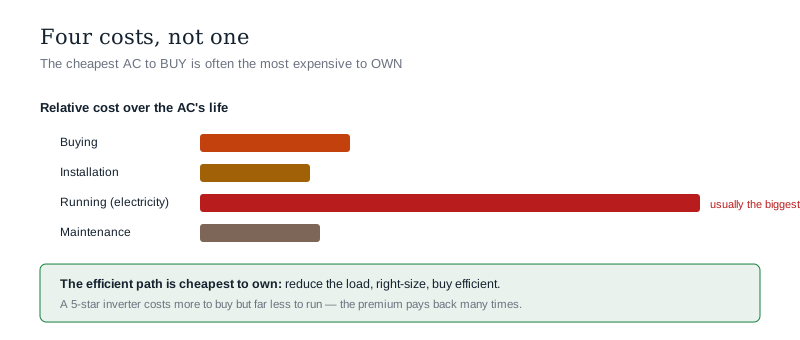
Every cooling system costs you at four points — count all four:
- Buying (upfront) — the equipment price. The one everyone looks at; the least important over time.
- Installation — mounting, piping, drainage, electrical and (for ducted/central) significant ductwork/plant. Ranges from small (a window unit) to major (ducted/central).
- Running (electricity) — what it costs to run each year — and over the AC's life, this is usually the biggest cost by far. An efficient unit costs more to buy but much less to run (see the running cost calculator).
- Maintenance — servicing, filters, gas top-ups, repairs, and eventual replacement (see maintenance).
The key insight: because running cost dominates over years, a cheap, inefficient AC is usually the most expensive overall — the efficiency premium pays back many times.
How costs compare across systems
Relative cost, not exact figures (which vary widely by brand, city and capacity):
| System | Buy | Install | Run (efficiency) | Best value for |
|---|---|---|---|---|
| Window AC | Lowest | Lowest | Higher | Budget, single room |
| Split AC | Low–Mid | Moderate | Low (inverter) | Most home rooms |
| VRF | High | High | Efficient at scale | Villas, offices |
| Ducted/cassette | High | Highest | Moderate | Clean-look whole-area |
| Central | Highest | Highest | Efficient at scale | Large buildings |
- Room by room, an efficient split is usually the best value for a home.
- VRF/ducted/central cost far more upfront and to install, justified by scale, control and looks — not for a single room.
- Within a type, the inverter/star-rating premium almost always pays back through lower running cost.
Why efficiency is a cost decision, not a green nicety
The maths, plainly:
- A 5-star inverter AC costs more upfront than a 3-star, but uses roughly a third less electricity — over years of running, the saving exceeds the price difference many times over (quantify it with the running cost calculator).
- Right-sizing saves too — an oversized unit wastes energy.
- Reducing the load (shading, insulation, passive cooling) lets you buy a smaller, cheaper system that also runs less — a double saving.
- So the cheapest-to-own path is: reduce the load, right-size, buy efficient — even though it isn't the cheapest sticker price.
Budgeting sensibly
- Count all four costs, weighting running cost heavily for anything used a lot.
- Get itemised quotes — equipment vs installation vs any building work — from a reputable installer; beware quotes far below the rest (corner-cut installation costs later).
- Phase it — cool the rooms you use most first; add others over time.
- Bundle ducted/concealed with construction — retrofitting is far costlier.
- Budget for maintenance — annual servicing keeps efficiency up and avoids big repair bills.
- Consider solar to cut the running cost structurally.
The one-line answer
Cooling costs you at four points — buying, installing, running and maintaining — and the sticker price is the least important, because over years of Indian summers the running cost usually dwarfs the rest, which is why a cheap, inefficient AC is normally the most expensive to own. Across systems, an efficient split is usually the best value room-by-room, while VRF, ducted and central cost far more upfront and to install (justified by scale, control and looks, not for a single room) — and within any type, the inverter/high-star premium pays back many times through lower running cost. So budget for all four costs (weighting running cost heavily), reduce the load and right-size first, buy efficient, get itemised professional quotes, and factor annual maintenance — the cheapest AC to own is rarely the cheapest to buy.
Where to go next
- Choose the right unit: How to Choose an Air Conditioner Guide.
- The running cost, quantified: AC Running Cost Calculator.
- Cut the running cost: HVAC Energy Efficiency Guide · Passive Cooling Guide.
- The maintenance cost: AC & HVAC Maintenance Guide.
References
- Bureau of Energy Efficiency (BEE) — Star Labelling & ISEER (running-cost efficiency): https://beeindia.gov.in/
- IS 1391 (Parts 1 & 2 : 2023) Room Air Conditioners; IS 8148 : 2018 Ducted & Package Air-Conditioners, Bureau of Indian Standards.
- Costs are indicative and vary by brand, city, capacity and site — obtain current itemised quotes.
All costs here are indicative and change with market, brand and site; get current quotes. Installation and servicing are qualified-professional work. Verify any standard's status via the BIS catalogue.
Export this guide
Related Guides — Deep-dive reading
Energy-Efficient Facades in India: How the Building Skin Cuts Your Cooling, Heating & Lighting Bills
How a building facade drives cooling, heating and lighting energy in India, the three levers of solar-heat-gain control, insulation and daylighting, U-value, SHGC, VLT and WWR in plain terms, ECBC and Eco-Niwas expectations, and real Indian green buildings.
Building FacadesHVAC Energy Efficiency: Cutting the Biggest Energy Bill in the Building
HVAC often runs half a building's electricity, so trimming it saves the most — the practical measures that cut HVAC energy without cutting comfort: right-sizing, inverter and efficient plant, smart controls and zoning, recovery, good maintenance and sensible set-points.
HVAC & CoolingWhy Sustainable Buildings Cost Less Over Time
The lifecycle-cost case for green homes in India, explained in plain money for ordinary homeowners
SustainabilityRelated Tools — Try Free
Cross-Ventilation Analyzer
Estimate airflow and air changes per hour (ACH) from room size, window areas, layout, and local wind — with NBC 2016 Part 8 compliance check.
Ventilation CalculatorVideo Door Phone Cost Calculator
Pick class, monitors, install stage and extras and get an indicative price band, the often-forgotten install and backup costs, the annual running cost and a five-year total for a home video door phone.
Cost CalculatorElectrical Safety & Load Audit
Home electrical audit — 10 categories, 65+ checkpoints across earthing, RCCB, MCB, wiring, switchboards, appliance circuits, DG/inverter backup.
Safety Audit